
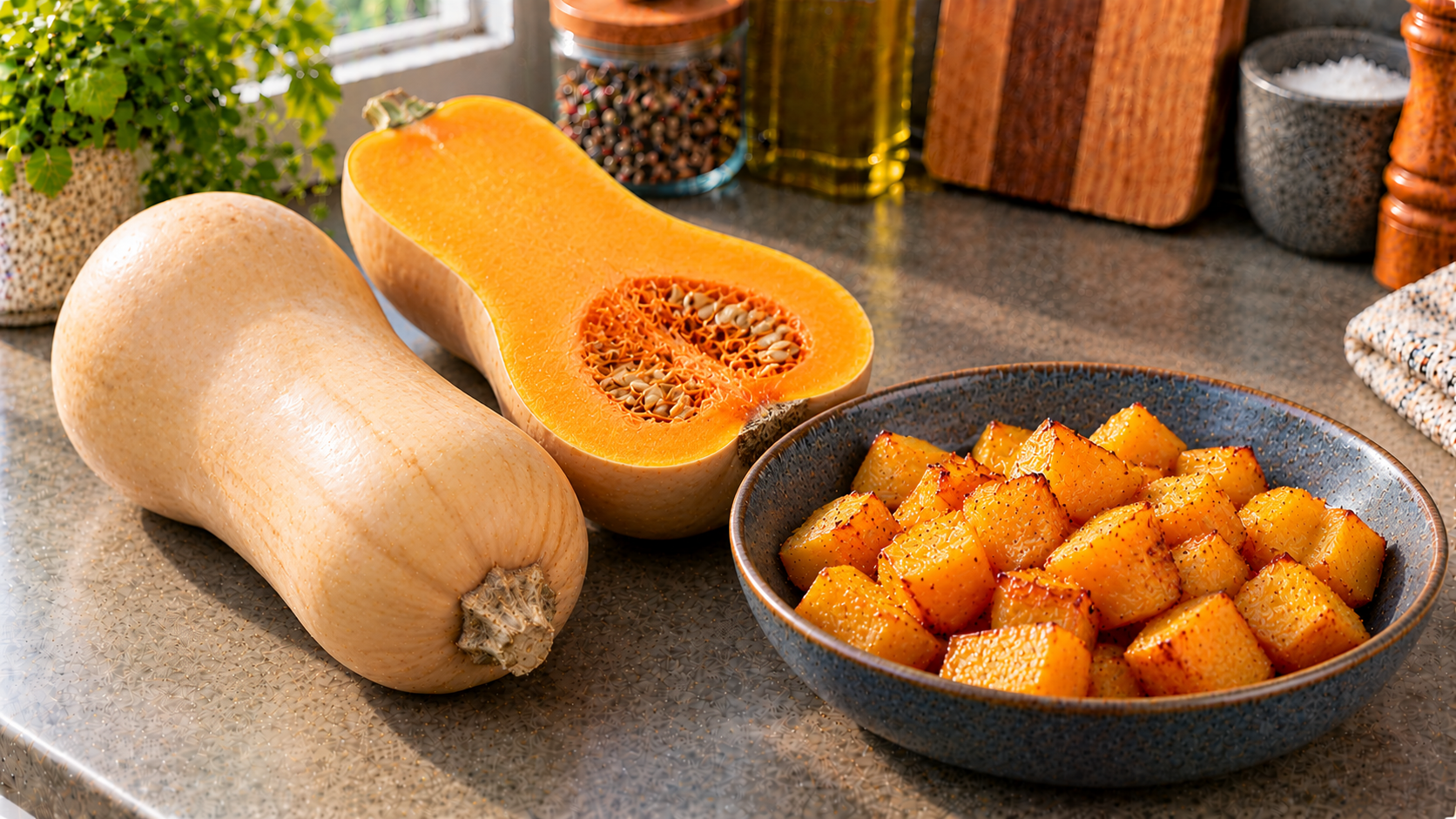
Butternut squash provides approximately 45 kcal per 100 g of raw edible flesh in the USDA FoodData Central reference. A separate USDA entry for baked butternut squash prepared with salt reports 40 kcal per 100 g. These are different food records; they should not be interpreted as proof that every squash loses five calories during roasting.
Butternut squash is a winter squash with tan skin, orange flesh and a seed cavity toward its rounded end. Its calories depend on edible weight, preparation and additions such as oil, butter, syrup or cream. A whole squash purchased at the supermarket is not entirely edible flesh.
Nutrition per 100 g: raw and baked
| Nutrient | Raw edible squash | Baked reference |
|---|---|---|
| Calories | 45 kcal | 40 kcal |
| Protein | 1.00 g | 0.90 g |
| Carbohydrates | 11.69 g | 10.49 g |
| Dietary fibre | 2.0 g | 3.2 g |
| Fat | 0.10 g | 0.09 g |
| Water | 86.41 g | 87.80 g |
The raw figures correspond to USDA FoodData Central entry 169295. The baked values are from USDA SR Legacy's Squash, winter, butternut, cooked, baked, with salt entry, NDB 11866. The latter is not an oil-roasted or glazed product. Raw USDA entry; USDA baked reference.
Water content, edible yield, variety and cooking methods affect values per 100 g. In particular, the baked record should not be treated as a guaranteed conversion of the same raw sample.
Calories by portion size
For raw peeled squash flesh, using 45 kcal and 2 g fibre per 100 g:
| Raw edible weight | Calories | Carbohydrates | Fibre |
|---|---|---|---|
| 50 g | 23 kcal | 5.8 g | 1.0 g |
| 100 g | 45 kcal | 11.7 g | 2.0 g |
| 150 g | 68 kcal | 17.5 g | 3.0 g |
| 200 g | 90 kcal | 23.4 g | 4.0 g |
| 250 g | 113 kcal | 29.2 g | 5.0 g |
| 300 g | 135 kcal | 35.1 g | 6.0 g |
For the separate baked reference, 150 g provides approximately 60 kcal and 200 g about 80 kcal, before added fats or sauces. All table figures are rounded calculations, not independent laboratory measurements of the portions.
Raw calories = edible raw grams × 45 ÷ 100. Use a matching cooked entry when weighing the finished cooked food.
How much of a whole butternut squash is edible?
A butternut squash has skin, a stem and seeds that are commonly discarded. The exact edible yield depends on size, peeling and trimming. It is not safe to multiply the whole purchased weight by the raw edible-flesh calories without accounting for discarded material.
For example, if a whole squash weighs 1 kg but produces 700 g of cleaned raw flesh, the raw flesh contributes approximately 315 kcal. The 700 g is an illustration, not a universal yield percentage. The only reliable method is to weigh the prepared edible flesh.
The seeds are a separate food when roasted and eaten. Their calories are not included in the USDA flesh figures.
Raw, steamed, boiled and roasted squash
Raw butternut squash is commonly peeled and cubed before cooking. Steaming or boiling without additions keeps it relatively light, although water movement can change its weight and per-100-g nutrient density. Roasting produces softer flesh and browned edges; moisture loss may affect final weight.
For squash weighed after cooking, the raw and cooked vegetable comparison clarifies why water changes the weight per serving.
A useful approach is to weigh all raw edible ingredients before cooking, calculate their combined energy, and divide the result into servings. Alternatively, weigh the cooked food and use a genuinely comparable cooked-food entry. Avoid combining cooked weights with raw per-100-g numbers without considering moisture changes.
The published baked reference includes salt but no added oil. It should not be used as the full nutritional value of squash roasted in substantial oil.
What does olive oil add?
Consider a tray containing 600 g cleaned raw butternut squash and 20 g olive oil. The squash contributes about 270 kcal and the oil about 180 kcal, giving approximately 450 kcal for the full tray before other ingredients. If three people eat equal shares, that is about 150 kcal each, provided all the oil is consumed.
This is a transparent recipe example, not a laboratory measurement or an average for roasted squash. If oil remains on the tray, the consumed calories may be lower. Butter, maple syrup, honey, nuts and cheese need to be counted too.
Butternut squash soup, mash and purée
Plain squash purée differs from purée containing butter or cream. Likewise, a soup made with squash and water or vegetable stock will have different calories from one containing coconut milk, potatoes, cream or oil.
For soup, record every ingredient, calculate the batch total, and divide by the number or weight of servings. Water added to a recipe increases its weight but adds no calories. A bowl of 300 g soup is not equivalent to 300 g plain squash flesh.
Packaged purées and soups should be logged using their own nutritional labels. Check whether the declared amount is per 100 g or per prepared serving.
Carbohydrates, fibre and natural sugars
The raw USDA entry reports 11.69 g total carbohydrate and 2.0 g dietary fibre per 100 g. It also reports approximately 2.2 g total sugars. These naturally occurring sugars are distinct from sugar or syrup deliberately added to a recipe.
USDA total carbohydrate is calculated using a convention that includes fibre, while European nutrition labels typically list available carbohydrate separately. This is relevant when comparing database entries or entering food into an app.
Butternut squash contributes some fibre but relatively little protein and fat. A balanced main meal will often benefit from a separate protein source, such as beans, tofu, eggs or fish.
Orange flesh and micronutrients
The orange colour reflects carotenoid pigments, including precursors of vitamin A. The raw USDA record lists approximately 532 micrograms of vitamin A as RAE per 100 g and about 21 mg vitamin C. It also lists potassium. Exact values vary with variety and preparation.
Vitamin A contributes to normal vision and immune function. Cooking may affect different nutrients differently. The presence of carotenoids is not evidence that a particular squash dish cures or prevents illness.
Butternut squash versus pumpkin and other squash
Butternut squash should not automatically inherit the calories of generic pumpkin, spaghetti squash or acorn squash. Those varieties differ in composition and moisture. Labels such as pumpkin and winter squash can also refer to different cultivars across countries.
Use the exact product or the closest accurately identified food entry. When a recipe contains several vegetables, calculate each separately.
Weight management and practical tracking
Plain butternut squash can contribute volume, fibre and flavour at a moderate calorie cost. It does not independently cause weight loss. Portions, total energy intake and added ingredients matter.
For reliable tracking: identify the edible portion, record whether it was weighed raw or cooked, use the matching food entry, and add fats, sweeteners and other ingredients. For a multi-serving recipe, calculate the batch before dividing it.
Sources
- USDA FoodData Central, butternut squash raw, FDC 169295.
- USDA SR Legacy, butternut squash baked with salt, NDB 11866.
Values above describe specific reference foods. Calculated serving sizes and recipes are estimates, and individual products may differ.