
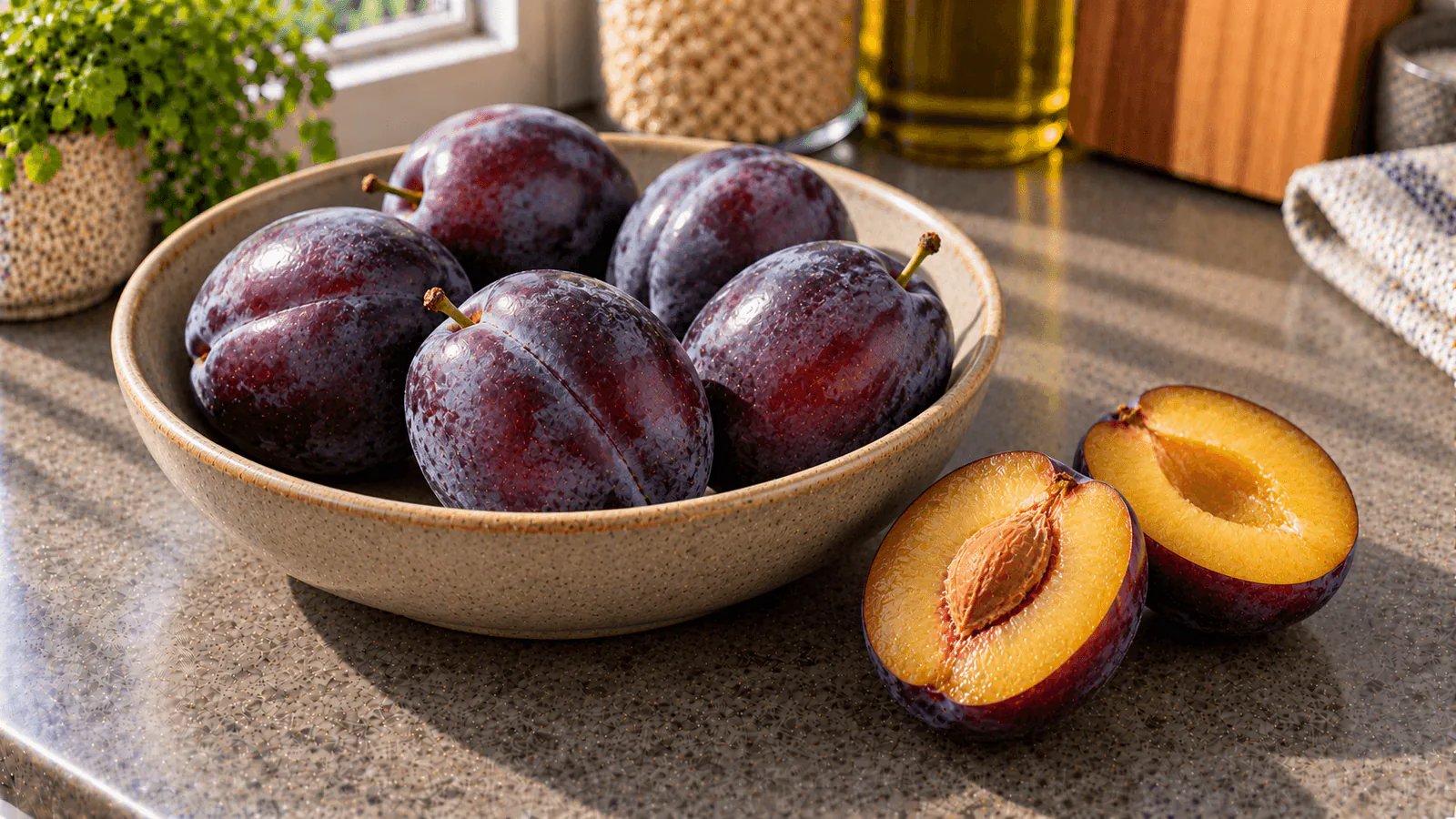
Fresh plums provide approximately 46 calories per 100 g of edible fruit, according to USDA FoodData Central's SR Legacy entry Plums, raw (FDC 169949). One reference plum with 66 g of edible fruit supplies about 30 kcal; a cup of sliced plums weighing 165 g supplies about 76 kcal. These are estimates based on a particular database entry, not fixed calorie counts for every plum.
This page focuses on fresh plums eaten with their skin, without the stone. It explains how to weigh a plum correctly and calculate calories in larger portions and simple recipes. Dried plums, usually called prunes, are a different food state with substantially more calories per 100 g and already have their own Mealisa guide.
Plum nutrition per 100 g
The table uses USDA SR Legacy FDC 169949, Plums, raw. Values refer to edible raw fruit, not the stone, a syrup-packed product, juice or an added-sugar dessert.
| Nutrient | Per 100 g of raw plum |
|---|---|
| Calories | 46 kcal |
| Protein | 0.70 g |
| Total carbohydrate (USDA) | 11.42 g |
| Naturally occurring sugars | 9.92 g |
| Dietary fibre | 1.40 g |
| Total fat | 0.28 g |
| Water | 87.23 g |
| Potassium | 157 mg |
| Vitamin C | 9.5 mg |
Source: USDA FoodData Central — Plums, raw, FDC 169949.
These are reference averages. Plums differ in variety, size, ripeness and water content. A particular dark-purple or yellow plum need not match every nutrient value exactly. USDA's total carbohydrate calculation includes fibre, whereas European labels usually separate available carbohydrate from fibre; be careful when comparing figures reported under different conventions.
Calories per plum and by serving size
The USDA household measures include a 66 g edible plum and a 165 g cup of slices. For an individual fruit, size and the weight of the discarded stone can change the result.
| Edible raw plum portion | Calories | Natural sugars | Fibre |
|---|---|---|---|
| 50 g | 23 kcal | 5.0 g | 0.7 g |
| 1 reference plum, 66 g | 30 kcal | 6.5 g | 0.9 g |
| 100 g | 46 kcal | 9.9 g | 1.4 g |
| 120 g | 55 kcal | 11.9 g | 1.7 g |
| 1 cup sliced, 165 g | 76 kcal | 16.4 g | 2.3 g |
| 200 g | 92 kcal | 19.8 g | 2.8 g |
| 250 g | 115 kcal | 24.8 g | 3.5 g |
The formula is calories = edible raw weight in grams × 0.46. Figures in the table are rounded from the same nutrient record; the weights for one reference plum and a cup of slices are household estimates, not rules for every shopping basket.
If you eat three plums, their calories cannot be calculated accurately by assuming every fruit weighs 66 g. Three small plums can contain less edible fruit than three large ones. Weigh them when precision matters. This distinction between a reference serving and the portion actually eaten is covered in portion size versus serving size.
Does the plum stone count toward the weight?
No. The hard stone is not part of the edible plum weight in the USDA reference. Skin and flesh are normally eaten, but the stone is removed. Entering the entire weight of a whole plum as edible fruit may slightly overstate calories.
For example, imagine two whole plums weighing 150 g together. If the discarded stones and inedible pieces weigh 12 g, the edible portion is 138 g: about 63 kcal (138 × 0.46 = 63.48). Those weights are an illustrative example, not a standard stone-to-fruit percentage.
You can weigh the fruit before eating and subtract the leftovers, or remove the stones and weigh the slices directly. If you are using a nutrition label or a recipe that reports net edible weight, avoid subtracting the stone a second time.
Are black, red, yellow and green plums different?
Plums vary widely in skin colour, acidity, firmness and sweetness. A darker skin does not automatically mean fewer or more calories. The general 46 kcal reference is a practical starting point when the exact cultivar is unknown.
Some cultivars contain more sugars or less water than others. A very sweet plum may still have a modest total calorie count because the fruit contains substantial water, but sweetness is not a reliable measuring instrument.
If a database offers a validated entry for the exact plum variety, you can use it. Otherwise, one general fresh-plum reference is usually more defensible than assigning unsupported precision to each colour. Avoid creating different calorie totals just from the look of the skin.
Fresh plums versus prunes: not interchangeable
Fresh plums and dried prunes come from related fruit, but dehydration greatly changes their water concentration and values per 100 g. The USDA SR Legacy entry Plums, dried (prunes), uncooked, FDC 168162, lists approximately 240 kcal per 100 g, versus 46 kcal for fresh plums.
This does not mean that drying mysteriously creates energy. Much of the water is removed, so 100 g of dried fruit represents more original fruit solids than 100 g of fresh fruit. A 25 g prune portion is about 60 kcal, but its exact sugar and fibre content should be taken from a matching product or USDA entry.
Read the separate prune calorie and serving guide for dried-plum portions, rehydration and packaged products. The complete USDA source for the dried comparison is FoodData Central — Plums, dried (prunes), uncooked, FDC 168162.
A fresh plum's edible-weight calculation should not be applied to prunes, prune purée or prune juice.
Cooking plums changes the recipe more than the fruit itself
Fresh plums can be baked, grilled, stewed or briefly heated. Cooking may change their water content, texture and weight. That means 100 g of cooked fruit is not necessarily nutritionally equivalent to 100 g of raw fruit measured before cooking.
For a homemade dessert, a practical method is to add the calories of the starting ingredients and divide the total by the portions actually eaten. Consider 300 g fresh edible plums, 12 g sugar and 10 g butter. The plums supply 138 kcal, the sugar about 48 kcal and the butter about 72 kcal at an illustrative 7.2 kcal per gram. Total: 258 kcal before other ingredients, or 86 kcal in each of three equal portions if all ingredients are consumed.
These figures describe the example, not every baked-plum recipe. Pastry, oats, nuts, honey, syrup, ice cream or cream require separate entries, and some fat may remain in the pan. Measure the ingredients rather than assuming that cooking itself has added a fixed number of calories.
Compote, jam, canned plums and juice
Plum compote can range from almost entirely fruit and water to a dessert with significant added sugar. Jam is commonly much more concentrated in sugar; juice may contain less fibre than whole fruit. None of these foods should automatically inherit the raw-plum value of 46 kcal per 100 g.
For canned plums, inspect the nutrition label and determine whether the listed values refer to drained fruit or fruit plus packing liquid. A product preserved in syrup may differ markedly from fruit packed in water. If you consume the syrup, its contribution belongs in the total.
For a homemade compote, weigh the raw fruit and each added ingredient, record the cooked yield and allocate calories by the amount served. If you buy a prepared product, its actual label is more relevant than a generic fresh-fruit record.
Sugars, fibre and a balanced snack
The raw-plum USDA entry contains 9.92 g natural sugars and 1.40 g dietary fibre per 100 g. Natural sugar in intact fruit is not the same product as sugar deliberately added to jam or sweetened syrup. Nevertheless, portion size matters if you are tracking total carbohydrate.
Plums are not protein-rich. If the fruit is your entire snack and you want more protein, you might combine it with plain yoghurt or another appropriate food, then count both items. The resulting snack will contain more energy than the fruit alone, but can be more substantial.
For a fruit bowl containing 150 g fresh plums, the plums contribute 69 kcal. Add the weighed calories of any other fruit, nuts or yoghurt rather than using a one-size-fits-all value. Fresh peaches have a separate reference, while dried apricots illustrate why dried and fresh fruit should be logged separately.
Recording fresh plums accurately
Choose a raw-plum entry when you eat fresh raw fruit. Use edible grams, subtracting the stones and discarded pieces. For cooked recipes, sum ingredients and account for portion size. For prunes, canned fruit and juice, choose the specific preparation or packaging label.
The most useful reference is 46 kcal per 100 g of raw edible plum, equivalent to about 30 kcal for the USDA 66 g fruit. Plums can contribute to a varied diet, but they are not a stand-alone solution for weight loss or a medical treatment.
Data sources and limits
- USDA FoodData Central — Plums, raw, SR Legacy 169949.
- USDA FoodData Central — Plums, dried (prunes), uncooked, SR Legacy 168162.
Serving and recipe calculations in this article use the cited reference figures and explicitly stated ingredient assumptions.