
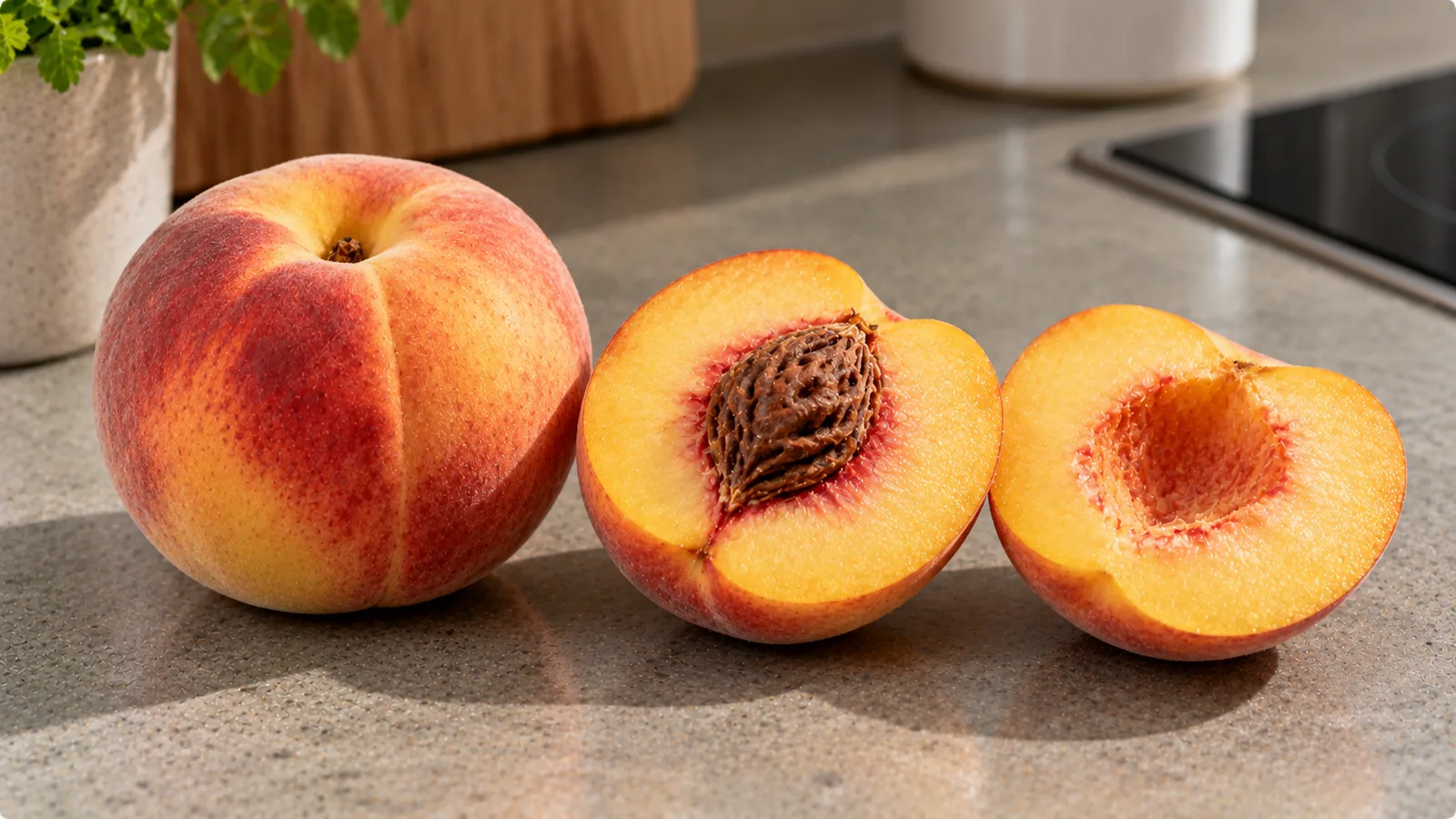
A fresh peach contains approximately 39 calories per 100 g of edible fruit. The calories in one peach depend on its size and, importantly, how much flesh remains after removing the stone.
A medium peach providing 150 g of edible flesh contains approximately 59 calories. A smaller portion of 100 g provides about 39 calories, while 200 g provides approximately 78 calories.
These values apply to raw, fresh peaches without added sugar, syrup, cream or other toppings.
Peach calories at a glance
| Edible peach flesh | Estimated calories |
|---|---|
| 50 g | 20 kcal |
| 75 g | 29 kcal |
| 100 g | 39 kcal |
| 125 g | 49 kcal |
| 150 g | 59 kcal |
| 175 g | 68 kcal |
| 200 g | 78 kcal |
| 250 g | 98 kcal |
| 300 g | 117 kcal |
The table uses approximately 39 kcal per 100 g, with figures rounded to the nearest whole calorie.
The weights refer to edible flesh, not a whole peach weighed with its stone.
Source for representative raw peach composition: USDA FoodData Central.
How many calories are in one peach?
There is no single calorie value for every peach. Fruit size, variety and edible yield differ.
For everyday food logging, these are useful examples:
| Example | Edible weight | Estimated calories |
|---|---|---|
| Small peach | 100 g | 39 kcal |
| Medium peach | 150 g | 59 kcal |
| Large peach | 200 g | 78 kcal |
| Very large peach | 250 g | 98 kcal |
These size labels are illustrative, not official grading standards.
A peach sold as medium in one shop may be heavier or lighter than a medium peach elsewhere.
For a more reliable estimate, weigh the edible portion rather than selecting a generic small, medium or large entry.
Does the stone count toward the weight?
No. The hard stone is not eaten and should not be included in the edible weight used for nutrition calculations.
For example, suppose a whole peach weighs 170 g and the discarded stone weighs 15 g.
Edible weight = 170 − 15 = 155 g.
Estimated energy = 155 × 39 ÷ 100 = approximately 60 kcal.
If you also discard bruised flesh or other parts, subtract those as well.
The exact weight of the stone varies between peaches, so a fixed percentage is less accurate than weighing the actual edible portion.
Nutrition facts for raw peach
The following figures are representative values for 100 g of raw peach flesh.
| Nutrient | Per 100 g | Per 150 g |
|---|---|---|
| Energy | 39 kcal | 59 kcal |
| Protein | 0.9 g | 1.4 g |
| Fat | 0.3 g | 0.5 g |
| Total carbohydrate, US definition | 9.5 g | 14.3 g |
| Dietary fibre | 1.5 g | 2.3 g |
| Sugars | 8.4 g | 12.6 g |
| Water | Approximately 89 g | Approximately 134 g |
Values are rounded. Individual fruit and database entries can differ.
Source: USDA FoodData Central.
Why do some labels show fewer carbohydrates?
US food composition data often report total carbohydrate, including dietary fibre.
EU nutrition labels generally report carbohydrate excluding fibre, with fibre listed separately.
Using the representative figures above:
9.5 g total carbohydrate − 1.5 g fibre = approximately 8.0 g available carbohydrate per 100 g.
This difference is primarily about labelling definitions, not a change in the fruit.
When logging peaches in a European nutrition app, check which carbohydrate definition the database uses.
Reference: Regulation (EU) No 1169/2011.
How to calculate peach calories by weight
The simplest formula is:
Calories = edible peach weight in grams × 0.39
For example:
- 80 g of peach flesh: 80 × 0.39 = 31.2 kcal.
- 130 g of peach flesh: 130 × 0.39 = 50.7 kcal.
- 180 g of peach flesh: 180 × 0.39 = 70.2 kcal.
- 225 g of peach flesh: 225 × 0.39 = 87.8 kcal.
The formula is an estimate based on the representative 39 kcal per 100 g value.
It is useful for raw peaches without added ingredients.
For canned peaches, dried peaches, peach jam or prepared desserts, use the nutritional information for that specific product instead.
Fresh peach versus canned peach
A fresh peach and a canned peach are not necessarily nutritionally identical.
Canned peaches may be packed in water, juice or syrup.
The energy content of the final serving depends on:
- The peach flesh itself.
- Whether added sugar is present.
- How much packing liquid is consumed.
- The drained weight of the fruit.
- The specific product formulation.
Peaches canned in syrup can contribute additional sugar and calories, particularly when the syrup is consumed.
However, the precise difference should be determined from the product label rather than assuming every canned peach has the same value.
Drained fruit versus fruit with syrup
Suppose you eat 150 g of drained canned peach slices.
The relevant database entry should describe drained peaches in the appropriate packing medium.
If you also consume 60 g of syrup, its energy must be added separately unless the nutrition entry already covers the complete prepared serving.
Do not use a raw-peach entry for the entire fruit-and-syrup mixture.
Fresh peach versus dried peach
Dried peach is much more concentrated by weight because much of the water has been removed.
Consequently, 100 g of dried peach generally contains substantially more calories than 100 g of fresh peach.
This does not mean the original fruit gains calories simply through drying.
Instead, a greater quantity of the original fruit is represented in the same 100 g of dried product.
Dried peaches may also contain added sugar or other ingredients.
For accurate tracking, read the package label and weigh the portion.
A small handful of dried fruit should not automatically be logged as the same weight of fresh peach.
Does peach skin change the calories?
Peach skin is edible when the fruit is properly washed and suitable for consumption.
The calorie difference between a peach eaten with its skin and one peeled is usually small relative to normal variation in fruit size.
Peeling removes some edible mass and can change the amount of fibre in the portion.
If you peel the peach, weigh the remaining flesh for the most accurate calorie estimate.
If you eat the skin, include it in the edible weight.
The stone remains excluded in both cases.
How much sugar is in a peach?
A representative 100 g serving of raw peach contains approximately 8.4 g of naturally occurring sugars.
A 150 g serving contains about 12.6 g.
The actual amount can vary with variety, growing conditions and ripeness.
The sugars naturally present in intact fruit should not automatically be treated as equivalent to sugar added to sweets or sugary drinks when considering dietary guidance.
The World Health Organization's recommendations on free sugars distinguish free sugars from sugars naturally present within the cellular structure of intact fruits and vegetables.
Source: WHO — Healthy diet.
This distinction does not mean that fruit has zero calories. The carbohydrates in peaches still contribute to the energy value of the food.
Is a peach low in calories?
At approximately 39 kcal per 100 g, fresh peach is relatively low in energy density compared with many calorie-dense snack foods.
It also contains substantial water.
However, whether a food fits into a person's eating plan depends on the full meal, portion size and overall dietary pattern.
A peach can be eaten on its own, alongside yogurt or as part of breakfast.
If you add honey, cream, ice cream, nut butter or pastry, those ingredients must be included in the calorie total.
Example: peach with yogurt
Consider a snack made from:
- 150 g peach flesh: approximately 59 kcal.
- 150 g plain yogurt: calories depend on the specific product.
- Optional nuts or honey: calculate separately.
The peach contributes approximately 59 kcal, but the complete snack cannot be calculated accurately without the yogurt's nutritional label and the quantities of any additions.
Peach versus nectarine
Peaches and nectarines are closely related fruits, but they should not automatically be treated as identical entries in a nutrition database.
Their representative calorie values can be similar, while actual values vary by variety and source.
A peach generally has fuzzy skin, while a nectarine has smooth skin.
If your food database contains separate entries, choose the correct fruit.
For calorie tracking, actual edible weight is usually more useful than a broad assumption based on fruit size.
Peach versus peach juice
A whole peach and a glass of peach juice are different servings.
Juice may contain less fibre than intact fruit, and some commercial drinks contain additional ingredients or added sugar.
A peach-flavoured beverage is not necessarily made entirely from peach juice.
Check whether the label describes:
- 100% fruit juice.
- Juice from concentrate.
- Nectar.
- A fruit drink with added ingredients.
Use the product's energy per 100 ml and the amount consumed.
Do not apply the 39 kcal per 100 g raw-peach figure directly to a glass of juice.
How to log peaches accurately
For a whole fresh peach:
- Weigh the peach.
- Remove the stone.
- Weigh the edible flesh, including the skin if eaten.
- Select a raw peach entry in the nutrition database.
- Enter the edible weight in grams.
For sliced peaches already prepared, weigh only the slices you actually eat.
For canned peaches, use a database entry matching the packing medium and whether the product is drained.
For a peach dessert, record all relevant ingredients.
If weighing is not possible, an estimated medium peach of 150 g edible flesh can serve as a practical starting point, but it should not be presented as the exact weight of every medium fruit.
Frequently confused measurements
100 g peach versus one peach
100 g is a measured weight. One peach is a variable-sized piece of fruit.
Whole weight versus edible weight
Whole weight can include the stone. Edible weight excludes it.
Dry fruit versus fresh fruit
Dried peach has less water and more concentrated calories per 100 g.
Peach slices in syrup versus raw peach
The syrup and added ingredients can change the energy content.
Calories versus carbohydrates
Calories measure energy. Carbohydrates are one of the nutrients contributing to that energy.
Quick answers
How many calories are in 100 g of peach?
Approximately 39 kcal for raw edible peach flesh.
How many calories are in a medium peach?
Approximately 59 kcal if the edible portion weighs 150 g.
How many calories are in a large peach?
Approximately 78 kcal if the edible portion weighs 200 g.
How many calories are in half a peach?
Half of a peach providing 150 g edible flesh would contain approximately 29 kcal, assuming the halves are equal.
Does peeling a peach reduce calories?
Peeling removes a small amount of edible mass. For accurate tracking, weigh the portion after peeling.
Can I count the stone in the weight?
No. The stone is not edible and should be excluded.
Are canned peaches the same calories as fresh?
Not necessarily. Packing liquid, added sugar and drained weight can affect the result.
Sources and methodology
- USDA FoodData Central — representative raw peach energy, carbohydrate, sugar, protein, fat and fibre values.
- Regulation (EU) No 1169/2011 — EU nutrition labelling definitions.
- WHO — Healthy diet — guidance on dietary patterns, fruit and free sugars.
All serving-size calorie figures are calculated from an approximate reference value of 39 kcal per 100 g of edible raw peach. Values are rounded and may vary between individual fruits.