
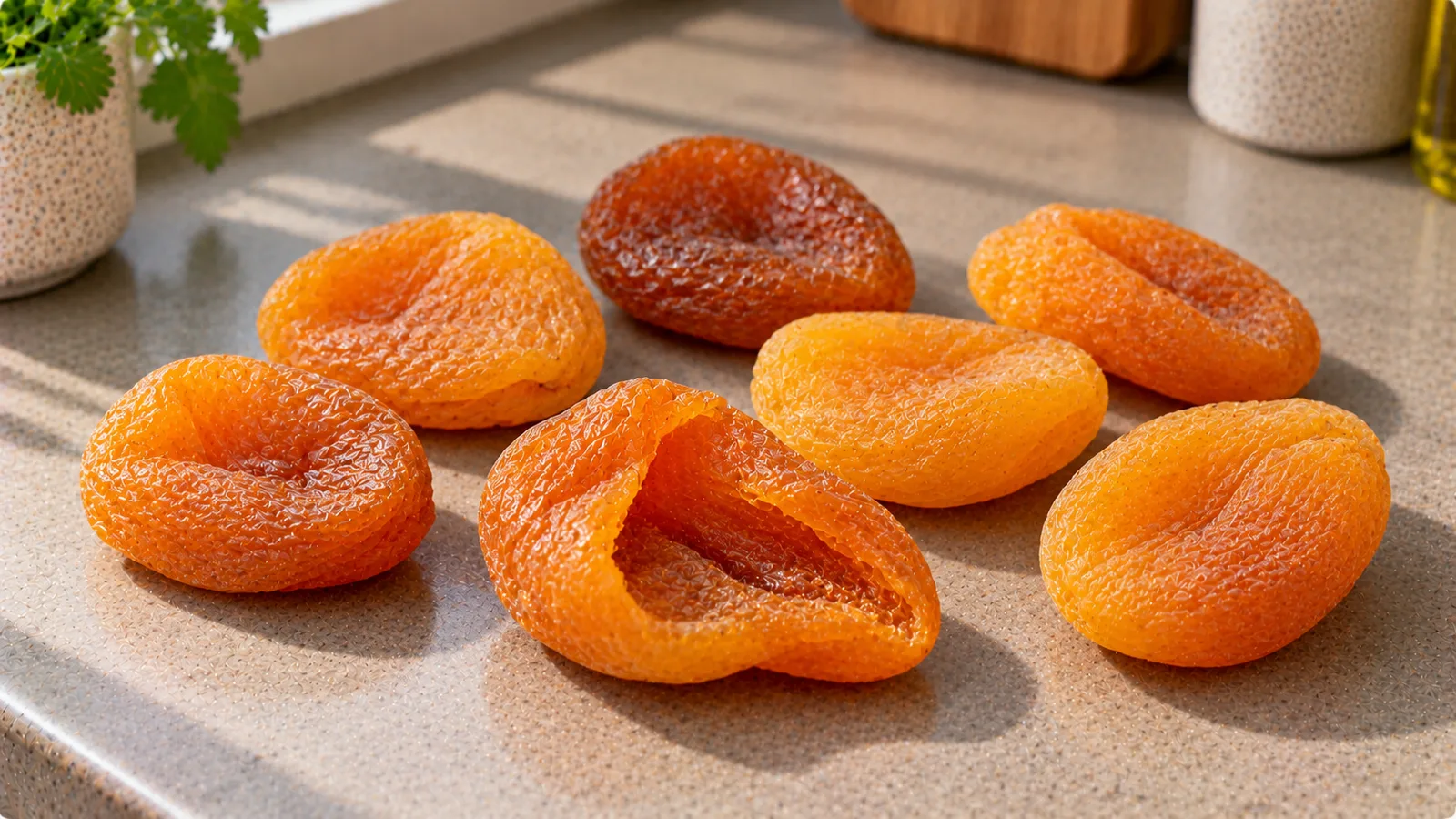
Dried apricots are fresh apricots that have had most of their water removed. They are convenient for snacking, baking and adding to oatmeal, yogurt or grain dishes.
Because drying concentrates the fruit into a smaller weight, dried apricots contain substantially more calories per 100 g than fresh apricots.
Plain dried apricots contain approximately 241 calories per 100 g.
This is a useful reference for unsweetened dried apricots without added oil or other energy-containing ingredients.
The actual calorie content of a product may vary with moisture, processing and added ingredients. For the most accurate result, use the nutrition label on your package.
Dried apricot calories by portion
Using 241 kcal per 100 g, one gram provides approximately 2.41 kcal.
| Dried apricot weight | Approximate calories |
|---|---|
| 5 g | 12 kcal |
| 10 g | 24 kcal |
| 15 g | 36 kcal |
| 20 g | 48 kcal |
| 25 g | 60 kcal |
| 30 g | 72 kcal |
| 40 g | 96 kcal |
| 50 g | 121 kcal |
| 60 g | 145 kcal |
| 75 g | 181 kcal |
| 100 g | 241 kcal |
| 125 g | 301 kcal |
| 150 g | 362 kcal |
| 200 g | 482 kcal |
These values are rounded estimates based on the reference composition of dried apricots.
They apply to the edible dried fruit, not to the weight of packaging or additional ingredients.
Source: USDA FoodData Central.
How many calories are in one dried apricot?
Dried apricots vary in size, shape and moisture content.
Some products contain small individual halves, while others contain larger pieces.
Consequently, there is no single calorie value that applies to every dried apricot.
| Weight of one edible piece | Approximate calories |
|---|---|
| 4 g | 10 kcal |
| 5 g | 12 kcal |
| 6 g | 14 kcal |
| 7 g | 17 kcal |
| 8 g | 19 kcal |
| 10 g | 24 kcal |
| 12 g | 29 kcal |
| 15 g | 36 kcal |
For example, a dried apricot half weighing 8 g contains approximately 19 kcal.
A larger piece weighing 12 g contains approximately 29 kcal.
The difference matters when you eat several pieces.
If you regularly buy the same brand, weigh five or ten pieces together and divide by the number of pieces to estimate their average weight.
Do not assume that the average weight of one brand applies to another.
Calories in 3, 5, 6 and 10 dried apricots
The following illustration assumes each piece weighs 8 g.
| Number of pieces | Total weight | Approximate calories |
|---|---|---|
| 1 | 8 g | 19 kcal |
| 2 | 16 g | 39 kcal |
| 3 | 24 g | 58 kcal |
| 4 | 32 g | 77 kcal |
| 5 | 40 g | 96 kcal |
| 6 | 48 g | 116 kcal |
| 8 | 64 g | 154 kcal |
| 10 | 80 g | 193 kcal |
These are examples, not standard serving sizes.
If your pieces weigh 5 g each, five pieces provide approximately 60 kcal.
If they weigh 12 g each, five pieces provide approximately 145 kcal.
For accurate tracking, weight is more reliable than counting pieces.
Dried apricot nutrition facts per 100 g
Dried apricots provide mostly carbohydrates, along with dietary fiber and minerals.
Representative values for plain dried apricots are:
| Nutrient | Per 100 g | Per 30 g |
|---|---|---|
| Energy | 241 kcal | 72 kcal |
| Protein | 3.39 g | 1.02 g |
| Total fat | 0.51 g | 0.15 g |
| Total carbohydrate, US definition | 62.64 g | 18.79 g |
| Dietary fiber | 7.3 g | 2.19 g |
| Total sugars | 53.44 g | 16.03 g |
| Potassium | 1,162 mg | 349 mg |
| Calcium | 55 mg | 17 mg |
| Iron | 2.66 mg | 0.80 mg |
Source: USDA FoodData Central.
The figures are representative database values rather than a guarantee for every packaged product.
Dried apricots are relatively low in fat and are not a major protein source.
Most of their calories come from carbohydrates.
Why carbohydrate values can differ between countries
US nutrition databases generally include fiber within total carbohydrate.
European nutrition labels list available carbohydrates and dietary fiber separately.
Using the representative values above:
62.64 g total carbohydrate − 7.3 g fiber = approximately 55.34 g available carbohydrate per 100 g.
This illustrates a labeling convention, not a laboratory analysis of a particular brand.
If you track carbohydrates using European packaging, use the carbohydrate value printed on that product.
Reference: Regulation (EU) No 1169/2011.
Dried apricots versus fresh apricots
Fresh apricots contain much more water than dried apricots.
Removing water increases the concentration of energy per 100 g.
| Food | Approximate calories per 100 g |
|---|---|
| Fresh apricots | 48 kcal |
| Plain dried apricots | 241 kcal |
Source: USDA FoodData Central.
This does not mean that drying creates additional calories.
If water alone is removed, the remaining fruit weighs less while retaining most of the original energy.
Comparing equal weights
A 100 g serving of fresh apricots contains approximately 48 kcal.
A 100 g serving of dried apricots contains approximately 241 kcal.
The dried version is around five times as energy-dense by weight.
Comparing the same original fruit
Imagine a batch of fresh apricots containing 240 kcal.
If the batch is dried without adding sugar or other calorie-containing ingredients, its total energy remains approximately 240 kcal, apart from processing losses.
However, its final weight is much lower.
The calorie difference appears when equal weights of fresh and dried fruit are compared.
How much sugar is in dried apricots?
Plain dried apricots contain approximately 53.4 g of naturally occurring sugars per 100 g.
| Portion | Approximate sugars |
|---|---|
| 10 g | 5.3 g |
| 20 g | 10.7 g |
| 30 g | 16.0 g |
| 40 g | 21.4 g |
| 50 g | 26.7 g |
| 75 g | 40.1 g |
| 100 g | 53.4 g |
The sugar in plain dried apricots comes naturally from the fruit.
However, naturally occurring sugar still contributes to the food's carbohydrate and energy content.
A product labeled no added sugar is not necessarily low in total sugar.
Some dried apricot products may contain added sugar, syrup or other sweeteners.
Check the ingredient list to distinguish plain dried apricots from sweetened varieties.
Unsweetened versus sweetened dried apricots
Plain dried apricots generally contain one main ingredient: apricots.
Other products may contain added sugar or be processed into a sweetened snack.
The calorie content depends on the final recipe.
Plain dried apricots
For ordinary unsweetened dried apricots, approximately 241 kcal per 100 g is a useful reference.
Sugar-added dried apricots
Products with added sugar may contain a different concentration of carbohydrates and calories.
However, it is not accurate to assume that every sweetened product must have a particular calorie value.
Added water, syrup concentration and final moisture content all influence calories per 100 g.
Use the actual nutrition label.
Chocolate-covered dried apricots
Chocolate adds fat, sugar and calories.
A chocolate-covered product should be tracked using its complete nutritional composition.
Do not calculate it as plain dried apricots.
Dried apricot paste
Apricot paste may contain dried apricots, water, added sugar or other ingredients.
Its calories per 100 g depend on the formulation.
If the paste is homemade, calculate the ingredients used and the final edible weight.
Orange and brown dried apricots
Dried apricots can appear bright orange, amber or dark brown.
The color may reflect the variety, drying conditions and processing.
Some commercially dried apricots are treated with sulfur dioxide or sulfites to help preserve color.
Others are sold without added sulfites and may darken during drying.
Color alone does not reliably indicate calorie content.
Two products with different colors may have similar calories if their moisture and ingredient composition are similar.
Check the ingredients and nutrition label rather than estimating calories from appearance.
Sulfites and sensitivity
Sulfites can cause reactions in some sensitive individuals.
In the European Union, sulfur dioxide and sulfites above specified thresholds must be declared as allergens under applicable food-labeling rules.
If you have a known sulfite sensitivity, check the product label carefully.
Source: Regulation (EU) No 1169/2011.
Carbohydrates in dried apricots
Under the US definition, dried apricots provide approximately 62.6 g total carbohydrate per 100 g, including fiber.
That corresponds to:
- 20 g dried apricots: approximately 12.5 g total carbohydrate.
- 30 g: approximately 18.8 g.
- 40 g: approximately 25.1 g.
- 50 g: approximately 31.3 g.
- 100 g: approximately 62.6 g.
For European-style available carbohydrate tracking, use the appropriate label value.
People managing carbohydrate intake for diabetes or other medical reasons should consider portion size and individualized dietary guidance.
Fiber in dried apricots
Dried apricots provide approximately 7.3 g dietary fiber per 100 g.
| Portion | Approximate fiber |
|---|---|
| 10 g | 0.7 g |
| 20 g | 1.5 g |
| 30 g | 2.2 g |
| 40 g | 2.9 g |
| 50 g | 3.7 g |
| 75 g | 5.5 g |
| 100 g | 7.3 g |
The European Food Safety Authority considers 25 g dietary fiber per day an adequate intake for normal laxation in adults.
Source: EFSA — Dietary Reference Values.
Dried apricots can contribute to fiber intake, but they do not need to provide all of it.
Vegetables, legumes, whole grains, nuts and other fruits can contribute as well.
If you are not accustomed to fiber-rich foods, increasing the amount gradually may be more comfortable.
Potassium in dried apricots
Dried apricots are a concentrated source of potassium.
Representative values are:
| Portion | Approximate potassium |
|---|---|
| 20 g | 232 mg |
| 30 g | 349 mg |
| 40 g | 465 mg |
| 50 g | 581 mg |
| 100 g | 1,162 mg |
Potassium is an essential mineral involved in normal physiological functions.
However, the presence of potassium does not mean dried apricots prevent or treat disease.
People with kidney disease or medical instructions to limit potassium should seek individualized advice before increasing their intake of potassium-rich dried fruit.
Are dried apricots a good source of protein?
Dried apricots provide approximately 3.4 g protein per 100 g.
A typical 30 g portion contains only about 1 g protein.
Therefore, dried apricots should not be considered a major protein source.
If you want a snack containing more protein, you can combine a measured amount of dried apricots with a protein-containing food.
For example, plain yogurt or skyr may increase the protein content of the complete snack.
The exact result depends on the type and quantity of dairy product used.
Calories in dried apricots with nuts
Dried apricots are often eaten with almonds, walnuts or other nuts.
The fruit contributes mostly carbohydrates, while nuts generally contribute more fat and energy.
Example: dried apricots and almonds
Suppose a snack contains:
- Plain dried apricots: 30 g.
- Almonds: 20 g.
The dried apricots provide approximately 72 kcal.
The almonds add their own calories.
Using an illustrative almond value of 579 kcal per 100 g, 20 g almonds provide approximately 116 kcal.
The complete snack would contain approximately 188 kcal.
The actual value depends on the products.
Example: dried apricots and walnuts
A snack containing 40 g dried apricots and 15 g walnuts includes approximately 96 kcal from the dried apricots.
The walnuts must be counted separately.
Do not use the calorie value for dried apricots to estimate the entire mixture.
Calories in dried apricots added to breakfast
Dried apricots can be chopped and mixed into oatmeal, yogurt or breakfast cereal.
Their calories should be added to those of the other ingredients.
Oatmeal with dried apricots
Example ingredients:
- Dry oats: 60 g.
- Milk: 200 ml.
- Dried apricots: 30 g.
- Cinnamon.
The dried apricots contribute approximately 72 kcal.
The oats and milk add additional energy.
Yogurt with dried apricots
A bowl might contain:
- Plain yogurt: 200 g.
- Dried apricots: 40 g.
- Pumpkin seeds: 15 g.
The dried apricots contribute approximately 96 kcal.
The yogurt and seeds must also be included in the total.
Packaged muesli
If a packaged muesli already contains dried apricots, its nutrition label includes the fruit.
Do not add those calories a second time.
Only record extra dried apricots separately if you add them yourself.
Dried apricots in baking
Dried apricots can add sweetness, texture and flavor to baked goods.
They may be used chopped, soaked or puréed.
Example: apricot muffins
Suppose a muffin recipe contains 150 g dried apricots.
The apricots contribute:
150 g × 2.41 kcal/g = approximately 362 kcal to the entire recipe.
If the recipe makes 12 equal muffins, the dried apricots account for approximately 30 kcal per muffin.
Flour, eggs, sugar, oil and other ingredients contribute additional energy.
Example: apricot energy bites
Suppose a recipe combines:
- Dried apricots: 100 g.
- Oats: 80 g.
- Almonds: 50 g.
The dried apricots contribute approximately 241 kcal.
The oats and almonds must be calculated separately.
The total energy of the mixture should then be divided by the number or weight of the finished portions.
Does soaking dried apricots change their calories?
Soaking dried apricots in water makes them softer and heavier.
The additional weight comes mainly from absorbed water.
If no sugar or other energy-containing ingredient is added, soaking does not create extra calories.
However, the calories per 100 g of soaked apricots may be lower because the fruit contains more water.
Example
Suppose 40 g dried apricots contain approximately 96 kcal.
After soaking, they weigh 65 g.
If no meaningful amount of energy is lost to the soaking water, the soaked fruit still contains approximately 96 kcal in total.
But per 100 g of soaked fruit, the calculated energy density is different.
For accurate tracking, it is usually easiest to weigh the dried apricots before soaking.
If the soaking liquid is discarded, some soluble components may be lost, so this calculation remains an approximation.
How to calculate dried apricot calories
For plain dried apricots at 241 kcal per 100 g:
Calories = dried apricot weight in grams × 2.41
Examples:
- 8 g × 2.41 = 19 kcal.
- 12 g × 2.41 = 29 kcal.
- 18 g × 2.41 = 43 kcal.
- 28 g × 2.41 = 67 kcal.
- 35 g × 2.41 = 84 kcal.
- 45 g × 2.41 = 108 kcal.
- 65 g × 2.41 = 157 kcal.
- 90 g × 2.41 = 217 kcal.
If your package states 260 kcal per 100 g, use 2.6 kcal per gram instead.
The product-specific label is preferable to a general database average.
How to weigh dried apricots accurately
A digital kitchen scale provides the simplest method.
- Place a small bowl on the scale.
- Set the scale to zero.
- Add the dried apricots you intend to eat.
- Record the weight.
- Use the nutrition information for that product.
- Include any additional ingredients separately.
If the dried apricots contain pits or other inedible material, exclude that material from the edible weight.
When preparing a recipe, weigh the fruit before chopping or mixing it with other ingredients.
For soaked fruit, recording the original dry weight generally makes calorie calculations easier.
Dried apricots and weight management
Dried apricots can fit into a diet designed to manage body weight.
They provide sweetness, fiber and minerals in a convenient form.
However, they are energy-dense compared with fresh apricots.
A 30 g serving contains approximately 72 kcal.
A 100 g serving contains approximately 241 kcal.
These are very different portions, even though both may look relatively small.
Dried apricots do not independently cause weight gain or weight loss.
Overall dietary patterns, energy intake and other factors influence body weight.
A practical approach is to portion the fruit before eating rather than repeatedly taking pieces directly from a large package.
How to store dried apricots
Follow the instructions on the package.
Keep dried apricots in a clean, sealed container and protect them from excess moisture and contamination.
Some products may require refrigeration after opening.
Check the best-before date and any product-specific instructions.
Discard dried apricots that show mold or other clear signs of spoilage.
If you notice an unusual smell, visible contamination or significant deterioration, do not rely on the original best-before date alone.
Common questions
How many calories are in 100 g of dried apricots?
Approximately 241 kcal for ordinary unsweetened dried apricots.
How many calories are in 30 g?
Approximately 72 kcal.
How many calories are in 50 g?
Approximately 121 kcal.
How many calories are in one dried apricot?
Approximately 19 kcal if the edible piece weighs 8 g. The actual value depends on size.
How many calories are in five dried apricots?
Approximately 96 kcal if five pieces weigh 40 g in total.
Are dried apricots more caloric than fresh apricots?
Per 100 g, yes. Dried apricots contain much less water and therefore more concentrated energy.
Do dried apricots contain added sugar?
Plain dried apricots may contain no added sugar, but sweetened varieties exist. Check the ingredient list.
Are orange dried apricots higher in calories than brown ones?
Not necessarily. Color alone does not determine calories.
Are dried apricots a source of fiber?
Yes. They provide approximately 7.3 g fiber per 100 g.
Should soaked apricots be tracked by dry or soaked weight?
For a homemade preparation, recording the original dry weight is usually the simplest method.
Sources and calculation method
- USDA FoodData Central — representative nutrition values for dried and fresh apricots.
- Regulation (EU) No 1169/2011 — European nutrition labeling and allergen information.
- EFSA — Dietary Reference Values — dietary fiber reference information.
The calculations use 241 kcal per 100 g of plain dried apricots. Piece weights are illustrative. For the most accurate result, use the actual edible weight and nutrition label of your product.