
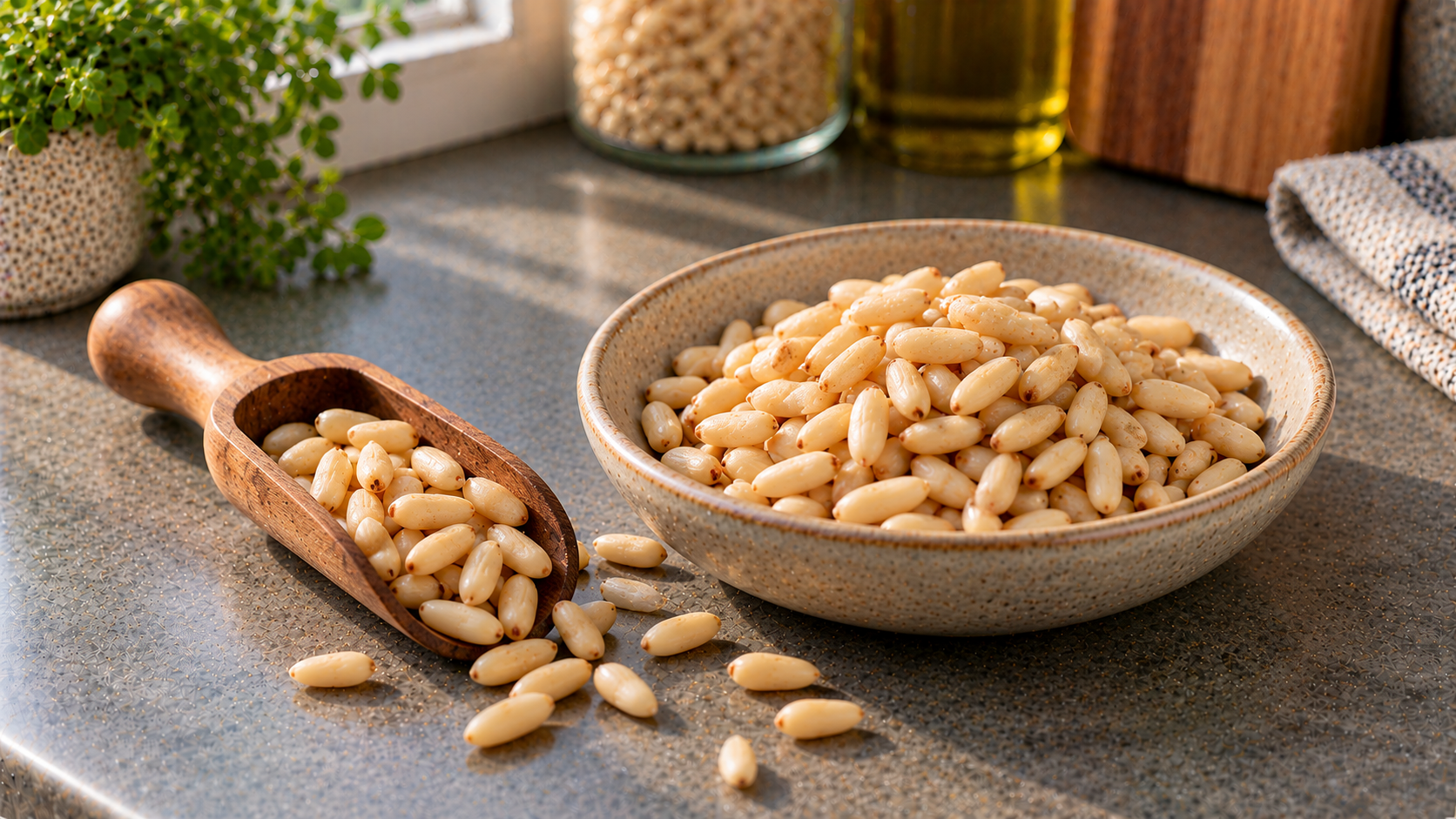
Pine nuts are edible seeds harvested from certain pine species. They are used in pesto, salads, rice dishes and baked foods.
The selected raw reference supplies approximately 673 kcal per 100 g of edible pine nuts.
In typical recipes, however, a small quantity is used, so portion weight is often more informative than the per-100-g value alone.
Calories by edible raw portion
| Edible weight | Calories |
|---|---|
| 10 g | 67.3 kcal |
| 15 g | 101 kcal |
| 20 g | 134.6 kcal |
| 25 g | 168.3 kcal |
| 30 g | 201.9 kcal |
| 50 g | 336.5 kcal |
| 100 g | 673 kcal |
Nutrition per 100 g
| Nutrition per 100 g | |
|---|---|
| Calories | 673 kcal |
| Protein | 13.69 g |
| Fat | 68.37 g |
| Carbohydrates | 13.08 g |
| Fiber | 3.7 g |
Pine nuts are seeds, not the entire cone
The edible pine nut is a seed removed from its protective shell.
Only the edible kernel should be counted when calculating nutrition.
Pine nuts can vary in size and composition depending on the pine species and geographic origin.
For an accurate recipe, weigh the shelled seeds used.
Counting individual pine nuts is impractical and less accurate than measuring grams.
For a packaged product, check whether it is raw, toasted or mixed with other ingredients.
Small amounts used as toppings
At 673 kcal per 100 g, a 10 g topping contributes about 67 kcal.
A 15 g serving provides approximately 101 kcal.
A 25 g portion contributes about 168 kcal.
These values refer to raw kernels and are rounded from USDA food-composition data. USDA FoodData Central.
The seeds add texture and flavor, but their calories should not be ignored when measuring salads or grain bowls.
A serving spoon may hold more or less than the weight assumed in a recipe.
Pesto is more than pine nuts
Traditional-style basil pesto commonly includes basil, pine nuts, olive oil, hard cheese and garlic.
Pesto combines pine nuts with oil, often cheese and other ingredients, so its calories differ from plain nuts; see the pesto nutrition guide.
Its energy content cannot be calculated by applying pine-nut values to the entire sauce.
For example, 30 g pine nuts supply approximately 202 kcal, while 40 g olive oil adds roughly 360 kcal.
Together they contribute around 562 kcal before cheese, basil and other ingredients.
If the sauce is split among four equal servings, those two ingredients contribute about 141 kcal per serving.
The actual pesto values depend on the complete recipe or the manufacturer's label.
Protein, fat and roasting
The selected USDA reference contains approximately 68.4 g fat, 13.7 g protein and 3.7 g fiber per 100 g. USDA FoodData Central.
A 15 g portion therefore provides approximately 10.3 g fat and 2.1 g protein.
Pine nuts contain a substantial proportion of unsaturated fatty acids.
Dry toasting can change moisture and flavor without adding oil, whereas frying or roasting with added oil requires additional calorie accounting.
Store pine nuts according to package guidance, since their oils may deteriorate and develop an unpleasant flavor during poor storage.
How to calculate a portion
Use the edible grams multiplied by the reference calories per 100 g, divided by 100. For cooked or processed products, use a nutrition entry corresponding to the actual preparation state. Oils, sauces and other ingredients must be counted separately. The values here are rounded references, not guarantees for every product.
Sources
- USDA FoodData Central — food composition data.
- EU Regulation 1169/2011 — food information and nutritional labeling.