
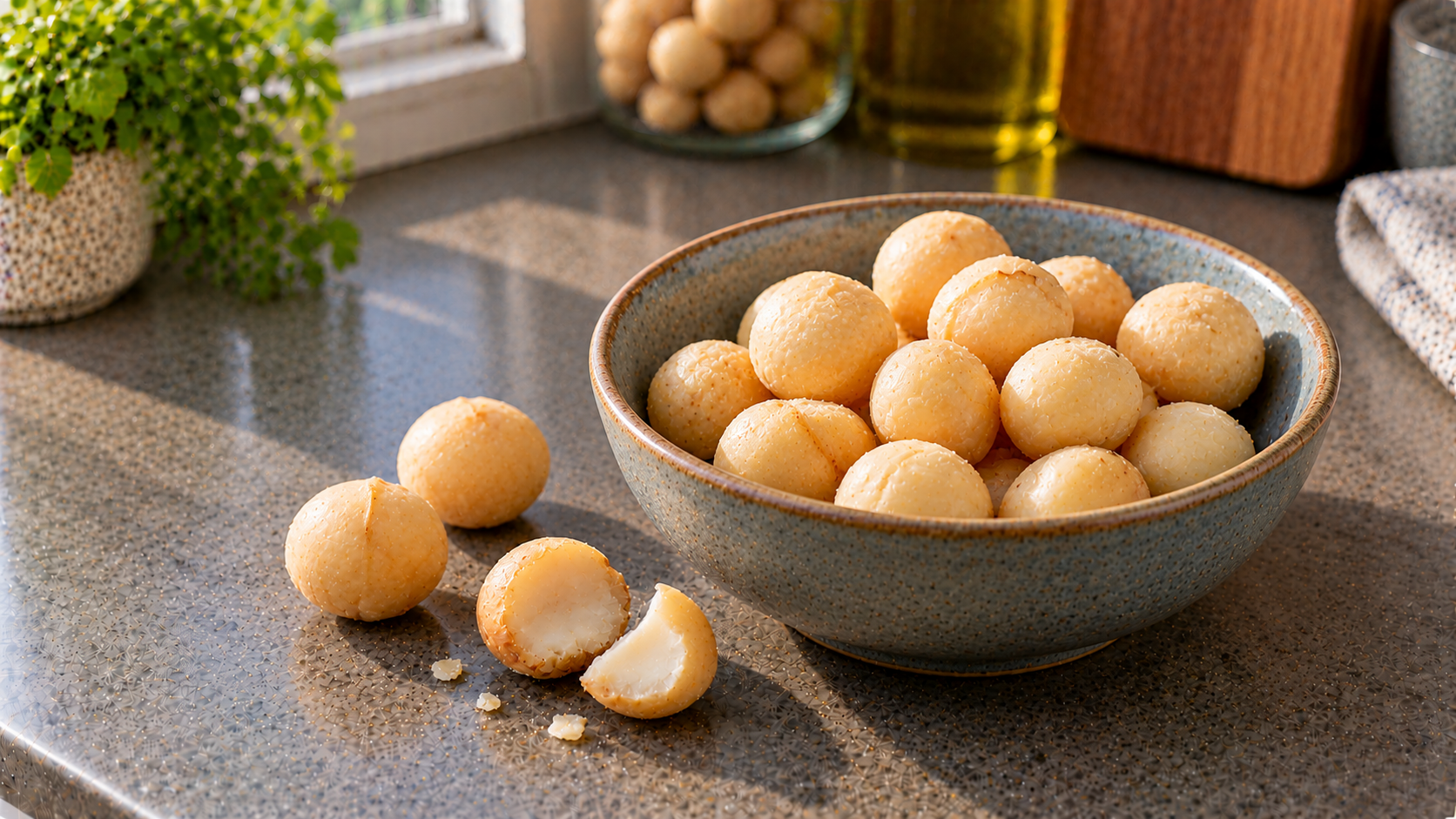
Macadamia nuts are rich, mild-flavored nuts containing a high proportion of fat.
The selected raw reference supplies approximately 718 kcal per 100 g of edible kernels.
This figure does not refer to the hard outer shell, chocolate-coated nuts or all roasted preparations.
Calories by edible raw portion
| Edible weight | Calories |
|---|---|
| 10 g | 71.8 kcal |
| 15 g | 107.7 kcal |
| 20 g | 143.6 kcal |
| 25 g | 179.5 kcal |
| 30 g | 215.4 kcal |
| 50 g | 359 kcal |
| 100 g | 718 kcal |
Nutrition per 100 g
| Nutrition per 100 g | |
|---|---|
| Calories | 718 kcal |
| Protein | 7.91 g |
| Fat | 75.77 g |
| Carbohydrates | 13.82 g |
| Fiber | 8.6 g |
Edible kernels versus whole nuts
Macadamias may be sold as shelled kernels or in their hard shells.
The shell is not part of the edible weight.
A bag of in-shell macadamias therefore cannot be entered using its entire weight as edible kernels.
For practical tracking, weigh the kernels actually eaten.
Individual kernel sizes vary, so counting five or ten nuts gives a less reliable result than using a kitchen scale.
Broken macadamia pieces should be calculated by their total weight rather than their number.
How much energy is in a small serving?
A 15 g serving of raw macadamia kernels contains about 108 kcal.
At 25 g, the estimate is roughly 180 kcal.
A 30 g serving contributes approximately 215 kcal.
The higher fat content means a small handful can supply a substantial amount of energy.
These calculations use the raw USDA reference. USDA FoodData Central.
A recipe that specifies a handful may therefore produce a different result depending on the actual portion size.
Fat, protein and fiber
The raw USDA reference contains approximately 75.8 g fat, 7.9 g protein and 8.6 g fiber per 100 g. USDA FoodData Central.
For context on why fat-rich foods can be energy-dense without all fats being nutritionally equivalent, see the guide to dietary fats.
For a 25 g serving, this corresponds to about 18.9 g fat, 2 g protein and 2.2 g fiber.
Macadamias contain a large proportion of monounsaturated fats.
However, their protein content per calorie is not as high as that of many lean protein foods.
They can contribute fat and other nutrients to a meal without serving as the main protein source.
Roasted, salted and chocolate-coated macadamias
Dry-roasted nuts may have nutrient values that differ slightly from raw nuts because of moisture and processing.
Oil-roasted nuts can contain added oil. Salted products can also have higher sodium levels.
Chocolate-coated macadamias contain ingredients beyond the nut, including sugar and cocoa products.
These products should be calculated from their actual labels.
For baking, weigh the macadamias and count chocolate, butter, flour and other ingredients separately.
A high per-100-g calorie value does not require avoiding the food; it makes portion measurement particularly helpful.
How to calculate a portion
Use the edible grams multiplied by the reference calories per 100 g, divided by 100. For cooked or processed products, use a nutrition entry corresponding to the actual preparation state. Oils, sauces and other ingredients must be counted separately. The values here are rounded references, not guarantees for every product.
Sources
- USDA FoodData Central — food composition data.
- EU Regulation 1169/2011 — food information and nutritional labeling.