
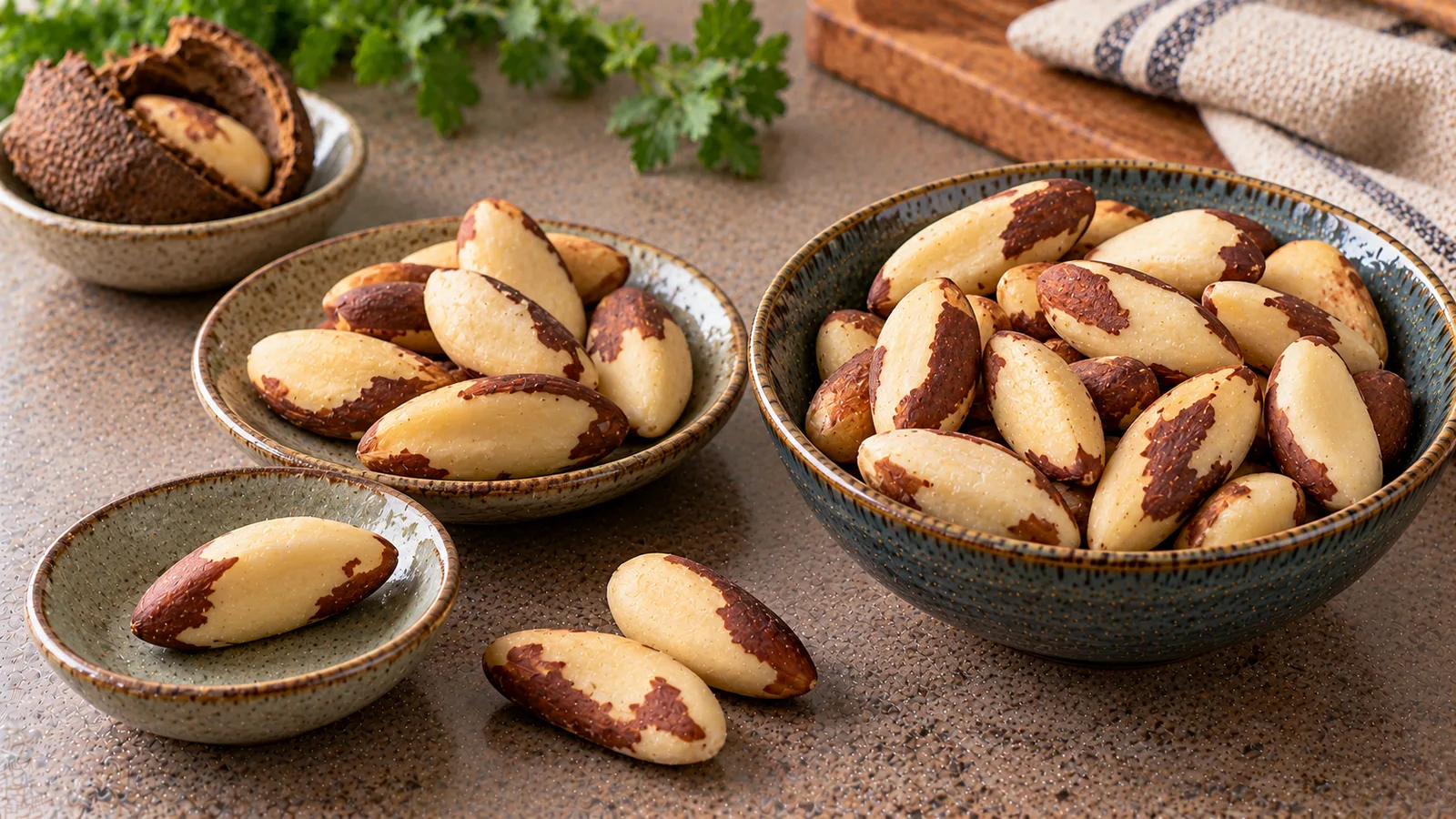
Brazil nuts are rich, crunchy kernels from the Amazonian tree Bertholletia excelsa. The most useful nutrition number depends on what you actually eat: a single shelled kernel, a weighed handful, or an ingredient mixed into porridge. This guide uses a specific USDA SR Legacy entry for dried, unblanched Brazil nuts rather than pretending that all flavoured, coated or roasted products are identical. It also explains why selenium deserves a separate decision from calories. Calories scale reasonably with weight; selenium can vary so much that a calorie-based serving cannot be treated as a reliable selenium dose.
Calories per 100 g and basic nutrition
USDA FoodData Central record 170569 lists 659 kcal per 100 g of shelled Brazil nuts, with about 67.1 g fat, 14.32 g protein, 11.74 g carbohydrate by difference, and 7.5 g fibre. Carbohydrate by difference is a US database convention and can include fibre; a European food label may list available carbohydrate and fibre separately. Most of the energy comes from fat, making even a small weighed portion substantial. These are reference figures for one food record, not a promise that a particular brand's label will be identical. If a packaged product gives different values, use the label for that product.
Calories in one Brazil nut
A nut has no fixed weight. For a transparent example, a 5 g edible kernel provides about 33 kcal using 659 kcal per 100 g. A smaller 3 g kernel works out to roughly 20 kcal, while a 7 g kernel is about 46 kcal. Those are mathematical examples, not a distribution measured in bags sold near you. Weigh several nuts, divide by the count if necessary, and record the edible kernels without a hard shell. Counting six nuts automatically as a standard 30 g serving is convenient for arithmetic but unreliable in real life.
Portion table: weight matters more than count
| Edible weight | Estimated energy | Meaning |
|---|---|---|
| 5 g | 33 kcal | Example single kernel |
| 10 g | 66 kcal | Small weighed amount |
| 15 g | 99 kcal | Ingredient amount |
| 30 g | 198 kcal | Weight example, not daily selenium advice |
| 100 g | 659 kcal | Database reference |
For a food diary, the reproducible calculation is weight in grams × 659 ÷ 100. Thirty grams yield 197.7 kcal, rounded to 198. The weight of the container or shell should not enter the calculation. When a recipe uses chopped nuts, weigh them before mixing: a tablespoon of pieces changes with chop size and packing. Dry-toasted or oil-roasted packaged nuts may have different numbers, especially when fat, coatings or salt are added.
Selenium: a separate question from calories
Brazil nuts are unusually concentrated in selenium, but one nut does not carry a guaranteed dose. NIH gives an illustrative range of 68–91 micrograms (µg) per nut, while the USDA database reports selenium for a composite food sample. Growing conditions, origin, nut size and batches can change the amount. Therefore multiplying a single database selenium value by the weight of your handful does not tell you the precise selenium content of that handful. It is particularly misleading to label 30 g as an everyday recommended portion simply because it supplies 198 kcal.
Why upper intake limits differ between authorities
Selenium is an essential nutrient, yet excessive intake over time can be harmful. EFSA's 2023 assessment sets the adult tolerable upper intake level at 255 µg per day; the US National Academies value presented by NIH is 400 µg per day for adults. Both apply to total selenium from food and supplements, not just Brazil nuts, and neither is a target to aim for. The authorities use different assessments, so do not substitute a US threshold for a European one without explaining it. People taking selenium supplements or needing individual advice should discuss intake with a qualified professional. This article does not prescribe a daily number of nuts or assess a medical condition.
A safer way to compare snacks
If the question is simply how many calories you consumed, start with grams: 10 g gives about 66 kcal, 15 g about 99 kcal, and 30 g about 198 kcal on this USDA basis. Do not infer that the highest-calorie snack is automatically the least nutritious or that Brazil nuts must be eaten daily for selenium. Compare ingredients, serving weights, added sugar and added oil alongside energy. Other nuts differ in texture and nutrition, but the main search question here is the calorie profile of Brazil nuts, not a ranking of all nuts.
For a different nut profile, see calories in pine nuts.
Raw, roasted, salted and coated versions
The main record is for dried, unblanched nuts. Dry roasting can lower moisture and modify the calories per 100 g without dramatically changing the energy of the original nut batch. Oil roasting may add retained fat; chocolate coatings add other ingredients. Salt itself contributes no calories but changes sodium. Never apply 659 kcal to a chocolate-covered packet automatically. For a homemade mix, calculate each ingredient using its weighed amount and a suitable food record, then divide by the total edible yield if you need calories per serving.
Shopping, storage and measuring tips
Look for intact, fresh-smelling kernels; rancid or mouldy nuts should not be used. Keep them tightly sealed according to the package instructions, away from warmth and moisture, and refrigerate or freeze for longer storage if practical. A scale accurate to grams is better for portion tracking than an assumed 'one handful'. For a weighed snack, tare the bowl, add the edible kernels, note the grams, and then eat. For a recipe, log the measured nut mass once; avoid accidentally logging both chopped nuts and the same pieces again under a garnish entry. Storage and portion measurement are practical handling advice, not medical safety guarantees.
What the numbers can and cannot tell you
A database describes a representative food; it does not identify your exact nut's selenium concentration, the mass of an individual kernel, or the composition of a branded coating. The 659 kcal/100 g figure is a defensible starting point for the plain product, and weighing improves calorie accuracy. Selenium requires greater caution because routine consumption and supplements can add to total exposure. Keep the two questions separate: use the scale for calories, and consult official selenium guidance rather than turning a calorie chart into a micronutrient prescription.