
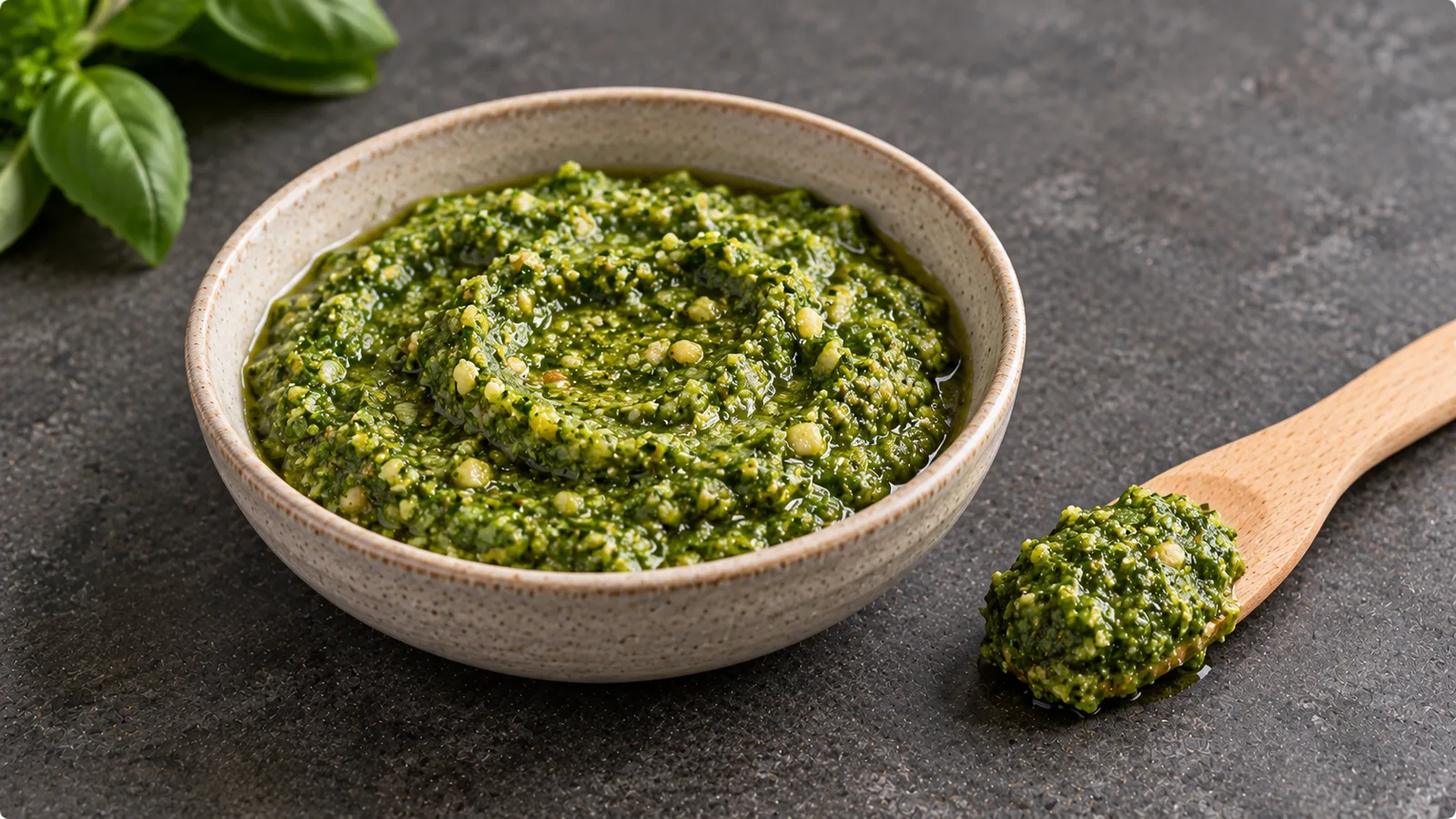
Pesto is a concentrated sauce traditionally made with herbs, olive oil, nuts, cheese and garlic. A small spoonful can add considerable flavour to pasta, sandwiches or vegetables, but its calorie content varies widely.
The most useful way to estimate pesto calories is to check the specific recipe or product label and calculate the amount actually eaten. Green pesto, red pesto and homemade pesto do not have one universal calorie value.
How many calories are in pesto?
Many conventional basil pesto products contain approximately 400–550 kcal per 100 g. Some products fall outside this range, particularly when their oil, cheese, nut or vegetable content differs.
For calculations in this article, we use 450 kcal per 100 g as an illustrative example, not as a standard value for all pesto.
| Pesto type | Calorie considerations |
|---|---|
| Classic basil pesto | Oil, nuts and hard cheese contribute most energy |
| Red pesto | Sun-dried tomatoes, oil, nuts and cheese vary by recipe |
| Vegan pesto | Cheese may be absent, but oil and nuts can still make it energy-dense |
| Reduced-fat pesto | Often contains less oil, but the label determines actual calories |
| Homemade pesto | Depends on exact ingredient weights and final yield |
A pesto containing more vegetables and less oil may provide fewer calories per 100 g than a traditional oil-rich version. However, colour and product names are not reliable substitutes for nutrition labels.
Calories in one tablespoon of pesto
A tablespoon is a volume measure, not a fixed weight. Thick pesto, loose pesto and pesto containing large pieces of nuts can fill a spoon differently.
For a practical calculation, suppose one tablespoon weighs 15 g and the pesto provides 450 kcal per 100 g.
| Pesto portion | Estimated calories |
|---|---|
| 5 g | 23 kcal |
| 10 g | 45 kcal |
| 15 g, illustrative tablespoon | 68 kcal |
| 20 g | 90 kcal |
| 30 g | 135 kcal |
| 40 g | 180 kcal |
| 50 g | 225 kcal |
| 100 g | 450 kcal |
These numbers are calculated examples. A brand listing 380 kcal per 100 g would provide 57 kcal in 15 g, while one listing 520 kcal would provide 78 kcal in the same weight.
Formula: calories = kcal per 100 g × portion weight in grams ÷ 100.
Weighing the pesto once can help establish the weight of the spoonful you normally use.
Why pesto contains so many calories
Traditional pesto combines ingredients with very different energy densities.
Olive oil is almost entirely fat and therefore contributes substantial energy. Pine nuts or other nuts add more fat, some protein and other nutrients. Hard cheese adds fat and protein. Basil, garlic and lemon juice generally contribute much less energy at the amounts used.
This means two recipes with the same amount of basil can have very different calorie totals.
A recipe with more oil and nuts will often be more energy-dense than one containing more herbs, vegetables or water.
Water content also matters. Adding water can lower calories per 100 g by increasing the finished sauce weight without adding much energy, although it does not remove calories from the original ingredients.
Pesto nutrition: fat, protein and carbohydrates
Pesto is usually a fat-rich condiment rather than a significant protein source.
A typical oil-rich pesto may contain roughly 35–55 g of fat per 100 g, but exact amounts differ considerably. Protein and carbohydrate values also depend on cheese, nuts, tomatoes and other ingredients.
| Nutrient | What affects the amount |
|---|---|
| Calories | Primarily oil, nuts, cheese and finished water content |
| Fat | Olive oil, nuts, seeds and cheese |
| Protein | Cheese, nuts and seeds |
| Carbohydrates | Tomatoes, nuts and other added ingredients |
| Fibre | Herbs, nuts, vegetables and seeds |
| Salt | Added salt, cheese and commercial seasoning |
Because pesto formulations vary, a single macro table cannot accurately represent every product. For reliable tracking, use the nutrition declaration for the particular pesto you consume.
Green pesto vs red pesto
Green pesto commonly contains basil, oil, nuts, cheese and garlic.
Red pesto often includes sun-dried tomatoes, peppers or other red ingredients. Depending on the formulation, it may contain less oil, a similar amount of oil or even more energy than green pesto.
A tomato-based sauce is not necessarily low-calorie simply because tomatoes are one of its ingredients.
For example, compare two hypothetical labels:
| Product | Label calories per 100 g | Calories in 25 g |
|---|---|---|
| Green pesto A | 480 kcal | 120 kcal |
| Red pesto B | 360 kcal | 90 kcal |
These figures demonstrate the calculation and do not describe particular brands.
When comparing products, use the same weight and consider how much sauce you would actually use.
Homemade pesto: calculate calories from ingredients
For homemade pesto, the most accurate practical method is to calculate the energy from all ingredients and divide by the weight of the finished sauce.
Consider this illustrative recipe:
| Ingredient | Amount | Example energy |
|---|---|---|
| Olive oil | 60 g | 531 kcal |
| Pine nuts | 30 g | 202 kcal |
| Parmesan-style hard cheese | 40 g | 172 kcal |
| Fresh basil | 40 g | 9 kcal |
| Garlic | 5 g | 7 kcal |
| Total | 175 g before processing | About 921 kcal |
The values are approximate and depend on the ingredients selected. This is a calculation example, not a claim that every homemade pesto recipe has this composition.
If the final sauce weighs 175 g, the calculated energy density is:
921 ÷ 175 × 100 = approximately 526 kcal per 100 g.
A 20 g serving would then contain approximately 105 kcal.
If the finished sauce weighs less because of losses during preparation, recalculate using the actual final weight.
If additional oil is poured on top and consumed later, include it in the recipe.
How many calories does pesto add to pasta?
Pesto is often eaten with pasta, so it is useful to separate the calories from the pasta and the sauce.
Consider an example meal with:
- 75 g dry pasta.
- 25 g pesto containing 450 kcal per 100 g.
- No additional oil or cheese.
The pesto contributes approximately 113 kcal.
The pasta calories must be calculated from the dry pasta label. If the pasta provides 350 kcal per 100 g dry, 75 g contributes approximately 263 kcal.
The combined example therefore provides approximately 376 kcal, before any other ingredients.
| Component | Weight | Example calories |
|---|---|---|
| Dry pasta | 75 g | 263 kcal |
| Pesto | 25 g | 113 kcal |
| Combined | — | 376 kcal |
Cooking pasta in water changes its weight, not the total calories of the original dry portion, apart from minor practical losses.
Adding cheese, olive oil, chicken or vegetables changes the final meal's nutritional composition and should be recorded separately.
Can pesto fit into a calorie-conscious diet?
Yes. Pesto can be included in many dietary patterns, including those intended for weight management.
The most practical adjustment is usually portion size.
For example, using 15 g instead of 40 g of pesto containing 450 kcal per 100 g changes the sauce contribution from 180 kcal to approximately 68 kcal.
That difference does not mean a larger portion is inherently unhealthy. It simply illustrates how a concentrated sauce can affect the energy content of a meal.
A measured portion of pesto can provide strong flavour when mixed with pasta cooking water, vegetables or other ingredients.
How to log pesto accurately
- Identify whether the sauce is green, red, vegan, reduced-fat or homemade.
- Check the product's calories per 100 g.
- Weigh the actual amount of pesto used.
- If preparing a shared meal, divide the pesto according to the amount each person eats.
- Record pasta, oil, cheese and other additions separately.
- For homemade pesto, calculate all ingredient calories and use the finished sauce weight.
If 80 g of pesto is mixed into four equal portions of pasta, each portion contains approximately 20 g of pesto, assuming the sauce is distributed evenly.
At 450 kcal per 100 g, that contributes about 90 kcal of pesto per serving.
Frequently asked questions
How many calories are in one tablespoon of pesto?
At an assumed 15 g per tablespoon and 450 kcal per 100 g, approximately 68 kcal. Actual spoon weights and product values vary.
Is red pesto lower in calories than green pesto?
Not necessarily. Compare the nutrition labels rather than relying on colour.
Is homemade pesto healthier than store-bought pesto?
Homemade pesto allows control over ingredients and portions, but it is not automatically lower in calories or salt.
Is pesto high in protein?
Traditional pesto contains some protein from cheese and nuts, but it is generally used in portions too small to serve as a major protein source.
Does adding pasta water reduce pesto calories?
Adding water lowers calories per 100 g of the diluted mixture, but it does not remove the calories already present in the original pesto.
Sources and interpretation
For ingredient composition, consult USDA FoodData Central. For European nutrition-labelling requirements, see Regulation (EU) No 1169/2011.
All numerical recipe and portion examples in this article are illustrative calculations. Product labels and weighed ingredients should take priority for the pesto you actually consume.