
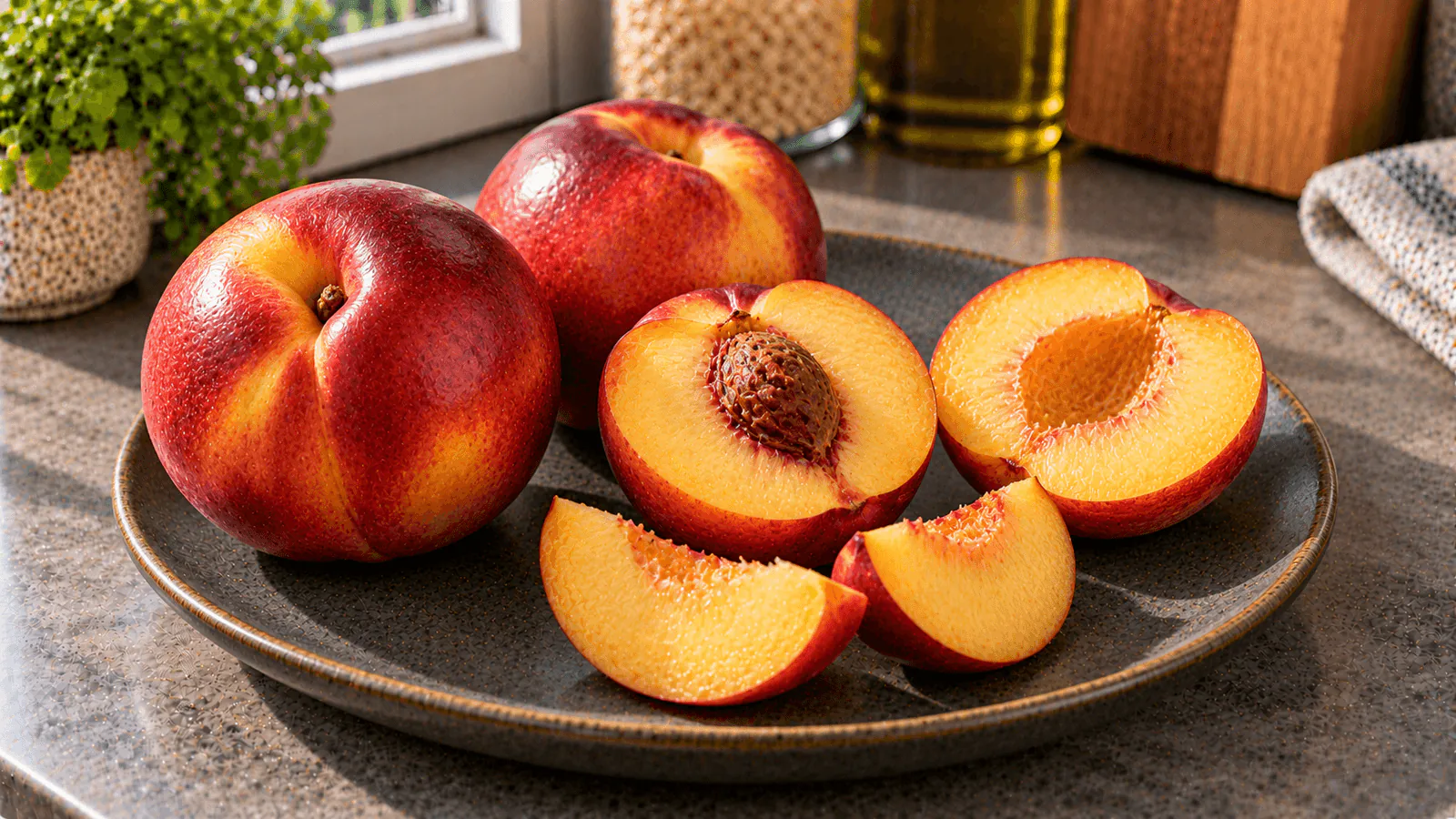
Fresh nectarines contain approximately 44 calories per 100 g of edible fruit, according to the USDA FoodData Central SR Legacy record Nectarines, raw (FDC 169914). One medium nectarine, using the USDA reference edible weight of 142 g, therefore supplies about 62 kcal. The weight of the stone, not eaten, should not be included when logging fruit by grams.
Nectarines are smooth-skinned stone fruit closely related to peaches. Their colour and sweetness do not tell you the exact calorie content of an individual fruit. Portion size, the edible yield and any toppings matter more than an impression that a fruit tastes particularly sweet.
Nectarine nutrition per 100 g
These data describe the raw edible portion, typically the flesh with the skin and without the hard stone. They do not describe canned nectarines in syrup, dried fruit, juice, or a prepared dessert.
| Nutrient | Per 100 g raw edible nectarine |
|---|---|
| Energy | 44 kcal |
| Protein | 1.06 g |
| Carbohydrate, USDA total | 10.60 g |
| Natural sugars | 7.89 g |
| Dietary fibre | 1.70 g |
| Total fat | 0.32 g |
| Water | 87.60 g |
| Potassium | 201 mg |
| Vitamin C | 5.4 mg |
Source: USDA FoodData Central — Nectarines, raw, FDC 169914.
Food composition values are averages. Cultivar, ripeness, growing conditions and storage can affect an individual nectarine. The USDA carbohydrate-by-difference figure includes fibre, whereas EU nutrition labels generally list available carbohydrate separately from fibre. Comparing those two reporting conventions without adjustment can be misleading.
Calories in a nectarine: small, medium and large
The USDA household portion data provide useful examples. The amounts below refer to edible raw fruit, not a whole nectarine on a scale including the stone. The names “small”, “medium” and “large” are reference measures, not guaranteed supermarket standards.
| Edible nectarine portion | Calories | Natural sugars | Fibre |
|---|---|---|---|
| 50 g | 22 kcal | 3.9 g | 0.9 g |
| 100 g | 44 kcal | 7.9 g | 1.7 g |
| Small, 129 g | 57 kcal | 10.2 g | 2.2 g |
| Medium, 142 g | 62 kcal | 11.2 g | 2.4 g |
| One cup sliced, 143 g | 63 kcal | 11.3 g | 2.4 g |
| Large, 156 g | 69 kcal | 12.3 g | 2.7 g |
| 200 g | 88 kcal | 15.8 g | 3.4 g |
These are rounded calculations from 44 kcal, 7.89 g sugars and 1.70 g fibre per 100 g. The household weights come from the same USDA food record. Slicing, packing, and fruit size can change the weight that fits in a household cup.
For any weighed amount, use calories = edible grams × 0.44. A measured 175 g portion, for example, contains about 77 kcal before additions. A food diary records the portion actually eaten, which may differ from the reference measure on a label; the guide to portion size versus serving size explains that distinction.
Does the stone change the calculation?
Yes. Nectarine skin is normally eaten, but the hard central stone is not. USDA values refer to the edible portion. If a whole fruit weighs 170 g with its stone, entering 170 g as edible nectarine slightly overestimates the amount consumed.
An accurate method is to weigh the fruit, eat it, and then subtract the measured stone and any other discarded flesh. An even simpler method for slices is to remove the stone before weighing. There is no universal percentage of edible flesh that applies to every cultivar and fruit size.
For example, if a whole nectarine weighs 180 g and its discarded stone and damaged pieces weigh 18 g, the edible amount is 162 g. That corresponds to roughly 71 kcal (162 × 0.44 = 71.28). Those weights are an illustrative measurement, not an assumed standard yield.
Are white and yellow nectarines different in calories?
White-fleshed and yellow-fleshed nectarines may taste different in sweetness and acidity. Differences in cultivar, maturity and water content mean their exact composition can vary. However, the general 44 kcal per 100 g reference should not be reinterpreted as an exact measurement for every colour.
A sweet-tasting nectarine is not necessarily a dramatically more caloric fruit. Perceived sweetness also reflects acidity and aroma. If a packaged product provides its own validated nutritional information, prefer that product-specific information rather than guessing based on flesh colour.
For usual fresh fruit portions, weighing the edible amount contributes more precision than trying to assign a unique calorie value from colour alone.
Nectarines versus peaches
Nectarines and peaches belong to the same species. Nectarines have smoother skin, while common peaches have fuzzy skin; the two fruit types are closely related but are not the same labelled product.
Both can fit into ordinary fruit portions. Taste, texture and seasonal availability may matter more to a shopper than tiny differences between food database averages. Do not copy nectarine values automatically into a peach entry if your food diary contains a separate entry for each.
The Mealisa article on calories in a peach gives the peach-specific reference and portion examples. Use that page for a peach and this article for a nectarine. No extra nectarine URL is needed for every colour, size or ripeness description unless the data support a genuinely different intent.
Fresh, grilled and baked nectarines
Fresh nectarines are often eaten without additional ingredients. Grilling or baking softens the flesh and changes water content, so 100 g of cooked fruit does not necessarily contain the same concentration of nutrients as 100 g raw fruit.
For a homemade recipe, you can start with the calories of the raw edible fruit and add the energy from all other ingredients. Heating alone does not create calories, whereas butter, oil, sugar, syrup and pastry do.
Suppose a baked dessert uses 300 g of raw nectarine flesh, 10 g of sugar and 15 g of butter. The fruit contributes approximately 132 kcal and the sugar 40 kcal. If the butter is estimated at 7.2 kcal per gram, its 15 g contributes 108 kcal. The recipe totals approximately 280 kcal before toppings; divided into four equal servings, that is 70 kcal each. The example is a calculation, not a nutrition claim about all baked nectarines.
If the fruit loses moisture while baking, the finished weight may be lower even though the recipe's initial calorie total is not reduced by the same proportion.
Canned nectarines, syrup and juice
Canned nectarines may be packed in water, juice or syrup. A label should identify both the nutrition values and the relevant serving basis. A product's calories can change depending on added sugar and the amount of packing liquid consumed.
When you eat only the drained fruit, use the label if it gives values for the drained portion. If you also drink or use the syrup, account for that liquid in the recipe. “No added sugar” does not mean the fruit contains no naturally occurring sugar.
Nectarine juice and smoothies should be recorded as drinks or recipes rather than assuming the same weight-and-fibre profile as whole fruit. If the beverage is strained, its fibre content can be different from that of the intact nectarine.
Carbohydrates, fibre and blood sugar
The reference reports 10.60 g total carbohydrate and 7.89 g naturally occurring sugars per 100 g, together with 1.70 g fibre. The naturally occurring sugars in intact fruit are distinct from sugar added to desserts or syrup.
Fruit can be part of an eating pattern that includes vegetables, whole grains, legumes, protein-rich foods and other fruit. For those counting carbohydrates for diabetes management, use the carbohydrate definition required by their care plan, especially when comparing USDA and EU label conventions.
A nectarine is not a concentrated protein source, and a piece of fruit alone may be less filling than a mixed snack. Pairing fruit with plain yoghurt or another suitable protein source can change satiety, while also changing the total calories.
Nectarines in a fruit salad: calculate every ingredient
For a simple fruit salad with 150 g nectarines and 100 g fresh grapes, the nectarine part contributes 66 kcal. The grapes add their own calories based on the values and edible weight used for that ingredient. Adding yoghurt, nuts or honey requires separate entries.
The Mealisa guide to calories in grapes is useful for checking the second ingredient. If you swap grapes for apple, calculate the apple portion rather than assuming all fruit contains the same number of calories per 100 g.
The method is straightforward: add the calories of each weighed edible ingredient, then divide the total by the number of servings or by the weight actually eaten. Using a generic “fruit salad” entry may be convenient, but it can conceal meaningful recipe differences.
Choosing, storing and tracking nectarines
Select fruit according to intended use. Firmer nectarines slice more neatly; softer ripe fruit may work well in yoghurt or a blended preparation. Storage conditions affect texture and ripening, but they do not justify arbitrarily changing a food diary's calorie value.
For accurate tracking, note “raw nectarine, edible flesh and skin, stone removed” and its weight. If you use an average size instead of grams, mark the result as an estimate. For canned or prepared fruit, use the actual product label or recipe.
The figure to remember is 44 kcal per 100 g raw edible nectarine, or approximately 62 kcal for the USDA reference medium fruit.
Source and calculation method
USDA FoodData Central: Nectarines, raw — FDC 169914. Portion values are calculations from the food-composition record and USDA household weights, not guaranteed values for every nectarine.