
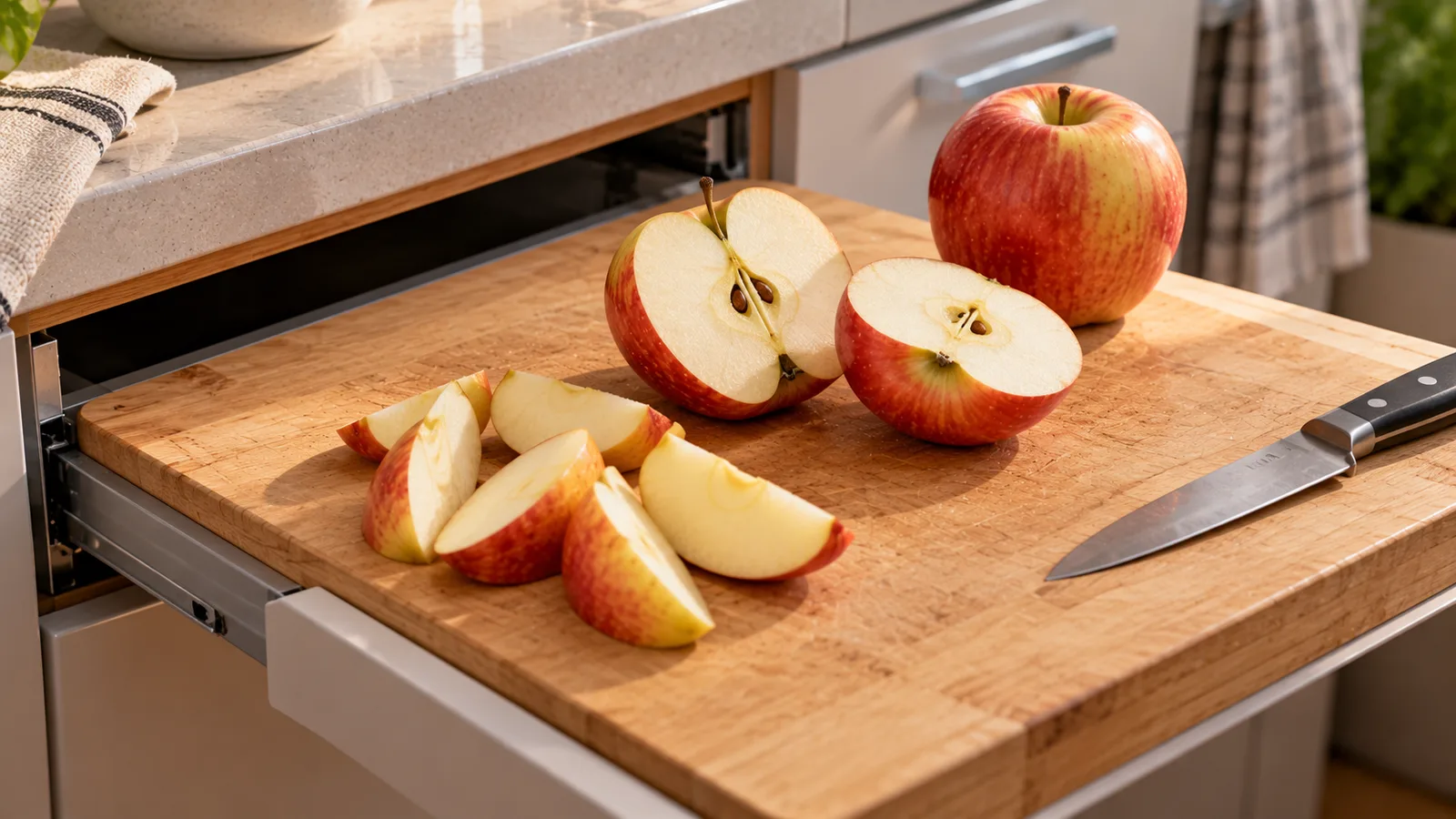
Apples are relatively low in calories, but the exact amount depends mainly on the edible weight of the fruit.
A useful reference for a raw apple with skin is approximately 52 kcal per 100 g.
That means a small apple and a very large apple can differ substantially in total calories even though both are simply described as "one apple."
Apple calories at a glance
| Amount of raw apple | Approx. calories |
|---|---|
| 50 g | 26 kcal |
| 100 g | 52 kcal |
| 150 g | 78 kcal |
| 180 g | 94 kcal |
| 200 g | 104 kcal |
| 250 g | 130 kcal |
| 300 g | 156 kcal |
These are practical estimates. Natural fruit varies slightly in composition, and nutrition databases can differ by variety and whether the food entry includes skin.
How many calories are in one apple?
The answer depends on size.
Using approximately 52 kcal per 100 g:
| Example apple size | Example edible weight | Approx. calories |
|---|---|---|
| Small | 120 g | 62 kcal |
| Medium | 180 g | 94 kcal |
| Large | 220 g | 114 kcal |
| Very large | 280 g | 146 kcal |
These weights are examples rather than universal definitions.
Two apples that look similar can have different weights, so weighing the edible portion gives a more precise estimate when accuracy matters.
How to calculate calories from the apple's weight
If your nutrition entry lists 52 kcal per 100 g, the calculation is straightforward:
Calories = apple weight in grams × 52 ÷ 100
For example, for a 165 g edible portion:
165 × 52 ÷ 100 = 85.8 kcal
So the practical estimate is about 86 kcal.
For a 235 g portion:
235 × 52 ÷ 100 = 122.2 kcal
That is approximately 122 kcal.
This method is more reliable than assuming every apple has the same calorie content.
What if you weigh the whole apple?
The core and stem are usually not eaten.
If you weigh the entire apple and then discard part of it, the weight entered into a tracker can be slightly higher than the amount actually consumed.
For everyday tracking, this difference is often small enough that estimating the whole fruit is convenient.
If you want greater precision:
- weigh the whole apple;
- eat it;
- weigh the remaining core;
- subtract the core weight.
For example:
Whole apple: 205 g
Core after eating: 18 g
Edible amount:
205 − 18 = 187 g
At 52 kcal per 100 g:
187 × 52 ÷ 100 ≈ 97 kcal
Apple nutrition per 100 g
A raw apple with skin is primarily water and carbohydrate.
A typical 100 g portion provides approximately:
| Nutrient | Approx. amount |
|---|---|
| Energy | 52 kcal |
| Carbohydrate | 13.8 g |
| Sugars | 10.4 g |
| Fiber | 2.4 g |
| Protein | 0.3 g |
| Fat | 0.2 g |
Values can vary slightly by variety, ripeness and nutrition database.
The numbers are best treated as reference values rather than an exact laboratory measurement of every apple.
Where do the calories in an apple come from?
Most of an apple's calories come from carbohydrate.
Protein and fat contribute very little.
Apples also contain fiber and a high proportion of water, which means their calorie density is much lower than that of dried fruit, nut butter, chocolate or many baked snacks.
That does not make apples automatically "better" than every higher-calorie food. It simply explains why a relatively large physical portion can contain a moderate amount of energy.
Does apple variety change the calories?
Different varieties can have somewhat different sugar, water and fiber contents.
Examples include:
- Gala;
- Granny Smith;
- Golden Delicious;
- Fuji;
- Braeburn;
- Pink Lady.
For ordinary calorie tracking, the difference between varieties is usually less important than the actual weight of the apple.
If your tracking database has a reliable entry for the exact variety, you can use it.
Otherwise, a generic raw-apple entry is usually a practical choice.
Apple with skin vs peeled apple
Removing the skin changes the composition slightly and removes some fiber.
For calorie tracking, the difference per 100 g is usually not large enough to justify complicated adjustments for most people.
The important point is consistency.
If you weigh a peeled apple, use an entry that represents peeled apple when available.
If you eat the skin, use a raw apple with skin entry.
Sliced apple has the same calories by weight
Cutting an apple does not meaningfully change its calories.
A 150 g whole edible portion and 150 g of freshly sliced apple contain essentially the same amount of energy.
The appearance changes, but the amount of food does not.
This matters because cups, slices and pieces are less reliable measures than grams.
One cup of apple pieces can contain different amounts depending on:
- slice thickness;
- how tightly the pieces are packed;
- whether the apple is peeled;
- the size and shape of the pieces.
When precision matters, weight is the simpler reference.
Fresh apple vs applesauce
Applesauce should not automatically be logged as raw apple.
Processing changes the physical form, and commercial applesauce may contain added ingredients.
Unsweetened applesauce and sweetened applesauce can have different calorie values.
Use the nutrition label for a packaged product whenever possible.
If you make applesauce at home, track the ingredients and the final recipe rather than substituting a generic whole-apple serving.
Fresh apple vs dried apple
Dried apple is much more calorie-dense by weight because much of the water has been removed.
Imagine that fresh apple contains around 52 kcal per 100 g.
Removing water does not remove the original food energy to the same extent.
As a result, 100 g of dried apple represents much more original fruit than 100 g of fresh apple.
This is why you should not use a fresh-apple database entry for dried apple.
Does cooking an apple change its calories?
Cooking an apple without adding ingredients does not create calories.
However, heating can change water content and therefore calories per 100 g.
For example, if apple pieces lose water during baking, the cooked fruit can weigh less while retaining most of its original energy.
The total calories of the original apple remain similar, but the calorie density per 100 g can change.
Added ingredients matter much more.
Baked apples may include:
- sugar;
- honey;
- butter;
- nuts;
- pastry;
- granola;
- sauces.
Those ingredients should be counted separately.
For more on how water changes food weight, see raw vs cooked food weight.
Apple juice is not the same as a whole apple
Apple juice and whole apples should be tracked separately.
Juice has a different physical structure and usually contains little of the intact fiber present in whole fruit.
It is also easy to consume a larger amount of fruit-derived carbohydrate in liquid form.
Use the nutrition information for the specific juice rather than converting a glass of juice into "number of apples."
What about an apple with peanut butter?
Track both foods.
For example:
- apple: 180 g;
- peanut butter: 20 g.
The apple might contribute roughly 94 kcal using the 52 kcal/100 g reference.
The peanut butter has its own calorie value and can contribute substantially to the total because nut butters are energy-dense.
The correct total is:
apple calories + peanut butter calories
The same principle applies to yogurt, caramel, nuts, chocolate or other additions.
Common tracking mistakes
Logging every apple as the same size
A small apple and a very large apple can differ by more than 100 g.
If apples are a regular part of your diet and you want accurate tracking, weighing a few typical apples can show how large your usual portions actually are.
Using a "medium apple" entry for an unusually large fruit
Database size labels are convenient but approximate.
If your apple clearly differs from the reference serving, grams are more reliable.
Confusing fresh and dried apple
Water loss makes dried fruit much more energy-dense by weight.
Use separate entries.
Ignoring toppings
Apple itself may be relatively low in calories, while nut butter, caramel, granola or pastry can add much more energy.
Counting the core when precision matters
If you weigh the whole fruit but do not eat the core, your logged amount will be slightly higher than your consumed amount.
Do you need to weigh every apple?
Not necessarily.
The appropriate level of precision depends on why you track food.
For general awareness, choosing a reasonable small, medium or large serving may be enough.
For more precise calorie tracking, weigh the edible portion.
A practical compromise is to weigh several apples you normally buy.
If they consistently fall around the same weight, you can use that typical value for similar apples instead of weighing every piece of fruit.
Example: three apples that look similar
Suppose three apples weigh:
- Apple A: 145 g;
- Apple B: 182 g;
- Apple C: 228 g.
Using 52 kcal per 100 g:
| Apple | Weight | Approx. calories |
|---|---|---|
| A | 145 g | 75 kcal |
| B | 182 g | 95 kcal |
| C | 228 g | 119 kcal |
Visually calling all three "one apple" hides a difference of about 44 kcal between the smallest and largest examples.
For one snack, that difference may not matter.
Across repeated food logging, grams make the estimate more consistent.
Is an apple a low-calorie food?
Relative to many energy-dense snacks, fresh apple has a low calorie density because it contains a large amount of water.
At roughly 52 kcal per 100 g, a 200 g apple provides about 104 kcal.
Whether that amount fits your meal, snack or daily target depends on the rest of your diet.
Calories are only one characteristic of a food.
How to log an apple in Mealisa
When recording an apple, use the most specific information available.
A practical order is:
- identify the food as raw apple;
- use weight if known;
- otherwise select a realistic serving size;
- use the package label for processed apple products;
- track toppings or additions separately.
Photo-based portion estimation can be useful when weighing is inconvenient, but visual estimates naturally have more uncertainty than a known gram weight.
Quick reference
For a raw apple with skin, using approximately 52 kcal per 100 g:
- 100 g ≈ 52 kcal;
- 150 g ≈ 78 kcal;
- 180 g ≈ 94 kcal;
- 200 g ≈ 104 kcal;
- 250 g ≈ 130 kcal.
For the most consistent estimate, use the edible weight of the apple rather than assuming every piece of fruit matches a standard size.
Nutrition data sources and product differences
The records below describe only the named foods, fat levels and preparation states. USDA figures are per 100 g; manufacturer figures retain their stated unit. These sources do not independently prove every approximate figure in the article.
USDA FoodData Central (search by FDC ID):