
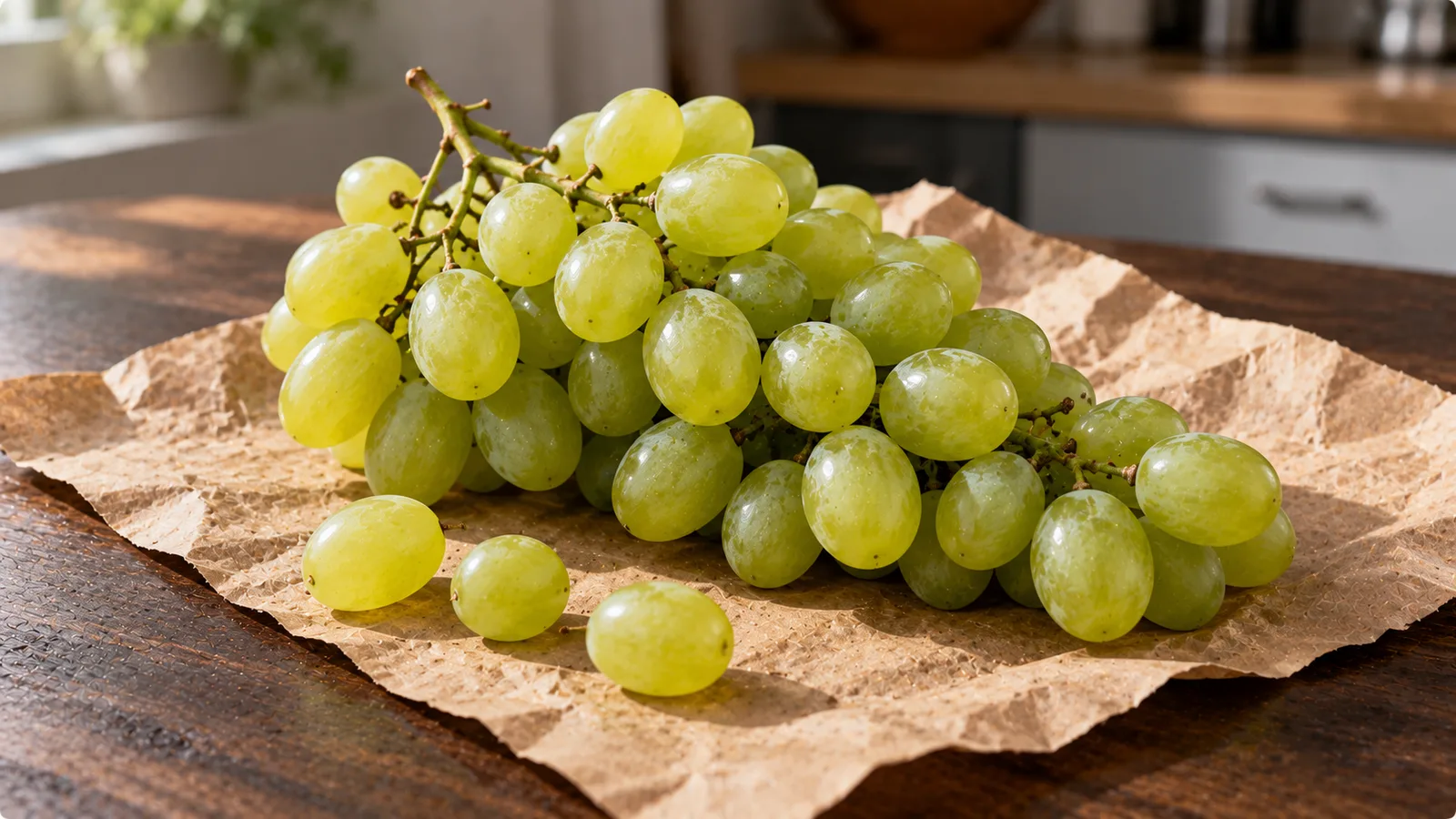
Grapes are a convenient fresh fruit, but estimating their calories by counting individual grapes can be surprisingly inaccurate. The berries vary in size, and a small handful can weigh much less than a large one.
Fresh grapes contain approximately 69 calories per 100 g. A 75 g handful therefore provides about 52 calories, while a 150 g portion provides about 104 calories.
These estimates refer to fresh, raw grapes, not raisins, grape juice or grapes covered in chocolate.
How many calories are in grapes?
The most useful reference is the edible weight.
Using approximately 69 kcal per 100 g:
| Fresh grapes | Approximate calories |
|---|---|
| 25 g | 17 kcal |
| 50 g | 35 kcal |
| 75 g | 52 kcal |
| 100 g | 69 kcal |
| 125 g | 86 kcal |
| 150 g | 104 kcal |
| 200 g | 138 kcal |
| 250 g | 173 kcal |
| 300 g | 207 kcal |
These are rounded estimates based on a general raw-grape reference. Variety, ripeness and composition can cause differences.
For accurate tracking, weigh the grapes you actually eat, excluding the stems.
Calories in a handful of grapes
A handful is not a standardized measurement. Hand size, grape size and how tightly the grapes are held all affect the result.
For practical estimates:
| Portion | Assumed edible weight | Calories |
|---|---|---|
| Small handful | 50 g | 35 kcal |
| Medium handful | 75 g | 52 kcal |
| Large handful | 100 g | 69 kcal |
| Generous snack bowl | 150 g | 104 kcal |
These weights are examples, not fixed definitions.
A handful of small grapes may contain more individual berries than a handful of large grapes without necessarily containing more calories.
How many calories are in one grape?
An individual grape often weighs roughly 4–6 g, although actual weights vary.
At 69 kcal per 100 g:
| Approximate grape weight | Calories per grape |
|---|---|
| 3 g | 2.1 kcal |
| 4 g | 2.8 kcal |
| 5 g | 3.5 kcal |
| 6 g | 4.1 kcal |
| 8 g | 5.5 kcal |
Counting grapes can work for a quick estimate, but weighing is more reliable.
For example, 20 grapes averaging 5 g each weigh about 100 g and provide approximately 69 kcal.
Twenty larger grapes averaging 8 g each weigh 160 g and provide approximately 110 kcal.
The number of grapes is identical, but the portion is substantially different.
Calories in one cup of grapes
A commonly used US reference for one cup of grapes is approximately 151 g.
At 69 kcal per 100 g, this equals roughly 104 kcal.
However, a cup measures volume rather than weight.
Large grapes, small grapes, gaps between berries and the shape of the cup all influence the amount.
If your nutrition database specifies a cup weight, use that particular weight consistently.
Nutritional values of grapes per 100 g
The following values are approximate reference figures for raw grapes.
| Nutrient | Per 100 g |
|---|---|
| Energy | 69 kcal |
| Carbohydrates | 18.1 g |
| Sugars | 15.5 g |
| Fibre | 0.9 g |
| Protein | 0.7 g |
| Fat | 0.2 g |
| Potassium | 191 mg |
| Vitamin C | 3.2 mg |
| Vitamin K | 14.6 µg |
The exact nutrient profile depends on the grape variety and source.
Grapes are mainly water and carbohydrates. They contain relatively little protein and fat.
Most of their energy comes from naturally occurring sugars.
Nutrition in a 150 g portion
For 150 g of fresh grapes, approximate values are:
| Nutrient | Amount |
|---|---|
| Calories | 104 kcal |
| Carbohydrates | 27.2 g |
| Sugars | 23.3 g |
| Fibre | 1.4 g |
| Protein | 1.1 g |
| Fat | 0.3 g |
Values are calculated from the per-100-g reference and rounded.
A 150 g portion can be a practical snack, but the amount of carbohydrate is relevant for anyone who needs to monitor their intake.
Do green and red grapes have different calories?
Green, red and dark grapes can differ in their exact composition, but colour alone is not a reliable way to determine calorie content.
The following comparison is best treated as a general estimate rather than a laboratory measurement for every variety.
| Grape type | Practical calorie estimate |
|---|---|
| Fresh green grapes | Around 69 kcal/100 g |
| Fresh red grapes | Around 69 kcal/100 g |
| Fresh dark grapes | Around 69 kcal/100 g |
Individual varieties may differ.
A sweeter-tasting grape is not necessarily much higher in calories. Sweetness perception also depends on acidity and ripeness.
If reliable variety-specific data are available, use them instead of the general estimate.
How much sugar is in grapes?
Fresh grapes contain approximately 15.5 g of naturally occurring sugars per 100 g.
Using this reference:
| Grape portion | Approximate sugars |
|---|---|
| 50 g | 7.8 g |
| 75 g | 11.6 g |
| 100 g | 15.5 g |
| 150 g | 23.3 g |
| 200 g | 31.0 g |
These sugars are naturally present in the fruit.
Whole grapes also contain water and some fibre, unlike a drink made with added sugar.
Nevertheless, portion size matters when tracking total carbohydrates.
People with diabetes or another condition requiring carbohydrate management should follow individualized dietary guidance.
Fresh grapes versus raisins
Raisins are dried grapes.
Drying removes much of the water, concentrating the energy and sugars into a smaller weight.
Approximate comparison:
| Food | Calories per 100 g |
|---|---|
| Fresh grapes | 69 kcal |
| Raisins | 299 kcal |
The raisins value varies by product and whether other ingredients have been added.
This does not mean raisins are inherently unhealthy. It means 100 g of raisins represents a much more concentrated portion than 100 g of fresh grapes.
For example:
- 30 g fresh grapes: approximately 21 kcal.
- 30 g raisins: approximately 90 kcal.
If you replace fresh grapes with raisins in a recipe, use the dried-fruit nutrition entry rather than the fresh-grape entry.
Grapes versus grape juice
Grape juice is different from whole grapes because much of the fruit's structure and fibre are removed during processing.
The calorie content depends on the juice type and its concentration.
As an illustrative reference, grape juice may contain approximately 60 kcal per 100 ml, but actual product labels should take priority.
| Product | Portion | Approximate calories |
|---|---|---|
| Fresh grapes | 150 g | 104 kcal |
| Grape juice | 150 ml | 90 kcal |
| Grape juice | 250 ml | 150 kcal |
Juice is not interchangeable with whole grapes on a gram-for-millilitre basis.
The comparison also should not be interpreted as showing that one option is universally better for everyone.
Are grapes suitable for weight loss?
Fresh grapes can fit into a weight-management eating pattern.
Their high water content makes a relatively large volume of fruit possible without an extremely high calorie total.
However, a large portion still contributes calories.
For example, 300 g of fresh grapes provides approximately 207 kcal.
Whether grapes help someone manage hunger or energy intake depends on the complete meal pattern, preferences and portion sizes.
No individual fruit causes weight loss independently of overall energy balance.
How to measure grapes accurately
For the most reliable calorie estimate:
- Remove the grapes from the stems.
- Weigh the edible grapes.
- Use a nutrition entry for fresh raw grapes.
- Calculate calories using the edible weight.
- Record any added ingredients separately.
Formula: calories = grape weight in grams × 69 ÷ 100.
Example:
185 g × 69 ÷ 100 = 128 kcal, rounded.
If the grapes are frozen without added ingredients, their calorie content per original edible quantity remains broadly similar.
If they are dried, juiced or coated in sugar, use a different nutrition entry.
Common tracking mistakes
Counting stems as edible weight
The stems are normally discarded and should not be included in the recorded portion.
Assuming every grape weighs the same
Small and large grapes can differ considerably.
Confusing fresh grapes with raisins
Dried grapes are much more energy-dense per 100 g because they contain less water.
Using the same nutrition entry for grape juice
Juice has a different composition and serving measurement.
Ignoring added ingredients
Grapes served with chocolate, syrup or other additions require separate calculations.
Frequently asked questions
How many calories are in 100 g of grapes?
Approximately 69 kcal for fresh raw grapes.
How many calories are in a handful of grapes?
A 75 g handful provides about 52 kcal. The actual amount depends on weight.
How many calories are in 20 grapes?
If the grapes average 5 g each, 20 grapes weigh approximately 100 g and provide around 69 kcal.
Are red grapes higher in calories than green grapes?
Not necessarily. Variety and weight are more useful than colour alone.
How many calories are in a cup of grapes?
A reference cup weighing approximately 151 g provides around 104 kcal.
Do frozen grapes have more calories?
Plain frozen grapes without added ingredients generally have a similar energy content to the equivalent amount of fresh grapes.
Sources and calculation notes
- USDA FoodData Central — food-composition reference for raw grapes, raisins and grape juice.
- World Health Organization: Healthy diet — general dietary guidance.
- American Diabetes Association: Nutrition — guidance on carbohydrate awareness and dietary choices.
Figures are approximate. Serving calculations use 69 kcal per 100 g for fresh grapes and rounded portion weights.