
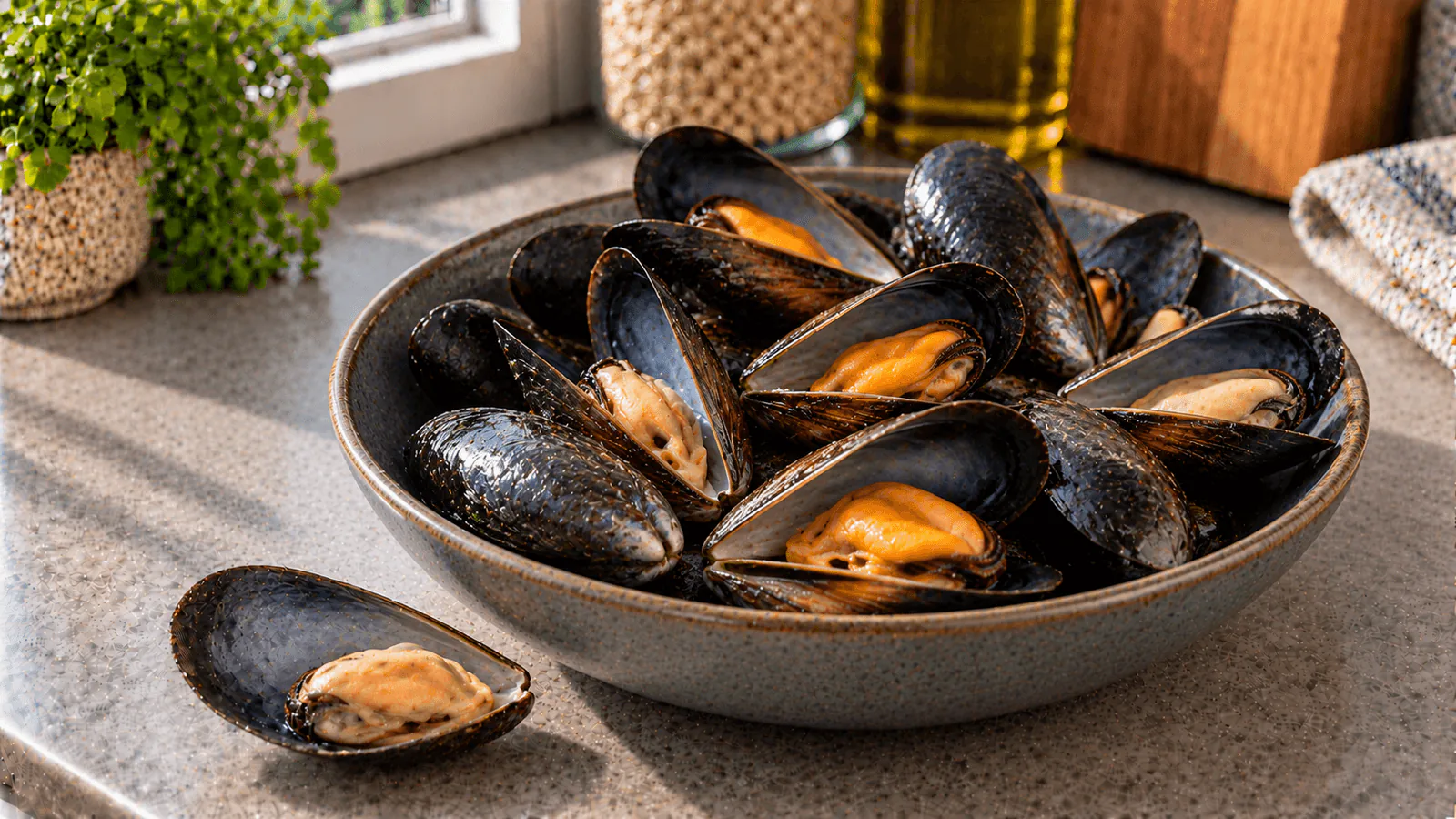
Mussels can be a substantial source of protein, yet the calorie number changes depending on whether you are looking at raw meat, cooked meat, a restaurant pot with shells, or a prepared product in sauce. The key measurement is the edible mussel meat actually eaten, not the total weight of the shells. A one-kilogram bag of live mussels is not one kilogram of edible seafood. For an accurate food log, distinguish the state of the meat first and add butter, oil, cream, bread or fries separately.
How many calories are in mussels per 100 g?
USDA FoodData Central reports 86 kcal per 100 g for raw blue mussel meat and 172 kcal per 100 g for blue mussels cooked using moist heat. Both refer to the edible portion. They are separate SR Legacy entries for two food states rather than two serving sizes of an identical product. In particular, the cooked entry is not a recipe for mussels in garlic butter, white wine cream sauce or oil.
| Blue mussels, edible meat per 100 g | Calories | Protein | Fat | Carbohydrate | Sodium |
|---|---|---|---|---|---|
| Raw | 86 kcal | 11.90 g | 2.24 g | 3.69 g | 286 mg |
| Cooked, moist heat | 172 kcal | 23.80 g | 4.48 g | 7.39 g | 369 mg |
Sources: USDA raw blue mussels, FDC 174216 and USDA cooked blue mussels, FDC 174217. These database values are a consistent reference, but the exact figures for other mussel species, canned versions and branded products can differ. If the food is sold with a label, check whether its nutrition refers to drained meat, an entire pack or a prepared serving.
Why is the cooked figure twice as high? The USDA entries report different water contents: approximately 80.6 g per 100 g of raw meat versus 61.2 g in the cooked entry. Cooking can remove water, so the same 100 g of finished food may contain more concentrated protein and other nutrients. Cooking does not create calories out of nothing. If you begin with a weighed quantity of raw edible meat, do not assume it doubles its energy merely because the per-100-g database figure is higher after cooking. Track the starting meat and added ingredients, or weigh finished edible meat and use the corresponding cooked reference, but do not mix both approaches within one dish.
Mussel calories by edible portion
The following table scales the two USDA values to realistic quantities of mussel meat without shells. It uses grams, not a count of mussels; the number of animals in a portion varies with size, harvest and shell-to-meat yield. Calculated calories are rounded to the nearest whole number.
| Edible meat weight | Raw (86 kcal/100 g) | Cooked (172 kcal/100 g) |
|---|---|---|
| 25 g | 22 kcal | 43 kcal |
| 50 g | 43 kcal | 86 kcal |
| 75 g | 65 kcal | 129 kcal |
| 85 g | 73 kcal | 146 kcal |
| 100 g | 86 kcal | 172 kcal |
| 125 g | 108 kcal | 215 kcal |
| 150 g | 129 kcal | 258 kcal |
| 200 g | 172 kcal | 344 kcal |
For example, 150 g of cooked mussel meat provides about 258 kcal and 35.7 g protein using the cooked USDA entry. That is a meaningful seafood portion, whereas 150 g of whole, shell-on mussels would provide far less edible meat. Similarly, 85 g of cooked meat provides about 146 kcal. Portion sizes in a food tracker should therefore describe what was weighed, not simply say “one bowl of mussels” without noting whether shells were included.
If you usually eat mussels from a shared pot, you can weigh a representative portion of meat removed from the shells after cooking. Alternatively, weigh all the shelled meat available to eat and divide it among diners according to what each person actually consumes. This takes longer than entering a restaurant menu description, but it gives a much better estimate. Where weighing is impossible, mark the serving as an approximation rather than using an unrealistically precise number.
One kilogram of mussels in shells: why it is not one kilogram of meat
Live mussels are sold by total shell-on mass, which includes two heavy shells, the flesh and fluid. After cleaning and cooking, shells are discarded and some liquid remains in the pot. The edible yield depends on mussel size, condition, season and cooking. There is no single reliable meat-yield percentage you can apply to every supermarket bag, and the USDA figures above do not provide a universal conversion from whole-shell weight.
Consider two diners who each buy a kilogram of live mussels. One batch could have smaller animals and relatively more shell; another could have larger, fuller meat. Recording 1,000 g × 172 kcal/100 g would wrongly treat the entire purchased mass as cooked edible meat. The correct workflow is to obtain or estimate the mass of the meat actually eaten and then use the matching nutritional state. Use a labelled drained weight if the package provides one; otherwise shell and weigh a typical cooked serving. Keep the shells out of the food log.
Restaurant descriptions such as “1 kg moules” or “a pound of mussels” often describe the shell-on serving placed in the pot. They do not establish how many grams of cooked meat were consumed. Bread dipped in broth, chips served on the side and rich sauces can add energy that is not included in the listed weight of mussels. When you cannot know the edible yield, it is better to record an estimated meat portion and its accompaniments than to invent an exact calorie figure from the weight on the menu.
Steamed mussels, butter sauce, cream and packaged products
Plain steaming or cooking in water without fat lets you use the cooked USDA reference for the resulting meat. Herbs, lemon and garlic change flavour without usually adding much energy in the small amounts typically used. The broth is separate: if you drink a large amount of it, its nutritional content depends on the liquid and ingredients used. A dish in a restaurant may include stock, wine, vegetables, oil and finishing butter; the cooked-mussel record does not capture those additions.
Oil and butter are especially important to record independently. For a straightforward illustration, 100 g cooked mussel meat is about 172 kcal. Adding 10 g olive oil contributes approximately 90 kcal, giving about 262 kcal for those two ingredients if all the oil is consumed. A second diner leaving much of the oil-rich broth behind does not necessarily consume the same total. Do not count every gram poured into the pot as eaten without considering leftovers, but do not ignore the sauce merely because the mussels themselves look lean.
Creamy moules dishes can include cream, butter or a thickened sauce; the energy depends on the recipe and the amount actually served. Tomato-based preparations may be lighter, but frying oil, sugar and bread can change the result. Canned mussels packed in oil, smoked mussels, pickled mussels and ready-made mussel salads also require their own labels. “Per 100 g drained” and “per 100 g including sauce” are different bases. If a jar says 200 g net weight and 120 g drained weight, a serving of drained meat should not be calculated as though it weighed 200 g.
Protein, sodium and other nutrients in mussels
Cooked blue mussels provide 23.80 g protein per 100 g in the USDA reference, compared with 11.90 g per 100 g raw. Again, that comparison partly reflects the changed moisture content of the food states. A 150 g cooked edible serving provides about 35.7 g protein, while a plate that contains 150 g of mussels with shells cannot be assumed to offer the same. Mussels also supply vitamin B12 and minerals including iron, but amounts vary among samples and preparation methods. They are nutrient-rich food, not a substitute for a varied diet.
The same USDA records report 286 mg sodium per 100 g raw and 369 mg per 100 g cooked. Sodium is present naturally in the seafood, and salted cooking liquid or prepared sauces can increase the amount in the finished meal. Sodium in milligrams is not identical to salt in grams: a common approximate conversion is salt equivalent in grams = sodium in milligrams × 0.0025. For perspective, 369 mg sodium corresponds to roughly 0.92 g salt equivalent per 100 g cooked mussels, before salt in broth, bread or condiments.
Our guide to converting sodium into salt helps compare American data with European food labels. Be especially careful if you have a prescribed sodium restriction: use the actual label and individual medical advice rather than assuming all seafood dishes are low in salt. A savoury broth can be much saltier than the plain mussel reference. The shellfish themselves also count as a mollusk allergen for people with relevant shellfish allergies.
Food safety: fresh, frozen and cooked mussels
Mussels are perishable shellfish and need careful handling. The FDA guidance on selecting and serving seafood advises avoiding live mussels with broken shells or ones that do not close when tapped, and discarding mussels that remain closed after cooking. Buy from reputable, traceable suppliers and keep chilled according to the seller's instructions. Follow applicable local guidance for cooking and storage rather than relying only on colour or smell.
A further distinction matters if someone collects mussels personally: some marine biotoxins associated with harmful algal blooms may not be reliably removed by normal cooking. Purchasing from controlled harvesting and distribution channels matters independently of how long you boil them. Raw or undercooked shellfish carry additional risks, particularly for people who are pregnant, immunocompromised or have other higher-risk conditions. This article provides nutritional calculations, not clearance to eat shellfish from an unknown source.
How to record mussels in a meal without double-counting
Start with the edible weight and preparation. If you steamed 100 g of edible raw mussel meat and weighed it raw, use the raw reference to estimate the seafood contribution, then add any oil, butter or other ingredients. If instead you weighed 100 g of already-cooked edible meat, use the cooked reference. Both methods can be sensible; the mistake is counting the raw seafood and then adding the cooked seafood entry as if a second food had been introduced. Discarded shells are not part of the calories.
For a plate with rice, vegetables and mussels, the most helpful comparison is another lean seafood portion, not the total weight of a shell-on pot. See our guide to shrimp calories and portions and our cod nutrition guide for related seafood, each with its own species and preparation data. Shrimp, cod and mussels should not share the same protein or energy entry simply because they appear together on a seafood menu.
Finally, distinguish a portion actually eaten from a standardised serving on packaging. If a restaurant supplies cooked mussels with shells and you estimate 125 g of edible meat, the cooked USDA reference gives about 215 kcal, before dipping bread or drinking a buttery broth. Our portion-size versus serving-size guide explains why a manufacturer’s reference portion and your consumed amount are not necessarily the same.
Practical takeaway: raw blue mussel meat has 86 kcal per 100 g in the USDA reference; cooked blue mussel meat has 172 kcal per 100 g. Always measure edible meat without shells, use the matching raw or cooked state and record sauces separately. The primary records are USDA raw mussels and USDA cooked mussels.