
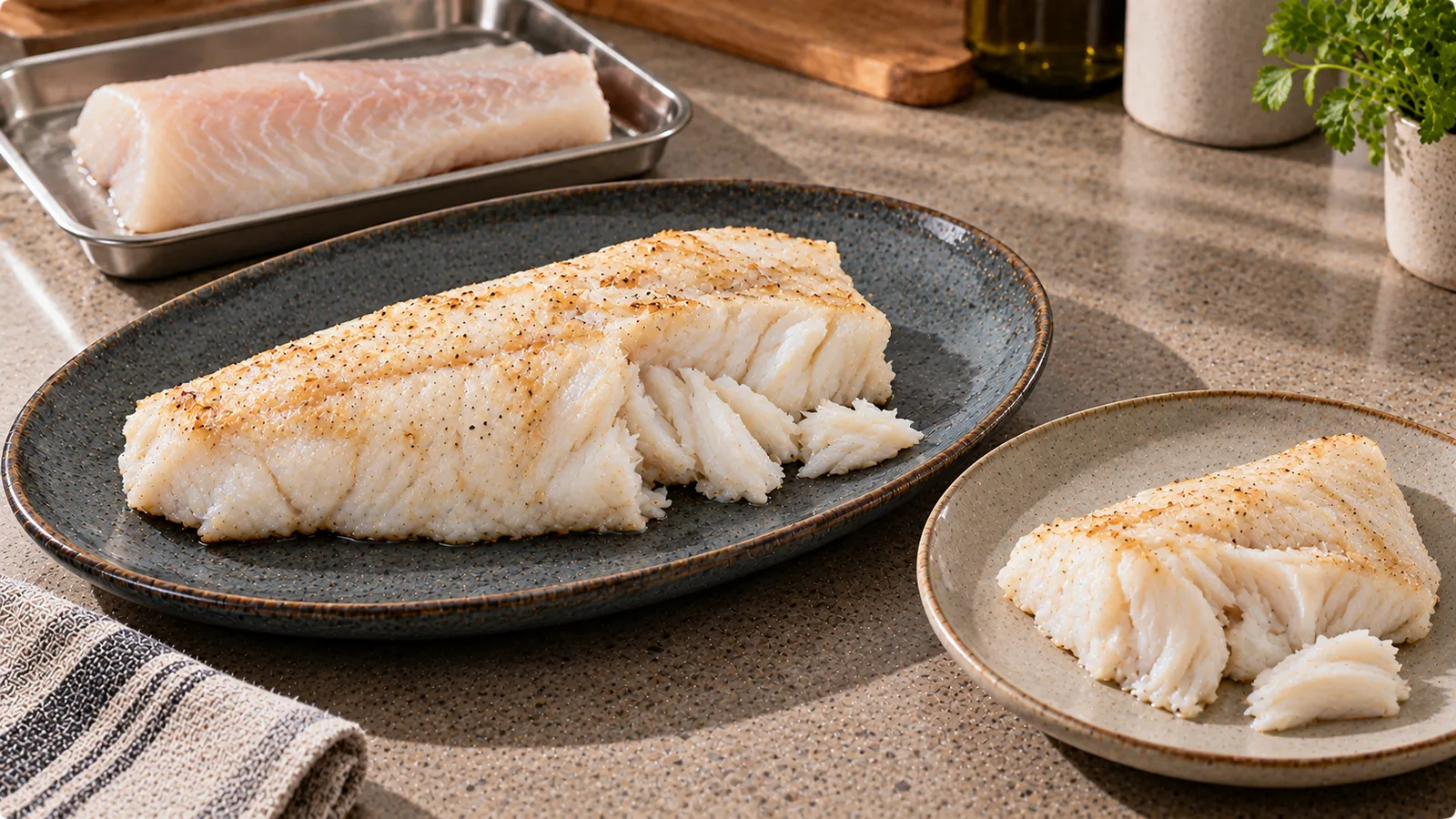
Cod is a lean white fish that provides substantial protein without much fat. But the calorie count depends on whether you weigh it raw or cooked, how large the edible portion is and what you add during preparation.
A plain cod fillet and a breaded, deep-fried portion can have very different energy values even when both are described as cod.
This guide explains the nutritional values of cod, shows practical serving calculations and helps you record it accurately in a food diary.
How many calories are in cod?
Plain Atlantic cod is relatively low in calories because it contains little fat.
The following figures are approximate reference values for edible fish without added oil, butter, breadcrumbs or sauce.
| Cod preparation | Calories per 100 g | Protein per 100 g | Fat per 100 g |
|---|---|---|---|
| Atlantic cod, raw | 82 kcal | 17.8 g | 0.7 g |
| Atlantic cod, cooked with dry heat | 105 kcal | 22.8 g | 0.9 g |
These are representative values based on USDA FoodData Central entries for Atlantic cod. Individual products and fish species may differ.
The increase in calories per 100 g after cooking does not mean the fish has gained energy.
Much of the difference comes from water loss.
As water evaporates, the remaining protein and energy become more concentrated in each 100 g of cooked fish.
The most important rule: match the nutritional entry to the state in which you weighed the fish.
Calories in common cod portions
Using the approximate values above:
| Portion | Raw cod | Cooked cod, dry heat |
|---|---|---|
| 100 g | 82 kcal | 105 kcal |
| 120 g | 98 kcal | 126 kcal |
| 150 g | 123 kcal | 158 kcal |
| 180 g | 148 kcal | 189 kcal |
| 200 g | 164 kcal | 210 kcal |
| 250 g | 205 kcal | 263 kcal |
These are calculations based on two different nutritional states.
A 200 g raw fillet will usually weigh less after cooking. It should not be treated as 200 g cooked cod unless that is its actual cooked weight.
Example: a 180 g raw cod fillet
Suppose you weigh a boneless fillet before cooking and the scale reads 180 g.
Using 82 kcal per 100 g:
180 ÷ 100 × 82 = 148 kcal.
That is the approximate energy content of the raw fish portion.
After baking, the fillet might weigh around 145–160 g, depending on cooking conditions.
You would not automatically recalculate the fish as 180 g of cooked cod.
Either use the original raw weight with a raw database entry or the actual cooked weight with a matching cooked entry.
Protein in cod
Cod is particularly useful when a meal needs protein without much additional fat.
Approximate values:
| Portion | Protein |
|---|---|
| 100 g raw cod | 17.8 g |
| 150 g raw cod | 26.7 g |
| 200 g raw cod | 35.6 g |
| 150 g cooked cod | 34.2 g |
| 200 g cooked cod | 45.6 g |
Again, raw and cooked portions are not directly interchangeable.
A 200 g cooked serving represents more fish before cooking than a 200 g raw serving.
The protein in cod can contribute to daily protein requirements, but a balanced diet should also include appropriate sources of energy, fibre and other nutrients.
Carbohydrates and fat in cod
Plain cod contains essentially no carbohydrates.
It is also a very lean fish.
For raw Atlantic cod, representative values are approximately:
- Protein: 17.8 g per 100 g.
- Fat: 0.7 g per 100 g.
- Carbohydrates: 0 g per 100 g.
- Energy: 82 kcal per 100 g.
Because the fish itself is low in fat, added cooking fats can make a noticeable difference to the finished meal.
For example, 10 g of oil contributes approximately 90 kcal.
A cod fillet cooked with a generous amount of oil should not be logged using only the nutritional value of plain fish.
Does baking cod change its calories?
Baking cod without added fat primarily changes its water content and final weight.
The fish may become lighter as moisture evaporates.
That can raise calories per 100 g of the cooked product, even though the total energy in the original portion changes relatively little.
Consider a simplified example:
- Raw cod: 200 g × 82 kcal per 100 g = 164 kcal.
- Cooked weight: 160 g.
- No oil or other caloric ingredients added.
The cooked fish still contains approximately the energy of the original portion, subject to cooking losses.
This would correspond to roughly 103 kcal per 100 g cooked.
Actual results vary, which is why measured cooked values and matched food database entries are preferable to assuming a fixed cooking yield.
Cod calories by cooking method
Cooking technique matters most when it adds other ingredients.
| Method | What changes the calorie total? |
|---|---|
| Steaming | Mainly water loss; no added fat required |
| Poaching | Usually little added energy if cooked in water or a light broth |
| Baking | Added oil, butter, glaze or sauce |
| Pan-frying | Oil or butter absorbed or retained in the serving |
| Air-frying | Breadcrumb coating and any added oil |
| Deep-frying | Batter, breadcrumbs and absorbed frying oil |
It is not possible to give one reliable calorie figure for every fried cod fillet.
A lightly oiled fillet and a thickly battered portion are different foods nutritionally.
Example: baked cod with olive oil
A meal contains:
- 180 g raw cod: approximately 148 kcal.
- 10 g olive oil: approximately 90 kcal.
- Lemon juice and herbs: a small additional amount.
The fish and oil together provide approximately 238 kcal, before sides.
If some oil remains in the pan, the amount actually eaten may be lower.
For consistent tracking, record the oil used and adjust only when the retained amount can be reasonably estimated.
Is cod different from haddock or pollock?
Cod, haddock and pollock are all commonly sold as white fish, but they are not identical products.
Their nutritional profiles are often broadly similar because they are generally lean fish.
However, calorie and protein values vary by species, product and preparation.
A label that simply says "white fish" is less precise than one identifying the species.
If you have the packaging, use the product's nutritional declaration rather than substituting a generic value for another fish.
The distinction becomes especially important for processed products, which may contain varying amounts of breading, water, salt or added fat.
Fresh versus frozen cod
Freezing cod does not inherently add calories.
Plain frozen cod and fresh cod can have similar nutritional profiles.
However, frozen products may differ because of:
- Ice glaze.
- Added water.
- Salt solutions.
- Marinades.
- Breadcrumbs or batter.
- Sauces.
A package may report nutritional values for the product as sold or after preparation.
Check which state the label describes.
What if the frozen fish has an ice glaze?
The weight printed on a package and the weight of the edible fish may not always be interpreted in the same way.
If a product has an ice glaze, follow the label's net-weight and nutritional information.
When weighing at home, avoid counting discarded ice or thawing liquid as edible fish.
For a reliable food diary, use the edible portion and the correct nutritional reference.
Cod fillet versus whole cod
A boneless fillet is mostly edible fish.
A whole cod includes parts that are not normally eaten, such as bones, head and other trimmings.
If you purchase a whole fish, its total weight is not the same as the weight of the edible flesh.
For example, a whole fish weighing 1 kg does not provide 1 kg of boneless cod fillet.
The edible yield depends on the fish, how it is cleaned and the way it is filleted.
To estimate calories accurately, weigh the edible flesh or use a reliable yield estimate specific to the preparation.
Do not multiply the weight of a whole fish by a per-100-g value intended for edible fillet.
Vitamins and minerals in cod
Besides protein, cod provides several micronutrients.
Depending on the species and portion, it can contribute:
- Vitamin B12.
- Iodine.
- Selenium.
- Phosphorus.
- Other vitamins and minerals in smaller amounts.
Cod is often associated with iodine because marine fish can contribute to iodine intake.
However, iodine content varies with species, environment and food composition data.
It is not appropriate to promise a fixed percentage of daily iodine needs for every cod fillet.
Cod is also different from oily fish such as salmon or mackerel.
Although cod contains some omega-3 fatty acids, its total fat content is low and it generally provides less marine omega-3 fat per serving than oily fish.
Is cod suitable for weight management?
Cod can fit into a weight-management meal plan because it provides protein with relatively few calories when prepared without large amounts of added fat.
But no single food causes weight loss.
The energy balance of the overall diet matters.
For example:
- Cod with boiled potatoes and vegetables can form a filling meal.
- Breaded cod with chips and a rich sauce can contain considerably more calories.
- A very small portion of plain fish without enough accompanying food may leave a person hungry.
A practical approach is to build a complete meal around the fish, including vegetables and a suitable carbohydrate source.
The portion should match personal energy and protein needs.
How to log cod accurately in a nutrition app
1. Identify the product
Choose Atlantic cod, Pacific cod or the exact packaged product when available.
Avoid selecting a processed cod product for plain fish.
2. Record whether the weight is raw or cooked
A raw fillet should use raw nutritional values.
A cooked fillet should use a matching cooked entry.
3. Weigh the edible portion
Exclude bones, packaging and discarded ice glaze.
4. Add cooking ingredients separately
Record oil, butter, batter, breadcrumbs, sauces and other additions.
5. Check the package when possible
For branded products, the nutrition label is often more relevant than a generic database estimate.
6. Keep the method consistent
If you always weigh fish raw, continue using raw entries.
If you prefer weighing the finished meal, use cooked entries that reflect the preparation.
Consistency reduces accidental double-counting of cooking weight changes.
Three common logging examples
Example A: plain steamed cod
You eat 150 g of steamed cod.
Using a representative cooked value of 105 kcal per 100 g:
150 × 1.05 = approximately 158 kcal.
Add the calories of any sauce or side dishes separately.
Example B: raw cod baked with oil
You start with:
- 200 g raw cod: approximately 164 kcal.
- 8 g olive oil: approximately 72 kcal.
Total before sides: approximately 236 kcal.
Do not add a second cooked-cod entry after recording the raw fish.
Example C: packaged breaded cod
The package lists 190 kcal per 100 g, and you eat 160 g of the product.
160 × 1.90 = 304 kcal.
Use the package value because it already reflects the composition of the breaded product, provided the stated preparation basis matches what you ate.
Food safety and cod
Cod should be stored and prepared according to applicable food-safety guidance.
Keep fresh fish refrigerated and follow use-by dates.
Thaw frozen fish safely, preferably in the refrigerator, unless the package gives another suitable method.
Cook fish thoroughly according to the product instructions and local food-safety recommendations.
Fish is also one of the allergen categories requiring declaration under EU food-information rules.
Anyone with a fish allergy should not assume that cod is safe simply because it is lean or minimally processed.