
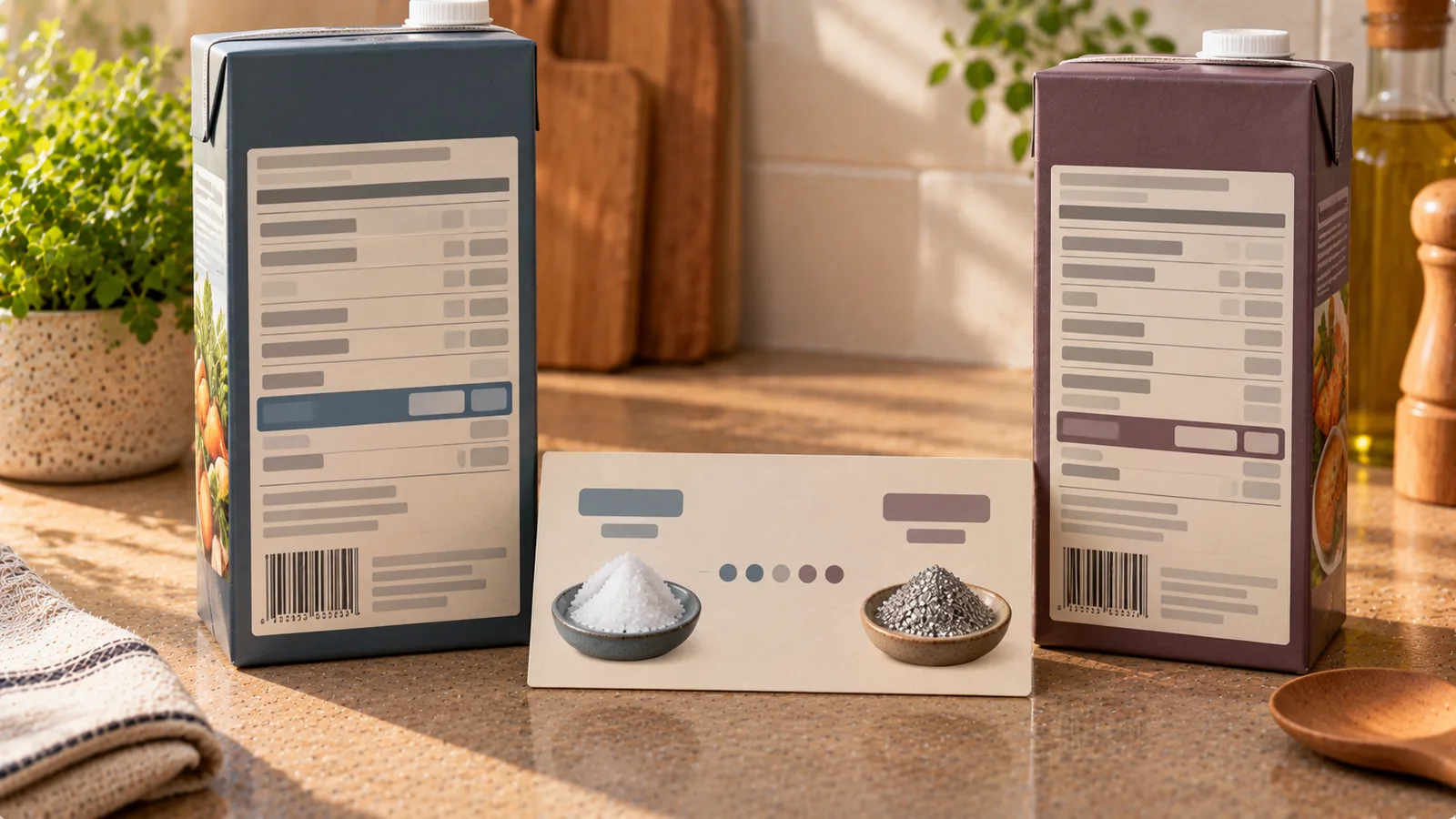
Sodium and salt are closely related, but they are not the same measurement.
This matters when comparing food labels because one product may list sodium, while another label or nutrition guideline may refer to salt.
A useful conversion is:
salt ≈ sodium × 2.5
The reverse calculation is:
sodium ≈ salt ÷ 2.5
The important detail is to keep the units consistent.
Sodium and salt are not interchangeable
Table salt is primarily sodium chloride.
Only part of its weight is sodium. The rest is mainly chloride.
That is why:
1 g sodium is not 1 g salt.
Approximately:
1 g sodium ≈ 2.5 g salt
and:
1 g salt ≈ 0.4 g sodium
This distinction is especially useful when comparing nutrition information from different countries or sources.
Quick sodium-to-salt conversion table
| Sodium | Approximate salt equivalent |
|---|---|
| 100 mg | 0.25 g |
| 200 mg | 0.50 g |
| 300 mg | 0.75 g |
| 400 mg | 1.00 g |
| 500 mg | 1.25 g |
| 600 mg | 1.50 g |
| 800 mg | 2.00 g |
| 1,000 mg | 2.50 g |
| 1,500 mg | 3.75 g |
| 2,000 mg | 5.00 g |
| 2,400 mg | 6.00 g |
These are approximate conversions and are usually sufficient for interpreting food labels.
How to convert sodium to salt
When sodium is given in grams:
salt in grams = sodium in grams × 2.5
Example:
A food contains:
0.6 g sodium
0.6 × 2.5 = 1.5 g salt
So 0.6 g sodium corresponds to approximately 1.5 g salt.
Converting sodium in milligrams to salt in grams
Food labels often list sodium in milligrams rather than grams.
First remember:
1,000 mg = 1 g
A convenient direct calculation is:
salt in grams = sodium in milligrams × 2.5 ÷ 1,000
For example:
400 mg sodium
400 × 2.5 ÷ 1,000 = 1 g salt
So 400 mg sodium is approximately equivalent to 1 g salt.
Example: 250 mg sodium
A serving contains:
250 mg sodium
Convert to grams:
250 mg = 0.25 g sodium
Then:
0.25 × 2.5 = 0.625 g salt
So the serving contains the equivalent of approximately:
0.63 g salt
Example: 600 mg sodium
A food contains:
600 mg sodium
Calculation:
600 × 2.5 ÷ 1,000 = 1.5 g salt
Therefore:
600 mg sodium ≈ 1.5 g salt
Example: 1,200 mg sodium
Suppose a prepared meal contains:
1,200 mg sodium
Calculation:
1,200 × 2.5 ÷ 1,000 = 3 g salt
So the sodium content corresponds to approximately:
3 g salt
How to convert salt to sodium
Sometimes you have the opposite problem: the label lists salt, but you want to estimate sodium.
Use:
sodium = salt ÷ 2.5
For example:
A product contains:
1.5 g salt
1.5 ÷ 2.5 = 0.6 g sodium
Convert grams to milligrams:
0.6 × 1,000 = 600 mg sodium
Therefore:
1.5 g salt ≈ 600 mg sodium
Quick salt-to-sodium table
| Salt | Approximate sodium |
|---|---|
| 0.25 g | 100 mg |
| 0.50 g | 200 mg |
| 0.75 g | 300 mg |
| 1.00 g | 400 mg |
| 1.25 g | 500 mg |
| 1.50 g | 600 mg |
| 2.00 g | 800 mg |
| 2.50 g | 1,000 mg |
| 5.00 g | 2,000 mg |
| 6.00 g | 2,400 mg |
Why the conversion factor is about 2.5
Common salt is sodium chloride.
By molecular weight, sodium accounts for roughly 39% of sodium chloride.
That means salt contains approximately:
0.4 g sodium per 1 g salt
Turning that relationship around gives approximately:
1 g sodium ≈ 2.5 g salt
The factor is rounded for practical nutrition-label calculations.
Check whether the label says sodium or salt
Before doing any calculation, read the nutrient name carefully.
A label stating:
Salt: 1.2 g
is not saying:
Sodium: 1.2 g
Those numbers would represent very different amounts.
Using the conversion:
1.2 g salt ÷ 2.5 = 0.48 g sodium
So:
1.2 g salt ≈ 480 mg sodium
Confusing the two would overestimate sodium substantially.
Per 100 g vs per serving
The sodium-to-salt conversion does not change the quantity basis of the label.
If a label says:
600 mg sodium per 100 g
the converted result is:
1.5 g salt per 100 g
It is not automatically 1.5 g salt per serving.
If the serving is 40 g:
600 × 40 ÷ 100 = 240 mg sodium per serving
Then:
240 × 2.5 ÷ 1,000 = 0.6 g salt per serving
Always preserve the original basis of the nutrition value.
Worked example: soup label
A soup lists:
Sodium: 350 mg per 100 g
The container contains 400 g.
First convert the sodium value to salt:
350 × 2.5 ÷ 1,000 = 0.875 g salt per 100 g
For the entire 400 g container:
0.875 × 4 = 3.5 g salt
Alternatively, calculate total sodium first:
350 × 4 = 1,400 mg sodium
Then:
1,400 × 2.5 ÷ 1,000 = 3.5 g salt
Both methods produce the same result.
Worked example: bread
Suppose bread contains:
0.9 g salt per 100 g
You eat 80 g.
Salt consumed:
0.9 × 80 ÷ 100 = 0.72 g salt
Estimated sodium:
0.72 ÷ 2.5 = 0.288 g
or:
288 mg sodium
The amount eaten must be accounted for separately from the sodium-salt conversion.
Worked example: restaurant meal
Suppose nutrition information for a restaurant meal lists:
1,800 mg sodium
To express that as salt:
1,800 × 2.5 ÷ 1,000 = 4.5 g salt
This does not mean 4.5 g of visible table salt was necessarily added during cooking.
Sodium can come from many ingredients, including:
- salt;
- sauces;
- cheese;
- processed meats;
- bread;
- seasoning mixtures;
- preserved ingredients.
The conversion expresses sodium as its approximate salt equivalent.
Sodium can exist without sodium chloride
The 2.5 conversion is useful for expressing sodium as a salt equivalent, but not every sodium atom in food necessarily comes from ordinary sodium chloride.
Food can contain sodium from ingredients such as sodium bicarbonate or other sodium-containing compounds.
Therefore, converting sodium to salt should be understood as a practical nutrition comparison, not as a laboratory measurement of how many grams of table salt were physically added.
Comparing two labels that use different systems
Imagine two similar foods.
Product A
Sodium: 320 mg per 100 g
Product B
Salt: 1.0 g per 100 g
Convert Product A:
320 × 2.5 ÷ 1,000 = 0.8 g salt
Now the products can be compared on the same basis:
| Product | Salt equivalent per 100 g |
|---|---|
| Product A | 0.8 g |
| Product B | 1.0 g |
Product B has the higher salt-equivalent value in this example.
Compare the same quantity
A conversion alone is not enough if the labels use different quantity bases.
For example:
Product A:
300 mg sodium per serving
Product B:
0.6 g salt per 100 g
You cannot compare these numbers directly unless you know the serving weight for Product A.
First convert both products to:
- per 100 g;
- per 100 ml;
- or the actual quantity you plan to consume.
Then compare sodium or salt on the same basis.
Milligrams and grams are a common source of mistakes
A frequent error is treating milligrams and grams as though they were equal.
Remember:
1 g = 1,000 mg
Therefore:
500 mg sodium = 0.5 g sodium
and:
0.5 × 2.5 = 1.25 g salt
Not 1,250 g salt.
Keeping units visible throughout the calculation reduces mistakes.
A simple three-step method
When a label lists sodium in milligrams:
Step 1: identify the sodium value
Example:
720 mg sodium
Step 2: multiply by 2.5
720 × 2.5 = 1,800 mg salt equivalent
Step 3: convert to grams
1,800 ÷ 1,000 = 1.8 g salt
Therefore:
720 mg sodium ≈ 1.8 g salt
If the food contains several servings
Suppose one serving contains:
280 mg sodium
The package contains three servings and you eat the entire package.
Total sodium:
280 × 3 = 840 mg
Salt equivalent:
840 × 2.5 ÷ 1,000 = 2.1 g
The serving calculation and sodium-to-salt conversion are separate steps.
If you eat only part of a serving
Suppose the label lists:
500 mg sodium per 50 g serving
You eat 30 g.
Sodium consumed:
500 × 30 ÷ 50 = 300 mg
Salt equivalent:
300 × 2.5 ÷ 1,000 = 0.75 g
This is more accurate than converting the full serving and logging it unchanged.
Sodium and salt in food tracking
When recording food, use the nutrient field actually provided by the source.
If your food database expects sodium, do not enter a salt value into the sodium field without converting it.
Likewise, if a system expects salt, a sodium number should not be entered unchanged.
For example:
Label:
Salt: 1.5 g
Equivalent sodium:
600 mg
Entering 1,500 mg as sodium would be incorrect.
What if the label already provides both?
Some nutrition information may show both sodium and salt.
If both are already available, there is normally no reason to calculate one manually.
You can use the value corresponding to the field you need.
Small differences between a displayed pair and your manual conversion can occur because of rounding.
Rounding differences are normal
A label may round nutrient values before displaying them.
For example, the underlying sodium amount might not be exactly 400 mg even if the printed label shows 400 mg.
Converting the rounded value:
400 mg sodium → 1.0 g salt
may therefore differ slightly from another independently rounded number on the same product.
Small discrepancies do not necessarily indicate an error.
Sodium vs salt: practical summary
The key conversions are:
1 g sodium ≈ 2.5 g salt
1 g salt ≈ 0.4 g sodium
For sodium listed in milligrams:
salt in grams = sodium in mg × 2.5 ÷ 1,000
For salt listed in grams:
sodium in mg = salt in g ÷ 2.5 × 1,000
Before calculating, always check:
- whether the label says sodium or salt;
- whether the number is in mg or g;
- whether it is per 100 g, per 100 ml or per serving;
- how much of the food you actually consumed.
Keeping those four details separate prevents most sodium-to-salt conversion errors.