
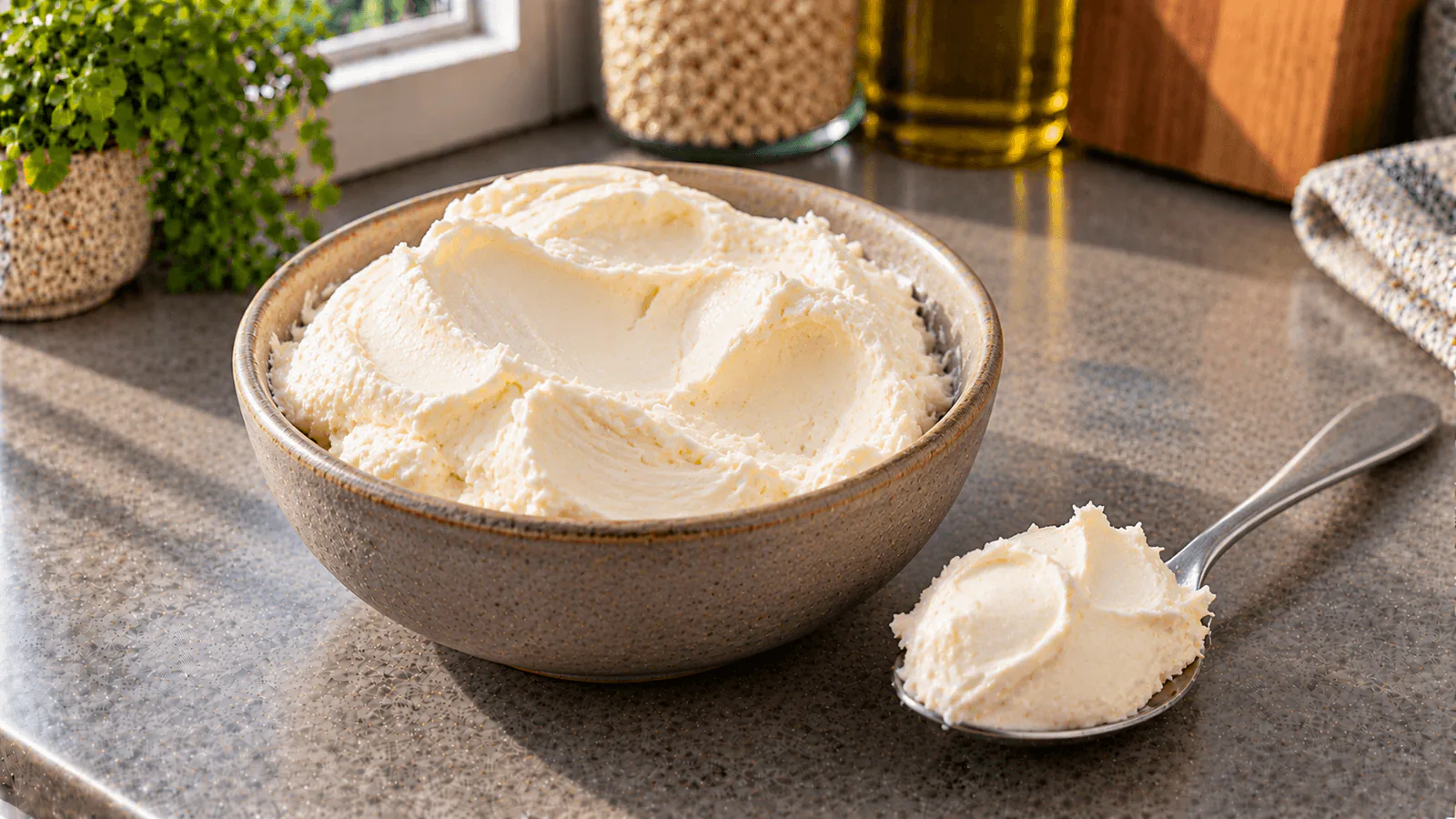
Mascarpone is a very creamy fresh dairy product used in tiramisu, pasta sauces, frostings and savoury fillings. The essential number is not the weight of the entire tub but the amount that actually goes into your portion. As a traceable example, Tesco Mascarpone provides 399 kcal per 100 g, including 41 g fat, 26 g saturated fat and 4 g protein. That is approximately 40 kcal for 10 g, 120 kcal for 30 g and 200 kcal for 50 g. Those numbers come from one labelled product, not an official universal value for every mascarpone on the shelf.
Mascarpone nutrition per 100 g
Mascarpone gets its rich texture mainly from cream. The nutritional profile is therefore very different from that of a lean, protein-focused fresh cheese. This table follows the published Tesco Mascarpone product label and applies to the plain product as sold, without sugar, coffee, pasta, chocolate or any other recipe ingredient.
| Nutrient | Tesco Mascarpone per 100 g |
|---|---|
| Energy | 399 kcal |
| Fat | 41 g |
| Saturated fat | 26 g |
| Carbohydrates | 3.5 g |
| Of which sugars | 3 g |
| Protein | 4 g |
| Fibre | 0 g |
| Salt | 0.08 g |
The saturated-fat value is part of the 41 g total fat, not an additional amount. Likewise, the 3 g of sugars is included in the 3.5 g of total carbohydrates. The small amount of naturally occurring milk sugar is not the same as sugar added later to a dessert. Salt is low in this particular product, but check a savoury prepared sauce separately because its other ingredients may change the result.
Mascarpone is energy-dense because fat supplies more energy per gram than carbohydrate or protein. In practical terms, an extra spoonful can change a recipe's calories noticeably even though the sauce or filling barely changes in volume. That is not a reason to avoid mascarpone; it is a reason to record a useful weight rather than a vague description such as “a little cheese.”
Why another tub may say 383 or 403 kcal
The same food name does not guarantee identical nutrition. The Galbani UK Mascarpone label declares 403 kcal per 100 g, with 41 g fat and 4.5 g protein. The Galbani Santa Lucia Italian label lists 383 kcal per 100 g, 39 g fat and 4 g protein. The Tesco reference in the table lists 399 kcal. These are three product-specific declarations, not three contradictory measurements of one identical batch.
Formulation, fat and moisture content, national products and label rounding all help explain differences. A difference of 20 kcal per 100 g between two labelled examples becomes only 6 kcal in a 30 g portion, but larger recipe quantities make the distinction more relevant. If your package says 383, 399 or 403 kcal, enter its own number into your food log; do not substitute the reference table automatically. Lower-fat soft cheeses and products sold as mascarpone-style alternatives need their own labels too.
Calories in a spoonful or practical serving
To make portions comparable, the following table multiplies the Tesco values by the edible weight. A 10 g amount is calculated as 10% of the 100 g label, while 125 g is 1.25 times the label values. Calories are rounded to the nearest whole number; fat and saturated fat are rounded to one decimal place.
| Mascarpone amount | Energy | Total fat | Saturated fat |
|---|---|---|---|
| 10 g | 40 kcal | 4.1 g | 2.6 g |
| 15 g | 60 kcal | 6.2 g | 3.9 g |
| 20 g | 80 kcal | 8.2 g | 5.2 g |
| 30 g | 120 kcal | 12.3 g | 7.8 g |
| 50 g | 200 kcal | 20.5 g | 13.0 g |
| 75 g | 299 kcal | 30.8 g | 19.5 g |
| 100 g | 399 kcal | 41.0 g | 26.0 g |
| 125 g | 499 kcal | 51.3 g | 32.5 g |
| 250 g | 998 kcal | 102.5 g | 65.0 g |
These are weight-based calculations, not promises about the contents of every spoon. A shallow teaspoon, heaped teaspoon and generously filled tablespoon can have very different masses. For planning, 15 g can serve as a hypothetical small spoonful and 30 g as a larger measured addition, but you should weigh your actual utensil once instead of treating a spoon as a standardised unit. Kitchen spoons, dessert spoons and measuring spoons are not interchangeable. If you are serving multiple people, first weigh the amount that goes into the entire dish, then divide by the number of portions eaten.
Our guide to portion size versus serving size explains why an amount printed on a package is not necessarily the amount you will use at home. A nutrition label per 100 g is a reference, whereas the serving on your plate depends on the recipe and your appetite.
Mascarpone in tiramisu, sweet creams and desserts
A spoon of plain mascarpone is not nutritionally equivalent to a spoon of finished tiramisu. A typical tiramisu combines mascarpone with biscuits, sugar and other ingredients; its calories come from all of them. The plain-cheese reference works only for the mascarpone component. You must also account for the sugar, biscuits, cream, chocolate or alcohol actually used, if any.
Consider a simple sweet topping: 125 g mascarpone at the Tesco reference contributes approximately 499 kcal. Add 20 g granulated sugar, about 80 kcal using 4 kcal per gram of sugar. The two ingredients together provide roughly 579 kcal. Dividing this mixture equally between four servings gives around 145 kcal per serving, before fruit, cake or other ingredients. This is a calculation example, not the nutrition declaration of a packaged dessert; actual values depend on the ingredients and the final yield.
For a smaller bowl, 30 g mascarpone supplies 120 kcal. If you add 10 g sugar, that brings another approximately 40 kcal, for 160 kcal before berries or biscuits. If you substitute a sweetened mascarpone mixture from a supermarket, do not use the plain-cheese table; read that product's finished-dessert label instead. Sweetness and richness are separate variables: plain mascarpone is high in fat even when no extra sugar has been added.
Mascarpone in pasta sauces and savoury dishes
Mascarpone may be stirred into tomato sauce, risotto or soup to add body. In a savoury dish, it is the amount of cheese in the batch that matters. Say a tomato-based sauce has 160 kcal before mascarpone and you mix in 30 g plain mascarpone. The additional cheese contributes 120 kcal, bringing the sauce to 280 kcal before pasta, vegetables, oil or toppings. If this is split equally between two plates, the sauce provides 140 kcal per plate, subject to the starting 160 kcal assumption. The pasta must be logged separately.
Mascarpone does not acquire new energy merely because it is warmed. Heating can evaporate water and change weight, making the calories per 100 g of finished sauce look different, while the total calories from the added cheese remain approximately the same. Butter, oil, grated cheese or cream added to the pan are extra ingredients and should be counted. For accurate recipe tracking, record the raw ingredient weights once, then divide the full recipe according to the cooked portions. Avoid entering both “mascarpone 30 g” and a sauce entry that already includes that same 30 g.
How does mascarpone compare with other creamy ingredients?
Mascarpone and cream cheese may both spread easily, but they are not necessarily equal in fat or calories. Standard cream cheese, light cream cheese and mascarpone have different formulations; compare the particular packages rather than exchanging their 100 g figures. This distinction matters especially in cheesecake, frosting and sandwich spreads.
Ricotta typically has a different texture, moisture content and protein-to-fat balance. It can be useful in some fillings, but swapping it into tiramisu will also change taste and structure. A recipe may need adjustment to stay creamy, so a direct one-for-one substitution should not be presented as calorie-equivalent. For sauces, liquid heavy cream is another nearby ingredient, but it is sold and measured differently from thick mascarpone. One is pourable, the other spoonable: use the appropriate nutrition panel and weigh or measure consistently.
If you are choosing an ingredient for a dish, consider four questions: how much richness you need, whether the food must hold its shape, what the package's saturated-fat content is, and how many portions the recipe makes. A lower energy density can be useful, but sensory quality and the role of the ingredient also matter. The goal is a workable dish with quantities you can track, not automatically replacing every creamy ingredient.
Fat, saturated fat, milk allergens and storage
The reference table shows 26 g saturated fat per 100 g. A 30 g addition therefore has 7.8 g saturated fat, and a 50 g portion has 13.0 g. These figures help make sense of a rich meal in the context of your overall dietary pattern. Mascarpone is not a particularly concentrated protein source relative to its energy: the selected label gives only 4 g protein per 100 g. Do not infer from the word “cheese” that it supplies the same protein as cottage cheese or quark.
Mascarpone contains milk and is unsuitable for people with a milk-protein allergy. It may contain lactose; lactose tolerance is individual and product-dependent. Keep it refrigerated according to its packaging and observe the use-by date and instructions after opening. Fresh dairy should not be left unrefrigerated for a long buffet or dessert display, and homemade desserts containing other perishable ingredients require appropriate handling too.
A simple method to log mascarpone correctly
Read the kcal-per-100-g figure on your actual tub, weigh the mascarpone before mixing it into the dish, and calculate grams used × kcal per 100 g ÷ 100. Add each other ingredient once; then divide by the number or weight of servings actually eaten. For the example label, that formula gives 399 × 25 ÷ 100 = 99.75 kcal, or approximately 100 kcal for 25 g. It also shows why “two tablespoons” can be a poor shortcut when the spoons are different sizes.
For quick decisions, 399 kcal/100 g is a clearly sourced example, and 383–403 kcal/100 g is the range of the three particular labels examined here, not a guaranteed range for every product sold internationally. Mascarpone can fit into both sweet and savoury dishes, but portion size and added ingredients determine the calories you actually eat. If a brand changes its formulation, the current package label should take precedence over this illustrative table.
Product sources: Tesco plain mascarpone nutrition for the 399 kcal reference and portion arithmetic; Galbani UK mascarpone nutrition for the 403 kcal comparison; Galbani Italian Santa Lucia nutrition for the 383 kcal comparison. Figures refer to the listed plain products as sold and may be updated by their manufacturers.