
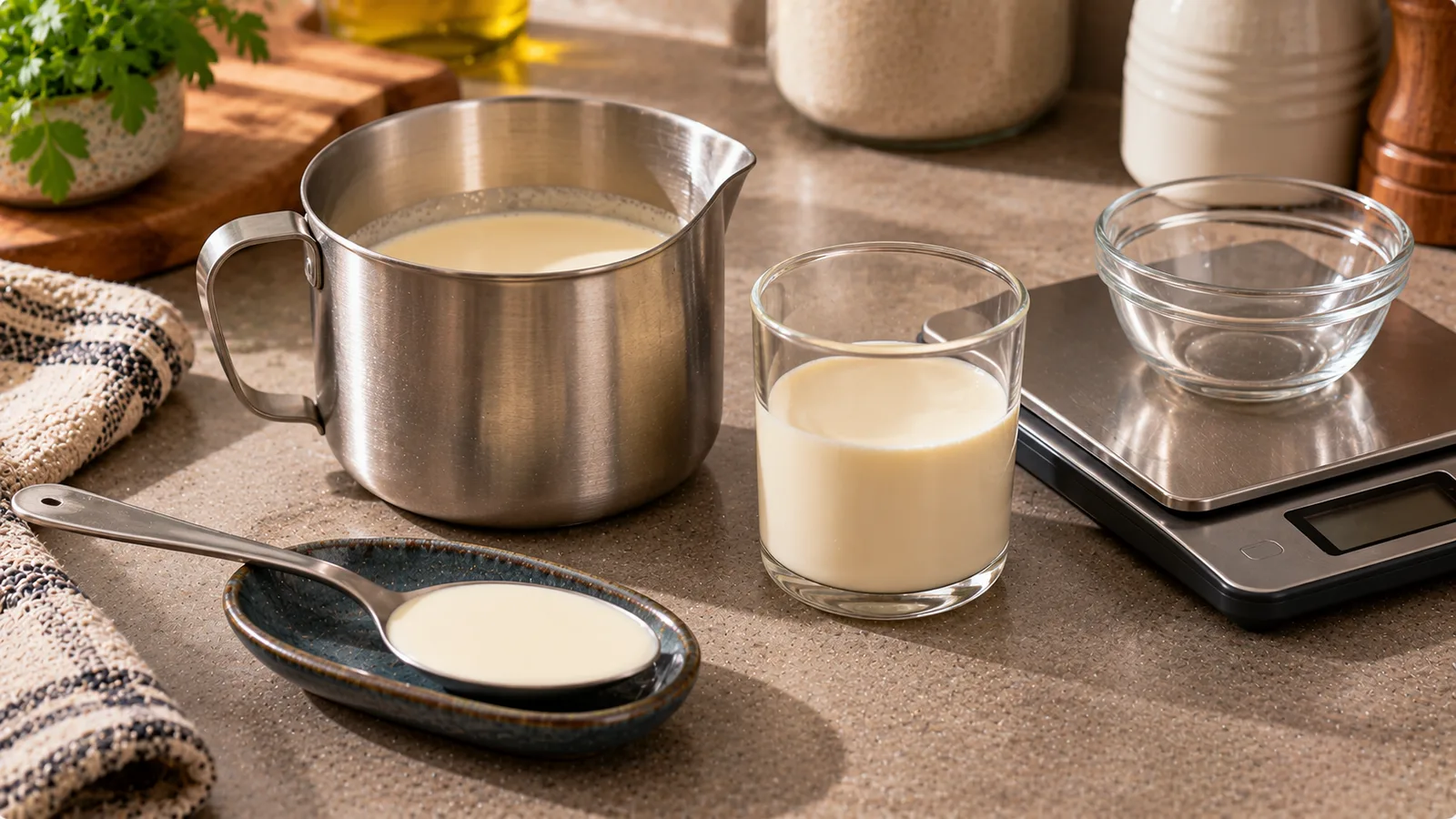
Heavy cream is a high-fat dairy product, so even a relatively small serving can contribute a noticeable number of calories.
A typical heavy cream with roughly 35–40% milk fat contains approximately 330–370 kcal per 100 g, although the exact value varies by product and country.
Because cream is usually poured rather than eaten in 100 g portions, the amount actually used matters considerably.
How many calories are in heavy cream?
A practical representative value is approximately:
350 kcal per 100 g
The 350 kcal per 100 g figure is a calculation example for higher-fat cream (roughly 35–40% milk fat), not a universal value for all creams. The serving calculations below use this same example; the actual product label takes precedence.
Using that value:
| Amount of heavy cream | Approximate calories |
|---|---|
| 10 g | 35 kcal |
| 15 g | 53 kcal |
| 20 g | 70 kcal |
| 30 g | 105 kcal |
| 50 g | 175 kcal |
| 100 g | 350 kcal |
These are representative calculations.
For precise tracking, use the nutrition label on the cream you actually consume.
Calories in a tablespoon of heavy cream
One tablespoon is approximately 15 ml.
The weight of 15 ml of cream is close to, but not necessarily exactly, 15 g because milliliters measure volume and grams measure mass.
For everyday estimation, a tablespoon often contributes roughly 50–55 kcal when the cream contains around 350 kcal per 100 g.
If you weigh exactly 15 g:
350 × 15 ÷ 100 = 52.5 kcal
So 15 g contains approximately 53 kcal.
Calories in 30 g of heavy cream
At 350 kcal per 100 g:
350 × 30 ÷ 100 = 105 kcal
A 30 g portion therefore contains approximately 105 kcal.
That can be relevant when cream is added freely to coffee, desserts or sauces.
Calories in 50 g
At the same calorie density:
350 × 50 ÷ 100 = 175 kcal
A 50 g serving contains approximately 175 kcal.
Because cream is energy-dense, the difference between a small splash and a larger pour can be substantial.
Nutrition in heavy cream
A representative heavy cream may contain approximately the following per 100 g:
| Nutrient | Approximate amount |
|---|---|
| Calories | 330–370 kcal |
| Protein | 2–3 g |
| Carbohydrate | 2–4 g |
| Fat | 35–40 g |
Values vary between products.
The majority of the calories come from milk fat.
Why heavy cream contains so many calories
Fat provides approximately 9 kcal per gram.
Protein and carbohydrate provide approximately 4 kcal per gram each.
If a cream contains 36 g fat per 100 g, the fat alone represents approximately:
36 × 9 = 324 kcal
Small amounts of protein and carbohydrate contribute additional energy.
That is why a high-fat cream can easily provide more than 300 kcal per 100 g.
Fat percentage matters
Not every product called cream has the same fat content.
Depending on the country and product category, you may encounter cream with substantially different percentages of milk fat.
As a general principle:
higher fat percentage → higher calorie density
For example, a cream around 20% fat will generally contain fewer calories per 100 g than one around 35–40% fat.
This is why a generic cream entry should not automatically be used for every cream product.
Heavy cream, whipping cream and double cream
Terminology differs between markets.
In the United States, heavy cream or heavy whipping cream typically refers to a high-fat cream suitable for whipping.
In other countries, products may be sold under terms such as whipping cream, cream, double cream or local equivalents with different fat percentages.
Double cream can contain considerably more fat than a typical American heavy cream and therefore can also contain more calories.
When tracking, the percentage on the package is more useful than relying only on the product name.
Volume versus weight
Cream is frequently measured in milliliters, cups or tablespoons, while nutrition databases often use grams.
These units are related but are not identical.
For rough home calculations, small cream volumes are sometimes treated as approximately the same number of grams.
For greater accuracy, weigh the cream directly.
This is particularly useful for recipes that contain 100 ml or more.
How to weigh cream accurately
Place the cup, bowl or pan on a kitchen scale.
Zero the scale.
Pour in the cream.
The increase in weight is the amount used.
For example, if you pour 42 g of cream containing 348 kcal per 100 g:
348 × 42 ÷ 100 = 146.16 kcal
That amount contributes approximately 146 kcal.
Heavy cream in coffee
A small amount of cream in coffee may look insignificant, but repeated servings can add up.
Using 350 kcal per 100 g:
| Cream added | Approximate calories |
|---|---|
| 5 g | 18 kcal |
| 10 g | 35 kcal |
| 15 g | 53 kcal |
| 20 g | 70 kcal |
| 30 g | 105 kcal |
If you drink several coffees with cream, calculate the total amount used across the day rather than assuming each splash is negligible.
Example: two coffees
Suppose you add 15 g of heavy cream to each of two coffees.
Total cream:
15 + 15 = 30 g
At 350 kcal per 100 g:
350 × 30 ÷ 100 = 105 kcal
The two coffees therefore receive approximately 105 kcal from the cream.
Any sugar or syrup would be additional.
Heavy cream in sauces
Cream is often used in pasta sauces, soups and pan sauces.
For a recipe, calculate the calories from the total amount of cream added to the batch.
Suppose a sauce contains 200 g of heavy cream at 350 kcal per 100 g.
Cream calories:
350 × 200 ÷ 100 = 700 kcal
If the finished sauce is divided into four equal portions:
700 ÷ 4 = 175 kcal
The cream alone contributes approximately 175 kcal to each portion.
Other ingredients are calculated separately.
Example: creamy pasta
Imagine a four-serving pasta recipe uses:
- 250 g heavy cream;
- pasta;
- chicken;
- vegetables;
- cheese.
If the cream contains 345 kcal per 100 g:
345 × 250 ÷ 100 = 862.5 kcal
Across four portions:
862.5 ÷ 4 = 215.6 kcal
The cream contributes approximately 216 kcal per serving before the other ingredients are counted.
Heavy cream in soup
Adding cream to a large pot can produce a smaller per-serving amount than the total cream calories might suggest.
Suppose you add 150 g of cream at 350 kcal per 100 g:
350 × 150 ÷ 100 = 525 kcal
If the soup makes six equal portions:
525 ÷ 6 = 87.5 kcal
The cream contributes approximately 88 kcal to each serving.
Heavy cream in desserts
Desserts can contain larger amounts of cream, especially when it is whipped or used in fillings.
Whipping cream changes its volume by incorporating air.
It does not remove the calories from the cream.
If 200 g of liquid cream contains 700 kcal before whipping, the whipped cream still contains approximately those 700 kcal in total unless other ingredients are added or some cream is left behind.
The larger volume does not mean the batch has fewer total calories.
Whipped cream and portion size
Whipped cream is less dense by volume because it contains incorporated air.
A spoonful of whipped cream can therefore weigh less than the same volume of liquid cream.
This is why grams are useful when comparing the two.
If sugar is added during whipping, include it separately.
Does heating cream change its calories?
Heating does not meaningfully create or destroy calories.
However, water can evaporate.
If a cream sauce reduces during cooking, the finished sauce weighs less while retaining most of the energy from its ingredients.
That means calories per 100 g of the finished sauce can increase.
The total calories of the batch do not increase merely because it becomes thicker.
Example of sauce reduction
Suppose a sauce contains 1,000 kcal in total and weighs 800 g before reduction.
Its initial energy density is:
1,000 ÷ 800 = 1.25 kcal per gram
After cooking, water evaporates and the sauce weighs 650 g.
The batch still contains approximately the same total energy, but its density becomes:
1,000 ÷ 650 = 1.54 kcal per gram
A 100 g serving after reduction is therefore more calorie-dense than a 100 g serving before reduction.
Protein in heavy cream
Heavy cream contains some protein, but it is not generally considered a concentrated protein food.
A representative product might contain approximately 2–3 g protein per 100 g.
If the cream contains 2.5 g protein per 100 g, a 30 g portion provides:
2.5 × 30 ÷ 100 = 0.75 g protein
Most of the energy in that serving comes from fat rather than protein.
Carbohydrates in heavy cream
Plain heavy cream generally contains a small amount of carbohydrate, primarily from naturally occurring milk sugar.
A representative range might be approximately 2–4 g carbohydrate per 100 g.
For 30 g of cream containing 3 g carbohydrate per 100 g:
3 × 30 ÷ 100 = 0.9 g carbohydrate
Sweetened cream products can contain substantially more carbohydrate.
Heavy cream and saturated fat
A significant proportion of milk fat is saturated fat.
The exact amount depends on the product.
If saturated fat intake is relevant to your dietary goals or medical advice, use the saturated-fat value on the package rather than estimating it only from total fat.
Heavy cream can contribute a meaningful amount even in relatively modest portions because its total fat concentration is high.
Is lower-fat cream always much lower in calories?
Usually, reducing the fat content lowers calorie density, but the exact difference depends on the formulation.
Suppose one cream contains 36 g fat per 100 g and another contains 20 g.
The difference in fat alone is:
16 g per 100 g
At approximately 9 kcal per gram:
16 × 9 = 144 kcal
This illustrates why two cream products can differ substantially in calories.
Always compare the actual labels.
Cream in packaged foods
If you eat a packaged soup, sauce or dessert containing cream, you generally do not need to calculate the cream separately.
Use the nutrition information for the finished packaged food.
Separate cream calculations are most useful when:
- cooking from scratch;
- modifying a recipe;
- adding cream to coffee;
- adding cream at the table.
How to calculate calories from your package
Use:
calories per 100 g × grams consumed ÷ 100
Example:
Your cream contains 356 kcal per 100 g.
You use 25 g.
356 × 25 ÷ 100 = 89 kcal
The portion contributes approximately 89 kcal.
Calculating fat for a serving
The same method works for fat.
Suppose your cream contains 36 g fat per 100 g.
For 25 g:
36 × 25 ÷ 100 = 9 g fat
So the 25 g portion provides approximately 9 g fat.
When the package gives values per 100 ml
Some liquid products provide nutrition per 100 ml instead of per 100 g.
If you measure your portion in milliliters, you can use that value directly.
For example:
Cream: 340 kcal per 100 ml
Amount used: 30 ml
340 × 30 ÷ 100 = 102 kcal
Avoid unnecessarily converting milliliters to grams if both your measurement and the label already use milliliters.
When the package uses tablespoons
If the label gives nutrition per tablespoon, check the serving definition.
For example:
Serving: 1 tbsp (15 ml)
Calories: 50
If you use two measured tablespoons:
50 × 2 = 100 kcal
A heaped household spoon may not equal the manufacturer's defined tablespoon.
Heavy cream versus milk
Milk generally contains much less fat than heavy cream and therefore substantially fewer calories per 100 ml.
Replacing cream with milk changes:
- calorie density;
- fat;
- texture;
- flavor;
- cooking behavior.
If you make that substitution, update the recipe with the milk actually used instead of keeping the original cream values.
Heavy cream versus half-and-half
Half-and-half typically contains less fat than heavy cream.
As a result, it usually contains fewer calories per equivalent amount.
However, exact formulations vary.
Use the label of the specific product rather than applying one generic conversion.
Heavy cream versus crème fraîche
Crème fraîche is also a high-fat dairy product, but fat percentage and formulation vary.
Some versions can have calorie values similar to heavy cream, while others differ.
Because crème fraîche is cultured and usually thicker, volume-based serving estimates can also behave differently.
Treat it as a separate product when tracking.
What if you do not know how much cream was used?
When eating restaurant food or food prepared by someone else, the exact amount may be unknown.
In that situation, use a reasonable estimate rather than inventing precise numbers.
For example, you might know that a pasta sauce is cream-based but not whether your serving contains 30 g or 80 g of cream.
The uncertainty should be reflected in the estimate.
Restaurant cream sauces can also contain butter, cheese or oil, so estimating the entire sauce as pure cream can be misleading.
Common tracking mistake: logging only a splash
A visually small splash can still be 15–30 g.
If cream is used every day, consistently underestimating the amount can create a noticeable difference in a food diary.
You do not need to weigh every serving permanently.
Weighing your usual pour a few times can help you learn whether your typical amount is closer to 10 g, 20 g or 40 g.
Common tracking mistake: using the wrong cream type
A database may contain entries for:
- light cream;
- whipping cream;
- heavy cream;
- double cream;
- coffee cream.
These products can differ substantially in fat and calories.
Choose the entry that most closely matches the fat percentage and nutrition label of your product.
A practical reference
For a representative heavy cream at approximately 350 kcal per 100 g:
- 10 g → about 35 kcal;
- 15 g → about 53 kcal;
- 20 g → about 70 kcal;
- 30 g → about 105 kcal;
- 50 g → about 175 kcal;
- 100 g → about 350 kcal.
Heavy cream is energy-dense because of its high milk-fat content. The most reliable way to track it is to use the calorie value from the package and measure the amount actually poured into the drink, sauce or recipe.
Nutrition data sources and product differences
The records below describe only the named foods, fat levels and preparation states. USDA figures are per 100 g; manufacturer figures retain their stated unit. These sources do not independently prove every approximate figure in the article.
The English, German and French examples describe creams with different typical fat percentages. Do not treat their rounded portion values as one identical product. The USDA references are per 100 g for specified cream types.
USDA FoodData Central (search by FDC ID):
- FDC 170859 — Cream, fluid, heavy whipping (340 kcal/100 g)
- FDC 170858 — Cream, fluid, light whipping (292 kcal/100 g)