
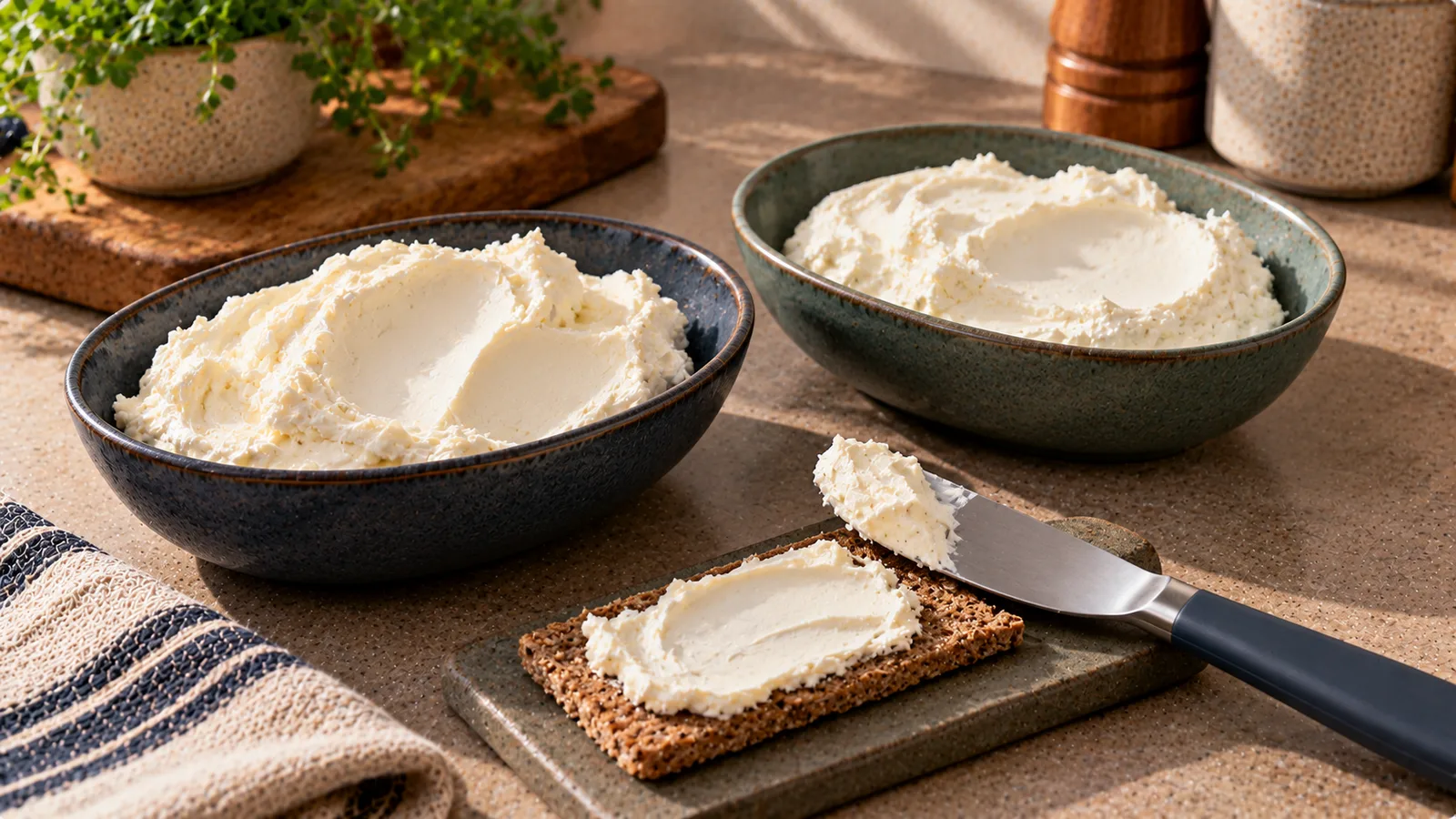
Cream cheese is relatively calorie-dense because much of its energy comes from fat. A small amount spread on bread or a bagel can therefore contribute more calories than its volume might suggest.
The exact nutrition varies by brand, fat level and formulation, so the package label should be used when you need precise numbers.
As a practical reference, regular plain cream cheese often provides approximately 340–350 kcal per 100 g.
Cream cheese calories at a glance
Using approximately 342 kcal per 100 g as an example:
| Amount | Approx. calories |
|---|---|
| 10 g | 34 kcal |
| 15 g | 51 kcal |
| 20 g | 68 kcal |
| 30 g | 103 kcal |
| 50 g | 171 kcal |
| 100 g | 342 kcal |
These values are estimates. Some regular cream cheeses are lower or higher depending on their fat and moisture content.
Nutrition in 100 g of cream cheese
A typical full-fat plain cream cheese may provide approximately:
| Nutrient | Per 100 g |
|---|---|
| Calories | 340–350 kcal |
| Protein | 5–7 g |
| Fat | 33–35 g |
| Carbohydrates | 4–6 g |
The largest share of calories generally comes from fat.
Because formulations differ, use these numbers as a reference rather than as universal values for every cream cheese.
Calories in 15 g of cream cheese
A 15 g portion of regular cream cheese contains roughly:
50 kcal
A portion this size can be enough for a thin spread on a slice of bread or toast.
However, visual estimates can be inaccurate. A thick spread may easily weigh considerably more than 15 g.
Calories in 30 g of cream cheese
A 30 g portion contains approximately:
100 kcal
Using the 342 kcal per 100 g example:
342 × 30 ÷ 100 = 102.6 kcal
Rounded, that is about 103 kcal.
This illustrates why weighing cream cheese can be useful when accurate food logging matters.
Calories in 50 g of cream cheese
At 342 kcal per 100 g:
342 × 50 ÷ 100 = 171 kcal
A 50 g serving can occur when cream cheese is used generously on a bagel, in a sandwich or as part of a recipe.
How to calculate calories for any amount
If your package lists calories per 100 g, use:
calories eaten = calories per 100 g × grams eaten ÷ 100
For example, suppose your cream cheese contains 335 kcal per 100 g and you use 24 g.
335 × 24 ÷ 100 = 80.4 kcal
You would log approximately 80 kcal.
This is more accurate than using a generic serving if you know the actual weight.
Regular vs light cream cheese
Light cream cheese generally contains less fat and therefore fewer calories than the regular full-fat version.
A simplified comparison might look like this:
| Type | Approx. calories per 100 g |
|---|---|
| Regular cream cheese | 340–350 kcal |
| Light cream cheese | about 200–270 kcal |
The range for light products is broad because manufacturers reduce fat to different levels and use different formulations.
Always compare the actual labels when choosing between products.
Example: regular vs light in a 30 g portion
Suppose:
- regular cream cheese = 342 kcal per 100 g;
- light cream cheese = 230 kcal per 100 g.
For 30 g:
Regular:
342 × 30 ÷ 100 = 103 kcal
Light:
230 × 30 ÷ 100 = 69 kcal
Difference:
103 - 69 = 34 kcal
The calorie difference becomes larger as the portion increases.
Why light cream cheese is not always the same
"Light" cream cheese is not one standardized recipe.
Products can differ in:
- fat percentage;
- water content;
- protein;
- added thickeners;
- carbohydrates;
- salt.
Two light cream cheeses can therefore have noticeably different calorie values.
Use the nutrition declaration for the specific product rather than assuming every light version has the same calories.
Cream cheese calories mostly come from fat
Fat provides approximately 9 kcal per gram, compared with approximately 4 kcal per gram for protein and carbohydrate.
Because full-fat cream cheese contains a substantial amount of fat, it has a relatively high calorie density.
For example, a product containing around 34 g fat per 100 g receives roughly:
34 × 9 = 306 kcal
from fat alone before accounting for protein and carbohydrates.
The exact calculation from macronutrients may not perfectly reproduce the calorie value printed on a label because of rounding and labeling rules.
How much protein is in cream cheese?
Cream cheese is a dairy product, but it is not usually a particularly concentrated protein source.
Regular cream cheese often contains approximately 5–7 g protein per 100 g.
At 6 g per 100 g, a 30 g serving would provide:
6 × 30 ÷ 100 = 1.8 g protein
So cream cheese should not be treated as nutritionally equivalent to higher-protein dairy foods simply because both are dairy products.
How much fat is in cream cheese?
Regular cream cheese commonly contains around 33–35 g fat per 100 g, although brands vary.
At 34 g fat per 100 g:
- 15 g contains about 5.1 g fat;
- 30 g contains about 10.2 g fat;
- 50 g contains about 17 g fat.
Reduced-fat and light products can contain substantially less.
How many carbs are in cream cheese?
Plain cream cheese is generally relatively low in carbohydrates.
A typical product may contain approximately 4–6 g carbohydrate per 100 g.
A 30 g serving would therefore contain only around 1–2 g carbohydrate.
Flavored varieties can be different, particularly products containing added sugar, fruit preparations or sweet flavorings.
Plain vs flavored cream cheese
Do not assume flavored cream cheese has the same nutrition as plain cream cheese.
Savory versions may contain ingredients such as:
- herbs;
- vegetables;
- garlic;
- spices.
Sweet versions may contain:
- sugar;
- fruit preparations;
- syrups;
- flavoring ingredients.
Added ingredients can change calories, carbohydrates, fat and sodium.
For accurate tracking, select the exact product whenever possible.
Does a tablespoon of cream cheese have a fixed weight?
Not perfectly.
A tablespoon is a volume measurement, while nutrition information is often most accurate by mass.
The amount that fits into a tablespoon depends on:
- how densely the cream cheese is packed;
- whether the spoon is level or heaped;
- texture and temperature;
- the exact spoon size.
A tablespoon may be useful for a rough estimate, but grams are preferable when precision matters.
Why visual portions can be misleading
Cream cheese is easy to spread thinly over a relatively large surface.
That makes it difficult to judge the weight by appearance.
Two slices of toast can look similarly covered while containing substantially different amounts.
For example:
- 15 g at 342 kcal/100 g = about 51 kcal;
- 30 g = about 103 kcal;
- 45 g = about 154 kcal.
The visual difference may seem modest even though the calorie amount triples between 15 g and 45 g.
Cream cheese on a bagel
The cream cheese is only one part of the meal.
Suppose a bagel contains 270 kcal and you add 40 g of cream cheese containing 342 kcal per 100 g.
Cream cheese:
342 × 40 ÷ 100 = 137 kcal
Total:
270 + 137 = 407 kcal
If you use 20 g instead:
342 × 20 ÷ 100 = 68 kcal
Total:
270 + 68 = 338 kcal
The amount of spread can therefore noticeably change the total.
Cream cheese on toast
Suppose two slices of bread provide 190 kcal in total.
You add 25 g cream cheese at 342 kcal per 100 g.
Cream cheese:
342 × 25 ÷ 100 = 85.5 kcal
Total:
190 + 86 = approximately 276 kcal
Any additional ingredients such as smoked salmon, jam, avocado or vegetables should be counted separately.
Cream cheese in recipes
When cream cheese is used in cheesecake, sauces, frosting or pasta dishes, calculate the amount added to the entire recipe.
For example, if a recipe contains 200 g cream cheese at 342 kcal per 100 g:
342 × 200 ÷ 100 = 684 kcal
Those 684 kcal belong to the entire batch.
If the finished recipe is divided into eight equal portions:
684 ÷ 8 = approximately 86 kcal per portion from the cream cheese alone
The other ingredients must then be added separately.
Whipped cream cheese can look lower in calories per spoon
Whipped products contain more incorporated air.
As a result, the same volume can weigh less than an equally sized spoonful of dense regular cream cheese.
This can reduce calories per tablespoon even when the nutrition per 100 g is not dramatically different.
For accurate comparisons, check whether the labels are expressed:
- per 100 g;
- per serving;
- by tablespoon or another volume measure.
Comparing products on the same weight basis gives a clearer picture of their calorie density.
Cream cheese vs cream cheese spread
Products sold as cream cheese spreads may have different formulations from traditional block cream cheese.
They can contain different amounts of:
- water;
- fat;
- protein;
- stabilizers;
- flavoring ingredients.
A softer spread can therefore have a different calorie value from a dense block product.
Do not automatically copy the nutrition values from one type to another.
Does cooking change the calories in cream cheese?
Heating cream cheese does not make its energy disappear.
If 100 g of cream cheese goes into a sauce, those calories remain part of the recipe unless some of the food is physically left behind or discarded.
What can change is the final weight of the dish as water evaporates or other ingredients are added.
That affects calories per 100 g of the finished food, even when the total calories in the recipe remain approximately the same.
Portion size matters more than the product name
Consider two products:
- regular cream cheese: 342 kcal per 100 g;
- light cream cheese: 230 kcal per 100 g.
If you eat 15 g regular:
342 × 15 ÷ 100 = 51 kcal
If you eat 35 g light:
230 × 35 ÷ 100 = 81 kcal
The light product has fewer calories per 100 g, but the larger portion contains more calories in this example.
Both calorie density and portion size matter.
How to log cream cheese accurately
For a packaged product:
- Check the exact product label.
- Identify whether the nutrition is listed per 100 g or per serving.
- Weigh the amount you actually use when practical.
- Calculate from the labeled value.
- If using a food database, make sure the entry matches the correct regular, light or flavored version.
For example:
Label: 315 kcal per 100 g
Amount eaten: 27 g
315 × 27 ÷ 100 = 85 kcal
That is usually more useful than relying on a generic entry for "one serving."
When a generic value is good enough
You may not always know the exact brand or weight.
For example, cream cheese may be served at:
- a café;
- a hotel breakfast;
- a restaurant;
- someone else's home.
In that situation, a generic estimate can be reasonable.
The important point is to treat it as an estimate rather than adding false precision.
A visibly thin spread and a very thick restaurant-style spread should not automatically be logged as the same amount.
Quick reference
Using approximately 342 kcal per 100 g for regular plain cream cheese:
| Portion | Approx. calories |
|---|---|
| 10 g | 34 kcal |
| 15 g | 51 kcal |
| 20 g | 68 kcal |
| 25 g | 86 kcal |
| 30 g | 103 kcal |
| 40 g | 137 kcal |
| 50 g | 171 kcal |
| 75 g | 257 kcal |
| 100 g | 342 kcal |
For a specific product, replace 342 with the value printed on its label.
The practical takeaway
Regular cream cheese typically provides around 340–350 kcal per 100 g, while light versions can be substantially lower in calories because they contain less fat.
For everyday tracking, the amount used is often more important than whether a serving looks "small."
If accuracy matters, weigh the cream cheese in grams and calculate from the nutrition label of the specific product. That avoids uncertainty from tablespoons, thick spreads and differences between regular, light and flavored varieties.
Nutrition data sources and product differences
The records below describe only the named foods, fat levels and preparation states. USDA figures are per 100 g; manufacturer figures retain their stated unit. These sources do not independently prove every approximate figure in the article.
The USDA entries listed here refer to regular cream cheese. Light cream cheese requires its own product-specific value.
USDA FoodData Central (search by FDC ID):
- FDC 173418 — Cheese, cream (350 kcal/100 g)
- FDC 2346385 — Cream cheese, full fat, block (336.73 kcal/100 g)