
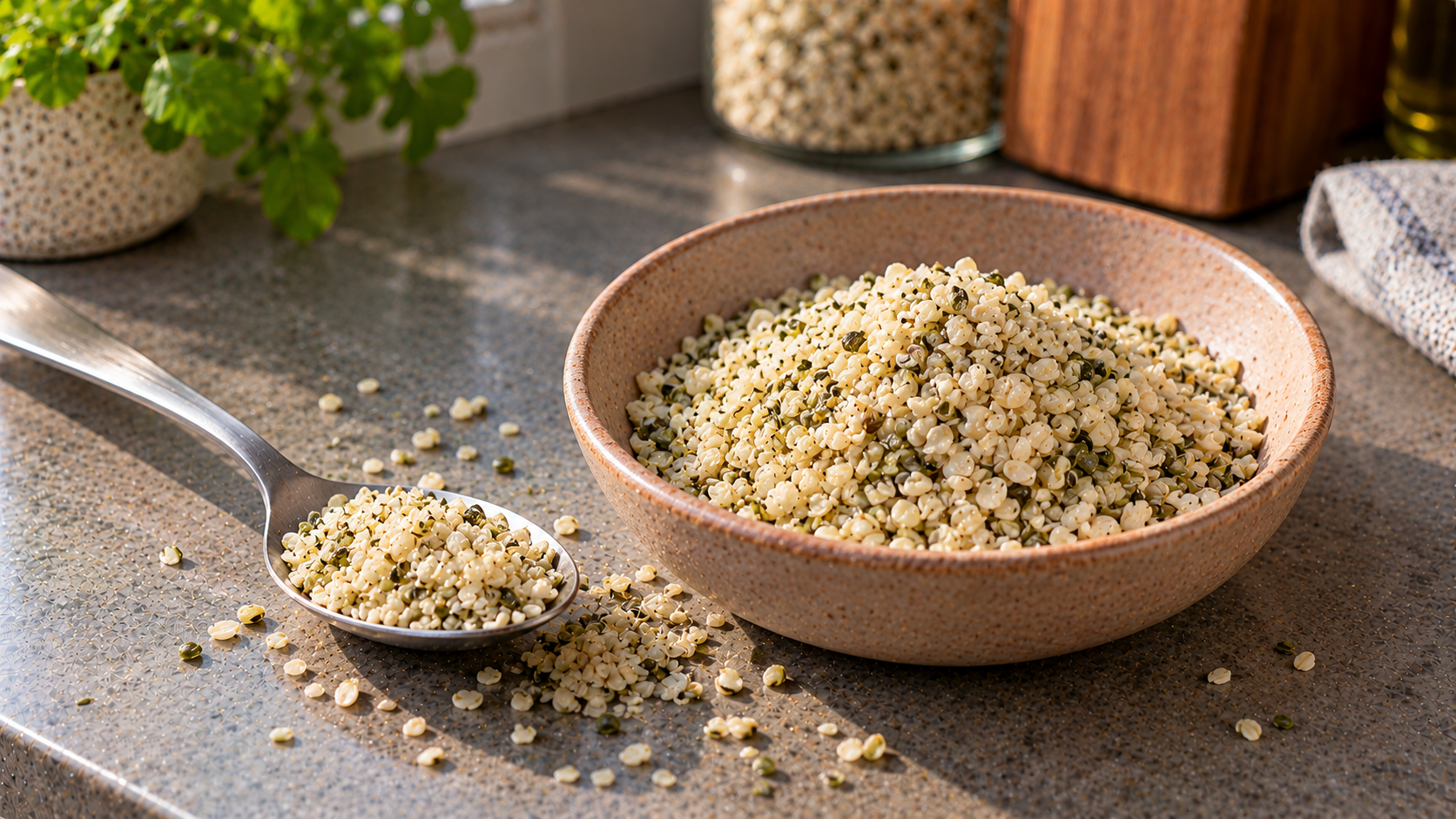
Hemp seeds are edible seeds commonly sprinkled over yogurt, porridge and salads.
This article uses a reference for hulled hemp seeds, often sold as hemp hearts, with approximately 553 kcal per 100 g.
Whole hemp seeds with their outer hulls and hemp seed oil require different food-composition references.
Calories by edible raw portion
| Edible weight | Calories |
|---|---|
| 10 g | 55.3 kcal |
| 15 g | 83 kcal |
| 20 g | 110.6 kcal |
| 25 g | 138.3 kcal |
| 30 g | 165.9 kcal |
| 50 g | 276.5 kcal |
| 100 g | 553 kcal |
Nutrition per 100 g
| Nutrition per 100 g | |
|---|---|
| Calories | 553 kcal |
| Protein | 31.56 g |
| Fat | 48.75 g |
| Carbohydrates | 8.67 g |
| Fiber | 4 g |
Hulled hemp hearts are not identical to whole seeds
Hulled hemp hearts have had the outer shell removed, changing the balance of fiber and other nutrients per 100 g.
Whole hemp seeds retain the hull, while hemp seed oil contains concentrated fat rather than the whole seed's protein and fiber.
For calorie tracking, choose the exact product on the label.
The numbers on this page should not automatically be used for hemp protein powder or ready-to-drink products.
Product forms differ substantially in fat, protein and water content.
Small portions contain meaningful calories
At approximately 553 kcal per 100 g, 10 g hemp hearts contribute about 55 kcal.
A 20 g portion provides roughly 111 kcal, while 30 g provides about 166 kcal.
These figures illustrate why small seed toppings should be weighed when monitoring energy intake.
A heaped tablespoon may not match the weight assumed in a recipe.
For yogurt with fruit and seeds, count all components separately rather than assigning the energy of the whole bowl to the seeds.
Protein and fatty acids
The selected hulled-seed reference contains approximately 31.6 g protein and 48.8 g fat per 100 g. USDA FoodData Central.
The plant omega-3 in hemp seeds is mainly ALA, not marine EPA/DHA; the omega-3 food guide puts these sources in context.
A 20 g serving therefore provides about 6.3 g protein and 9.8 g fat.
Hemp hearts contain unsaturated fatty acids, including omega-6 and some omega-3 fatty acids.
The exact fatty acid amounts vary by product.
Hemp seeds are not equivalent to fish oil or algae-derived omega-3 supplements merely because both may contain omega-3 compounds. NIH ODS — Omega-3 Fatty Acids.
Hemp seeds in meals and storage
Hemp hearts have a mild nutty flavor and can be added to salads, cereal bowls or homemade sauces.
Because they contain substantial fat, their energy contribution can be important even in a small garnish.
Their oils may deteriorate during poor storage. Follow the manufacturer's recommendations and avoid products that smell rancid.
For recipes containing additional nuts, oil or nut butter, calculate the complete mixture.
The best portion is determined by the meal and nutrition goals rather than a universal spoon-count rule.
How to compare hemp hearts with other toppings
A topping should be evaluated by the portion you actually eat, not only by its label per 100 g. Two tablespoons of different seeds may weigh different amounts, and a serving of nuts or granola may contribute a different balance of energy, protein and fiber. Hemp hearts can add substantial protein to a dish, but their fat content also means that the calorie contribution is easy to underestimate.
For example, adding 20 g of hulled hemp hearts to 200 g plain yogurt changes the yogurt bowl by approximately 111 kcal, 6.3 g protein and 9.8 g fat. The yogurt's own values, any fruit and sweeteners remain separate. This is a calculation using the reference food, not a prediction about all branded hemp seeds.
Fiber values and label differences
The reference for hulled hemp hearts used here contains roughly 4 g fiber per 100 g. That translates to about 0.8 g in 20 g. Whole hemp seeds can retain more fiber because the outer shell has not been removed. A product advertised as “hemp seeds” may mean hulled hearts or seeds with hulls, so read the ingredient description carefully.
USDA total carbohydrate figures include fiber, while EU nutrition labels ordinarily show available carbohydrate and fiber separately. Do not interpret these two reporting conventions as a laboratory disagreement. For a packaged seed product in Germany, France or elsewhere, prefer its exact per-100-g label for your food log.
Are hemp seeds a complete meal?
A small seed topping is not a complete meal. Hemp hearts contribute protein and unsaturated fat, but the meal's overall energy, fiber, micronutrients and satiety depend on other foods as well. A balanced bowl could include oats, fruit and a dairy or fortified plant-based food alongside a measured quantity of hemp hearts.
Hemp hearts are ordinary edible food, not the same as CBD preparations. Their protein content does not imply a proven treatment for hormonal, digestive or other medical conditions. People with specific allergies should check ingredient and cross-contact statements on the pack.
Practical portion checklist
Weigh hulled hearts before sprinkling, especially when using several toppings. Record the full amount actually eaten. Distinguish hulled hearts, whole seeds, hemp protein powder and oil. If a recipe produces several servings, calculate all ingredients first and divide according to portion weights. Store the remaining product as instructed by the manufacturer.
How to calculate a portion
Use the edible grams multiplied by the reference calories per 100 g, divided by 100. For cooked or processed products, use a nutrition entry corresponding to the actual preparation state. Oils, sauces and other ingredients must be counted separately. The values here are rounded references, not guarantees for every product.
Sources
- USDA FoodData Central — food composition data.
- EU Regulation 1169/2011 — food information and nutritional labeling.