
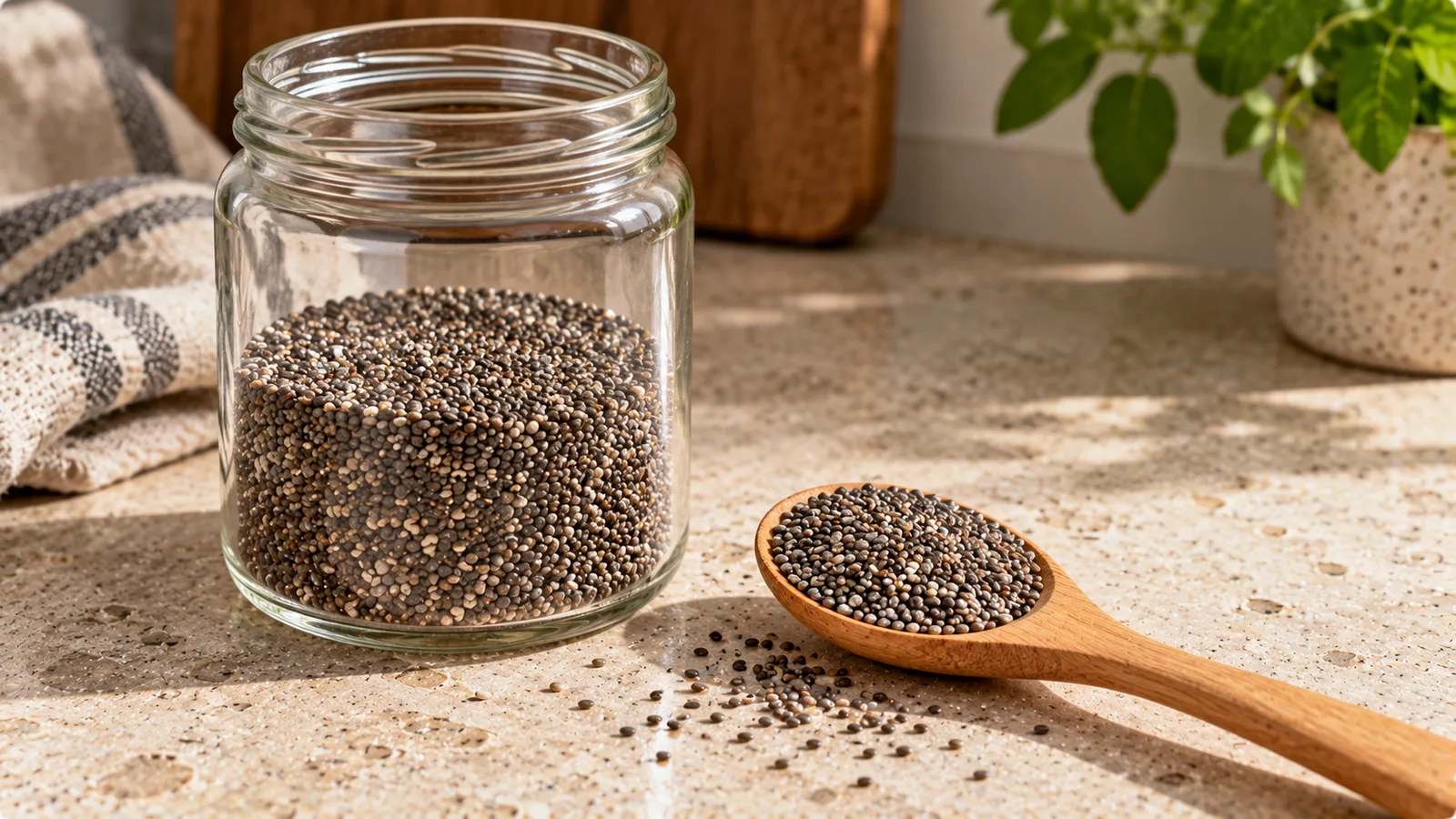
Chia seeds are small, but their nutritional contribution can be substantial. They contain fat, dietary fiber, protein and several minerals. Because they are often sprinkled onto meals rather than eaten as a main ingredient, their calories are easy to overlook.
For ordinary dried chia seeds, a widely used reference value is approximately 486 kcal per 100 g. This corresponds to about 73 kcal in a 15 g portion and 146 kcal in a 30 g portion.
These figures are estimates based on generic food-composition data. Actual products and household spoon measurements can differ.
Chia seed calories by serving size
The following table uses 486 kcal per 100 g, equivalent to 4.86 kcal per gram.
| Amount of dry chia seeds | Estimated calories |
|---|---|
| 1 g | 5 kcal |
| 1 teaspoon, approximately 4 g | 19 kcal |
| 2 teaspoons, approximately 8 g | 39 kcal |
| 1 tablespoon, approximately 12 g | 58 kcal |
| 15 g | 73 kcal |
| 20 g | 97 kcal |
| 25 g | 122 kcal |
| 30 g | 146 kcal |
| 40 g | 194 kcal |
| 50 g | 243 kcal |
| 100 g | 486 kcal |
The spoon weights are illustrative, not standardized measurements. Seed size, spoon shape and how full the spoon is can change the weight.
For accurate tracking, weigh dry seeds before adding water, milk or yogurt.
The calculation is straightforward:
Calories = grams of dry chia seeds × 4.86.
For example, 18 g provides approximately:
18 × 4.86 = 87 kcal.
The most appropriate value for a packaged product is the value declared on its nutrition label.
Nutrition per 100 grams
A commonly cited generic composition for dried chia seeds is approximately:
| Nutrient | Per 100 g |
|---|---|
| Energy | 486 kcal |
| Protein | 16.5 g |
| Total fat | 30.7 g |
| Total carbohydrate, including fiber in US data | 42.1 g |
| Dietary fiber | 34.4 g |
| Carbohydrate excluding fiber, calculated difference | 7.7 g |
| Calcium | 631 mg |
| Magnesium | 335 mg |
| Phosphorus | 860 mg |
These are rounded reference values for generic dried chia seeds, not guaranteed values for every brand.
The carbohydrate figure requires special care: some US food-composition databases report total carbohydrate including dietary fiber, while EU nutrition labels report carbohydrate separately from fiber.
Consequently, 42.1 g of total carbohydrate from a US database should not be directly compared with 42.1 g of carbohydrate on an EU label.
The 7.7 g figure above is an arithmetic difference, not a laboratory measurement of available carbohydrate.
Source for generic food composition: USDA FoodData Central.
What does a 15 g serving provide?
Using the generic values above, 15 g of dried chia seeds provides approximately:
| Nutrient | Estimated amount |
|---|---|
| Calories | 73 kcal |
| Protein | 2.5 g |
| Fat | 4.6 g |
| Dietary fiber | 5.2 g |
| Calcium | 95 mg |
| Magnesium | 50 mg |
| Phosphorus | 129 mg |
A 15 g portion is relatively small in energy but can contribute meaningful dietary fiber.
It is not a complete meal. Chia seeds alone do not provide the full balance of protein, energy and other nutrients needed in a typical breakfast or lunch.
What does a 30 g serving provide?
Doubling the dry quantity to 30 g approximately doubles the nutritional contribution:
| Nutrient | Estimated amount |
|---|---|
| Calories | 146 kcal |
| Protein | 5.0 g |
| Fat | 9.2 g |
| Dietary fiber | 10.3 g |
| Calcium | 189 mg |
| Magnesium | 101 mg |
| Phosphorus | 258 mg |
A 30 g serving may be reasonable in some recipes, but it is not automatically the best portion for everyone.
People who are not accustomed to fiber-rich foods may prefer smaller amounts and a gradual increase, with adequate fluid intake.
Why are chia seeds calorie-dense?
Chia seeds contain a substantial amount of fat, and fat contributes more energy per gram than protein or digestible carbohydrate.
However, the presence of fat does not mean that chia seeds are nutritionally equivalent to cooking oil.
Whole chia seeds also provide fiber, protein and minerals. Their fat includes alpha-linolenic acid, or ALA, a plant-based omega-3 fatty acid.
A food can be calorie-dense and still contribute useful nutrients. The important question is how much of it fits into the meal and the overall dietary pattern.
Omega-3 fats in chia seeds
Chia seeds are known for their ALA content.
ALA is an essential omega-3 fatty acid. The body can convert some ALA into the longer-chain omega-3 fatty acids EPA and DHA, but conversion is limited and varies between individuals.
Therefore, chia seeds should not be described as nutritionally identical to oily fish or algae-based EPA/DHA sources.
The amount of ALA in a serving depends on the seed composition and portion weight.
For meal planning, chia seeds can contribute plant-based omega-3 fats, but they should not be presented as a treatment for medical conditions.
Fiber and digestion
One of the most distinctive features of chia seeds is their high dietary-fiber content.
A 15 g serving may provide roughly 5 g of fiber, while 30 g may provide about 10 g.
Fiber can contribute to digestive function and the overall quality of a varied diet. However, increasing fiber too quickly may cause bloating, gas or abdominal discomfort in some people.
If you are introducing chia seeds for the first time, begin with a modest amount rather than immediately adding large portions to several meals.
Chia seeds absorb liquid and form a gel-like texture. Avoid swallowing a spoonful of dry chia seeds followed by water, particularly if you have swallowing difficulties; prepare them safely as part of a moist food or hydrated mixture.
Dry chia seeds versus soaked chia seeds
Soaking chia seeds changes their weight and texture, but it does not create additional calories.
Imagine you mix:
- 20 g dry chia seeds.
- 180 g water.
The mixture weighs approximately 200 g before any losses or additions.
The chia seeds contribute about:
20 × 4.86 = 97 kcal.
Water contributes zero calories.
The prepared mixture therefore still contains approximately 97 kcal, even though it now weighs around 200 g.
Its calorie density is approximately:
97 ÷ 200 × 100 = 49 kcal per 100 g prepared mixture.
This is a recipe-specific calculation, not the calorie value of every chia pudding.
If you replace water with milk, plant milk, yogurt or juice, their calories must be added.
Chia pudding calories depend on the recipe
A chia pudding may contain far more calories than its seeds alone.
Consider a hypothetical pudding:
| Ingredient | Quantity | Illustrative calories |
|---|---|---|
| Dry chia seeds | 25 g | 122 kcal |
| Unsweetened milk or plant drink | 200 ml | 60 kcal |
| Berries | 80 g | 40 kcal |
| Honey | 10 g | 30 kcal |
| Total | — | 252 kcal |
The values for the milk or plant drink, berries and honey are illustrative. Their actual calories depend on the products used.
The correct calculation is the sum of all ingredients, not the calories of chia seeds multiplied by the total weight of the finished pudding.
Chia seeds in yogurt, oatmeal and smoothies
Chia seeds are often used in small quantities as toppings.
For example:
- Adding 10 g to yogurt contributes approximately 49 kcal.
- Adding 15 g to oatmeal contributes approximately 73 kcal.
- Adding 20 g to a smoothie contributes approximately 97 kcal.
The finished meal may be much higher in calories depending on the base ingredients.
A smoothie containing fruit, milk, nut butter and chia seeds should be calculated ingredient by ingredient.
Likewise, a bowl of oatmeal with chia seeds is not necessarily lower or higher in calories than another breakfast. Portion sizes determine the result.
Do chia seeds help with weight management?
Chia seeds can be included in a weight-management diet because they provide fiber and can be used in measured portions.
However, they do not automatically cause weight loss.
A large portion still adds calories, and adding chia seeds on top of an unchanged diet increases energy intake unless something else changes.
For someone tracking calories, a practical approach is to decide on the dry weight first and then account for it in the meal.
For example, reducing a topping from 30 g to 15 g changes the estimated contribution from 146 kcal to 73 kcal, a difference of approximately 73 kcal.
This is a portion calculation, not a recommendation that everyone should use the smaller amount.
Chia seeds versus flaxseed
Chia and flaxseed are both fiber-rich seeds containing plant-based omega-3 fats.
Their nutritional profiles are not identical, and the most appropriate choice depends on the recipe, preparation method and nutritional priorities.
Chia seeds readily form a gel in liquid and are often used for puddings.
Flaxseed is frequently used ground, particularly when the goal is to make its nutrients more accessible.
Comparing the foods fairly requires equal dry weights and the same type of nutritional data. Comparing one tablespoon of chia with one tablespoon of ground flax can be misleading because spoon weights differ.
Black chia versus white chia
Black and white chia seeds are commonly sold as different color varieties.
Color alone is not a reliable basis for assigning substantially different calorie values.
For routine tracking, use the nutrition label on the package or an appropriate generic reference when product-specific data are unavailable.
Claims that one color is dramatically healthier than the other should be treated cautiously unless supported by meaningful product-specific evidence.
How to measure chia seeds accurately
The most reliable method is to weigh them dry.
- Place a small bowl on a kitchen scale.
- Reset the scale to zero.
- Add the desired quantity of dry seeds.
- Record the weight.
- Add the seeds to your meal.
If a scale is unavailable, spoon measurements can provide a rough estimate, but they are less precise.
Be particularly careful when a recipe uses tablespoons while your food diary expects grams.
A tablespoon is a volume measure, not a fixed weight for every food.
How to use chia seeds in meal planning
Chia seeds are versatile because they can be added to several kinds of meals:
- Yogurt with fruit.
- Oatmeal or overnight oats.
- Smoothies.
- Chia pudding.
- Homemade bread or baked goods.
- Moist sauces or other suitable recipes.
They can contribute fiber and fat without requiring a complicated recipe.
However, a meal consisting mainly of chia seeds and liquid may not provide enough protein or energy for a particular person's needs.
Evaluate the whole meal rather than focusing on a single ingredient.
Common tracking mistakes
Using soaked weight as dry weight. Water increases the mixture's mass without adding calories.
Assuming all tablespoons weigh the same. Spoon size and filling level vary.
Forgetting toppings. Honey, nuts, milk and fruit contribute their own calories.
Confusing US and EU carbohydrate values. US total carbohydrate may include fiber, while EU labels separate it.
Assuming healthy foods are calorie-free. Chia seeds provide useful nutrients and substantial energy.
Copying another brand's label without checking. Products may differ slightly in their declared values.
Sources and data interpretation
- USDA FoodData Central — food-composition database used for generic chia-seed nutrient estimates.
- NIH Office of Dietary Supplements: Nutrient Recommendations — background on dietary reference values.
- Regulation (EU) No 1169/2011 — EU food-information and nutrition-labeling rules.
Nutritional values in this article are rounded estimates for ordinary dried chia seeds. Calculations for prepared foods depend on the exact ingredients, their labels and the amount consumed.
The practical conclusion
Dry chia seeds provide approximately 486 kcal per 100 g, or about 73 kcal per 15 g and 146 kcal per 30 g.
They are a concentrated source of energy, fiber and plant-based fats. Their usefulness depends on the portion and the rest of the meal.
For accurate calorie tracking, measure the dry seeds, account for every ingredient in the recipe and use the package label when available. Soaking changes the weight and texture, not the total calories contributed by the seeds.