
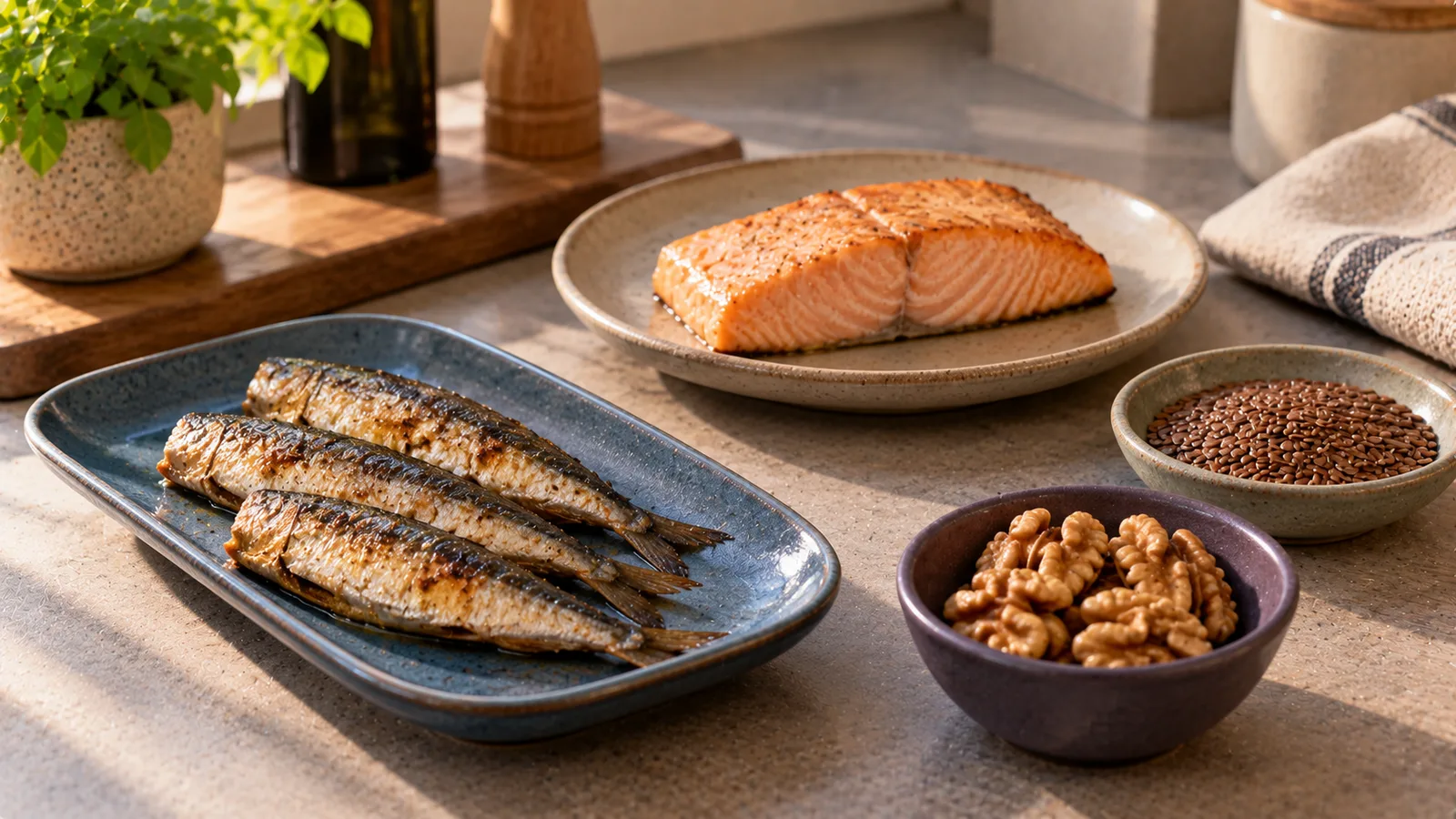
Omega-3 fats are a family of polyunsaturated fatty acids found in both plant and animal foods.
The term "omega-3" does not refer to just one nutrient. The three forms most commonly discussed in nutrition are:
- ALA — alpha-linolenic acid;
- EPA — eicosapentaenoic acid;
- DHA — docosahexaenoic acid.
Understanding the difference matters because foods provide these forms in very different amounts.
ALA, EPA and DHA at a glance
| Omega-3 | Main food sources | What to know |
|---|---|---|
| ALA | Flaxseed, chia seeds, walnuts, rapeseed/canola oil, some other plant foods | Essential fatty acid obtained from food |
| EPA | Oily fish and seafood | Long-chain omega-3 |
| DHA | Oily fish and seafood | Long-chain omega-3 |
ALA is considered essential because the body cannot make it and therefore needs to obtain it from the diet.
The body can convert some ALA into EPA and DHA, but this conversion is limited. For that reason, plant sources of ALA and direct food sources of EPA and DHA are not nutritionally identical.
Foods high in EPA and DHA
Fatty or oily fish are among the most concentrated common food sources of EPA and DHA.
Examples include:
- salmon;
- sardines;
- herring;
- mackerel;
- trout;
- anchovies.
The exact omega-3 content varies with species, origin, feed, season and preparation.
Rather than assuming that all fish contain the same amount, it is more useful to think of oily fish as generally richer in long-chain omega-3s than many lean fish.
Salmon
Salmon is one of the best-known food sources of EPA and DHA.
A typical serving can provide a substantial amount of long-chain omega-3 fats, although the exact quantity differs between wild and farmed salmon and between individual products.
Salmon also provides protein and several micronutrients, making it more than simply an "omega-3 food."
It can be:
- baked;
- grilled;
- poached;
- added to salads;
- served with potatoes, rice or vegetables.
Sardines
Sardines are another concentrated source of EPA and DHA.
They are convenient because canned sardines require little preparation and can be stored for long periods.
They can be used in:
- toast or sandwiches;
- salads;
- pasta;
- grain bowls;
- simple meals with potatoes and vegetables.
When comparing canned products, remember that the liquid or oil in the can can affect the total calories of the portion depending on how much is eaten or drained.
Herring and mackerel
Herring and mackerel are also oily fish that can provide substantial long-chain omega-3 fats.
Preparation matters for the overall nutritional profile.
For example, products may be:
- fresh;
- smoked;
- pickled;
- canned;
- served in sauces.
Salt, added oil and sauces can vary considerably between products even when the underlying fish is similar.
If you are comparing packaged versions, read the full nutrition label rather than evaluating the food only by its omega-3 content.
Trout
Trout can contribute EPA and DHA and is widely available in many European markets.
As with other fish, the exact fatty-acid composition depends on the species and production conditions.
A simple meal could combine trout with:
- potatoes;
- whole grains;
- vegetables;
- salad;
- beans or lentils as part of a larger meal.
Omega-3 intake does not require building an entire meal around a single nutrient.
Plant foods containing ALA
People who do not eat fish can still obtain the essential omega-3 fatty acid ALA from plant foods.
Useful sources include:
- flaxseed;
- chia seeds;
- walnuts;
- rapeseed or canola oil;
- soybean oil;
- soy foods in smaller amounts;
- some fortified foods.
These foods provide ALA rather than the same EPA and DHA profile found in oily fish.
Flaxseed
Flaxseed is particularly rich in ALA.
Ground flaxseed is often easier to incorporate into ordinary meals than whole seeds.
It can be added to:
- porridge;
- yogurt;
- skyr;
- smoothies;
- homemade bread;
- muesli.
Flaxseed is also energy-dense, like other seeds. That does not make it unhealthy, but portions still contribute to total energy intake.
Chia seeds
Chia seeds are another plant source of ALA.
They can be mixed into:
- yogurt;
- oats;
- puddings;
- smoothies;
- breakfast bowls.
They also contribute fiber and other nutrients.
Again, the relevant omega-3 is mainly ALA, so chia seeds should not be described as nutritionally identical to fish-derived EPA and DHA.
Walnuts
Walnuts provide ALA and can be an easy way to add omega-3 fats to an ordinary diet.
They can be eaten:
- as a snack;
- with yogurt;
- in porridge;
- in salads;
- in baked dishes.
Nuts are calorie-dense, so a small portion can provide meaningful energy.
That is not a reason to avoid them. It is simply useful context when combining them with other foods.
Rapeseed and canola oil
Rapeseed oil, commonly used in Europe, and canola oil are useful sources of ALA.
They can be practical everyday cooking oils and can also be used in dressings.
Oils are nearly entirely fat and therefore energy-dense. A tablespoon contributes considerably more calories than the same weight of most vegetables or grains.
When tracking food intake, include cooking oils rather than treating them as nutritionally invisible.
Are plant omega-3s the same as fish omega-3s?
No.
Plant foods such as flaxseed, chia seeds and walnuts mainly provide ALA.
Oily fish mainly provide EPA and DHA.
The body can convert ALA into longer-chain omega-3 fatty acids, but conversion is limited and varies between individuals.
This is why it is misleading to compare foods only by the total number of grams labeled "omega-3" without considering which fatty acids they contain.
What about people who do not eat fish?
A diet without fish can still contain ALA through foods such as:
- flaxseed;
- chia seeds;
- walnuts;
- rapeseed oil;
- other suitable plant foods.
Some foods are also fortified with omega-3 fats.
People following vegetarian or vegan diets may encounter foods containing DHA or EPA derived from algae.
The nutritional needs of an individual can depend on age, pregnancy, medical conditions and other factors. Questions about supplements or specific therapeutic doses are better discussed with an appropriate healthcare professional rather than inferred from a general food guide.
Fortified foods
Some products are fortified with omega-3 fatty acids.
Depending on the market, examples can include certain:
- eggs;
- dairy products;
- plant-based alternatives;
- spreads;
- beverages.
Do not assume that a product marketed with an omega-3 claim contains the same type or amount as oily fish.
Check the label.
A fortified product may contain:
- ALA;
- DHA;
- EPA;
- a combination.
The actual quantity matters more than the front-of-package wording.
Eggs and omega-3
Ordinary eggs contain fat, but they are not usually among the most concentrated sources of long-chain omega-3s.
Some eggs are specifically produced or marketed as omega-3 enriched.
Their fatty-acid composition can differ from standard eggs because of the hens' feed.
If omega-3 content is important to your comparison, use the information for the specific product rather than assuming all eggs provide the same amount.
Does cooking destroy omega-3 fats?
Omega-3 fatty acids are unsaturated fats and can be susceptible to oxidation.
However, that does not mean that cooked fish suddenly stops being a useful omega-3 source.
Common cooking methods such as baking, grilling or pan-cooking can still leave the meal with meaningful amounts of EPA and DHA.
The exact effect depends on factors such as:
- cooking temperature;
- duration;
- food;
- added oils;
- storage conditions.
There is generally no need to eat fish raw simply to obtain omega-3 fats.
Omega-3 foods are still whole foods with complete nutrition profiles
A common mistake in nutrition is reducing a food to one nutrient.
Salmon is not just EPA and DHA.
Walnuts are not just ALA.
Chia seeds are not just omega-3.
These foods also contain different combinations of:
- protein;
- carbohydrates;
- fiber;
- vitamins;
- minerals;
- other fats;
- calories.
A useful diet therefore considers the entire food and the overall eating pattern rather than maximizing one nutrient in isolation.
Omega-3 fats and other dietary fats
Omega-3 fatty acids are polyunsaturated fats.
That places them within the broader category of unsaturated fats.
This is separate from the distinction between saturated and unsaturated fat.
Foods can contain several types of fatty acids at the same time. A food does not usually consist of only one type of fat.
For example, a piece of salmon contains a mixture of fatty acids rather than pure omega-3.
Similarly, walnuts contain ALA alongside other fats.
A practical food-first approach
You do not need to calculate every individual fatty acid in every meal to include omega-3 foods in your diet.
A practical approach is to regularly include appropriate sources from the foods you eat.
For someone who eats fish, that might include oily fish alongside a varied diet.
For someone who does not eat fish, regular plant sources of ALA can include:
- ground flaxseed;
- chia seeds;
- walnuts;
- rapeseed oil.
Fortified foods may provide additional options depending on the product.
Example combinations
Omega-3 sources can fit into ordinary meals without creating a special "omega-3 diet."
Examples include:
- salmon with potatoes and vegetables;
- sardines on whole-grain toast with salad;
- trout with rice and roasted vegetables;
- yogurt with ground flaxseed and fruit;
- oats with chia seeds and berries;
- salad with walnuts;
- vegetables dressed with rapeseed oil.
The purpose is not to make every meal high in omega-3.
It is to understand where different omega-3 fats come from and how those foods can fit into a varied eating pattern.
What to check on packaged foods
If a packaged food makes an omega-3 claim, look beyond the marketing language.
Check:
- the serving size;
- the amount of omega-3 stated;
- whether the label identifies ALA, EPA or DHA;
- the full nutrition profile;
- ingredients such as added oils, salt or sugar when relevant.
This makes comparisons between products more meaningful.
The main takeaway
Omega-3 fats include several different fatty acids.
ALA is found mainly in plant foods such as flaxseed, chia seeds, walnuts and rapeseed oil. EPA and DHA are found mainly in oily fish and seafood, with algae-derived sources also used in some foods.
The body can convert some ALA into EPA and DHA, but the conversion is limited, so the different food sources should not be treated as interchangeable.
Rather than focusing on one "best" omega-3 food, look at your overall eating pattern and include suitable sources regularly.
For individualized advice about supplements, therapeutic doses, pregnancy, medical conditions or specific nutrient deficiencies, consult an appropriate healthcare professional.
Sources
- European Food Safety Authority (EFSA), dietary reference values for fats including omega-3 fatty acids.
- U.S. National Institutes of Health Office of Dietary Supplements, Omega-3 Fatty Acids Fact Sheet.
- German Nutrition Society (DGE), guidance on dietary fats and fish consumption.