
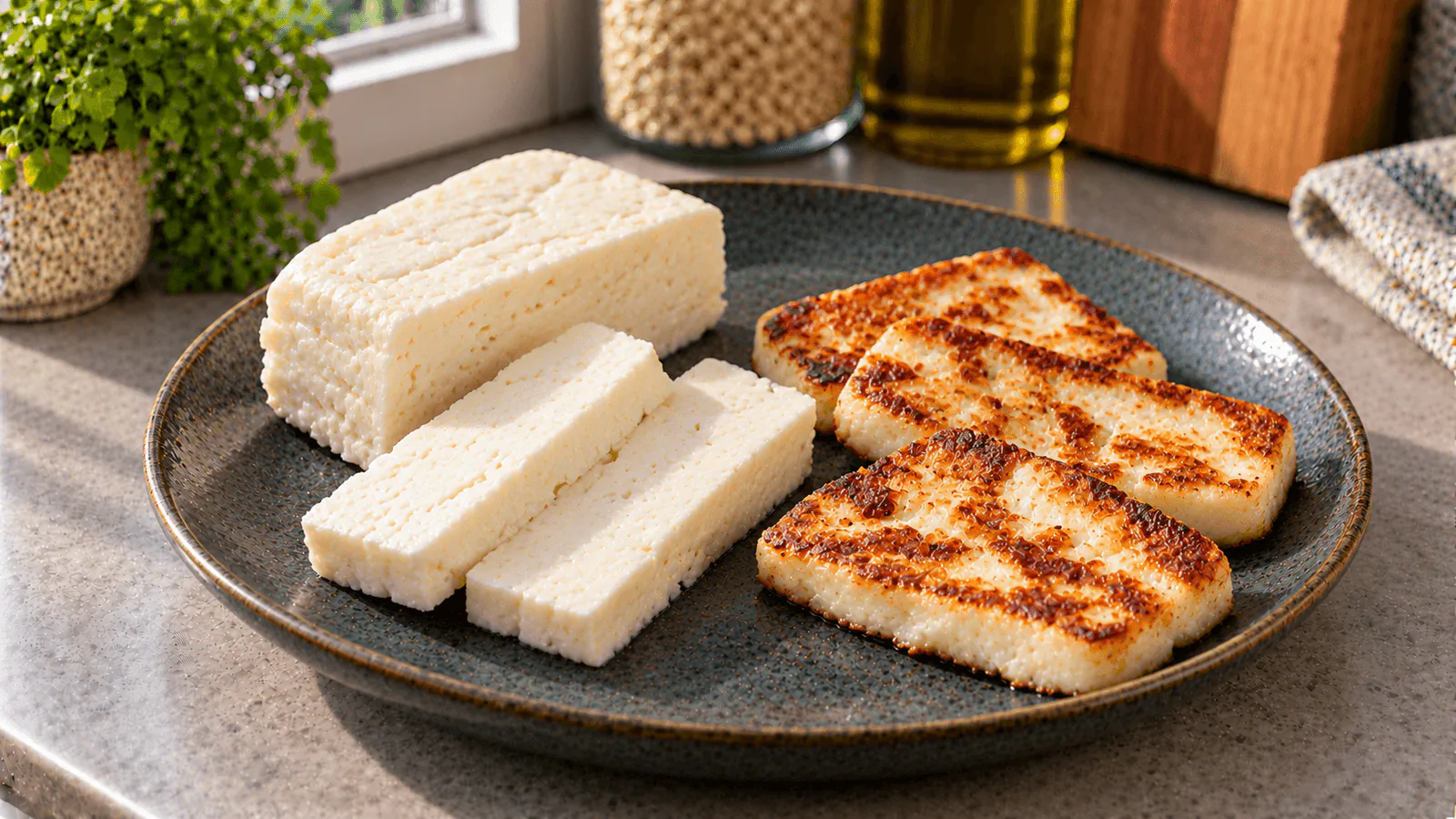
Halloumi is a firm, brined cheese commonly grilled or pan-fried because it holds its shape when heated. For a verified label-based example, DODONI halloumi supplies 316 kcal per 100 g, with 23 g protein, 24 g fat and 2.5 g salt. That works out to approximately 158 kcal for 50 g, 237 kcal for 75 g and 316 kcal for 100 g, before adding cooking oil, bread or sauce. These figures refer to the named product as sold; another halloumi may have a different recipe. This guide explains the nutrition, realistic slice sizes, the effect of grilling and the salt content without pretending that every packet has identical values.
Halloumi nutrition per 100 g: a traceable product example
Halloumi is traditionally made in Cyprus using milk, rennet and salt, often with mint. Producers may use different proportions of sheep, goat and cow's milk. Water and fat levels also vary. Instead of presenting a single anonymous average as if it were a universal food standard, the table below uses the published nutrition declaration for a named product: DODONI halloumi. The information describes cheese before any additional oil is absorbed during cooking.
| Nutrient | DODONI halloumi per 100 g |
|---|---|
| Energy | 316 kcal |
| Protein | 23 g |
| Total fat | 24 g |
| Saturated fat | 16 g |
| Carbohydrates | 2 g |
| Of which sugars | 2 g |
| Salt | 2.5 g |
The saturated-fat line is part of total fat, not an additional 16 g of fat. Likewise, the sugars are included within carbohydrates. Food labels use rounded quantities, so reconstructing calories from the displayed macronutrients may not reproduce 316 perfectly. Use the energy declaration for your exact packet when a reliable label is available. Halloumi contains milk and is unsuitable for someone with a milk-protein allergy; a vegetarian claim also depends on the rennet used in the specific product.
Calories in 30 g, 50 g, 75 g and larger halloumi portions
A slice may weigh 25–50 g, depending on the block and how thickly it is cut. Two pieces on a salad can easily represent a different quantity from the three slices in a restaurant wrap. Weigh the portion before cooking where possible. The following calculations use 316 kcal, 23 g protein and 24 g fat per 100 g from the DODONI example, rounded to the nearest calorie and one decimal place for macronutrients.
| Halloumi weight | Calories | Protein | Fat |
|---|---|---|---|
| 30 g | 95 kcal | 6.9 g | 7.2 g |
| 50 g | 158 kcal | 11.5 g | 12.0 g |
| 75 g | 237 kcal | 17.3 g | 18.0 g |
| 80 g | 253 kcal | 18.4 g | 19.2 g |
| 100 g | 316 kcal | 23.0 g | 24.0 g |
| 125 g | 395 kcal | 28.8 g | 30.0 g |
| 150 g | 474 kcal | 34.5 g | 36.0 g |
| 200 g | 632 kcal | 46.0 g | 48.0 g |
For example, 75 × 316 ÷ 100 = 237 kcal. A 50 g portion provides 50 × 23 ÷ 100 = 11.5 g protein. You can use the same formula with your own packet's per-100-g figures. A block weighing 200 g is a package size, not a recommended single serving. Our explanation of portion size versus serving size shows why the quantity in a pack, a suggested serving and the portion you actually eat often differ.
Does grilling or frying change halloumi calories?
Heat does not manufacture calories. If you grill a weighed 75 g piece on a dry, non-stick surface and eat the whole piece, its starting estimate is still about 237 kcal. But halloumi can lose water and some fat during heating. A piece may weigh less after grilling: simply applying 316 kcal per 100 g to its smaller cooked weight can underestimate what went into the pan. For a reliable diary entry, record the original cheese weight and any cooking fat separately; account for substantial fat that was visibly lost only when you have a defensible way to estimate it.
Oil makes the difference clearer. If a 75 g portion absorbs an estimated 5 g of olive oil, adding about 45 kcal at 9 kcal per gram gives an illustrative total of 282 kcal. That does not mean that every teaspoon of oil poured into a pan ends up on the cheese. Some may remain behind. Conversely, breading, honey, sweet chilli glaze or a dressing can raise the energy beyond the dry-grilled version. Record the amount you actually use and consume rather than assigning one universal figure to "fried halloumi." Grilling marks themselves provide no reliable information about how much oil was absorbed.
The cooked-weight trap
Imagine 100 g of cheese is grilled until it weighs 85 g. The moisture loss concentrates the nutrients per 100 g of finished cheese, but the energy in the original cheese has not necessarily fallen by 15%. Dividing an unaltered 316-kcal portion by 85 g would mathematically produce around 372 kcal per 100 g of that hypothetical cooked portion. This is not a new measured database entry, because cooking losses, especially any lost fat, have not been measured. It illustrates why raw and cooked weight entries must not be mixed. For recipe calculation, start with the ingredient's label and the amount purchased or added.
Why halloumi brands have different calories
DODONI lists 316 kcal per 100 g. A separate Tesco halloumi 225 g product declares 300 kcal per 100 g, 20.7 g protein and 22.5 g fat. A Tesco 30% Less Fat Halloumi listing reports 253 kcal per 100 g, 24 g protein and 17 g fat. These examples demonstrate variation among named products. They are not a measured market range, and an entirely different brand or seasoned grilling cheese may fall outside them.
To compare labels, make sure the figures refer to the cheese as sold, not a cooked recipe with oil, and use the same 100 g basis. A lower-fat version may have a different salt concentration, texture or cooking behaviour; "less fat" does not automatically mean "less salt." The milk blend, degree of moisture removal and product formulation all contribute. The product name "grilling cheese" also does not guarantee the same recipe as Cypriot halloumi. Whenever the pack is available, it should outrank a generic app entry.
Protein, saturated fat and salt: interpreting the numbers
With 23 g protein per 100 g, the reference halloumi contributes 17.3 g protein in 75 g. It can therefore make a meaningful contribution to a meal's protein, especially with vegetables or legumes. However, the same 75 g also contains about 18 g total fat, including 12 g saturated fat when calculated from the 16 g/100 g reference. Whether that is appropriate depends on the whole dietary pattern, not on labeling halloumi simply good or bad. Comparing cheese solely by protein per 100 g hides differences in calories and saturated fat.
Salt is especially worth checking. At 2.5 g salt per 100 g, a 50 g portion supplies 1.25 g salt and a 75 g portion 1.875 g salt, commonly rounded to about 1.9 g. If a label reports sodium instead, the usual approximate conversion is salt (g) = sodium (g) × 2.5. The two labels are not interchangeable units. Our guide to converting sodium to salt covers the calculation, including milligrams and grams. Rinsing or soaking may change the salt in some cheeses, but do not claim a specific percentage reduction without measured data for that product and method.
Halloumi compared with feta and mozzarella
Halloumi's firm texture allows it to be seared in slices without melting into a sauce. Crumbled feta behaves very differently, and mozzarella is usually chosen for softness or melting rather than the characteristic browned halloumi crust. Those cooking differences matter when deciding which product can replace another. They do not establish an automatic calorie ranking: different moisture and fat levels require label-by-label comparison. If a recipe calls for one of these cheeses, changing it can alter both the finished dish and the amount actually eaten.
For specific alternative ingredients, see the separate guides to feta nutrition and portions and mozzarella calories. This halloumi page focuses on slices and cooking, rather than copying nutritional tables from related cheeses. If you substitute 75 g feta for 75 g halloumi, remove the halloumi numbers and use the actual feta product's data; do not simply keep 237 kcal because the weight has stayed the same.
Worked meal: halloumi salad and a wrap
Consider a plate with 75 g halloumi, 200 g tomatoes and 10 g olive oil. The cheese supplies 237 kcal according to our reference. Assuming the tomatoes contribute 18 kcal per 100 g, their 200 g contribute 36 kcal. Ten grams of olive oil add roughly 90 kcal using an illustrative 9 kcal/g. The resulting arithmetic is 237 + 36 + 90 = 363 kcal, before bread, nuts, dressing or any additional toppings. If some of that oil remains on the grill pan, the consumed amount could be lower; these are transparent assumptions, not a laboratory analysis of a finished restaurant dish.
A halloumi wrap needs separate entries for the flatbread, cheese, vegetables, sauces and oil. A restaurant entry may already include all of them; adding an extra cheese portion on top of a complete meal estimate double-counts it. For home cooking, weighing a block before slicing provides a straightforward starting point. If a 200 g block is divided into four equal parts, each is 50 g and roughly 158 kcal from the DODONI reference alone. That simple method is more practical than estimating cooked slice dimensions from a photograph.
What to enter in a calorie tracker
Choose a branded halloumi entry when it matches your package. Enter the edible cheese weight before grilling, then account for oil and other ingredients. Use 316 kcal/100 g only for the DODONI-style reference described here; the named Tesco regular and lower-fat labels demonstrate why one online number does not fit every block. Keep cooked and uncooked weights consistent, check salt as well as protein, and avoid counting sauces twice if you are logging a completed recipe.
Sources and scope: DODONI halloumi nutrition label for the main table and serving arithmetic; Tesco regular halloumi label and Tesco reduced-fat halloumi listing for contrasting product-specific examples. Label values may change; always check the pack you buy.