
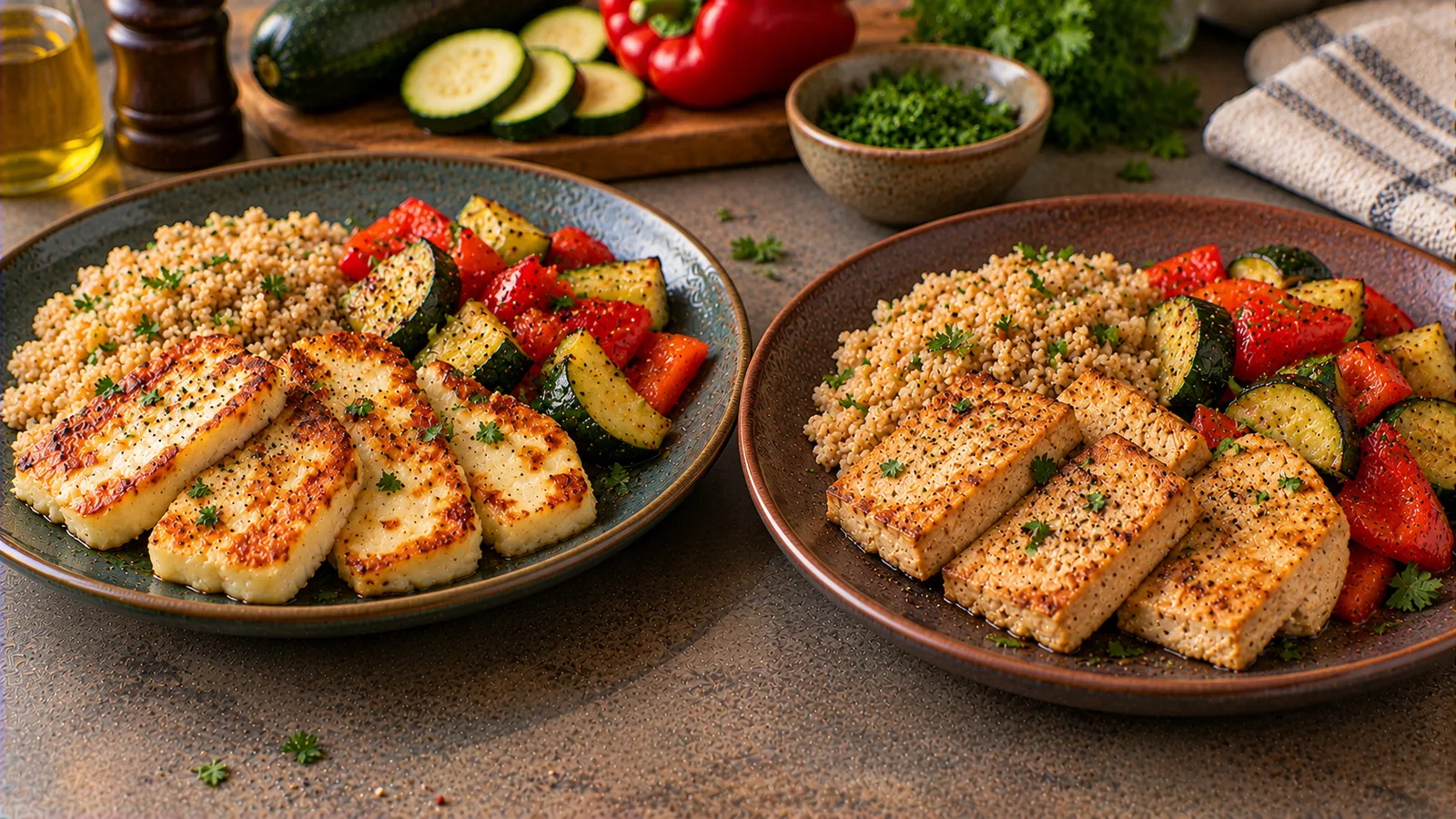
Halloumi and firm tofu both brown nicely in a pan, but they are not interchangeable nutritionally. Halloumi is a brined dairy cheese with a salty, squeaky bite; firm tofu is pressed soy curd with a mild flavour and usually much less salt. The meaningful dinner question is not simply which has more protein per 100 g, but how much of each delivers the same amount of protein, and what happens to salt, saturated fat and total meal composition.
This comparison uses two explicitly identified German retail labels: REWE Bio Halloumi from Cyprus and REWE Bio natural tofu. The figures are as sold, before frying, and describe these two products, not every halloumi or tofu worldwide. Check the pack you actually buy: brands, recipes and draining change the numbers.
At a glance: 100 g of each product
| Nutrient, as sold | REWE Bio halloumi, 100 g | REWE Bio natural firm tofu, 100 g |
|---|---|---|
| Energy | 318 kcal | 146 kcal |
| Protein | 22 g | 15 g |
| Total fat | 25.3 g | 8.5 g |
| Saturated fat | 15.2 g | 1.3 g |
| Salt, label equivalent | 2.4 g | 0.03 g |
Per 100 g, halloumi has more protein, yet it also has substantially more saturated fat and salt. Both foods can be part of a vegetarian dinner; the comparison is about a particular trade-off, not a claim that either food is inherently unhealthy or automatically causes weight gain. These figures do not include frying oil, sauces, bread or vegetables.
Same protein, different weights: 150 g halloumi versus 220 g tofu
A 150 g portion of the selected halloumi provides 33 g protein, because 150 × 22 ÷ 100 = 33. To reach the same 33 g protein using the tofu's 15 g per 100 g, you need 220 g tofu: 220 × 15 ÷ 100 = 33. This is a deliberately matched-protein comparison; equal weights are shown in the table above, but they answer a different question.
| As-sold amount needed for 33 g protein | Halloumi: 150 g | Tofu: 220 g |
|---|---|---|
| Protein | 33 g | 33 g |
| Energy | 477 kcal | 321.2 kcal |
| Total fat | 37.95 g | 18.7 g |
| Saturated fat | 22.8 g | 2.86 g |
| Salt | 3.6 g | 0.066 g |
The equal-protein halloumi portion contains 155.8 kcal more, 19.94 g more saturated fat and 3.534 g more label salt before adding anything else. The calculation is transparent: multiply the 100 g entry by 1.5 for halloumi or 2.2 for tofu. The tofu portion looks larger on the plate; it is 70 g heavier because this selected product has less protein per 100 g. The values remain label-based estimates, not laboratory tests of cooked portions.
This is also why a claim such as “halloumi is higher-protein than tofu” needs its comparison basis. Per 100 g of these packs it is higher; for the same 33 g protein, it is the salt and saturated fat difference—not protein itself—that most strongly separates the two choices. Protein per calorie also differs, although real diets should not be judged on a single ratio.
What does 3.6 g of salt mean at dinner?
The World Health Organization recommends adults consume less than 5 g salt per day, equivalent to less than 2 g sodium. The 3.6 g of salt in 150 g halloumi would account for 72% of that 5 g reference maximum before any salted bread, dressing, olives, stock or extra seasoning. The 0.066 g in 220 g tofu is about 1.3% of the same reference. These are shares of a population-level daily limit, not individual medical prescriptions or a measure of sodium removed by cooking.
EU labels usually display salt, which is a sodium-equivalent calculation rather than only added table salt. Avoid comparing one pack's “sodium” number directly with another pack's “salt” number: approximately 1 g salt corresponds to 400 mg sodium. If your goal is to lower meal salt, avoid adding salt to the halloumi pan and choose unsalted vegetables, fresh lemon, garlic, pepper and herbs. Tofu may pick up substantial sodium from soy sauce, miso or commercial marinades; the plain tofu comparison is not a guarantee about a seasoned tofu dinner.
Soaking or rinsing halloumi sometimes changes its surface flavour, but there is no verified salt-removal percentage here. Do not subtract a guessed amount from the nutrition table. Compare the actual food you use, and if the label differs, recalculate.
Saturated fat matters more than the label “vegetarian”
The cheese's saturated fat comes largely from milk fat; the tofu label shows mostly other fats. The German Nutrition Society's fat guideline describes why replacing saturated fats with polyunsaturated fats can improve blood-lipid measures and cardiovascular risk. The DGE reference overview similarly emphasises choosing more unsaturated in place of saturated fat. That does not classify one serving as disease-causing or turn tofu into a treatment; the overall diet over time matters.
In this example, 22.8 g saturated fat for a 150 g halloumi portion is a material amount from one ingredient. The 2.86 g in the protein-matched tofu is much lower. Cheese also contributes nutrients not enumerated in these two online labels, so the table should not be presented as a complete micronutrient comparison. Calcium content, for example, depends on the brand and tofu coagulant; without comparable labelled calcium figures, no reliable numeric “calcium winner” can be declared.
Neither product is especially close to zero fat. A spoonful of oil adds energy and fat to both plates, regardless of whether the base is cheese or tofu. Pan-browning tofu in a lot of oil can narrow the calorie gap; adding sauces can also dominate a meal's sugar or sodium. For a fair comparison, use the same amount of oil and comparable sides.
A smaller, practical matched-protein dinner
You do not need to eat 150 g of salty cheese to use halloumi at dinner. A simpler trial is 75 g halloumi versus 110 g tofu, giving 16.5 g protein from either ingredient. That smaller pair is exactly half of the matched-protein calculation above.
| Ingredient-only comparison | 75 g halloumi | 110 g firm tofu |
|---|---|---|
| Protein | 16.5 g | 16.5 g |
| Energy | 238.5 kcal | 160.6 kcal |
| Saturated fat | 11.4 g | 1.43 g |
| Salt | 1.8 g | 0.033 g |
The smaller halloumi serving still provides about 36% of the WHO's 5 g/day salt reference before other food is counted. Pair either protein with 200 g vegetables and 150 g cooked potatoes or another grain side, while noting that side values are not included in the comparison table. Those side amounts describe a repeatable plate, not an official ideal portion or a prescription for everyone.
For a different goal, consider combining a modest portion of halloumi with beans or lentils rather than multiplying the cheese weight to hit a high protein target. The extra legumes bring their own protein and fibre, while the amount of cheese—and its salt—remains controlled. If using canned pulses, rinse them and read the salt label.
One plate, two cooking methods
Start with 200 g non-starchy vegetables, such as peppers and courgette, plus 150 g cooked potatoes. Keep these sides identical for both trials. For the cheese plate, cut 75 g halloumi into thick slices and sear in a non-stick pan until golden, following the packaging instructions. Salt the vegetables sparingly, if at all. Lemon and parsley lift the cheese without extra salty sauce.
For the tofu plate, drain and pat 110 g firm tofu dry, cut it into cubes and brown it in the same pan style with garlic, smoked paprika and pepper. A splash of lemon or vinegar gives acidity, while the soy itself needs more seasoning than brined cheese. Measure any oil used; for example 10 g added oil supplies roughly 90 kcal, assuming approximately 9 kcal per gram of fat, whether poured over halloumi or tofu. This is an energy estimate for the added oil, not the cooked plate's calculated nutrition.
Weigh food before cooking if you are using the product-label numbers above. The final cooked weight may change from moisture loss or oil uptake; it is not valid to label 150 g cooked halloumi as if it were the same as 150 g raw cheese. Never claim an exact post-cooking macro value from a raw label without a measured recipe yield and retained ingredients.
Texture, allergies and shopping differences
Halloumi stays resilient and chewy when warmed, with a pronounced salty taste that makes it useful as a small topping or a main component for people who enjoy it. Its salt and dairy fat remain important even if it is grilled without oil. Firm tofu needs drying and browning to develop a crisp outer surface; inside it remains softer, with a neutral base that absorbs marinades. They are not one-for-one replacements in every recipe: a halloumi salad can use a few slices, while tofu in a stir-fry may need a larger volume and different seasonings.
Halloumi contains milk. Firm tofu contains soy. These are different allergens; neither is a safe substitution for someone allergic to its respective ingredient. Tofu is generally suitable for vegan meals if other ingredients are vegan, while dairy halloumi is not. Check individual labels for other ingredients, traces and handling advice rather than assuming all “grilling cheese” and all “tofu” have the values listed here.
Label variation is consequential. A sweeter marinated tofu could add sugar and salt; smoked or flavoured tofu may carry much more sodium than plain tofu. Halloumi brands can differ in salt and fat. If you change products, use this repeatable formula: required grams = desired grams of protein × 100 ÷ labelled protein per 100 g. Then multiply every other labelled nutrient per 100 g by the resulting portion weight ÷ 100. Always use the same as-sold weight basis.
Which should you choose tonight?
Choose halloumi if its distinct taste and searing texture matter and a moderate portion fits the rest of your day's salt and saturated-fat intake. Choose plain firm tofu if you want a low-salt, lower-saturated-fat route to the same protein, or need a dairy-free vegan ingredient. Neither ingredient alone defines a balanced dinner: vegetables, fibre-rich sides, cooking oil, sauces, dietary variety and your actual serving all count.
If you are mainly searching for halloumi calories and serving sizes, our separate guide to halloumi calories and serving sizes answers that single-food question. If you are comparing different soy foods by protein, fibre and price, see tofu versus edamame for protein, fibre and cost. This page has a narrower job: match halloumi and plain firm tofu for 33 g or 16.5 g protein, show exactly how salt and saturated fat change, and help build a sensible whole plate without treating a product label as medical advice.
Sources
- REWE Bio Halloumi from Cyprus, nutrition per 100 g — energy, protein, total fat, saturated fat and salt for this particular cheese.
- REWE Bio natural tofu, nutrition per 100 g — corresponding values for the selected firm plain tofu.
- WHO: sodium reduction — adult limit below 5 g salt / 2 g sodium per day.
- DGE: questions on fat guidelines — fat quality, saturated fat and substitution context.
- DGE: fat and essential fatty acids — preference for unsaturated instead of saturated fats.