
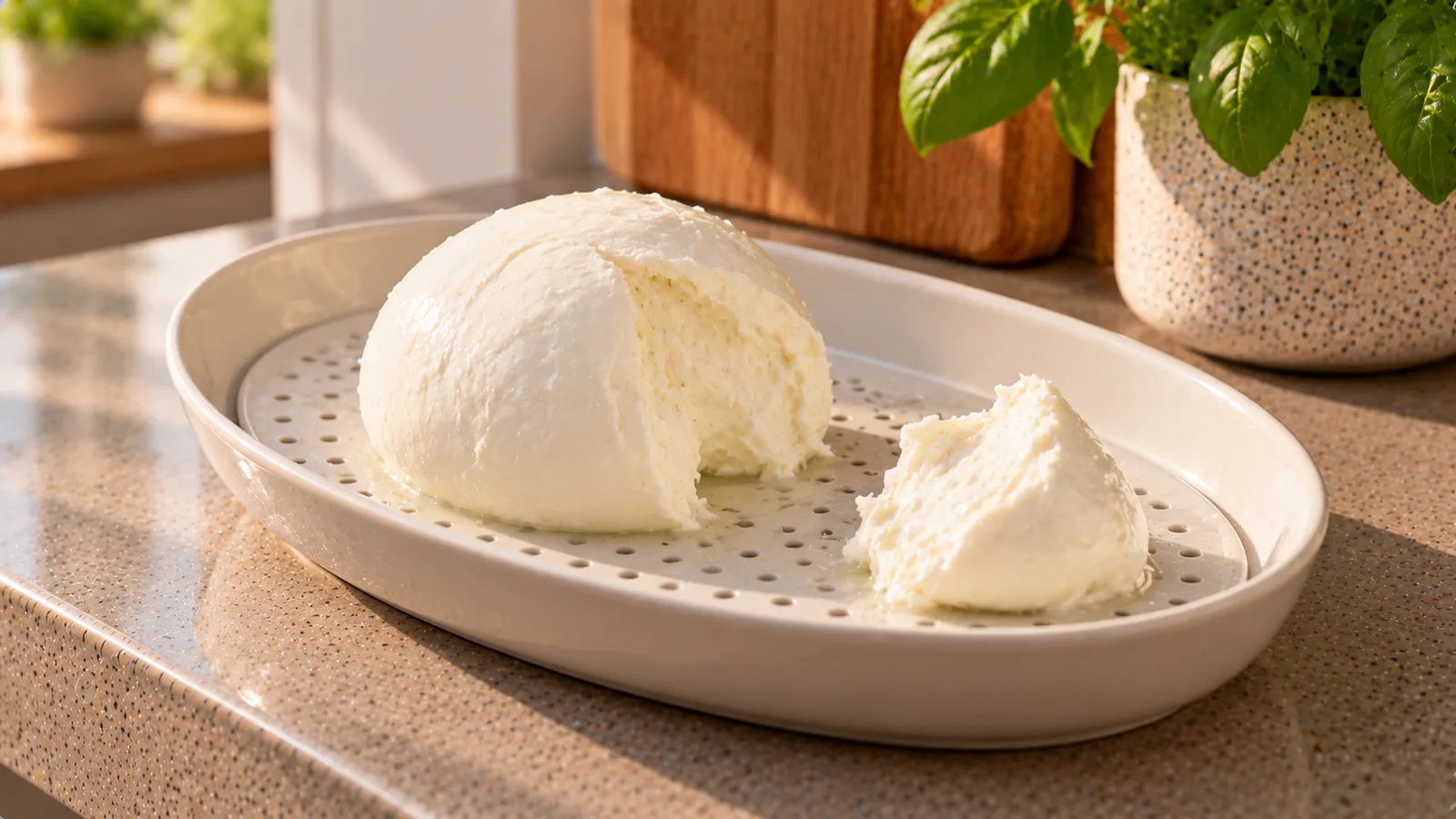
Mozzarella does not have one universal calorie value. Fresh mozzarella packed in liquid, low-moisture mozzarella for pizza and reduced-fat products can contain different amounts of water and fat, which changes their calories per 100 g.
As a practical reference, fresh whole-milk mozzarella is often around 250–300 kcal per 100 g, while some low-moisture mozzarella can be more energy-dense.
The most accurate approach is therefore to identify the type of mozzarella you are eating and use its nutrition label.
Mozzarella calories at a glance
For an example mozzarella containing 280 kcal per 100 g:
| Amount | Approx. calories |
|---|---|
| 10 g | 28 kcal |
| 20 g | 56 kcal |
| 25 g | 70 kcal |
| 30 g | 84 kcal |
| 40 g | 112 kcal |
| 50 g | 140 kcal |
| 75 g | 210 kcal |
| 100 g | 280 kcal |
| 125 g | 350 kcal |
These values are examples rather than universal numbers for every mozzarella.
If your package says 240 kcal per 100 g, use 240. If it says 310 kcal, use 310.
Typical nutrition per 100 g
Whole-milk mozzarella commonly provides substantial amounts of protein and fat while remaining relatively low in carbohydrates.
A representative mozzarella may provide approximately:
| Nutrient | Per 100 g |
|---|---|
| Calories | ~280 kcal |
| Protein | ~20–25 g |
| Fat | ~20–22 g |
| Carbohydrates | ~1–3 g |
The exact values depend strongly on the style and product.
Mozzarella also provides calcium and phosphorus, although exact amounts vary.
Why mozzarella calories vary so much
Water content is one of the main reasons.
Fresh mozzarella contains substantial moisture. Low-moisture mozzarella has less water, so nutrients and calories can become more concentrated per 100 g.
Fat content also matters.
Two products that are both called mozzarella can therefore have noticeably different calorie values.
For tracking, “mozzarella” alone is sometimes not specific enough.
Fresh mozzarella
Fresh mozzarella is usually soft and moist and is often sold in liquid.
Examples include larger mozzarella balls and smaller formats such as bocconcini.
Because fresh mozzarella contains relatively high amounts of water, its calorie density may be lower than that of drier low-moisture varieties.
Check whether the label refers to:
- the cheese itself;
- drained product;
- total package weight;
- drained weight.
The liquid in the package should not automatically be counted as edible mozzarella.
Low-moisture mozzarella
Low-moisture mozzarella is firmer and commonly used for pizza, sandwiches and baked dishes.
Because less water is present, calories, protein and fat can be more concentrated per 100 g.
A generic fresh mozzarella database entry may therefore be inaccurate for a low-moisture pizza mozzarella.
Match the database entry or label to the actual product.
Reduced-fat mozzarella
Reduced-fat mozzarella can contain less fat and fewer calories than a full-fat version.
However, there is no single calorie value that applies to every reduced-fat mozzarella.
Compare products using the nutrition values per 100 g rather than relying only on the front-of-package description.
Protein can remain relatively high even when fat is reduced, but the exact composition depends on the product.
Buffalo mozzarella
Mozzarella di bufala is made from buffalo milk rather than cow's milk.
Its nutrition can differ from standard cow's-milk mozzarella.
Do not automatically use the same calorie value for both.
If the package provides nutrition information, use that specific value.
How many calories are in one mozzarella ball?
The phrase “one mozzarella ball” can describe very different amounts.
A large fresh mozzarella ball may weigh 100–125 g or more, while bocconcini and mini mozzarella balls are much smaller.
If a 125 g mozzarella contains 280 kcal per 100 g:
125 × 280 ÷ 100 = 350 kcal
If a small ball weighs 20 g:
20 × 280 ÷ 100 = 56 kcal
Counting balls without knowing their weight is therefore unreliable.
A 125 g mozzarella ball
A common package size for fresh mozzarella in Europe is around 125 g drained weight.
Using our example of 280 kcal per 100 g:
125 × 280 ÷ 100 = 350 kcal
But if your mozzarella contains 240 kcal per 100 g:
125 × 240 ÷ 100 = 300 kcal
The same physical package size can therefore produce a meaningful difference depending on the product.
A 100 g mozzarella ball
If the edible mozzarella weighs exactly 100 g, the calorie number is simply the product's value per 100 g.
For example:
- 240 kcal/100 g → 240 kcal
- 280 kcal/100 g → 280 kcal
- 300 kcal/100 g → 300 kcal
This is one reason nutrition values per 100 g are useful for comparing cheeses.
Mini mozzarella
Mini mozzarella balls are convenient, but their individual weight varies between brands.
Suppose each drained ball weighs 10 g and the cheese contains 280 kcal per 100 g.
Each ball contains approximately:
10 × 280 ÷ 100 = 28 kcal
Five balls would be:
5 × 28 = 140 kcal
If another brand's balls weigh 15 g each, the result will be different.
Use the total drained weight and number of pieces if you want to estimate weight per ball.
Drained weight matters
Fresh mozzarella is frequently packaged in brine or another liquid.
Imagine the package states:
- total weight: 200 g;
- drained mozzarella weight: 125 g.
If you eat the cheese and discard the liquid, your mozzarella portion is based on the 125 g drained weight, not the full 200 g package weight.
This distinction can prevent a substantial tracking error.
How to calculate any mozzarella portion
Use:
grams eaten × calories per 100 g ÷ 100
If your mozzarella contains 265 kcal per 100 g and you eat 70 g:
70 × 265 ÷ 100 = 185.5 kcal
You would log approximately 186 kcal.
The same method works for macros.
If the cheese contains 22 g protein per 100 g:
70 × 22 ÷ 100 = 15.4 g protein
Calories and protein by portion
For an example mozzarella containing 280 kcal and 22 g protein per 100 g:
| Portion | Calories | Protein |
|---|---|---|
| 25 g | 70 kcal | 5.5 g |
| 30 g | 84 kcal | 6.6 g |
| 50 g | 140 kcal | 11 g |
| 75 g | 210 kcal | 16.5 g |
| 100 g | 280 kcal | 22 g |
| 125 g | 350 kcal | 27.5 g |
Again, use your own package values for the most accurate calculation.
Mozzarella slices
There is no standard weight for a slice.
A thin slice may weigh 15–20 g, while a thick hand-cut slice can weigh considerably more.
At 280 kcal per 100 g:
- 15 g ≈ 42 kcal
- 20 g ≈ 56 kcal
- 25 g ≈ 70 kcal
- 30 g ≈ 84 kcal
If you regularly slice mozzarella yourself, weighing a few typical slices can give you a useful visual reference.
Grated mozzarella
Grated mozzarella is especially difficult to estimate by appearance because shredding increases its volume.
A loose handful and a compressed handful can have very different weights.
If you use grated mozzarella for pizza or pasta, weighing it is more reliable.
At 280 kcal per 100 g:
- 20 g ≈ 56 kcal
- 30 g ≈ 84 kcal
- 50 g ≈ 140 kcal
- 75 g ≈ 210 kcal
Remember that packaged grated mozzarella may have a different composition from fresh mozzarella.
Mozzarella on pizza
The amount of cheese can substantially affect the nutrition of a pizza.
For a homemade pizza, track the mozzarella as a recipe ingredient.
Suppose you use 150 g of mozzarella containing 280 kcal per 100 g:
150 × 280 ÷ 100 = 420 kcal
If the pizza is divided into four equal portions:
420 ÷ 4 = 105 kcal from mozzarella per portion
You would then add the calories from dough, sauce, oil and toppings separately.
Mozzarella in a Caprese salad
A Caprese-style salad commonly contains mozzarella, tomatoes, basil and olive oil.
The cheese and oil should be tracked separately because both can contribute meaningful energy.
For example:
- mozzarella, 100 g at 280 kcal/100 g = 280 kcal;
- tomatoes = calculated separately;
- olive oil, 10 g = calculated separately.
Do not use a generic “Caprese salad” entry if you know your ingredient quantities, because recipes can vary considerably.
Mozzarella in sandwiches
For a sandwich, track the bread, mozzarella and other ingredients separately.
For example:
- bread;
- 50 g mozzarella;
- tomato;
- pesto or oil;
- other fillings.
At 280 kcal per 100 g, 50 g mozzarella contributes approximately 140 kcal.
Sauces and oils should not be assumed to be included in the cheese value.
Does melting mozzarella change the calories?
Melting does not remove the calories from mozzarella.
If you place 80 g of cheese on a pizza and eat all of it, the cheese contribution is based on the 80 g you used.
Heating may cause moisture loss or some fat separation, so the final cooked cheese can weigh differently.
For ordinary tracking, using the known amount added before cooking is usually more practical than trying to recalculate the nutrition of the melted cheese.
Fresh versus cooked weight
A cheese that loses water during heating can become more calorie-dense per 100 g of final cooked weight.
That does not mean calories were created.
It means the same energy is present in a smaller final mass after water loss.
If you know the amount of mozzarella added to a recipe before cooking, track that amount rather than comparing raw and cooked weights directly.
Mozzarella versus cheddar
Mozzarella and cheddar are not nutritionally interchangeable.
Regular cheddar generally contains less water and can be more calorie-dense than fresh mozzarella.
However, low-moisture mozzarella can have values closer to other firm cheeses.
The correct comparison is between the specific products you are considering.
Do not assume every cheese has the same calories per slice or per 100 g.
Mozzarella versus burrata
Burrata and mozzarella may look similar from the outside, but they are different foods.
Burrata typically contains a creamy filling, which can change its fat and calorie content.
If you eat burrata, use a burrata entry or its package label rather than logging it as plain mozzarella.
Mozzarella versus processed pizza cheese
Some products marketed for pizza may be cheese blends or processed products rather than plain mozzarella.
Check:
- product name;
- ingredient list;
- nutrition per 100 g.
If the product is a blend, use its own label instead of a generic mozzarella value.
Weighing mozzarella accurately
For fresh mozzarella:
- remove the cheese from the packaging;
- allow excess packing liquid to drain;
- place a plate on the scale;
- tare the scale;
- weigh the amount you will eat.
For low-moisture blocks or grated mozzarella, weigh the cheese directly before adding it to the meal.
This is more reliable than estimating balls, slices or handfuls.
Package-first example
Suppose your mozzarella label says:
- 272 kcal per 100 g;
- 21 g protein per 100 g;
- 21 g fat per 100 g.
You eat 65 g.
Calories:
65 × 272 ÷ 100 = 176.8 kcal
Protein:
65 × 21 ÷ 100 = 13.7 g
Fat:
65 × 21 ÷ 100 = 13.7 g
You would log approximately 177 kcal, 13.7 g protein and 13.7 g fat.
Common tracking mistakes
Mozzarella estimates can become inaccurate when you:
- use the total package weight instead of drained weight;
- count mozzarella balls without knowing their size;
- use fresh mozzarella data for low-moisture mozzarella;
- treat reduced-fat and full-fat products as identical;
- estimate grated cheese by handfuls;
- use mozzarella data for burrata;
- forget cheese added to pizza or baked dishes;
- use cooked weight with nutrition data intended for the original product.
Matching the product and weighing the edible portion prevents most of these problems.
Quick reference
For an example mozzarella containing 280 kcal per 100 g:
- 10 g: ~28 kcal
- 20 g: ~56 kcal
- 25 g: ~70 kcal
- 30 g: ~84 kcal
- 50 g: ~140 kcal
- 75 g: ~210 kcal
- 100 g: ~280 kcal
- 125 g: ~350 kcal
Because mozzarella varies considerably in moisture and fat content, these are example values rather than a universal calorie chart.
Use the label of your specific mozzarella whenever possible, pay attention to drained weight for fresh cheese, and track the amount you actually eat.