
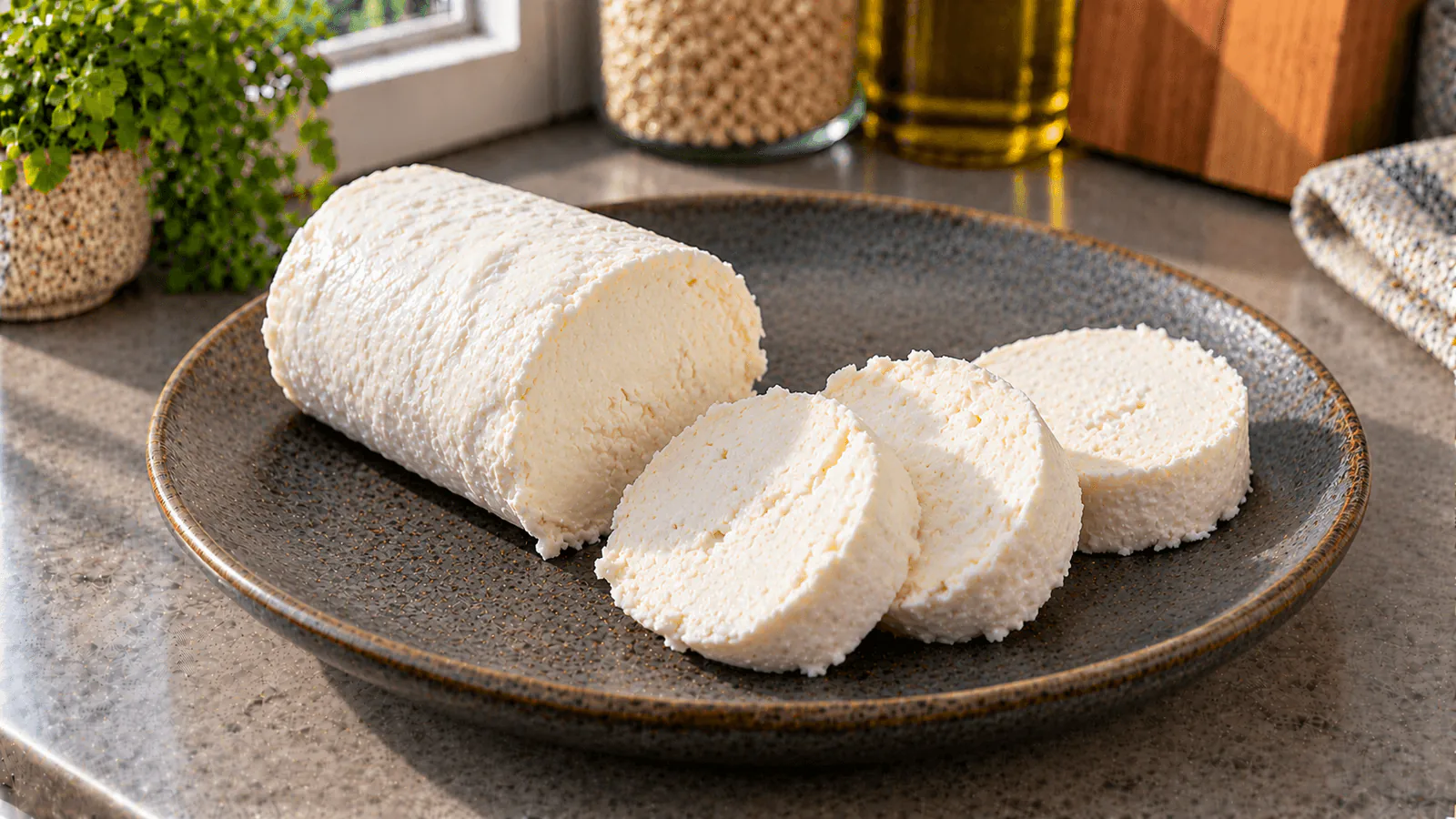
Goat cheese is not a single nutritional product. A moist, spreadable fresh chèvre, a semisoft log and a firm aged cheese can all be sold as goat cheese, even though their water and fat concentrations differ considerably. For calorie tracking, the most useful question is therefore which goat cheese is on your plate and how many grams of it you actually ate?
As a reproducible reference, the USDA's soft goat cheese entry lists 264 kcal per 100 g. The same database records 364 kcal per 100 g for semisoft goat cheese and 452 kcal per 100 g for hard goat cheese. These are different reference foods, not three estimates for one identical cheese. Exact retail products may differ, so a package label takes precedence for your own purchase.
Goat cheese calories per 100 g: soft, semisoft and hard
| USDA goat cheese type | Energy per 100 g | Protein | Total fat | Saturated fat |
|---|---|---|---|---|
| Soft type, fresh-style reference | 264 kcal | 18.5 g | 21.1 g | 14.6 g |
| Semisoft type | 364 kcal | 21.6 g | 29.8 g | 20.6 g |
| Hard type, aged-style reference | 452 kcal | 30.5 g | 35.6 g | 24.6 g |
Sources: USDA soft goat cheese, FDC 173435, USDA semisoft goat cheese, FDC 173433, and USDA hard goat cheese, FDC 172197. Numbers are rounded from reference entries and are not a claim that every cheese within a category has an identical composition.
The significant difference comes partly from water. Fresh soft cheese contains more moisture; aged cheese typically loses water during ripening, so a fixed 100 g can contain more concentrated fat, protein and calories. That does not mean every aged goat cheese must be higher in calories than every fresh one. Ingredients, manufacturing and fat content also matter. Cheese made using skimmed or mixed milk can be different again, as can products with herbs, oil or flavourings.
A common error is to log a 30 g piece of firm aged goat cheese using the lower value for a soft spread. At 30 g, the three USDA reference energies work out to approximately 79 kcal (soft), 109 kcal (semisoft), or 136 kcal (hard). The difference is small enough to miss visually but can be meaningful across frequent meals.
How many calories are in a serving of soft goat cheese?
The following table uses the 264 kcal, 18.5 g protein and 21.1 g fat per 100 g soft-type reference. These are weighed edible portions, not universally fixed 'slices', tablespoons or restaurant servings. Values are rounded independently.
| Weighed soft goat cheese | Calories | Protein | Total fat |
|---|---|---|---|
| 20 g | 53 kcal | 3.7 g | 4.2 g |
| 30 g | 79 kcal | 5.6 g | 6.3 g |
| 40 g | 106 kcal | 7.4 g | 8.4 g |
| 50 g | 132 kcal | 9.3 g | 10.6 g |
| 75 g | 198 kcal | 13.9 g | 15.8 g |
| 100 g | 264 kcal | 18.5 g | 21.1 g |
| 150 g | 396 kcal | 27.8 g | 31.7 g |
For example, a standard-looking tablespoon of crumbly chèvre might not weigh what a tablespoon of whipped spread does. If a recipe calls for 'two tablespoons', weighing the actual spoonfuls is more dependable than assigning an assumed mass. If the cheese is labelled in ounces, convert the weight first: 1 oz is about 28.35 g, so an ounce of the soft reference is about 75 kcal. This is a unit conversion, not a promise about the serving printed on any particular pack.
For general logging, use the same distinction explained in Mealisa's portion size versus serving size guide: a manufacturer's reference serving is not necessarily the amount you eat.
Fresh chèvre versus aged goat cheese: choosing the correct entry
Fresh chèvre often comes in a short log, tub or spreadable disk. It may be soft and tangy, but appearances cannot establish its calories. A firm log with a rind might be described as 'soft-ripened' rather than the precise USDA 'semisoft' category. Equally, a hard goat cheese can resemble another aged cheese in appearance without sharing its nutrient values. If your product has a nutrition panel, look for the per-100-g column before deciding which database entry to use.
The word goat refers to milk origin, not a guaranteed level of fat, carbohydrate or protein. It is also not shorthand for 'low calorie'. A product made of goat's milk still contains milk proteins and is not suitable for someone with a milk-protein allergy unless their clinician has specifically advised otherwise. If you are interested in alternatives made with other milk, compare the same portion weights, not just the calories shown for one brand's serving.
Both soft and aged goat cheeses can contribute protein, but high-protein marketing is not a reason to ignore total calories or saturated fat. Using the soft USDA entry, 50 g provides approximately 9.3 g protein alongside 132 kcal. Using the hard entry instead, 50 g provides about 15.3 g protein and 226 kcal. A higher-protein choice may also contain more calories per weighed portion.
What happens when goat cheese is baked or fried?
Oven heat does not magically add energy to plain cheese. Yet the number per 100 g after cooking may rise if water evaporates, even when the whole piece has largely the same energy. Oil, breadcrumbs, nuts or honey change the total by adding ingredients. Weigh the cheese before cooking, then log the coating and fat separately. If some cheese melts into the pan or remains on a baking tray, the portion actually eaten may be smaller than the amount cooked.
Consider a warm salad containing 40 g soft goat cheese and 10 g olive oil. Using the soft USDA reference, the cheese contributes roughly 106 kcal. If the oil you actually consume provides about 90 kcal, that combination is around 196 kcal before salad vegetables, bread, dressing or other toppings. The cheese entry alone would badly understate the complete dish. Oil quantities here are illustrative; use the bottle's label or a reliable oil entry in a real food log.
Now consider a 30 g hard-cheese garnish. At 452 kcal per 100 g, that is about 136 kcal. Thirty grams of soft goat cheese would be 79 kcal. Simply writing 'goat cheese, 30 g' without the type can conceal a roughly 57 kcal difference between these two reference examples.
Comparing goat cheese with feta, mozzarella and cheddar
Goat cheese is frequently substituted for other cheeses in salads, toast, omelettes and pasta. But the name of the replacement alone does not predict a lighter meal. For a practical comparison, check Mealisa's individual articles about feta calories, mozzarella calories and cheddar calories. Each describes a distinct food category and serving conventions.
A salad with 30 g of fresh goat cheese and a salad with 30 g of feta may taste different and have different salt, fat and protein values. The useful method is to compare both cheeses by 100 g, then multiply by 0.30 for a 30 g serving. Don't assume a goat-cheese version is automatically healthier, or that a reduced-fat alternative always tastes or behaves like a traditional cheese. Texture and meltability can affect the amount you use.
Fat, sodium, calcium and ingredient labels
For soft goat cheese, the USDA entry contains about 14.6 g saturated fat and 459 mg sodium per 100 g. A 30 g weighed portion therefore supplies about 4.4 g saturated fat and 138 mg sodium. This is different from the amount of salt printed on many European labels: salt is often reported as the equivalent of sodium multiplied by approximately 2.5. Sodium in a recipe also comes from bread, dressings, olives and other ingredients; it is not determined by the cheese alone.
Calcium content can be quite different across cheese styles. In the USDA entries, soft goat cheese provides about 140 mg calcium per 100 g, semisoft about 298 mg, and hard about 895 mg. That does not make any particular variety a medical treatment or justify treating 100 g as a recommended daily portion. For a balanced diet, read the whole label and consider your overall intake rather than focusing on a single nutrient.
Buying and storing fresh goat cheese safely
Look for the product's milk source, pasteurization statement, ingredients, date and storage instructions. Fresh soft cheese usually requires refrigeration, and its shelf life after opening may be short. A goat cheese flavoured with oil or nuts may carry calories not represented in the plain-food USDA entries. If a soft cheese is made from unpasteurized milk, it may present additional food-safety risks for people who are pregnant or otherwise at higher risk of foodborne illness. The CDC's food-safety guidance distinguishes riskier raw-milk products from safer pasteurized options. Follow product-specific advice and local medical guidance where relevant.
A quick way to calculate the cheese in your meal
First identify whether you have a soft spread, semisoft cheese or hard cheese. Next weigh the edible amount actually served, choosing either the matching product label or a clearly named reference entry. Multiply the listed calories per 100 g by the grams eaten and divide by 100. Finally add cooking oils, toppings and other ingredients, without counting them twice. This method works for open sandwiches, salads, roast vegetables and cheese boards.
For a soft cheese logged at 264 kcal/100 g, a 25 g addition is 66 kcal; a 75 g serving is 198 kcal. Using the semisoft value instead, the same 75 g would be 273 kcal, while 75 g of the hard reference gives 339 kcal. Correctly identifying the cheese type often matters at least as much as perfecting a tablespoon estimate.
Data method: Reference values are from USDA FoodData Central's soft entry, semisoft entry and hard entry, all labelled SR Legacy. USDA entries describe reference foods; brands and individual batches can vary. Serving calculations are arithmetic based on those values and do not substitute for the nutrition information printed on the specific product in your refrigerator.