
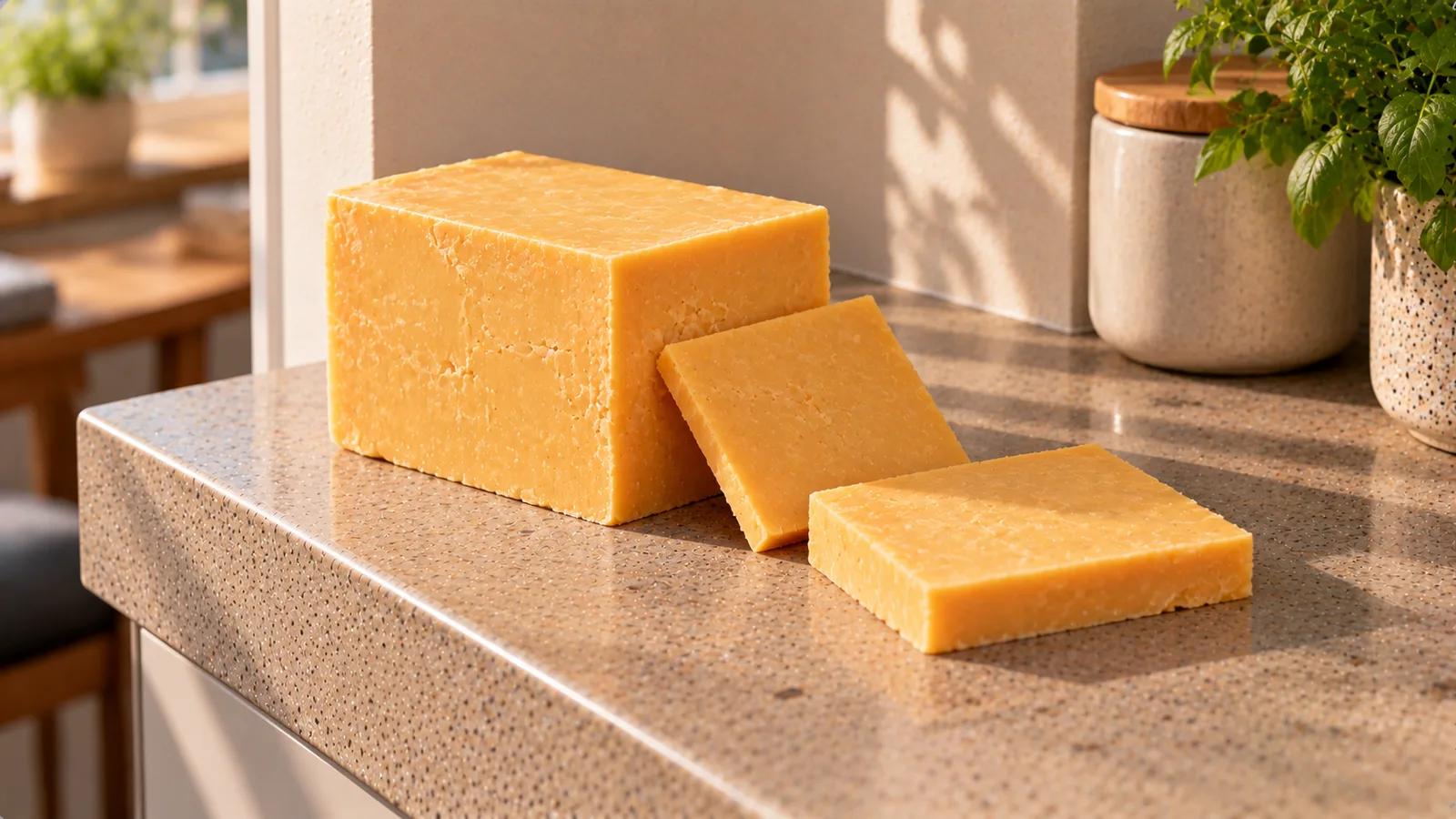
Cheddar is a relatively energy-dense cheese because it contains substantial amounts of both fat and protein while containing little water compared with many fresh cheeses.
A useful reference for regular full-fat cheddar is approximately 400 kcal per 100 g, but the exact value varies by brand, maturity and formulation.
For accurate tracking, use the nutrition label on the cheddar you actually eat whenever possible.
Cheddar cheese nutrition per 100 g
Typical full-fat cheddar provides approximately:
| Nutrient | Per 100 g |
|---|---|
| Calories | ~400 kcal |
| Protein | ~25 g |
| Fat | ~33 g |
| Carbohydrates | ~1–2 g |
Cheddar also provides calcium and phosphorus, although exact micronutrient values vary between products.
The combination of relatively high fat and low water content explains why a physically small piece can contain a meaningful number of calories.
Calories in common cheddar portions
Using 400 kcal per 100 g as a simple reference:
| Portion | Approx. calories |
|---|---|
| 10 g | 40 kcal |
| 15 g | 60 kcal |
| 20 g | 80 kcal |
| 25 g | 100 kcal |
| 30 g | 120 kcal |
| 40 g | 160 kcal |
| 50 g | 200 kcal |
| 75 g | 300 kcal |
| 100 g | 400 kcal |
The calculation is straightforward:
grams eaten × calories per 100 g ÷ 100
For example:
35 g × 400 ÷ 100 = 140 kcal
If your cheddar contains 416 kcal per 100 g, use 416 rather than the generic reference.
How many calories are in a slice of cheddar?
There is no universal weight for a slice of cheddar.
A thin pre-sliced piece may weigh around 15–20 g, while a thicker hand-cut slice may weigh 30 g or more.
At 400 kcal per 100 g:
- 15 g ≈ 60 kcal
- 20 g ≈ 80 kcal
- 25 g ≈ 100 kcal
- 30 g ≈ 120 kcal
This is why logging “one slice” without knowing its weight can produce a large error.
If the cheese is pre-sliced, check whether the package states the weight per slice. Otherwise, weigh a typical slice once.
Calories and macros by portion
Using approximately 400 kcal, 25 g protein and 33 g fat per 100 g:
| Portion | Calories | Protein | Fat |
|---|---|---|---|
| 15 g | 60 kcal | 3.8 g | 5.0 g |
| 20 g | 80 kcal | 5.0 g | 6.6 g |
| 25 g | 100 kcal | 6.3 g | 8.3 g |
| 30 g | 120 kcal | 7.5 g | 9.9 g |
| 40 g | 160 kcal | 10.0 g | 13.2 g |
| 50 g | 200 kcal | 12.5 g | 16.5 g |
These are calculated reference values and are not intended to replace the label on a specific product.
Why cheddar is calorie-dense
Cheese is produced by concentrating components of milk.
During cheesemaking, much of the water and whey are separated while fat and protein become concentrated in the finished cheese.
Fat provides approximately 9 kcal per gram, so a cheese containing around one-third fat by weight naturally has a relatively high energy density.
This does not mean cheddar needs to be avoided. It means that portion weight is useful when total energy intake is being tracked.
Mature versus mild cheddar
The terms “mild,” “mature,” “extra mature” or similar descriptions mainly refer to aging and flavor.
Maturity does not provide a reliable shortcut for predicting calories.
Two cheddars with different ages may have similar energy values, while two products sold under the same maturity description may have different nutrition.
Use the label rather than assuming that stronger flavor means more or fewer calories.
White versus colored cheddar
The color of cheddar is not a reliable indicator of its calorie content.
Some cheddar is naturally pale, while some products contain coloring such as annatto.
The addition of coloring does not normally create a meaningful calorie difference.
Again, the nutrition label is more useful than appearance.
Reduced-fat cheddar
Reduced-fat cheddar can contain fewer calories than regular full-fat cheddar because some of the fat has been reduced.
However, the difference varies considerably between products.
For example, do not assume that every reduced-fat cheese has a specific percentage fewer calories simply because of the wording on the front of the package.
Compare the values per 100 g.
A practical comparison might look like this:
| Product | Calories per 100 g | Protein per 100 g | Fat per 100 g |
|---|---|---|---|
| Regular cheddar | 400 kcal | 25 g | 33 g |
| Example reduced-fat cheddar | 300 kcal | 30 g | 20 g |
The second row is illustrative only. Use the actual label when comparing products.
Cheddar cubes
Cubes are convenient for serving but difficult to estimate consistently because cube size varies.
If one cube weighs 8 g:
8 × 400 ÷ 100 = 32 kcal
Five such cubes would contain approximately:
5 × 32 = 160 kcal
But if each cube weighs 12 g, five cubes weigh 60 g and provide approximately 240 kcal.
Counting cubes is therefore only useful when their approximate weight is known.
Grated cheddar
Grated cheese can look like a large portion because it occupies more volume after shredding.
Volume is therefore a poor guide to weight.
If you add grated cheddar to pasta, potatoes, eggs or a casserole, weigh it before adding it.
At 400 kcal per 100 g:
- 10 g grated cheddar ≈ 40 kcal
- 20 g ≈ 80 kcal
- 30 g ≈ 120 kcal
- 40 g ≈ 160 kcal
A kitchen scale is usually more reliable than estimating tablespoons or handfuls of grated cheese.
Cheddar in a sandwich
When tracking a cheese sandwich, record the components separately.
For example:
- bread: 190 kcal;
- cheddar, 25 g: 100 kcal;
- butter, 5 g: separate according to its label;
- other fillings: separate.
The cheddar portion contributes approximately 100 kcal when using the 400 kcal per 100 g reference.
A generic “cheese sandwich” database entry may use different bread, cheese and spread amounts from your meal.
Cheddar on a burger
A burger may contain a pre-sliced piece of cheddar or a processed cheese slice.
These are not necessarily nutritionally identical.
If you use 20 g of regular cheddar at 400 kcal per 100 g:
20 × 400 ÷ 100 = 80 kcal
Track the burger components individually when practical, especially if you know the cheese type and weight.
Cheddar in cooked dishes
Cheddar is commonly used in:
- pasta dishes;
- casseroles;
- omelets;
- baked potatoes;
- sauces;
- soups;
- savory pies.
For a homemade recipe, include the full weight of cheddar in the recipe calculation.
Suppose a casserole contains 120 g cheddar.
At 400 kcal per 100 g:
120 × 400 ÷ 100 = 480 kcal
If the finished casserole is divided into six equal portions, the cheddar contributes approximately:
480 ÷ 6 = 80 kcal per portion
Other ingredients must of course be included separately.
Does melting cheddar change its calories?
Melting cheese does not make its calories disappear.
If you melt 30 g of cheddar, the calories from those 30 g remain part of the meal unless some cheese or fat is physically left behind and not eaten.
The melted cheese may look smaller or spread across a larger area, but appearance is not a reliable indicator of calorie content.
For tracking, use the amount added before melting.
Does cooking change the weight?
Heating can cause moisture loss and fat separation.
This means the final cooked cheese may not weigh exactly the same as it did before heating.
For a simple meal, tracking the known amount of cheddar added before cooking is usually the most practical approach.
Avoid weighing a small amount of melted cheese afterward and assuming its nutrition per 100 g is identical to the uncooked product.
Cheddar versus processed cheese slices
Processed cheese products may contain cheese plus other dairy ingredients, emulsifying salts and additional ingredients.
Their nutrition can differ from regular cheddar.
Do not automatically use a cheddar entry for a processed cheese slice just because it has a cheddar-like flavor or appearance.
Check the product name and nutrition label.
Cheddar versus mozzarella
Cheddar and mozzarella should be tracked separately.
Their water and fat contents can differ substantially, especially because mozzarella itself exists in several forms.
As a result, the calorie value per 100 g can differ.
Use the entry that matches the actual cheese rather than treating all cheese as nutritionally interchangeable.
How to weigh cheddar accurately
For cheese cut from a block:
- place a plate or bowl on the scale;
- tare to zero;
- add the cheese;
- record the weight;
- calculate from the label or use the matching database entry.
Another convenient option is to weigh the block before and after cutting.
If the block weighs 356 g before and 324 g afterward:
356 − 324 = 32 g eaten or used
At 400 kcal per 100 g:
32 × 400 ÷ 100 = 128 kcal
Package-first tracking
If your cheddar package states:
412 kcal per 100 g
and your portion weighs 27 g:
27 × 412 ÷ 100 = 111.2 kcal
You would log approximately 111 kcal.
This is preferable to using a generic 400 kcal value because it reflects the actual product.
The same approach works for protein and fat.
If the label states 26 g protein per 100 g:
27 × 26 ÷ 100 = 7.0 g protein
Common tracking errors
Cheddar estimates can become inaccurate when you:
- log “one slice” without checking its weight;
- estimate grated cheese by volume;
- treat all cheese varieties as equivalent;
- use a regular cheddar entry for reduced-fat cheese;
- use cheddar data for processed cheese slices;
- forget cheese added during cooking;
- divide a recipe incorrectly;
- use a generic database value when the package provides a more specific one.
Matching the product and measuring the portion solves most of these problems.
Quick reference
Using approximately 400 kcal per 100 g:
- 10 g: ~40 kcal
- 15 g: ~60 kcal
- 20 g: ~80 kcal
- 25 g: ~100 kcal
- 30 g: ~120 kcal
- 40 g: ~160 kcal
- 50 g: ~200 kcal
- 100 g: ~400 kcal
Treat these numbers as convenient reference values rather than universal nutrition data for every cheddar.
For accurate everyday tracking, use the label on your specific cheese and the weight you actually eat.