
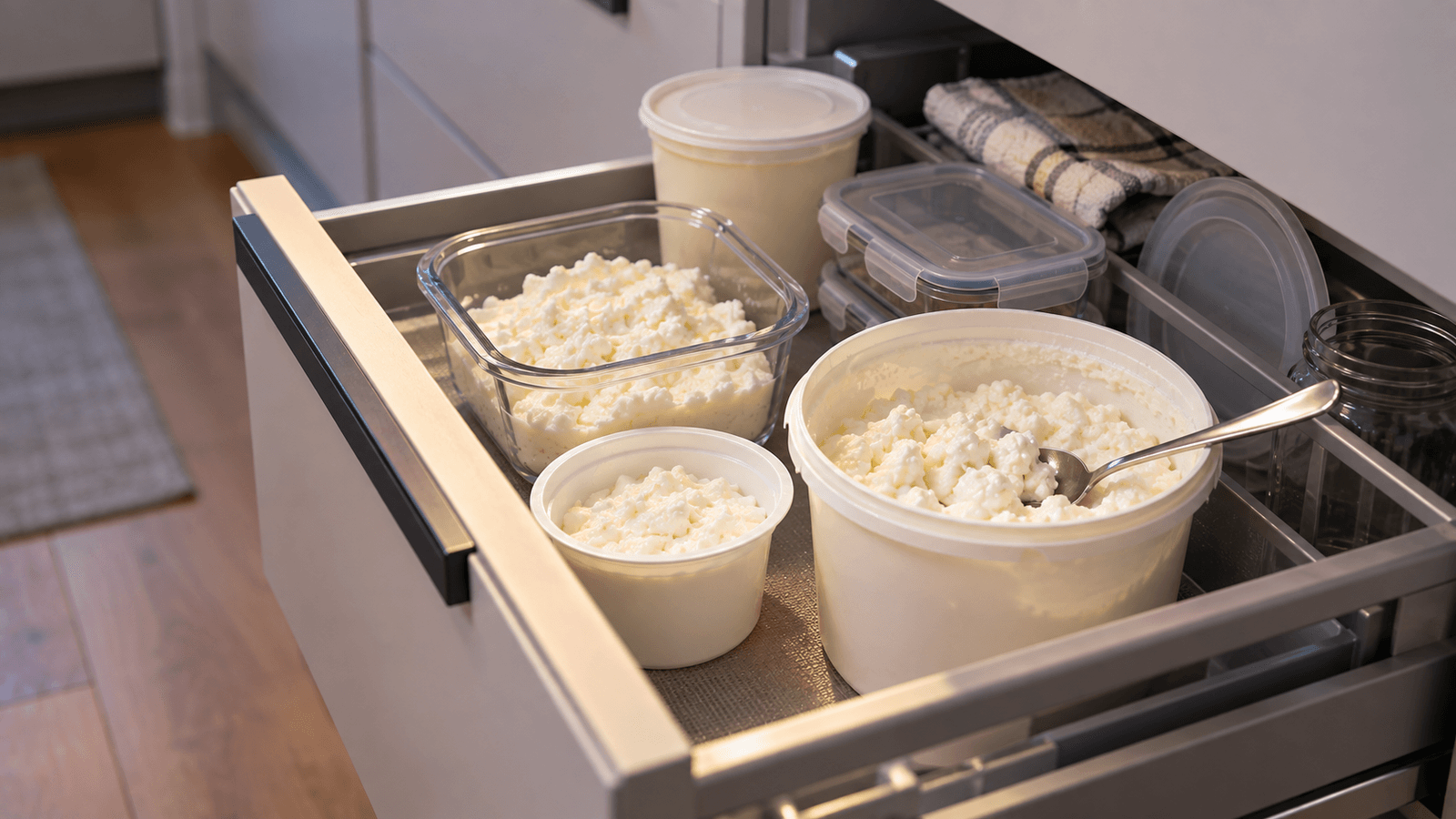
Cottage cheese can vary noticeably in calories depending on its fat content, formulation and the amount you actually eat.
A low-fat version may provide roughly 80–90 kcal per 100 g, while higher-fat products can contain more. Because cottage cheese is sold in several fat levels and formulations, the nutrition label on your specific product is more useful than treating “cottage cheese” as one fixed calorie value.
Cottage cheese calories by portion
Using 85 kcal per 100 g as a practical example for a low-fat cottage cheese:
| Amount | Approx. calories |
|---|---|
| 50 g | 43 kcal |
| 100 g | 85 kcal |
| 150 g | 128 kcal |
| 200 g | 170 kcal |
| 250 g | 213 kcal |
| 300 g | 255 kcal |
These figures are examples rather than universal values.
To calculate the calories in your own portion:
Calories in your portion = calories per 100 g × portion weight ÷ 100
If your cottage cheese contains 85 kcal per 100 g and you eat 180 g:
85 × 180 ÷ 100 = 153 kcal.
Why cottage cheese calorie values differ
Two containers labeled cottage cheese can have different nutrition values.
The main reasons include:
- fat content
- milk and cream used in the formulation
- serving size
- added ingredients
- differences between brands and regional products
This is why a generic database entry can be useful for an estimate but should not automatically replace the label when you have the package available.
Fat content makes a difference
Cottage cheese is available in versions ranging from very low-fat to considerably richer products.
Fat provides about 9 kcal per gram, so products containing more fat generally provide more calories when the other ingredients are similar.
For example, one cottage cheese might contain around 80–90 kcal per 100 g, while a richer version could exceed 100 kcal per 100 g.
That does not make the higher-fat product inherently better or worse. It simply means the two products should not be logged with the same calorie value.
Protein in cottage cheese
Cottage cheese is typically a protein-rich dairy food.
Many products provide roughly 10–13 g of protein per 100 g, although the exact amount varies.
If your product contains 12 g protein per 100 g:
| Portion | Approx. protein |
|---|---|
| 100 g | 12 g |
| 150 g | 18 g |
| 200 g | 24 g |
| 250 g | 30 g |
Use the label on your own product when protein intake matters, because formulations are not identical.
What does a 200 g portion look like nutritionally?
Suppose your cottage cheese contains:
- 85 kcal per 100 g
- 12 g protein per 100 g
A 200 g portion would provide approximately:
- 170 kcal
- 24 g protein
If another product contains 110 kcal per 100 g, the same 200 g portion would provide 220 kcal.
The serving weight has not changed. The product has.
This is why accurate tracking requires both pieces of information:
- which cottage cheese you are eating
- how much of it you eat
What is a normal serving size?
There is no single portion that everyone needs to use.
Cottage cheese might be eaten as:
- a small snack
- part of breakfast
- a protein component of lunch
- a topping or filling
- an ingredient in a recipe
- part of a larger meal
A suggested serving on packaging can be useful as a reference, but it does not determine the amount you personally consume.
For calorie tracking, your actual portion matters.
How to track cottage cheese accurately
If you eat an entire single-serving package, the package weight may provide the easiest measurement.
For a larger container:
- place your bowl or other container on a kitchen scale
- tare the scale
- add the cottage cheese
- record the weight in grams
- use the calories per 100 g from the product label
For example, if the scale shows 165 g and the package lists 92 kcal per 100 g:
92 × 165 ÷ 100 = about 152 kcal.
You do not need to search for a different serving-size entry when you already have the weight and per-100-g nutrition information.
Can you estimate cottage cheese without weighing it?
Yes, but the result will be less precise.
Cottage cheese has an uneven curd structure, and the amount that fits into a spoon, cup or bowl can vary.
Visual estimates are therefore useful for convenience but should not be treated as exact measurements.
If cottage cheese is something you eat regularly, weighing your usual portion a few times can help you develop a better visual reference.
Full container vs actual portion
Package size should not automatically be treated as serving size.
Imagine a 300 g container containing 85 kcal per 100 g.
The full container provides:
85 × 300 ÷ 100 = 255 kcal.
If you eat only half, your portion is approximately 150 g and provides about 128 kcal.
This sounds simple, but confusing container size with consumed amount is a common source of tracking error.
What you add to cottage cheese also matters
Plain cottage cheese may be only one component of what you eat.
Common additions include:
- fruit
- honey
- jam
- nuts
- seeds
- bread
- crackers
- oil
- vegetables
- sauces
When calorie accuracy matters, log those ingredients separately.
For example, 200 g of cottage cheese does not have the same calorie total as 200 g of cottage cheese plus nuts, honey and bread.
The additional foods may contribute as many or more calories than the cottage cheese itself.
Cottage cheese and calorie density
Cottage cheese contains a substantial amount of water and protein, so many low-fat versions have a moderate calorie density compared with foods that contain much more fat or less water.
However, calorie density still differs between cottage cheese products.
A richer product containing more cream or fat will generally provide more calories for the same weight.
For a broader explanation, see What Is Calorie Density?.
Is cottage cheese good for weight loss?
Cottage cheese can fit into a weight-loss diet, but no individual food causes weight loss.
Its relatively high protein content can make it a practical option for people who enjoy it and want to include protein-rich foods in their meals.
Whether a meal supports your goal depends on the overall eating pattern, total energy intake, portion size and the other foods eaten with it.
A low-fat cottage cheese is not automatically the best choice for everyone, and a higher-fat version does not automatically prevent weight loss.
The relevant question for calorie tracking is how the chosen product fits into your overall intake.
Cottage cheese compared with other dairy foods
Cottage cheese, skyr and Greek yogurt can all provide substantial protein, but their textures, ingredients and nutrition profiles differ.
Even within one category, fat content can change the calorie value considerably.
If you are comparing dairy products, use values per 100 g first and then consider your normal portion.
For related food guides, see:
Practical example: breakfast or snack
Suppose you eat:
- 180 g cottage cheese
- one piece of fruit
- 15 g nuts
Your cottage cheese contains 85 kcal per 100 g.
The cottage cheese contributes:
85 × 180 ÷ 100 = 153 kcal.
The fruit and nuts should then be calculated separately.
This gives you a more accurate total than selecting a generic database entry such as “cottage cheese with fruit and nuts,” because the quantities in that entry may not match your meal.
Which value should you use in Mealisa?
When the exact product is available, use its nutrition label.
When you only know that the food is cottage cheese, a generic food-database value can provide a reasonable estimate, but it remains an estimate.
For photo-based tracking, two sources of uncertainty are especially relevant:
- identifying the exact type or fat level
- estimating how much cottage cheese is present
If you know either of those details, correcting the estimate can improve accuracy.
See How to Correct an AI Food Estimate.
Practical reference
For a low-fat cottage cheese containing about 85 kcal and 12 g protein per 100 g:
- 100 g: about 85 kcal and 12 g protein
- 150 g: about 128 kcal and 18 g protein
- 200 g: about 170 kcal and 24 g protein
- 250 g: about 213 kcal and 30 g protein
These numbers are useful for orientation, not as universal nutrition values.
For accurate tracking, use the nutrition information from the cottage cheese you actually eat.
This article provides general educational nutrition information and is not individualized medical or dietary advice.
Nutrition data sources and product differences
The records below describe only the named foods, fat levels and preparation states. USDA figures are per 100 g; manufacturer figures retain their stated unit. These sources do not independently prove every approximate figure in the article.
USDA FoodData Central (search by FDC ID):
- FDC 328841 — Cheese, cottage, lowfat, 2% milkfat (84 kcal/100 g)
- FDC 172179 — Cheese, cottage, creamed, large or small curd (98 kcal/100 g)