
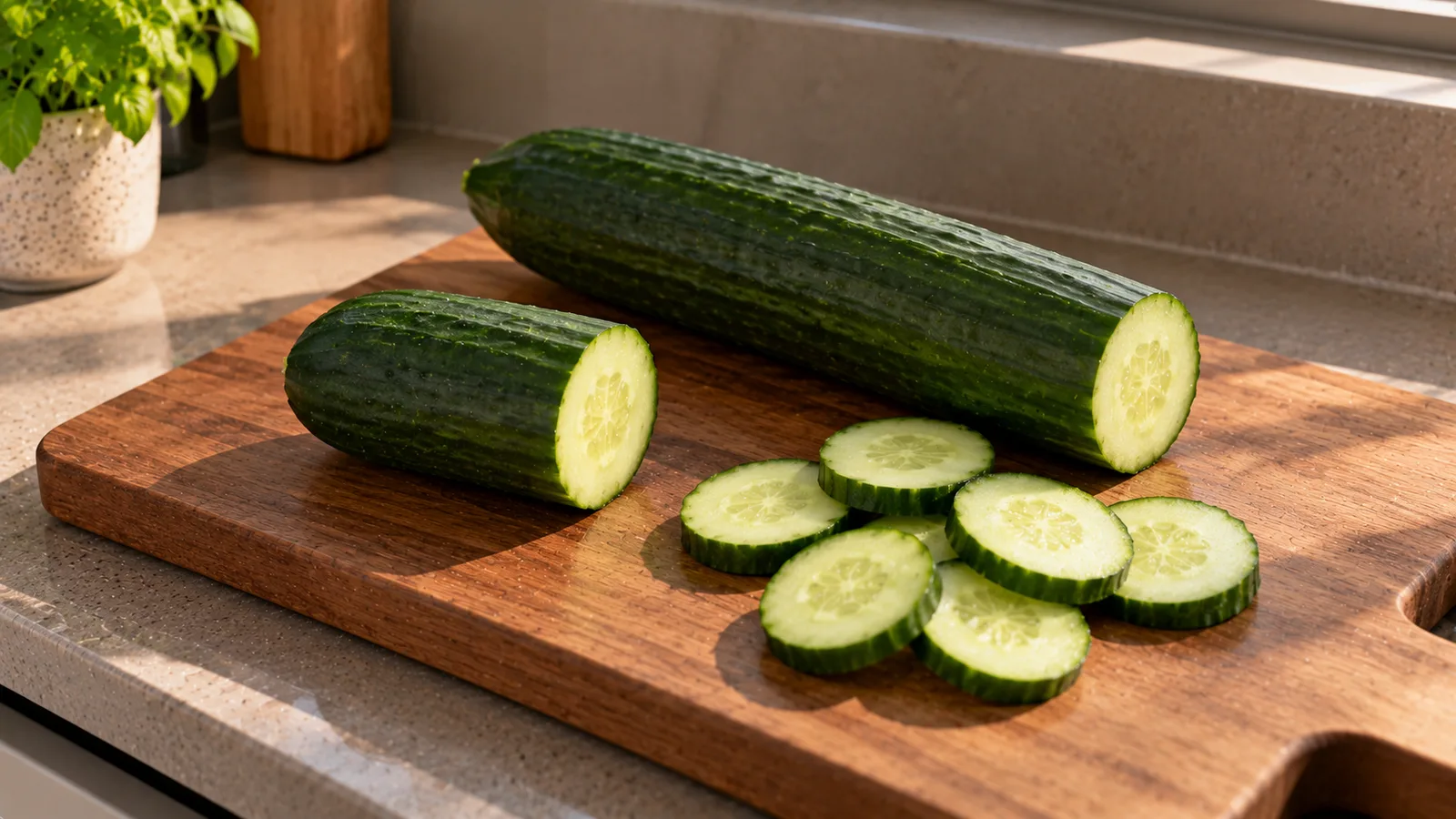
Cucumber is a very low-calorie food because most of its weight is water.
A typical raw cucumber with the peel contains about 15 calories per 100 g. The exact value can vary slightly by variety and food database, but the difference is usually small enough that portion size matters more than choosing between similar raw cucumber entries.
Cucumber calories at a glance
Approximate values for raw cucumber with peel:
| Amount | Calories |
|---|---|
| 50 g | 8 kcal |
| 100 g | 15 kcal |
| 150 g | 23 kcal |
| 200 g | 30 kcal |
| 250 g | 38 kcal |
| 300 g | 45 kcal |
These values refer to plain raw cucumber without dressing, oil or other ingredients.
Nutrition in 100 g of cucumber
A typical 100 g portion of raw cucumber with peel provides approximately:
| Nutrient | Per 100 g |
|---|---|
| Calories | 15 kcal |
| Protein | 0.7 g |
| Carbohydrates | 3.6 g |
| Fiber | 0.5 g |
| Fat | 0.1 g |
Cucumber also contains a large amount of water, which explains its low calorie density.
Values can vary slightly depending on cucumber variety, maturity and the database used.
How to calculate calories for your cucumber portion
If the database entry gives 15 kcal per 100 g, you can calculate any weighed portion with:
portion weight × 15 ÷ 100
For example, for 180 g:
180 × 15 ÷ 100 = 27 kcal
So 180 g of plain cucumber contains approximately 27 calories.
How many calories are in half a cucumber?
There is no single calorie value for half a cucumber because cucumbers vary substantially in size.
If a whole cucumber weighs 300 g, half weighs about 150 g:
150 × 15 ÷ 100 = about 23 kcal
If the cucumber is larger and the half weighs 220 g:
220 × 15 ÷ 100 = about 33 kcal
Weighing the edible portion is more reliable than assuming that every half cucumber has the same weight.
How many calories are in a whole cucumber?
Again, the answer depends on weight.
Using 15 kcal per 100 g:
| Edible weight | Approximate calories |
|---|---|
| 200 g | 30 kcal |
| 250 g | 38 kcal |
| 300 g | 45 kcal |
| 350 g | 53 kcal |
| 400 g | 60 kcal |
A small cucumber and a large cucumber therefore should not automatically be logged as the same serving.
Peeled vs unpeeled cucumber
Removing the peel can slightly change the nutrient values per 100 g, but the calorie difference is small.
For everyday calorie tracking, the more important question is usually:
How much cucumber did you actually eat?
If your food database offers separate entries for peeled and unpeeled cucumber, choose the one matching what you ate.
For precise tracking, weigh the edible portion after peeling if that is how you consume it.
Mini cucumbers and other varieties
Mini cucumbers, English cucumbers and other common varieties can have slightly different nutrition values.
However, plain fresh cucumber remains a low-calorie food across typical varieties.
Instead of relying on a generic label such as “one cucumber,” use the weight when practical.
This becomes especially useful when comparing a small mini cucumber with a large long cucumber.
Cucumber slices
The calorie content of cucumber slices depends on their total weight, not the number of slices.
Ten thin slices and ten thick slices can represent very different amounts.
If your plate contains 80 g of cucumber:
80 × 15 ÷ 100 = about 12 kcal
For simple vegetables such as cucumber, weighing the total portion is usually easier than counting pieces.
Cucumber in a salad
Plain cucumber may contribute very few calories to a salad, but the entire salad can have much more energy.
Consider a salad containing:
- cucumber;
- tomatoes;
- feta;
- olives;
- olive oil;
- dressing.
The cucumber might contribute only a small share of the total calories.
Ingredients such as oil, cheese, nuts, seeds and creamy dressings can contribute much more.
For mixed dishes, calculate the ingredients separately or log the complete recipe rather than assigning the calories of plain cucumber to the entire dish.
Cucumber with olive oil
Oil changes the calorie content substantially.
For example, cucumber itself may contain only a few dozen calories in a large portion, while added oil can contribute considerably more energy.
If you are tracking calories, record the oil separately rather than searching for a generic entry such as “cucumber salad.”
That gives you more control over the estimate.
Cucumber with yogurt or sour cream
Cucumber is frequently combined with yogurt, sour cream or other creamy ingredients.
The final calorie content depends on:
- the amount of cucumber;
- the amount of yogurt or cream;
- the fat content of the dairy product;
- any added oil;
- other ingredients.
If you prepare the dish yourself, entering the ingredients as a recipe is usually more accurate than choosing a generic database entry.
Pickled cucumber is not exactly the same
Fresh cucumber and pickled cucumber should normally be treated as different foods in a nutrition database.
Pickling can change the nutritional profile, particularly sodium content, and recipes may include sugar or other ingredients.
If you eat pickles, choose an entry for the specific type rather than using the values for fresh cucumber.
For packaged pickles, the nutrition label is usually the best starting point.
Does cooking change cucumber calories?
Cucumber is most often eaten raw, but it can also be cooked.
Cooking can change water content.
When water is lost, the food may weigh less after cooking even though the energy originally present in the cucumber has not disappeared.
This means calories per 100 g can change if the water content changes.
For tracking foods before and after cooking, the general rule is to match the measured state with the appropriate database entry.
See Raw vs Cooked Weight: Which Should You Use for Calories?.
Is cucumber good for a low-calorie meal?
Cucumber has low calorie density and can add volume, crunch and freshness to meals for relatively few calories.
But cucumber alone does not make a meal nutritionally complete.
A more balanced meal may also include:
- a protein source;
- another vegetable or fruit;
- a carbohydrate source when appropriate;
- a source of dietary fat.
The role of cucumber is usually as one component of the meal rather than the main source of energy or protein.
Cucumber and weight loss
No individual food causes weight loss by itself.
Cucumber can be useful in a weight-management eating pattern because a relatively large physical portion contains few calories.
For example, replacing part of a calorie-dense side dish with cucumber or other vegetables can reduce the energy density of a meal.
But the overall calorie balance, dietary pattern and consistency over time remain more important than any single food.
Does cucumber have much protein?
No.
At roughly 0.7 g of protein per 100 g, cucumber is not a significant protein source.
Even a 300 g portion would provide only about 2 g of protein.
If protein is important for your meal, combine cucumber with foods such as:
- eggs;
- Greek yogurt;
- cottage cheese;
- fish;
- chicken;
- tofu;
- beans;
- lentils.
Does cucumber have carbohydrates?
Yes, but relatively little.
Raw cucumber contains roughly 3.6 g of carbohydrate per 100 g.
Because the total amount is small, cucumber usually contributes only a modest amount of carbohydrate to a meal.
Sauces and accompanying ingredients can contribute considerably more.
Does cucumber contain fiber?
Cucumber contains some fiber, but it is not among the most fiber-dense foods.
The peel contributes part of the fiber, which is one reason values can differ slightly between peeled and unpeeled cucumber.
For a higher-fiber meal, cucumber can be combined with foods such as:
- beans;
- lentils;
- whole grains;
- other vegetables;
- fruit;
- seeds.
Why database values may differ
You may see one database list 15 kcal per 100 g and another show a slightly different number.
Possible reasons include:
- different cucumber varieties;
- peeled vs unpeeled entries;
- rounding;
- different laboratory datasets;
- user-created database entries.
A difference of one or two calories per 100 g usually has very little practical effect.
Large differences deserve a closer look.
Make sure you have selected plain fresh cucumber rather than pickles, cucumber salad or another prepared product.
Common tracking mistake: logging one generic cucumber
A database entry such as “1 cucumber” can be convenient, but it assumes a particular size.
Your cucumber may be much smaller or larger.
For example:
- 200 g cucumber ≈ 30 kcal;
- 400 g cucumber ≈ 60 kcal.
Both could be described as “one cucumber.”
When you want a more consistent estimate, use grams.
Common tracking mistake: forgetting additions
The cucumber itself is rarely the main source of calories in dishes such as:
- cucumber salad with oil;
- tzatziki-style sauces;
- cucumber sandwiches;
- creamy cucumber salads;
- cucumber bowls with cheese or seeds.
Track the additions as well.
A low-calorie vegetable does not make every recipe containing it low in calories.
Practical portion examples
Light side portion
100 g cucumber:
about 15 kcal
This can be a small side portion or part of a salad.
Larger vegetable portion
200 g cucumber:
about 30 kcal
This provides substantially more volume while remaining low in calories.
Very large portion
300 g cucumber:
about 45 kcal
Even at this size, most of the calories in a complete meal will usually come from the other ingredients.
How to log cucumber in a calorie tracker
A simple workflow is:
- Choose a plain raw cucumber entry.
- Check whether the entry is peeled or unpeeled.
- Weigh the edible amount if practical.
- Enter the weight in grams.
- Add sauces, oil, cheese or other ingredients separately.
If you do not have a scale, use the closest reasonable serving estimate rather than avoiding the entry completely.
For another practical estimation method, see Hand Portion Method: How to Estimate Portions Without a Scale.
Cucumber in mixed recipes
If cucumber is part of a homemade recipe, calculate the whole recipe rather than trying to estimate each finished spoonful.
For example, suppose a salad contains:
- 300 g cucumber;
- 250 g tomatoes;
- 100 g feta;
- 15 g olive oil.
Record each ingredient.
Then calculate the nutrition for the complete recipe and divide it by the number of portions or by final recipe weight.
This approach captures the ingredients that contribute much more energy than cucumber itself.
Fresh cucumber vs prepared cucumber products
When tracking, distinguish between:
- fresh cucumber;
- pickled cucumber;
- cucumber salad;
- cucumber with dressing;
- yogurt-based cucumber sauce;
- sandwiches containing cucumber.
These foods can have very different calorie values even though cucumber appears in all of them.
The simplest rule is:
Use the nutrition entry that matches the food as you actually ate it.
Quick reference
For plain raw cucumber with peel, a practical estimate is:
about 15 kcal per 100 g
That means:
- 100 g ≈ 15 kcal;
- 150 g ≈ 23 kcal;
- 200 g ≈ 30 kcal;
- 250 g ≈ 38 kcal;
- 300 g ≈ 45 kcal.
The cucumber itself is usually easy to track. The larger source of error often comes from oils, dressings, cheese and other ingredients eaten with it.
Nutrition data sources
Reference values below are per 100 g of the specified food. Product varieties and preparation methods can differ.
- USDA FoodData Central — Cucumber, with peel, raw (FDC 168409; 15 kcal/100 g).