
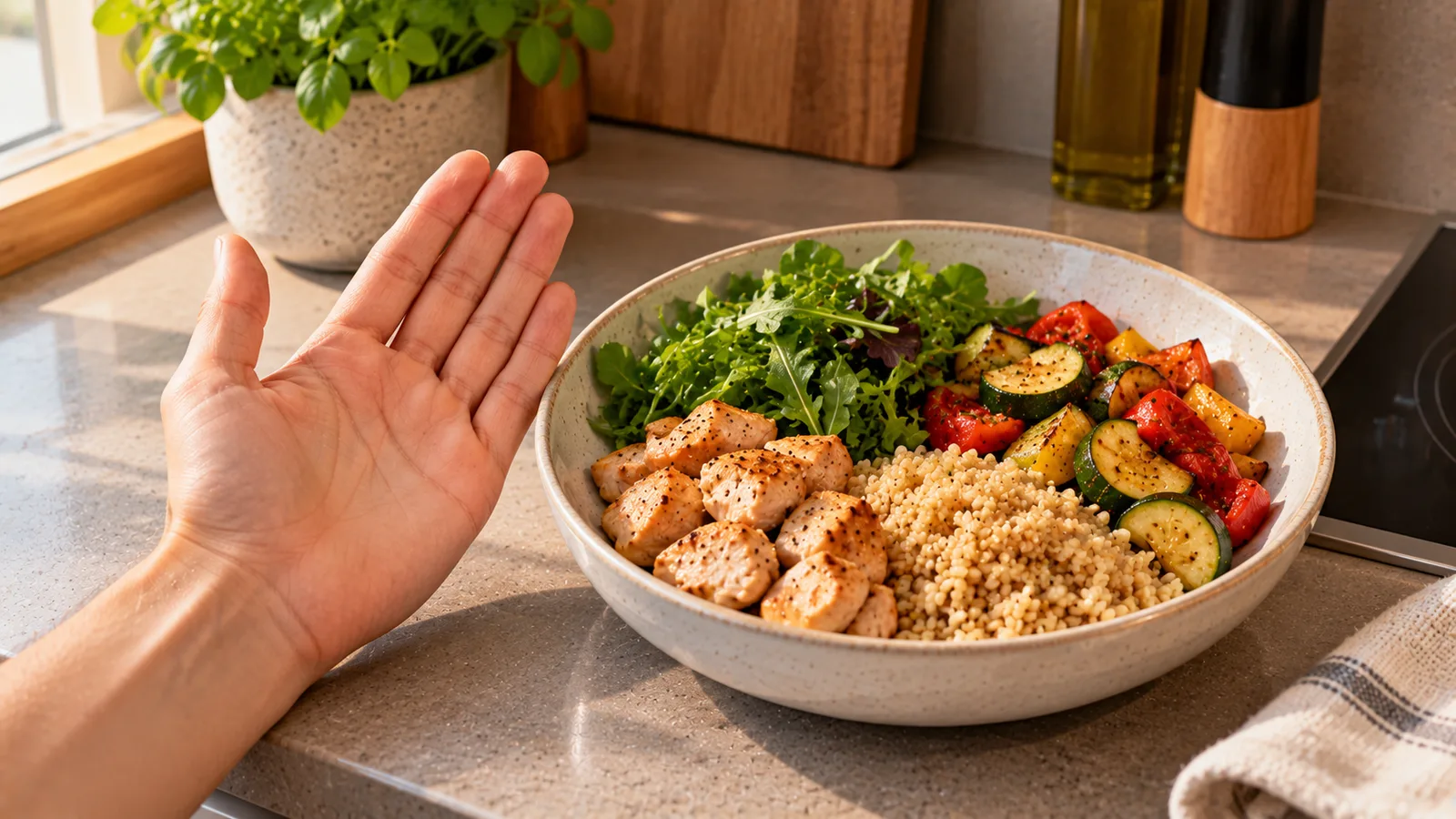
The hand portion method uses your own hand as a convenient visual reference for estimating food portions.
It can be useful when you cannot weigh food — for example at a restaurant, while traveling, at work or when you simply want a faster way to judge approximate portions.
The method is not a precise replacement for a kitchen scale. Its purpose is to provide a consistent reference when exact weighing is unnecessary or unavailable.
The basic hand portion method
A commonly used practical framework associates different parts of the hand with different types of food:
| Hand reference | Often used for |
|---|---|
| Palm | Protein-rich foods |
| Cupped hand | Carbohydrate-rich foods |
| Fist | Vegetables or fruit |
| Thumb | Fats and spreads |
These are visual references rather than exact gram measurements.
Your palm does not mean a universal number of grams of chicken, and your fist does not represent the same weight for every vegetable.
The value of the method comes from having a repeatable reference.
1. Palm for protein-rich foods
The palm can be used as a rough reference for foods such as:
- chicken;
- turkey;
- fish;
- lean meat;
- tofu;
- other similarly shaped protein foods.
Use the size and approximate thickness of the palm rather than including the fingers.
For example, when looking at a piece of grilled chicken, you can compare its surface area and thickness with your palm.
A piece roughly similar to your palm becomes one practical visual unit.
This does not mean every palm-sized protein portion contains the same calories or protein.
A palm-sized piece of salmon, chicken breast and tofu can differ substantially in weight, energy density and nutrient composition.
The hand is estimating portion size, not nutritional composition.
2. Cupped hand for carbohydrate-rich foods
A cupped hand can provide a rough reference for foods that naturally sit in a scoop-like shape, such as:
- cooked rice;
- cooked pasta;
- couscous;
- cereal;
- beans;
- other cooked grains.
Imagine placing the food into one cupped hand.
That volume becomes a practical reference unit.
This can be particularly useful at buffets, restaurants or shared meals where weighing the food is unrealistic.
Again, the calorie content of one cupped-hand portion depends on the food.
Cooked rice and granola, for example, can have very different calorie densities even if they occupy a similar volume.
3. Fist for vegetables and fruit
A closed fist can be used as a visual reference for a portion of many vegetables or pieces of fruit.
Examples include:
- broccoli;
- mixed vegetables;
- leafy vegetables after serving;
- chopped vegetables;
- an apple or orange of roughly comparable volume.
The method is especially convenient when you want to judge whether vegetables occupy a meaningful part of a meal without measuring them.
But different vegetables contain different amounts of water and pack differently.
A fist of leafy salad and a fist of cooked peas are not nutritionally equivalent.
The reference describes approximate physical volume.
4. Thumb for fats and spreads
The thumb is sometimes used as a visual reference for concentrated fat-rich foods such as:
- nut butter;
- butter;
- some spreads;
- portions of cheese;
- similar energy-dense additions.
This category requires extra caution because small differences in quantity can make a relatively large difference in calories.
Liquids such as cooking oil are also difficult to judge accurately from the final meal because some may be distributed across several portions.
When accurate calorie tracking matters, measuring oils and other concentrated ingredients is generally more reliable than trying to reconstruct them visually afterward.
Hand portions are not standardized measurements
A tablespoon is a defined volume.
One hundred grams is a defined mass.
A hand portion is neither.
People have different hand sizes, so two people looking at the same meal may describe it differently.
That is not necessarily a flaw if the method is being used as a personal consistency tool.
Your own hand travels with you and remains a relatively convenient reference for your own meals.
The method becomes less useful when someone treats a hand portion as if it were an exact standardized measurement.
Why hand size can actually be useful
The fact that hands vary is often presented only as a limitation.
But for practical self-monitoring, it can also make the reference somewhat personal.
A larger person often has a larger hand than a smaller person, although the relationship is far from precise and should not be treated as an individualized nutrition prescription.
The important point is simpler:
Use your own hand consistently rather than trying to convert every hand portion into a universal gram value.
Portion size and serving size are different concepts
A portion is the amount you actually choose to eat.
A serving size may be a defined reference on a package, nutrition database or dietary guide.
They are not automatically the same.
For example, a package might define one serving as 40 g.
You might eat 60 g.
Your portion is therefore larger than the labeled serving.
The hand method estimates the amount on your plate. It does not change the serving definition printed on the package.
A practical plate example
Imagine a lunch containing:
- grilled chicken;
- cooked rice;
- mixed vegetables;
- a small amount of sauce.
You might describe it as approximately:
- one palm of chicken;
- one cupped hand of rice;
- one to two fists of vegetables;
- a small thumb-sized amount of a concentrated sauce or fat component, where applicable.
This gives you a structured description without needing a scale.
It does not automatically tell you the exact calories in the meal.
To estimate calories, you still need information about the foods themselves and, ideally, how they were prepared.
One hand portion does not equal one fixed calorie value
This is one of the most important limitations.
Consider three palm-sized foods:
- grilled chicken breast;
- salmon;
- breaded fried chicken.
Their visible size could be similar.
Their calorie content may not be.
The same applies to carbohydrate foods.
One cupped hand of:
- boiled potatoes;
- cooked rice;
- granola;
does not represent the same amount of energy.
Hand portions help estimate quantity. They do not eliminate differences in calorie density.
Cooking method still matters
Two visually similar portions can differ because of preparation.
For example:
Potatoes boiled without added fat
and
potatoes roasted with oil
may occupy similar space on a plate but have different calorie totals.
The same issue occurs with:
- fried vs grilled foods;
- creamy vs tomato-based sauces;
- vegetables cooked with different amounts of oil;
- breaded vs unbreaded protein foods.
A visual portion estimate cannot reveal every ingredient used during cooking.
Mixed dishes are harder
The method works most naturally when meal components are visible separately.
For example:
- chicken;
- rice;
- vegetables.
It becomes less direct with mixed dishes such as:
- lasagna;
- curry;
- casserole;
- stew;
- pizza;
- creamy pasta.
A single portion may contain protein, carbohydrates, fat and vegetables mixed together.
Trying to divide one piece of lasagna into separate palm, fist and thumb measurements can create false precision.
For mixed dishes, it is usually better to estimate the overall portion and use recipe information, menu data or a suitable food entry when available.
Restaurant example
Suppose a restaurant serves:
- grilled fish;
- potatoes;
- vegetables;
- sauce.
You do not have a scale.
You can compare the meal with your hand:
Fish: approximately 1.5 palms.
Potatoes: approximately 1 to 1.5 cupped hands.
Vegetables: approximately 1 fist.
Sauce: difficult to determine precisely, especially if its ingredients are unknown.
This creates a more structured estimate than simply entering "one restaurant meal."
But it should still be treated as an estimate.
Buffet example
At a buffet, hand references can help before food is placed on the plate.
Instead of trying to reconstruct the amount afterward, you can roughly observe each serving as you take it.
For example:
- one palm-sized piece of meat;
- one cupped hand of rice;
- two fist-sized portions of vegetables.
This can be easier than estimating a crowded plate after several foods have been combined.
Travel example
When traveling, access to your usual kitchen equipment may disappear.
A hotel breakfast might contain:
- eggs;
- bread;
- fruit;
- yogurt.
Rather than trying to find exact gram weights for every item, you can use visual references and package information where available.
For example:
- fruit compared with your fist;
- bread counted by pieces when the item is standardized enough;
- packaged yogurt taken from the printed package amount;
- other foods estimated visually.
The best method can vary by food.
You do not need to force every item into a hand measurement.
Use package information when it is better
The hand method is a fallback or convenience tool, not a reason to ignore better information.
If a yogurt cup clearly states that it contains 150 g, use 150 g.
If a bread package provides reliable information per slice and you ate two slices, use the slice information.
If you cooked 200 g of dry rice and know the final batch size, use those measurements.
Hand estimation is most valuable when better quantity information is unavailable or inconvenient.
Hand method vs weighing food
| Method | Main advantage | Main limitation |
|---|---|---|
| Food scale | More precise weight | Requires equipment and extra effort |
| Hand portions | Fast and always available | Approximate |
| Package serving | Convenient for packaged food | Serving may differ from amount eaten |
| Visual guess without reference | Very fast | Usually less consistent |
There is no need to choose only one method for every situation.
You can weigh food at home and use hand estimates when eating elsewhere.
Hand method vs photo-based estimation
A hand estimate uses a physical reference you can see directly.
Photo-based estimation uses an image and software to identify food and potentially estimate portion size.
Both methods involve uncertainty.
A photograph can also be affected by:
- camera angle;
- hidden food;
- plate depth;
- lack of scale reference;
- mixed ingredients.
The two approaches can complement each other.
For example, a hand reference or known plate size can provide additional context when visually estimating a meal.
When the method is most useful
Hand portions are particularly practical when:
- eating at a restaurant;
- traveling;
- eating at someone else's home;
- using a buffet;
- eating in a workplace cafeteria;
- you do not have a food scale;
- exact calorie tracking is not required;
- you want a quick consistency check.
The method works best as a repeatable approximation rather than a promise of precision.
When greater precision may be useful
A scale or known package quantity may be preferable when:
- you are testing a recipe;
- you need accurate nutrition information for a batch;
- you are comparing small changes in intake;
- the food is highly energy-dense;
- a small quantity difference matters to your calculation;
- you need a more reproducible measurement.
The appropriate level of precision depends on the purpose of the measurement.
Do not convert hand portions into fake precision
Suppose you estimate a piece of chicken as one palm.
It may be tempting to declare:
1 palm = exactly 100 g
and enter 100 g every time.
That defeats the purpose of acknowledging uncertainty.
A thick palm-sized piece and a thin palm-sized piece can weigh differently.
If you need exact grams, weigh the food when possible.
If you are using the hand method, keep the result appropriately approximate.
A better way to improve your estimates
You can calibrate your eye without turning the method into a rigid conversion table.
At home:
- Place a normal portion on your plate.
- Estimate it using your hand.
- Weigh it.
- Compare the estimate with the actual weight.
- Repeat occasionally with foods you eat often.
You may learn, for example, what your usual portion of cooked rice looks like relative to your cupped hand.
The purpose is not to memorize a universal conversion.
It is to understand your own visual estimates better.
Example calibration
You serve cooked rice and estimate it as one cupped hand.
Then you weigh it and find that this particular portion is 145 g.
On another day, a similar-looking portion might be 160 g.
That tells you something useful:
your visual unit represents a range, not an exact number.
Over time, you can become more consistent without pretending the method has scale-level accuracy.
What about soups and drinks?
Hand portions are poorly suited to many liquids.
For drinks, soups and other fluid foods, better references may include:
- package volume;
- bottle size;
- cup or glass volume;
- measuring jug;
- menu information.
Use the measurement method that fits the food.
There is no advantage in forcing a fist or palm reference onto a liquid.
What about nuts?
Nuts are small, irregular and energy-dense.
A handful can provide a rough visual reference, but the amount can change depending on:
- hand size;
- whether the hand is flat or cupped;
- nut size;
- how tightly they are held.
If precision matters, weighing nuts is more reliable.
If the goal is simply a repeatable everyday portion, a consistent handful may still be useful.
What about cheese?
Cheese varies greatly in shape and density.
A thumb-sized reference may be useful for some pieces, but it should not be interpreted as a universal calorie amount.
A soft cheese, hard cheese and grated cheese can behave very differently by volume.
Package weight or weighing is preferable when available.
A simple decision rule
Use the best information that is reasonably available.
Known package quantity?
Use it.
Food weighed during cooking?
Use the measured amount.
Reliable serving information?
Use it when it matches what you ate.
No practical measurement available?
Use your hand as a consistent visual reference.
This avoids turning the hand method into something it is not.
The method is about consistency, not perfection
The biggest advantage of the hand portion method is not accuracy to the gram.
It is convenience.
A method you can use:
- at home;
- in a restaurant;
- while traveling;
- at work;
can give you a consistent language for describing approximate portions.
For many everyday situations, knowing that a meal contained roughly one palm of a protein food and one cupped hand of rice is more informative than simply recording "some chicken and rice."
Quick reference
| Food type | Visual reference | Remember |
|---|---|---|
| Protein-rich solid food | Palm | Compare area and thickness |
| Cooked grains/starches | Cupped hand | Approximate volume |
| Vegetables/fruit | Fist | Approximate volume |
| Concentrated fats/spreads | Thumb | Small changes can matter |
| Liquids | Use volume instead | Hand method is usually unsuitable |
| Packaged portions | Use label when available | Better than visual estimation |
The practical takeaway
The hand portion method is a simple way to estimate portions when a scale is unavailable.
Use:
palm → protein-rich foods
cupped hand → many cooked carbohydrate foods
fist → many vegetables and fruits
thumb → some concentrated fats and spreads
Treat these as visual references, not standardized gram conversions.
Use package quantities, measured weights or recipe information whenever they provide better data.
When those are unavailable, your own hand gives you a convenient and repeatable reference without requiring equipment.