
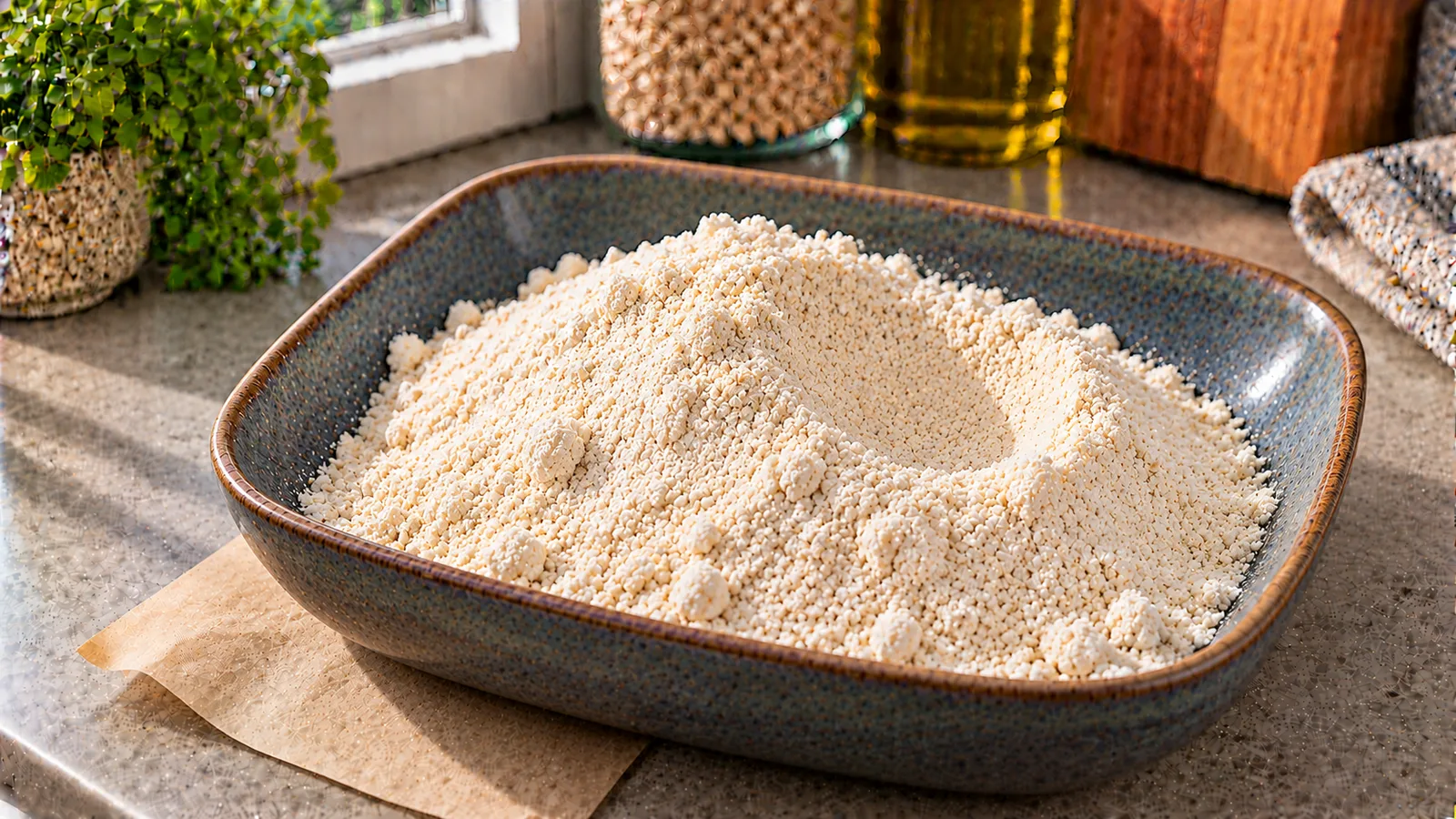
Coconut flour can have about 60 calories in a 14 g serving (2 tablespoons), according to the nutrition label for Bob’s Red Mill Organic Coconut Flour. If you scale that particular label to 100 g, the result is approximately 429 kcal. That is a calculated label equivalent, not an independently measured universal value for every coconut flour. Brands, processing methods and nutrition-label rounding can change the actual number.
The practical question is usually not how many calories are in an imaginary 100 g serving, but how much dry flour went into a pancake batter, a batch of muffins or a bread recipe. Coconut flour absorbs considerable liquid and is often used in modest quantities alongside eggs, milk or other ingredients. This guide separates the dry ingredient from the finished food so your calorie log reflects what you really ate.
Coconut flour nutrition: a verified product example
The following figures are transcribed from the Bob’s Red Mill Organic Coconut Flour product label. They apply to that labelled product and portion, not to every brand. The manufacturer's current listing specifies organic coconut as the ingredient.
| Nutrient | Per 14 g labelled serving |
|---|---|
| Calories | 60 kcal |
| Protein | 3 g |
| Total fat | 2 g |
| Saturated fat | 1 g |
| Total carbohydrate (US label) | 9 g |
| Dietary fiber | 5 g |
| Total sugars | 3 g |
| Added sugars | 0 g |
| Sodium | 10 mg |
| Potassium | 309 mg |
The figures are rounded as they appear on the US label. Multiplying every number by 100/14 may produce apparently precise but misleading values: for instance, the 60-calorie serving corresponds arithmetically to 428.6 kcal per 100 g, but this does not establish that laboratory testing would find exactly 428.6. For a European package, use the manufacturer's per-100-g energy declaration directly rather than reconstructing it from a rounded US serving.
Coconut flour is prepared from coconut solids after processing; it is not simply a jar of coconut oil, and it is not interchangeable with plain grated coconut. Its fiber and fat profile therefore needs its own product entry. See the comparison with general flour calories and portions if you are switching ingredients in a recipe.
Calories by dry coconut flour portion
These values use the label's 60 kcal, 3 g protein and 5 g fiber for every 14 g. They are proportional arithmetic estimates, useful for weighing a particular flour. They are not extra manufacturer's serving claims.
| Dry coconut flour | Calories | Protein | Fiber |
|---|---|---|---|
| 7 g | 30 kcal | 1.5 g | 2.5 g |
| 14 g | 60 kcal | 3.0 g | 5.0 g |
| 21 g | 90 kcal | 4.5 g | 7.5 g |
| 28 g | 120 kcal | 6.0 g | 10.0 g |
| 35 g | 150 kcal | 7.5 g | 12.5 g |
| 42 g | 180 kcal | 9.0 g | 15.0 g |
| 56 g | 240 kcal | 12.0 g | 20.0 g |
| 70 g | 300 kcal | 15.0 g | 25.0 g |
| 100 g | 429 kcal | 21.4 g | 35.7 g |
Formula: dry grams × 60 ÷ 14 = estimated calories. For 30 g, that is about 129 kcal; for 42 g, 180 kcal. The 100 g row is rounded to the nearest whole calorie. These figures should be replaced by the nutrition facts of your own product when available.
Using spoons instead of a scale introduces another source of variation. A level tablespoon, a heaped tablespoon and a compressed spoon do not contain the same mass. The labelled 2 tablespoons = 14 g describes one manufacturer's measurement, not a universal weight for every flour in every kitchen. Weigh the ingredient before adding water or eggs, especially when preparing several servings.
Why coconut flour and wheat flour cannot be swapped gram for gram
Coconut flour's high fiber content makes it very absorbent. The manufacturer specifically explains that coconut-flour baking typically needs more eggs and liquid than comparable wheat-flour baking. Replacing 100 g of wheat flour with 100 g of coconut flour in an ordinary recipe can produce a dry, dense result even if the calories look comparable.
Start with a recipe developed for coconut flour, measure the flour by weight and adjust water, milk or eggs according to that recipe. A recipe that uses only 30–45 g of coconut flour can still make multiple pancakes or muffins because the added liquid increases the total batter weight. Those liquids do not erase the flour's calories, however, and eggs, oils and sweeteners contribute their own energy.
Plain coconut flour is made from coconut and contains no wheat as an ingredient. Yet naturally wheat-free does not automatically establish gluten-free manufacturing conditions. If you have celiac disease or must avoid gluten strictly, choose an appropriately labelled product and consider production cross-contact. Our guide to gluten-free versus wheat-free labels explains the distinction.
Does high fiber make coconut flour lower calorie?
High fiber and low calorie are not synonyms. The example product provides 5 g of fiber within a 14 g serving, but still supplies 60 calories. Different nutrition regulations can also make the carbohydrate number look different: a US label's total carbohydrate generally includes fiber, whereas EU nutrition tables typically present carbohydrate and fiber separately. It would be incorrect to subtract fiber from a European carbohydrate figure a second time.
You can use fiber information to compare foods, but do not automatically assign a universal 4 kcal per gram to all reported carbohydrate, because fiber is metabolized differently and some nutrition systems account for it separately. A consistent logging method starts with the stated calorie value of the product and checks how much was actually used. Our fiber versus carbohydrate guide explains why the label categories matter.
Coconut flour can help add fiber to a recipe, but it is not a treatment for digestive problems and its use does not guarantee weight loss. Introducing a substantially higher amount of fiber than you normally eat may cause discomfort for some people. Adapt portion sizes gradually and maintain adequate fluid intake as appropriate for your circumstances.
Example: how to calculate coconut-flour banana pancakes
Consider a small household recipe using measured dry flour, eggs, banana and oil. The numbers below are an illustration, not a standardized recipe or a nutritional analysis of every ingredient brand. Assume two eggs contribute approximately 144 kcal, a 100 g edible banana about 89 kcal and 10 g of oil approximately 90 kcal.
| Ingredient | Recipe quantity | Estimated calories |
|---|---|---|
| Coconut flour | 42 g | 180 kcal |
| Eggs | 2 | 144 kcal |
| Banana, peeled | 100 g | 89 kcal |
| Cooking oil, all consumed | 10 g | 90 kcal |
The estimated total is 503 kcal for the whole batch, or about 126 kcal for each of four equal portions. This assumes the entire measured amount of oil is eaten and there are no other caloric additions. If some oil remains in the pan, the amount actually consumed may be lower. If you add milk, sugar, chocolate or toppings, include them separately.
What if the cooked pancakes weigh 360 g altogether? The batch still represents approximately 503 kcal before any ingredients are discarded. A 90 g cooked portion (one quarter of the batch) contributes about 126 kcal. If the cooked batch weighs 300 g because more water evaporated, its total calories are essentially unchanged, but its calories per 100 g finished food are higher. That is why raw ingredient weight and cooked food weight must not be treated as the same number.
Coconut flour versus coconut meat, coconut oil and other flours
Several coconut products share a name but not a nutrient profile. Dried coconut meat may retain substantially more of the original coconut fat. Coconut oil is predominantly fat. Coconut milk is a mixture whose energy depends on water and fat proportions. Coconut flour, especially a partially defatted variety, can have relatively high fiber. Do not select a dried-coconut, fresh-coconut or coconut-oil entry to record coconut flour.
Even among coconut flours there can be meaningful differences. Products may be processed differently, finely or coarsely milled, or sold as baking blends containing other flours and starches. A composite gluten-free flour mix requires its own label; it cannot inherit the calories of pure coconut flour. Check whether the ingredient list says coconut only or includes almond flour, tapioca starch, sugar or other additives.
If you want the closest calorie estimate, compare the same unit and food state: 100 g of dry coconut flour with 100 g of another dry flour, or your completed recipe with a completed recipe. Comparing a tablespoon of flour to 100 g of fresh coconut is not a meaningful nutrition comparison.
What changes when coconut flour is baked?
Baking removes or redistributes water but does not make the calories from flour disappear. Forty-two grams of the example dry flour contribute approximately 180 kcal whether baked into six biscuits, mixed into a loaf or stirred into batter. The finished food's calories depend on every other ingredient and the amount of the batch you consume.
If a mix absorbs 200 g of water, that increases weight without adding calories from the water. Once baked, some of that water evaporates. Calculating calories from the final 100 g based only on a raw flour figure would therefore be unreliable. For homemade recipes, add ingredient calories first and divide by measured cooked yield or by the actual number of portions.
Store coconut flour as instructed on the pack, keeping moisture out. Also note that flour and uncooked batters should not be treated as ready-to-eat foods: the FDA advises against tasting raw flour, raw dough or batter. Follow the recipe's adequate cooking instructions, especially where eggs are included.
A more dependable logging method
Choose the exact packaged coconut flour if possible. Record its calories per labelled serving or 100 g, weigh the dry amount before mixing, and add the energy from eggs, oil, dairy, fruit or sugar. For a multi-portion bake, calculate the complete batch before dividing it among the portions you eat. Keep separate entries for coconut oil, coconut milk, coconut flakes and prepared coconut-flour foods.
If the package uses a small US serving, remember that conversion to 100 g magnifies rounding uncertainty. A food journal works best when calculations are transparent about their source rather than implying a greater precision than the nutrition label provides. The distinction between the serving on a package and the food actually eaten is covered in our portion size versus serving size guide.
Sources and calculation basis: Bob’s Red Mill Organic Coconut Flour nutrition label, with 60 kcal, 3 g protein and 5 g fiber per 14 g; FDA flour safety guidance. All other coconut-flour portion values are rounded calculations from the example label, not a universal USDA SR Legacy coconut-flour composition entry.