
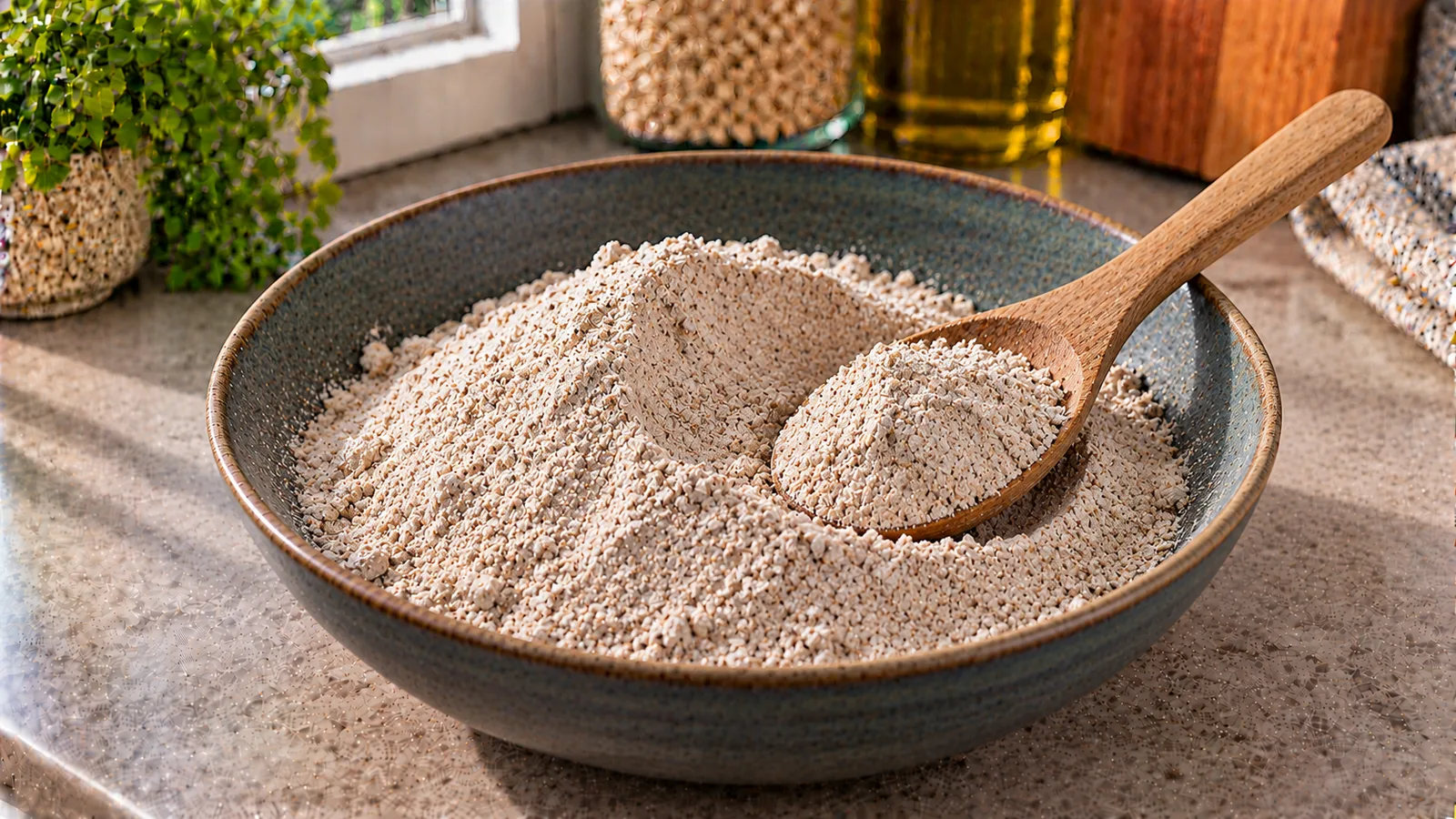
Buckwheat flour contains about 335 calories per 100 g of dry flour, according to USDA FoodData Central's SR Legacy entry for whole-groat buckwheat flour (FDC 170687). It supplies roughly 12.6 g protein and 10 g fibre per 100 g. In an actual pancake or galette, however, the flour is only one ingredient. The amount of dry flour used, added fat and other ingredients determine the calories in the finished food.
This guide covers plain, dry buckwheat flour rather than cooked buckwheat groats. It explains portions, the difference between flour and finished dishes, how to read labels, and what to look for if you need to avoid gluten.
Buckwheat flour nutrition per 100 g
The USDA record is “Buckwheat flour, whole-groat” (FDC 170687). It represents flour ground from buckwheat groats, not a sweetened pancake mix, cooked porridge or wheat-and-buckwheat blend.
| Nutrient | Per 100 g dry buckwheat flour |
|---|---|
| Energy | 335 kcal |
| Protein | 12.62 g |
| Total fat | 3.10 g |
| Total carbohydrate | 70.59 g |
| Total sugars | 2.60 g |
| Dietary fibre | 10.00 g |
| Water | 11.15 g |
| Sodium | 11 mg |
Source: USDA FoodData Central, FDC 170687. This is a reference for one type of flour, not a guarantee for every bag sold in Germany, France or elsewhere. Whole-groat and light or sifted products may have different fibre and macronutrient levels. The manufacturer's label should take priority when recording that exact product.
The USDA figure for total carbohydrate includes fibre, whereas European nutrition labels usually present available carbohydrate separately from fibre. This accounting difference matters when comparing US and EU numbers; it does not mean the flour changed in energy content.
Calories in 15, 30, 50 and 100 g
The most reliable measurement is the weight of flour before it goes into a dough or batter. These examples use 335 kcal, 12.62 g protein and 10 g fibre per 100 g of dry flour.
| Dry flour weight | Calories | Protein | Fibre |
|---|---|---|---|
| 15 g | 50 kcal | 1.9 g | 1.5 g |
| 25 g | 84 kcal | 3.2 g | 2.5 g |
| 30 g | 101 kcal | 3.8 g | 3.0 g |
| 40 g | 134 kcal | 5.0 g | 4.0 g |
| 50 g | 168 kcal | 6.3 g | 5.0 g |
| 60 g | 201 kcal | 7.6 g | 6.0 g |
| 75 g | 251 kcal | 9.5 g | 7.5 g |
| 100 g | 335 kcal | 12.6 g | 10.0 g |
Calories from flour = dry grams × 335 ÷ 100. A 45 g portion therefore contributes approximately 151 kcal before you add water, milk, eggs, oil or toppings. Values in the table are rounded calculations from a single reference, not separate laboratory measurements of each serving.
How many calories are in a tablespoon?
A spoonful is not a standard weight: a heaped tablespoon, a level tablespoon and a compacted spoonful can contain quite different amounts of flour. If a recipe specifies tablespoons, weigh the flour once using your own spoon and measuring technique. As an illustration, 15 g of flour provides about 50 kcal, but it would be misleading to claim that every tablespoon holds exactly 15 g. Cups vary for the same reason.
When you are baking, use a kitchen scale instead of relying on the volume of flour in a cup. Even small errors per spoon add up if you use many spoonfuls.
Buckwheat flour versus buckwheat groats
Buckwheat flour and buckwheat groats originate from the same plant, but they serve different culinary purposes. Flour is milled and normally used in batters, noodles, bread and thickening. Groats can be boiled and served like a grain. Do not record either one under a generic “buckwheat” entry without checking whether it is dry, cooked or ground.
Our separate guide to buckwheat calories, dry versus cooked covers whole groats. Water added during cooking does not introduce calories, but it increases the finished food's weight. As a result, 100 g of cooked groats or prepared batter cannot be compared directly with 100 g of dry flour.
The same caution applies to other types of flour. Our general flour calorie guide explains why a product's composition and portion weight matter more than a broad category label.
What changes when buckwheat flour becomes a galette?
A plain buckwheat galette can be relatively simple, but there is no universal calorie value per pancake. One cook might use only buckwheat flour and water, while another adds eggs, dairy, butter or oil. Galettes also differ greatly in diameter and thickness.
Consider an illustrative two-portion batter using 60 g buckwheat flour, 100 g plain yogurt and 10 g oil. For this calculation, the yogurt is assumed to provide 60 kcal per 100 g and the oil about 9 kcal per gram. Real packaged products may differ.
| Ingredient | Amount | Estimated energy |
|---|---|---|
| Buckwheat flour | 60 g | 201 kcal |
| Plain yogurt, example label | 100 g | 60 kcal |
| Oil | 10 g | 90 kcal |
| Total batter | — | 351 kcal |
If you cook and eat all the batter as two equally sized galettes, it provides about 176 kcal per galette, excluding fillings. That figure assumes all 10 g of oil is consumed and no batter is discarded. For a ham-and-cheese filling, vegetables, extra butter or sauce, add each ingredient separately. Conversely, if you fry in a non-stick pan with no oil, do not add oil that was never used.
The finished pancakes might weigh more or less depending on how much water evaporates. The total recipe energy does not disappear with evaporated water. For logging, count the total ingredients first, and then divide by the number of portions actually eaten.
Is buckwheat flour gluten-free?
Pure buckwheat is naturally gluten-free, despite the word “wheat” in its English name. Botanically, buckwheat is not wheat. However, buckwheat flour may be processed alongside wheat or sold in mixtures containing wheat flour. Commercial soba noodles and some restaurant galettes may also be blended products.
If you have coeliac disease or need strict gluten avoidance, choose flour with a trustworthy gluten-free declaration and check ingredients and cross-contact information. The Celiac Disease Foundation explains that naturally gluten-free ingredients can be contaminated during growing, handling or processing. Our guide to gluten-free versus wheat-free labels discusses why those two claims should not be treated as identical.
A nutrition database entry cannot certify a particular manufacturer's batch as safe for someone with coeliac disease. A product label and manufacturing information are essential for that question.
Protein, fibre and carbohydrates: what the numbers mean
The reference flour provides 12.62 g protein and 10 g fibre per 100 g. In a more typical 30 g recipe portion, that becomes roughly 3.8 g protein and 3 g fibre. A meal may contain significantly more protein if it also includes eggs, yogurt, cheese, beans or meat.
The reference's 70.59 g total carbohydrate per 100 g is measured using a US reporting convention. When comparing a German or French package, look at the local nutritional declaration rather than mechanically copying the USDA total-carbohydrate number. Whole-groat flour is not a low-carbohydrate flour simply because it is naturally gluten-free.
Buckwheat flour may contribute useful nutrients, but it is not a cure for high blood sugar or any other condition. Serving size, recipe composition and the rest of the diet remain relevant. More fibre in a flour does not make the calories in added sugar, butter or sweet fillings disappear.
How to log buckwheat flour accurately
For uncooked flour, weigh the amount you put into the recipe and use an entry specifically describing dry buckwheat flour. Record added ingredients, then divide the full batch's estimated calories by the actual serving count or the fraction you eat. Do not weigh cooked galettes and multiply by 335 kcal per 100 g: the cooked weight includes water and other ingredients.
For a packaged buckwheat-flour mix, read the label because it may contain wheat flour, starch, sugar, salt or raising agents. To distinguish between the quantity you eat and the serving printed on the packaging, see our portion size versus serving size guide.
References: USDA SR Legacy, Buckwheat flour, whole-groat, FDC 170687; Celiac Disease Foundation, gluten-free foods. All displayed portion values are rounded estimates for the named reference food.