
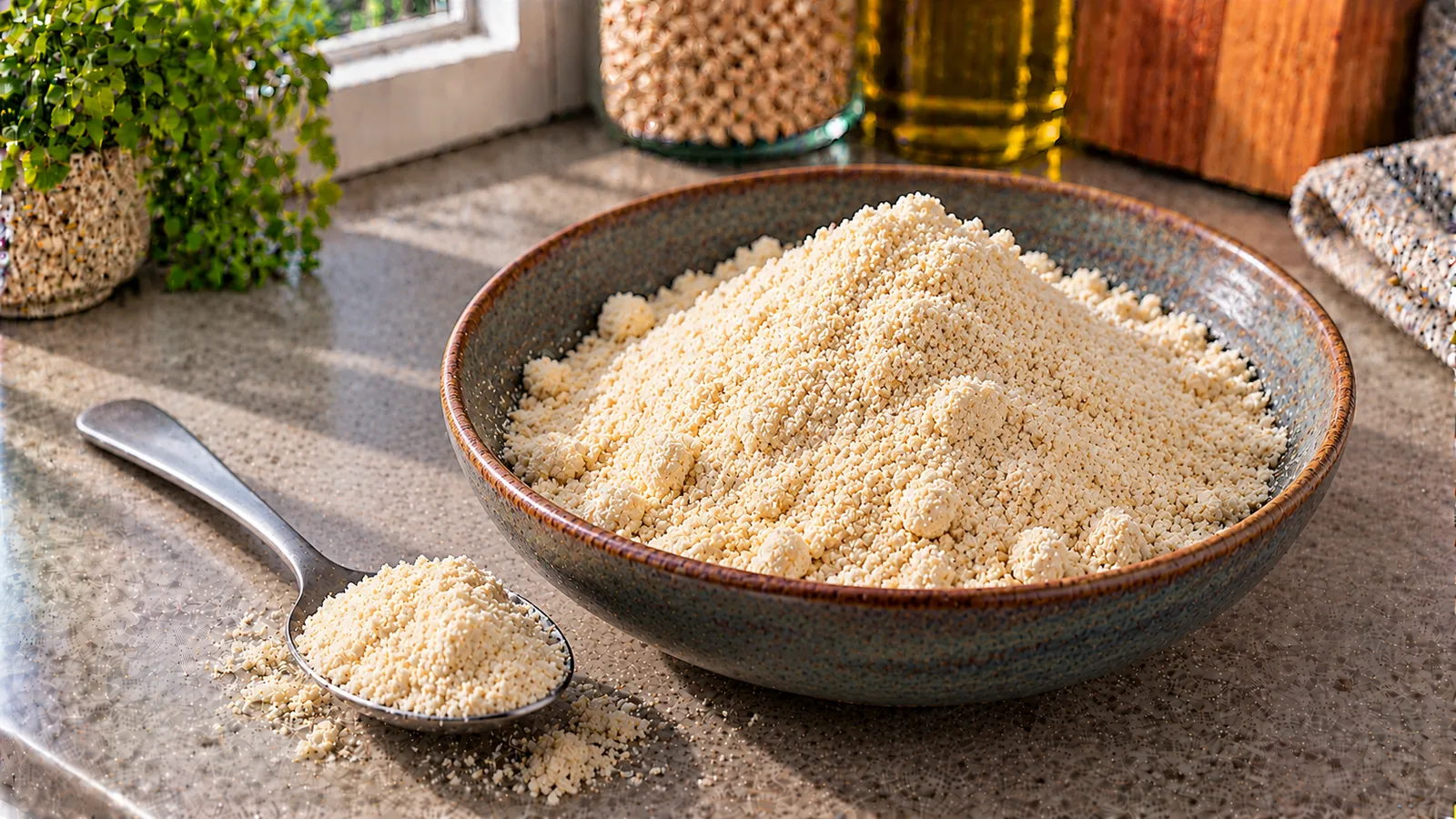
Almond flour is calorie-dense because ordinary full-fat almond flour is made by grinding almonds, which naturally contain substantial fat. For a transparent reference, USDA FoodData Central lists 579 kcal per 100 g of whole almonds (SR Legacy, FDC 170567). This is a useful starting point for ground whole almonds, not a laboratory measurement of every almond flour. A real blanched almond flour from Blue Diamond lists 170 kcal per 28 g, which is about 607 kcal per 100 g if you scale its rounded label. The label of the flour you actually use takes priority.
This guide covers dry, unsweetened, full-fat almond flour and almond meal. It distinguishes ground almonds from reduced-fat almond flour, explains amounts used in baking, and shows how to avoid counting the water in a recipe as extra calories. If a packet contains sugar, starch or other ingredients, use that product's own nutrition information rather than treating it as pure ground almonds.
Calories and nutrition: the reference must match the ingredient
The following table gives the USDA's composition of whole almonds (FDC 170567), which can serve as a proxy for flour ground from the same whole almonds. Blanching removes skins and can change fibre and other values, so it is not correct to claim that this is the exact analysis of blanched flour. A partially defatted product can differ much more.
| Nutrient in raw whole almonds (proxy) | Per 100 g |
|---|---|
| Energy | 579 kcal |
| Protein | 21.15 g |
| Total fat | 49.93 g |
| Total carbohydrate, US method | 21.55 g |
| Dietary fibre | 12.50 g |
| Total sugars | 4.35 g |
| Calcium | 269 mg |
| Magnesium | 270 mg |
| Vitamin E | 25.63 mg |
Source: USDA FoodData Central, Nuts, almonds, SR Legacy, FDC 170567. These are values for almonds, not an independent USDA analysis of a branded flour. The US carbohydrate-by-difference number includes fibre; EU labels commonly report available carbohydrate separately from fibre. Do not subtract fibre blindly from labels that have already excluded it.
A helpful product cross-check is Blue Diamond almond flour nutrition: its blanched-almond product lists 170 kcal, 15 g fat, 6 g protein and 3 g fibre in 28 g. The implied 607 kcal per 100 g is a conversion of a rounded serving label, not an exact new measurement. It explains why a generic food-database entry and a packet may not give identical results.
Almond flour calories by weighed portion
For the calculation below, the reference is 579 kcal per 100 g of whole almonds. Use this table only as an estimate for comparable full-fat ground almonds; substitute your flour's package value when available.
| Dry ground-almond weight | Calories | Protein | Fat |
|---|---|---|---|
| 15 g | 87 kcal | 3.2 g | 7.5 g |
| 20 g | 116 kcal | 4.2 g | 10.0 g |
| 25 g | 145 kcal | 5.3 g | 12.5 g |
| 28 g | 162 kcal | 5.9 g | 14.0 g |
| 30 g | 174 kcal | 6.3 g | 15.0 g |
| 40 g | 232 kcal | 8.5 g | 20.0 g |
| 50 g | 290 kcal | 10.6 g | 25.0 g |
| 60 g | 347 kcal | 12.7 g | 30.0 g |
| 75 g | 434 kcal | 15.9 g | 37.4 g |
| 100 g | 579 kcal | 21.2 g | 49.9 g |
Calculations are rounded and reflect only the dry ingredient. For example, 40 g × 579 ÷ 100 = 231.6 kcal, rounded to 232 kcal. For the Blue Diamond label, a measured 28 g portion would be logged as 170 kcal, not 162 kcal. The difference may seem small for one batch but adds up across several servings.
Volume measures are less reliable. An apparent quarter-cup depends on flour fineness, settling, packing and the measuring cup. The 28 g serving printed on one brand does not prove that everyone's quarter-cup weighs 28 g. A kitchen scale gives a clearer basis for food logging.
Almond flour, almond meal and defatted almond flour
The names on packages can be confusing. Blanched almond flour is generally ground almonds with skins removed and often has a fine texture. Almond meal is often coarser and may include skins; if both are made solely from whole almonds, their overall energy density tends to be comparable, but not precisely identical. Some sellers use these names interchangeably.
Defatted or partially defatted almond flour is a different ingredient. Some oil has been removed during processing, so fat and calorie content can be substantially lower per 100 g while protein and fibre become more concentrated. Its absorbency and baking behaviour also differ. The 579 kcal proxy is not appropriate for such products.
Check the ingredients as well as the front of the pack. A mix described as “almond baking flour” can contain other flours, gums, sweeteners or protein powder. Those mixtures require a product-specific entry. The best distinction is not the marketing word “flour” but whether the ingredient is full-fat ground almonds or an altered blend.
For a comparison with the whole ingredient, read Mealisa's calories in almonds. This page is about the milled ingredient in recipes; the almond page focuses on nuts as a snack.
A baking example: flour calories are not pancake calories
Imagine a simple two-serving batter made with 60 g full-fat almond meal, two eggs and 10 g oil. Use the whole-almond proxy for the almond meal and explicit example values of 72 kcal per egg and 9 kcal per gram of oil. Water and unsweetened spices contribute negligible energy for this illustration.
| Ingredient | Amount | Estimated energy |
|---|---|---|
| Almond meal (whole-almond proxy) | 60 g | 347 kcal |
| Eggs (illustrative 72 kcal each) | 2 eggs | 144 kcal |
| Oil (9 kcal/g assumption) | 10 g | 90 kcal |
| Full recipe | 2 servings | 581 kcal |
If divided equally, 581 ÷ 2 = 290.5 kcal, or approximately 291 kcal per serving. The 347 kcal from flour is already part of the 581 kcal total; do not add it a second time when you log the finished pancake. The egg and oil values are recipe assumptions, not USDA measurements of the specific eggs or oil in your kitchen.
Using the example Blue Diamond serving label instead of the almond proxy changes the 60 g flour contribution to about 364 kcal (60 × 170 ÷ 28), raising the batch by about 17 kcal. That is why choosing the appropriate flour entry is worth more than arguing over whether a tablespoon weighs exactly 7 or 8 g.
If the cooked batter weighs 240 g after preparation, dividing the recipe into two 120 g portions still gives about 291 kcal per portion, provided it was mixed evenly and nothing was left behind. Water lost during cooking can raise calories per 100 g of the cooked food without increasing the calories in the batch.
Does baking remove calories or reduce fat?
Baking does not make the almond oil disappear. Heat changes water content, texture and sometimes browning, but the original almonds, eggs and fats still contribute energy. If oil remains in the pan or batter is discarded, the amount consumed can differ; otherwise count the ingredients used.
For cookies, a seemingly small scoop can contain more energy than its dry weight suggests once butter, chocolate or sugar are added. Conversely, a cake batter with water or fruit puree may weigh more after mixing without the extra water supplying energy. Log the full recipe and divide it by the number or weight of portions actually eaten.
A package may express serving size by a volume such as 1/4 cup, but EU packs commonly provide per-100-g values. Mealisa's per 100 g versus per-serving label guide helps reconcile the two before you calculate a recipe.
Is almond flour lower in calories than regular flour?
Not necessarily. Full-fat almond flour is typically more calorie-dense by weight than plain wheat flour because almonds naturally contain much more fat. It also has a different balance of carbohydrate, protein and fibre. “Low carb” is a description of carbohydrate content, not a promise of fewer calories. A low-carbohydrate cake may still contain substantial energy from nuts, butter and toppings.
Almond flour cannot automatically replace wheat flour one-for-one in every recipe. It lacks wheat gluten, often absorbs liquid differently and gives a different structure. If you substitute it, follow a recipe tested for almond flour rather than only changing the gram value in a wheat-flour recipe. This matters for texture as well as for accurate portion estimates.
Gluten and almond allergy: two separate questions
Pure almond flour contains no wheat gluten as an ingredient. However, cross-contact during processing can matter for people with celiac disease; look for appropriate gluten-free labelling when needed. The Celiac Disease Foundation's guidance on gluten-free foods identifies nut flours as naturally gluten-free while stressing product controls. Mealisa also explains gluten-free versus wheat-free labels.
Almonds themselves are tree nuts and a recognised food allergen. Gluten-free does not mean nut-free. Anyone with an almond allergy must avoid almond flour; changing almonds into powder does not remove the allergen. The FDA's food-allergy guidance explains tree-nut declaration on US food labels.
How to record almond flour accurately
First check whether the package is pure full-fat ground almonds, blanched flour or a defatted product. Second weigh the dry flour in grams. Third choose the calorie value from that specific package if available; otherwise use a clearly marked ground-almond estimate. Finally include eggs, sugar, oil, butter, milk and toppings in any finished recipe rather than recording only the flour.
If a recipe lists a “serving” but you eat a different amount, scale the batch by the quantity actually consumed. Mealisa's portion size versus serving size guide provides the method. This is more dependable than assuming that every cookie, spoonful or muffin has a standard weight.
Sources and limitations: USDA SR Legacy FDC 170567 — whole almonds, proxy for ground whole almonds; Blue Diamond almond flour product label; Celiac Disease Foundation; FDA food allergens. All calculations are rounded estimates. Different flour formulations can have different nutritional values.