
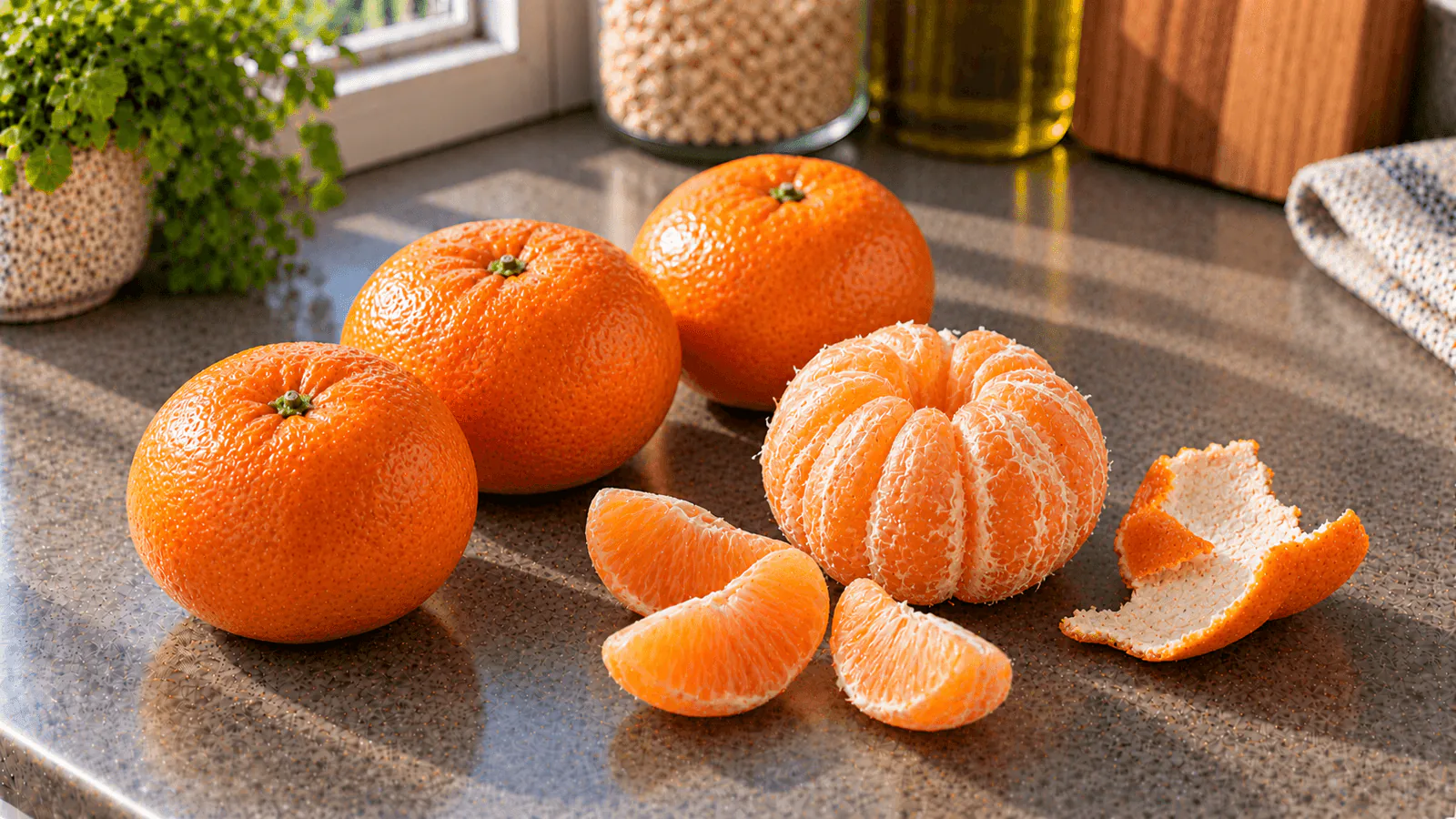
Fresh clementines contain approximately 47 calories per 100 g of edible flesh, according to USDA FoodData Central. One reference-sized clementine with 74 g of edible fruit provides about 35 calories. The peel is not included in either figure.
These small citrus fruits make convenient snacks, but the calories in one fruit or a bag depend on the weight of the segments you actually eat. This guide explains the nutrition figures, portion calculations and differences between fresh fruit, juice, canned fruit and sweetened products.
Clementine nutrition per 100 g
USDA SR Legacy entry 168195 describes Clementines, raw. The values below refer to fresh edible segments, without the outer rind.
| Nutrient | Per 100 g of edible fresh clementine |
|---|---|
| Calories | 47 kcal |
| Protein | 0.85 g |
| Carbohydrate, USDA total | 12.02 g |
| Total sugars | 9.18 g |
| Dietary fibre | 1.70 g |
| Total fat | 0.15 g |
| Water | 86.58 g |
| Vitamin C | 48.8 mg |
| Potassium | 177 mg |
| Folate | 24 µg |
Source: USDA FoodData Central, Clementines, raw, FDC 168195. These are representative composition values, not a laboratory analysis of every fruit sold in a shop. Cultivar, storage, ripeness and individual fruit size can affect measured values.
The USDA total-carbohydrate figure includes dietary fibre under the United States reporting convention. European packaged-food labels generally list available carbohydrate separately from fibre, so the figures should not be combined as if they use the same convention.
Calories in one, two or several clementines
A USDA household portion describes one clementine as approximately 74 g of edible fruit. That is a useful reference, not a guarantee that every clementine weighs 74 g after peeling.
| Edible segments | Calories | Natural sugars | Fibre |
|---|---|---|---|
| 50 g | 24 kcal | 4.6 g | 0.9 g |
| 74 g, one reference fruit | 35 kcal | 6.8 g | 1.3 g |
| 100 g | 47 kcal | 9.2 g | 1.7 g |
| 148 g, two reference fruits | 70 kcal | 13.6 g | 2.5 g |
| 150 g | 71 kcal | 13.8 g | 2.6 g |
| 200 g | 94 kcal | 18.4 g | 3.4 g |
The calculation is edible grams × 47 ÷ 100. The table rounds calories to the nearest whole number and sugars and fibre to one decimal place.
If three peeled clementines weigh 180 g, they contribute approximately 85 calories. If you only know how many fruits you ate, an estimate may be enough for a general food diary; weighing the peeled fruit is better when precision matters. The difference between a standard serving and your actual serving is covered in Mealisa's portion size versus serving size guide.
Should clementines be weighed with the peel?
No, not when you are using the USDA entry for the edible raw fruit. Store receipts and prepacked nets generally describe the purchased weight, which includes the rind and any inedible material.
For home tracking, peel the clementines, remove parts you discard, and weigh the segments you will eat. Do not use the full weight of a shopping bag as if every gram were edible. Nor should you automatically subtract a fixed percentage from every bag: rind thickness and fruit size vary.
A practical alternative is to weigh the remaining peels after eating and subtract them from the original weight, provided nothing else was discarded or added. This gives an estimate of consumed mass without requiring you to handle peeled fruit on a scale.
The thin white membranes surrounding the segments are usually eaten and belong in the edible weight. The outer peel does not belong in a calculation based on plain fresh segments unless it is actually part of a recipe with its own suitable food entry.
Clementines, mandarins, tangerines and oranges
Clementines belong to the broader mandarin citrus group. Shop labels sometimes use mandarin as an umbrella name, while clementines, satsumas and other varieties are sold separately. That naming overlap does not mean all nutritional database entries are identical.
The USDA SR Legacy entry for generic raw tangerines or mandarin oranges (FDC 169105) reports about 53 kcal per 100 g, compared with 47 kcal for the separate clementine entry. This is a comparison between reference foods, not proof that one individual fruit will have exactly those numbers.
The corresponding references are USDA clementines and USDA mandarins/tangerines. A generic mandarin entry can be a reasonable fallback if the variety is unknown, but use the clementine-specific entry when you know what you bought.
A larger orange should not be compared against a small clementine simply by counting one fruit each. For a fair comparison, use the same edible weight. The Mealisa guide to orange calories provides a separate orange-specific reference.
Whole clementines versus juice
A peeled clementine supplies edible segments and their fibre. Squeezing and filtering changes how much pulp is consumed and can produce a drink with different nutrition per 100 ml.
For a glass of clementine juice, use a suitable juice reference or the manufacturer's label. Calculate by the actual millilitres consumed, not by converting the volume directly to the mass of a whole fruit. A drink may also include other citrus juices, added sugar or water.
When a recipe uses three squeezed fruits, record the juice actually obtained or use a recipe estimate that reflects pulp discarded. Do not assume the entire weight of three unpeeled fruits ended up in the glass.
Fresh, canned and sweetened clementines
Fresh fruit without added ingredients can be counted using the raw-fruit reference. However, the same figure does not automatically apply to canned mandarin segments, fruit in syrup, dried citrus, candied peel or citrus jam.
| Form | What to weigh or measure | Best calorie reference |
|---|---|---|
| Fresh peeled clementines | Edible segments in grams | 47 kcal per 100 g reference |
| Freshly squeezed juice | Millilitres drunk | Actual juice or recipe data |
| Mandarin segments in juice | Drained fruit, liquid consumed | Specific package label |
| Mandarin segments in syrup | Drained fruit plus any syrup eaten | Label and recipe ingredients |
| Candied citrus peel | Finished portion in grams | Product label or full recipe |
In particular, the phrase “no added sugar” on a product is not a claim that the fruit has zero sugar. Fresh clementines naturally contain sugars. Mealisa's added sugar versus total sugar explanation helps distinguish the terms on packages.
Vitamin C and other nutrients
At 48.8 mg per 100 g, vitamin C is a notable nutrient in the USDA raw clementine record. A 74 g reference fruit therefore provides about 36 mg of vitamin C by calculation. This is not a guaranteed dose for every supermarket clementine.
Vitamin C contributes to normal immune function and collagen formation. Clementines also contain potassium and smaller quantities of folate, but should not be presented as a treatment for any disease.
The fruit contains little fat or protein. If it forms part of breakfast or an afternoon snack, pairing it with plain yogurt, nuts or another suitable food can make the eating occasion more substantial. Additional food brings additional calories, which should be included separately.
Do clementines fit into a weight-management plan?
Their relatively low energy density and portionable size make clementines convenient fruit options. But eating them does not automatically cause weight loss, and a “low-calorie fruit” does not make all fruit-based desserts low in calories.
For instance, 150 g of fresh clementine segments contributes around 71 kcal. If you also add 170 g of plain yogurt labelled 60 kcal per 100 g and 15 g of granola labelled 450 kcal per 100 g, the components contribute about 71 + 102 + 68 = 241 kcal after rounding. Check the actual brands before using that figure in your own diary.
Different fruits are best compared by edible portions rather than fruit counts. A grape-calorie guide can be useful if you are comparing fruit snacks by weight.
How to log clementines accurately
Choose a database entry for raw clementines when you ate fresh peeled segments. Enter the edible weight, not the unpeeled purchase weight. If you ate two fruits and cannot weigh them, about 70 kcal for two 74 g reference portions is a practical estimate, but the true quantity can differ.
For juice, syrup-packed segments or recipes with toppings, use the corresponding product or recipe nutrition. Keep sugar, honey, chocolate and other additions separate. The source figures are rounded and should not be treated as exact measurements of an individual item.
Nutrition sources
- USDA FoodData Central: Clementines, raw, FDC 168195
- USDA FoodData Central: Tangerines (mandarin oranges), raw, FDC 169105
All portion calculations use edible weights. Nutrient values and final recipe totals are estimates subject to food variation and rounding.