
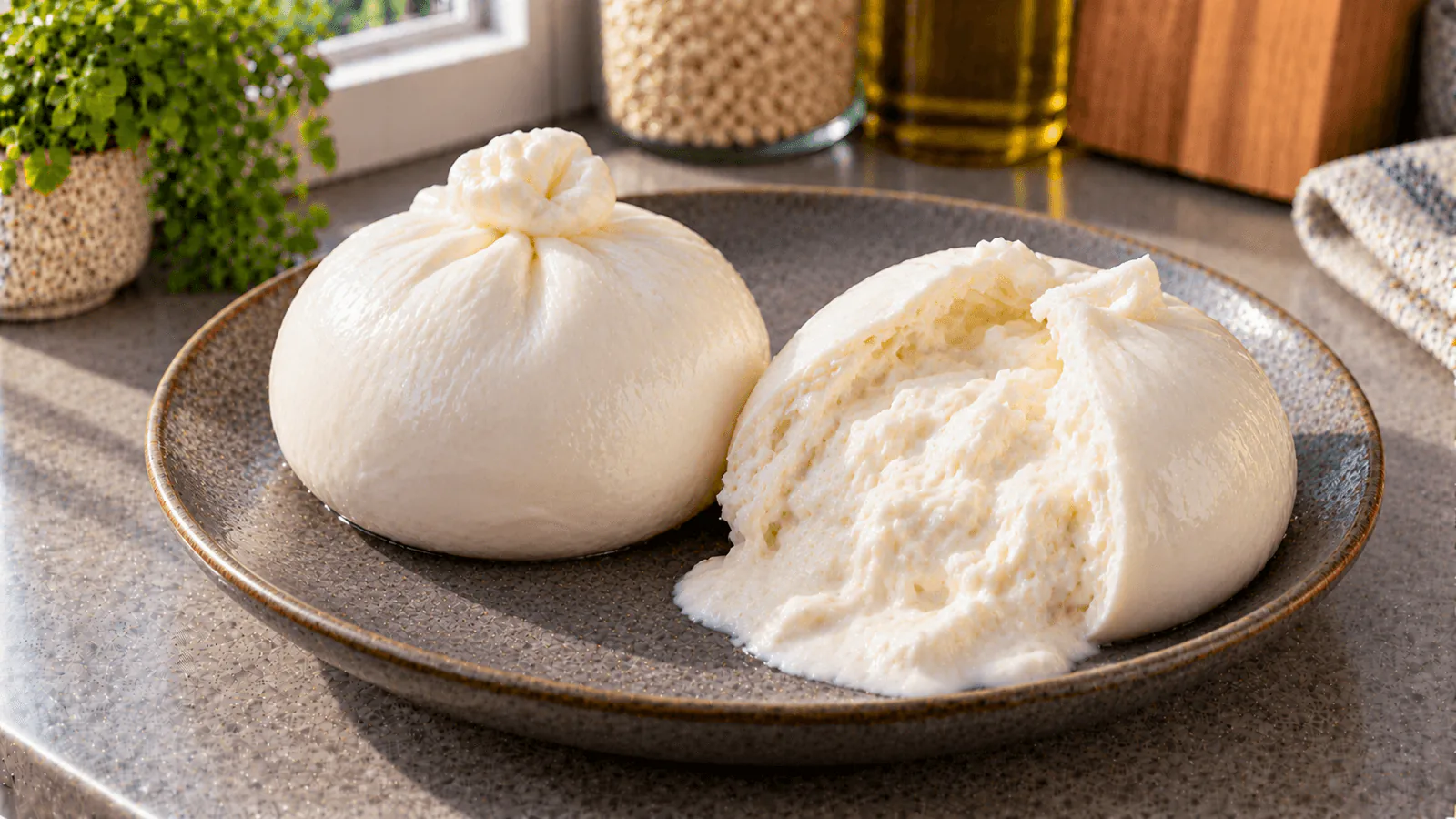
Burrata is a fresh Italian cheese with a thin mozzarella-style shell and a creamy center made from cheese strands and cream. A practical label-based answer is 256 kcal per 100 g for the Galbani 150 g burrata sold in the United Kingdom. That works out to 128 kcal for 50 g, 192 kcal for 75 g or 384 kcal for an entire 150 g ball, before any oil, bread or other additions. But 256 kcal is a product-specific figure, not a universal rule for every burrata: another manufacturer listing from Galbani Italy gives 232 kcal per 100 g for its 120 g Santa Lucia version. This article explains how to use a label, how much protein and fat a serving provides, and how to count burrata in a meal without confusing it with plain mozzarella.
What is burrata, and why does the filling matter?
Burrata looks like a ball of mozzarella from the outside, yet cutting it reveals a soft, rich filling. The Italian name for the cheese-and-cream interior is stracciatella. The two parts matter nutritionally: the amount of cream, the relative thickness of the shell and the recipe used by the producer all change the balance of fat, protein and calories. Two equally heavy pieces of burrata can therefore differ in energy even when their appearance is similar. A photograph or a restaurant menu cannot reliably determine that balance.
When comparing cheeses, distinguish burrata from a ball of standard mozzarella in water and from a tub of loose stracciatella. Those are related products but not interchangeable entries in a food diary. Our mozzarella calorie guide covers ordinary mozzarella as a separate ingredient, with its own serving sizes. Burrata is often used as a topping, which also makes the amount actually eaten easier to underestimate than a pre-portioned slice of cheese.
Burrata nutrition per 100 g: one labelled example
The following is the published nutrition declaration for Galbani Burrata 150 g in the United Kingdom. It describes that particular recipe and is a useful worked example, not a promise that all fresh burrata has identical nutrition. Salt is stated as salt on the package, rather than being silently converted into sodium. Fat includes the saturated fraction; saturated fat must not be added on top of total fat when calculating a meal.
| Nutrient | Label amount per 100 g |
|---|---|
| Energy | 256 kcal |
| Protein | 8.0 g |
| Total fat | 24.0 g |
| Saturated fat | 15.0 g |
| Carbohydrates | 2.0 g |
| Of which sugars | 2.0 g |
| Salt | 0.54 g |
Primary label source: Galbani UK — Burrata 150 g. The label values are rounded as required for packaged foods. Do not try to force the stated calories to equal a precise calculation using rounded macronutrients: fibre, rounding and the label's energy methodology can produce a small difference. This is especially relevant when adding several ingredients with their own rounded labels.
How many calories are in a serving of burrata?
Use the edible weight you actually eat. The examples below apply only to the 256-kcal-per-100-g reference product. Values are rounded to the nearest calorie; protein and total fat are rounded to one decimal place. A 150 g ball shared between two people gives about 75 g per person if it is divided evenly. A 120 g packet is not automatically nutritionally equivalent to the same weight of a different brand.
| Burrata eaten | Calories | Protein | Total fat |
|---|---|---|---|
| 30 g | 77 kcal | 2.4 g | 7.2 g |
| 50 g | 128 kcal | 4.0 g | 12.0 g |
| 75 g | 192 kcal | 6.0 g | 18.0 g |
| 100 g | 256 kcal | 8.0 g | 24.0 g |
| 120 g | 307 kcal | 9.6 g | 28.8 g |
| 125 g | 320 kcal | 10.0 g | 30.0 g |
| 150 g | 384 kcal | 12.0 g | 36.0 g |
For a 75 g serving the arithmetic is 75 ÷ 100 × 256 = 192 kcal. For a 120 g serving the result is 120 ÷ 100 × 256 = 307.2, rounded to 307 kcal. If your pack shows 232 kcal rather than 256 kcal per 100 g, replace the reference figure before doing the calculation. See portion size versus serving size for why a whole package, a manufacturer's declared portion and the amount on your plate may all be different.
Why different burrata brands give different calorie totals
Cream is central to the recipe, and manufacturers do not all use the same proportion. Galbani's Italian Santa Lucia 120 g burrata lists 232 kcal and 20 g fat per 100 g, compared with 256 kcal and 24 g fat for the UK 150 g reference. For that 120 g Italian product, using its own label gives approximately 278 kcal per full 120 g package (120 × 232 ÷ 100 = 278.4). This is different from the 307 kcal calculated above for 120 g of the UK-labelled reference. Neither calculation is wrong: the recipes differ.
A separate Galbani 100 g burrata product page in Sweden lists 226 kcal per 100 g. That reinforces the practical rule: copy the figures from the exact packaging, not a generic online average. A serving can also contain more shell or more filling than a perfectly mixed 100 g sample, so a weight-based estimate is reasonable but not laboratory precision. The Italian Santa Lucia 120 g manufacturer declaration provides the 232-kcal comparison.
Is burrata high in protein?
The example product provides 8 g protein per 100 g. A 50 g addition contributes 4 g and a whole 150 g ball contributes 12 g. Protein is a genuine component of the food, but burrata is also rich in fat; choosing it solely as a high-protein ingredient may be inefficient if the goal is to obtain much more protein for fewer calories. Compare those figures with the nutrition of your usual dairy foods rather than assuming that all cheeses deliver the same protein-to-calorie ratio.
Fat contributes much of the energy in the UK example. Of the 24 g total fat per 100 g, 15 g is labelled saturated fat. That is relevant for someone monitoring saturated fat across the whole day, but it does not make a small portion of burrata inherently unsuitable for a balanced diet. Portion, frequency and the rest of the menu determine the context. The ricotta nutrition guide is useful when choosing another fresh cheese for a different type of dish; compare the actual packs when making a substitution.
Burrata versus mozzarella, ricotta and feta
Burrata and mozzarella share some cheesemaking methods, yet the cream-filled interior is burrata's distinguishing feature. Ricotta has a different texture and is used differently in recipes; feta brings a distinctly salty, crumbly profile. It is tempting to build a single ranking of all three, but a fair comparison needs the same 100 g basis and the precise product labels. Lower-fat mozzarella, full-fat mozzarella and fresh burrata are not a single nutritionally identical product family.
For salads, pizza and pasta, the substitution also changes what happens in the pan. Burrata is usually added close to serving to preserve its creamy center; firmer mozzarella can be heated and stretched. Replacing 100 g of burrata with 100 g of a different cheese should prompt a new nutrition calculation rather than an automatic transfer of the burrata figure. If salt is a concern, compare the actual declarations with the feta calorie and nutrition guide, not with impressions based solely on flavor.
A worked example: tomato and burrata salad
Suppose your plate contains 75 g burrata from the 256-kcal reference, 200 g tomatoes and 10 g olive oil. The burrata contributes 192 kcal. If your tomatoes are estimated at 18 kcal per 100 g, 200 g adds 36 kcal. If you log 10 g olive oil at 9 kcal per gram, that adds about 90 kcal. The illustrative total is therefore 318 kcal before bread, olives, pesto, balsamic glaze or other extras. The example uses explicit assumptions for the other ingredients, not claims that every tomato or oil product has the exact same label.
Now add 50 g bread: enter the particular bread's nutrition label instead of assigning a universal value. Restaurant salads may include dressings, croutons, nuts or more olive oil than expected. A plate that appears to consist mostly of vegetables can obtain a large share of its calories from cheese and oil. Conversely, half a ball served with abundant vegetables can be a perfectly manageable part of a meal; quantity is more informative than a food's reputation.
Burrata on pizza, pasta and toast
Burrata can be served cold or added after cooking. Heating may cause water and some filling to spread onto the dish, but that does not automatically remove its calories. Record the amount of cheese actually consumed and any obvious leftovers, rather than assuming that creamy liquid which moves across the plate is calorie-free. For pasta, count dry or cooked pasta consistently with the database entry used; adding cheese calories to an already complete restaurant meal entry can double-count the topping.
On toast, count bread, burrata, olive oil and any sweet spreads separately. With pizza, check whether the cheese is part of an existing whole-pizza calorie estimate. If an app has a single entry named “burrata pasta,” its ingredients can vary dramatically; use a recipe breakdown when possible. A reliable food log is not the one with the most decimal places but the one that matches the food and amount you actually ate.
How to weigh and store burrata for more accurate tracking
If a retail package is marked 150 g, that may refer to the drained or net quantity depending on its labelling; check the pack. The surrounding preserving liquid is not equivalent to the cheese's creamy interior. For a shared ball, weigh the cheese portion after draining the outside liquid, or divide the labelled edible weight if everyone shares it evenly. Never count the brine as 150 g of cheese. When the centre spreads across a salad, weighing each portion before serving can be simpler than estimating the leftovers afterward.
Burrata is a highly perishable fresh dairy product. Respect the manufacturer's storage temperature and use-by instructions, and follow any after-opening guidance on the package. If pregnant or otherwise advised to avoid unpasteurized dairy, check the ingredient and milk-treatment statement for the precise product rather than treating all burrata as either pasteurized or unpasteurized. Burrata contains milk and is not appropriate for someone with a milk allergy; lactose tolerance is a separate question and should not be inferred from its fat content.
The best way to log burrata calories
Start with the exact brand if you have its label. Read calories per 100 g, weigh the edible serving, multiply by grams divided by 100 and round sensibly. Add oil, bread and other ingredients separately unless you are using a verified complete-recipe entry. If the product is unlabelled, 256 kcal per 100 g can be an illustrative estimate, but burrata is variable enough that the uncertainty should be acknowledged. The important distinction is between a documented package figure and a generic assumption.
Source notes: The Galbani UK 150 g burrata nutrition declaration supports the main table and serving calculations. Galbani Italy's 120 g Santa Lucia burrata and Galbani Sweden's 100 g burrata show why exact packaging matters. Product recipes and labels can change; inspect your own pack for the most relevant values.