
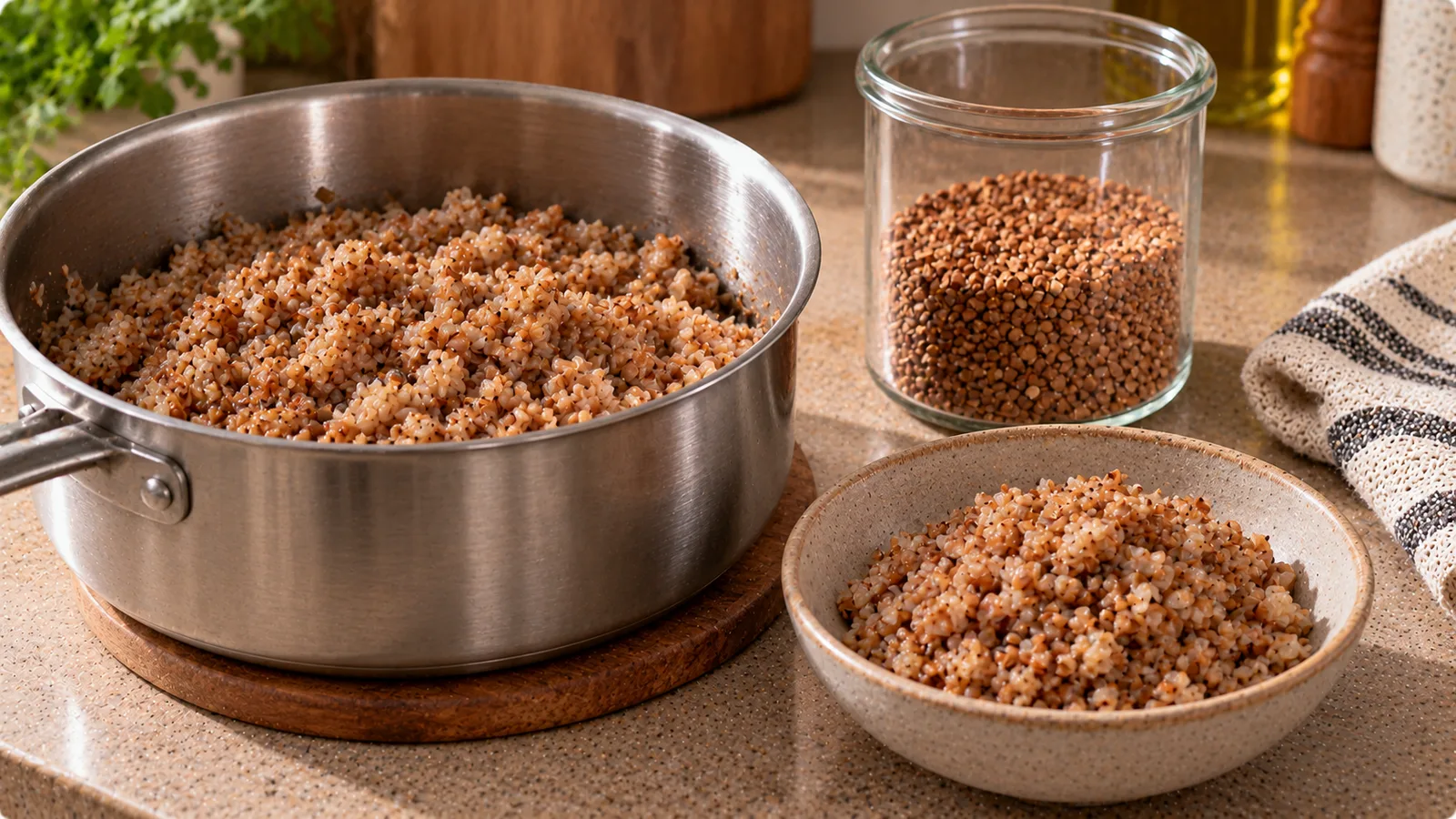
Buckwheat is a versatile grain-like seed used in porridge, side dishes, salads and flour-based recipes.
If you track calories, the most important distinction is whether you are weighing dry buckwheat or cooked buckwheat.
Cooking adds water, increasing the weight without adding calories when no other ingredients are used.
That means 100 g of dry buckwheat and 100 g of cooked buckwheat have very different calorie values.
How many calories are in buckwheat?
Typical reference values for plain buckwheat are:
| Amount | Approximate calories |
|---|---|
| 100 g dry buckwheat groats | 343 kcal |
| 30 g dry buckwheat | 103 kcal |
| 50 g dry buckwheat | 172 kcal |
| 75 g dry buckwheat | 257 kcal |
| 100 g cooked buckwheat | 92 kcal |
| 150 g cooked buckwheat | 138 kcal |
| 200 g cooked buckwheat | 184 kcal |
| 250 g cooked buckwheat | 230 kcal |
These figures are approximate food-composition references, not guaranteed values for every brand or cooking method.
For packaged dry buckwheat, the product label is usually the best starting point.
Buckwheat nutrition per 100 g
The following table compares approximate reference values for dry buckwheat groats and plain cooked buckwheat.
| Nutrient | Dry, 100 g | Cooked, 100 g |
|---|---|---|
| Calories | 343 kcal | 92 kcal |
| Protein | 13.3 g | 3.4 g |
| Total carbohydrate | 71.5 g | 19.9 g |
| Fiber | 10.0 g | 2.7 g |
| Fat | 3.4 g | 0.6 g |
| Water | About 10 g | About 76 g |
Carbohydrate values in this table follow a US-style total-carbohydrate convention, which includes fiber.
On European nutrition labels, carbohydrate is generally declared separately from fiber. This distinction matters when comparing database entries.
Dry and cooked reference values may come from different samples or analytical records. They should not be treated as an exact mathematical conversion.
Why cooked buckwheat has fewer calories per 100 g
Buckwheat absorbs water during cooking.
Imagine you start with 70 g of dry buckwheat.
Using the reference value of 343 kcal per 100 g:
70 × 343 ÷ 100 = approximately 240 kcal.
After cooking, the buckwheat might weigh around 180–210 g, depending on the amount of water absorbed.
The plain cooked batch still contains approximately 240 kcal.
Its calorie density is lower because the weight now includes more water.
The actual cooked weight depends on the cooking method, variety and final texture.
Dry-to-cooked weight conversion
There is no single exact conversion factor for every batch.
A practical illustration is:
| Dry buckwheat | Possible cooked weight |
|---|---|
| 40 g | 100–120 g |
| 60 g | 150–180 g |
| 80 g | 200–240 g |
| 100 g | 250–300 g |
These ranges are illustrative, not fixed nutritional standards.
For accurate tracking, weigh your dry buckwheat before cooking and weigh the finished batch afterward.
Suppose 100 g dry buckwheat contains 343 kcal and produces 270 g cooked buckwheat.
The calculated energy density is:
343 ÷ 270 × 100 = approximately 127 kcal per 100 g cooked.
That differs from the generic cooked-food reference of about 92 kcal per 100 g because water absorption and reference data can vary.
Your measured batch yield is more useful than a generic conversion factor when tracking a specific meal.
How to calculate calories in your cooked portion
Use the total calories from the dry ingredients and divide by the final cooked weight.
Example:
- Dry buckwheat: 120 g.
- Energy value: 343 kcal per 100 g.
- Total energy: approximately 412 kcal.
- Final cooked weight: 330 g.
Calories per 100 g cooked:
412 ÷ 330 × 100 = approximately 125 kcal.
If you eat 165 g of that batch:
412 × 165 ÷ 330 = approximately 206 kcal.
This method assumes no calorie-containing ingredients were added and the entire batch is accounted for.
If you add oil, butter or sauces, include those calories in the total.
Is buckwheat high in carbohydrates?
Dry buckwheat is carbohydrate-rich, as are most cereal grains and grain-like seeds.
But the amount you eat depends on the portion and whether the weight is dry or cooked.
For example, a 150 g serving of plain cooked buckwheat contains approximately 30 g total carbohydrate using the generic cooked reference.
A 75 g dry portion contains approximately 54 g total carbohydrate before cooking.
Those are not equivalent portions.
Comparing dry and cooked values without checking the weight basis can lead to major tracking errors.
Does buckwheat contain protein?
Yes.
Dry buckwheat contains approximately 13 g protein per 100 g in common reference data.
Cooked buckwheat contains much less protein per 100 g because water increases its weight.
A typical cooked portion can contribute some protein, but buckwheat is not as protein-dense as foods such as fish, eggs, tofu or many legumes.
For a balanced meal, combine buckwheat with an appropriate protein source.
Is buckwheat gluten-free?
Buckwheat is not botanically related to wheat and is naturally gluten-free.
Despite its name, it is a pseudocereal rather than a wheat variety.
However, cross-contact with gluten-containing grains can occur during processing or packaging.
People with celiac disease should choose products labeled gluten-free and follow appropriate medical guidance.
Buckwheat noodles and flour blends may also contain wheat, so always check the ingredient list.
Buckwheat groats vs buckwheat flour
Buckwheat groats are the whole or broken seeds.
Buckwheat flour is milled from buckwheat and is used in pancakes, breads and other recipes.
Their calorie values per 100 g can be similar, but exact nutrition varies with processing and the product.
A cooked bowl of buckwheat and a buckwheat pancake are not nutritionally interchangeable.
Pancakes may contain milk, eggs, oil, sugar or other ingredients.
Track the complete recipe rather than applying the plain cooked-buckwheat value.
Roasted vs unroasted buckwheat
Roasted buckwheat groats are often called kasha.
Roasting changes flavor, aroma and sometimes cooking behavior.
The calorie difference between plain roasted and unroasted dry groats is usually less important than differences in portion size, added ingredients and moisture.
Check the label when comparing specific products.
If a roasted buckwheat product contains added oil or seasoning, its nutritional values may differ.
Calories in common buckwheat meals
The following examples show how additions change the total.
| Meal | Illustrative calories |
|---|---|
| 150 g plain cooked buckwheat | 138 kcal |
| 150 g cooked buckwheat + 5 g olive oil | About 183 kcal |
| 200 g cooked buckwheat + 10 g butter | About 256 kcal |
| 150 g cooked buckwheat + 100 g cooked vegetables | Depends on the vegetables and oil |
These are estimates using generic cooked-buckwheat values.
The exact total should be calculated from the ingredients actually used.
Even a small amount of oil can contribute a meaningful number of calories.
How much buckwheat is one serving?
There is no universal portion size for everyone.
A practical dry serving for a side dish might be 50–75 g per adult, depending on the meal and energy needs.
A larger portion may be appropriate when buckwheat is the main carbohydrate source.
A smaller portion may work when the meal also contains bread, potatoes or other starchy foods.
For calorie tracking, decide whether your portion is recorded dry or cooked and use the matching entry.
Is buckwheat good for weight management?
Buckwheat can fit into a weight-management eating pattern.
It provides carbohydrates, some protein and fiber, especially when used as part of a meal with vegetables and a protein source.
However, buckwheat does not cause weight loss by itself.
Total energy intake, portion sizes, meal composition and long-term dietary habits matter more.
Cooking buckwheat in water without added fat can make it relatively low in calorie density.
That does not mean unlimited portions are calorie-free.
Common calorie-counting mistakes
Logging cooked buckwheat as dry.
This can substantially overestimate calories for a weighed cooked portion.
Logging dry buckwheat as cooked.
This can underestimate calories.
Using a fixed cooking yield for every batch.
Water absorption changes the final weight.
Forgetting butter or oil.
Added fat increases the energy content.
Confusing total carbohydrate with EU-label carbohydrate.
Different conventions may account for fiber differently.
Using the plain-food entry for a prepared recipe.
A buckwheat dish with meat, sauce or cheese needs a complete recipe calculation.
Best way to log buckwheat in a nutrition app
For a single serving:
- Weigh the dry buckwheat.
- Select the matching dry product.
- Record any oil, butter or other ingredients.
- Log the amount you actually eat.
For batch cooking:
- Weigh all dry ingredients.
- Calculate the total calories.
- Weigh the finished cooked batch.
- Record your portion as a fraction of the final weight.
This avoids guessing how much water the buckwheat absorbed.
Sources
- USDA FoodData Central — reference food-composition data for buckwheat.
- EU Regulation No 1169/2011 — European nutrition labeling conventions.
- Celiac Disease Foundation — information on gluten-containing grains and gluten-free food choices.
The bottom line
Plain dry buckwheat contains approximately 343 kcal per 100 g, while a generic reference for plain cooked buckwheat is approximately 92 kcal per 100 g.
The difference mainly reflects water content.
For accurate calorie tracking, use the correct dry or cooked entry, account for added ingredients and, when possible, calculate portions from your own cooked batch.