
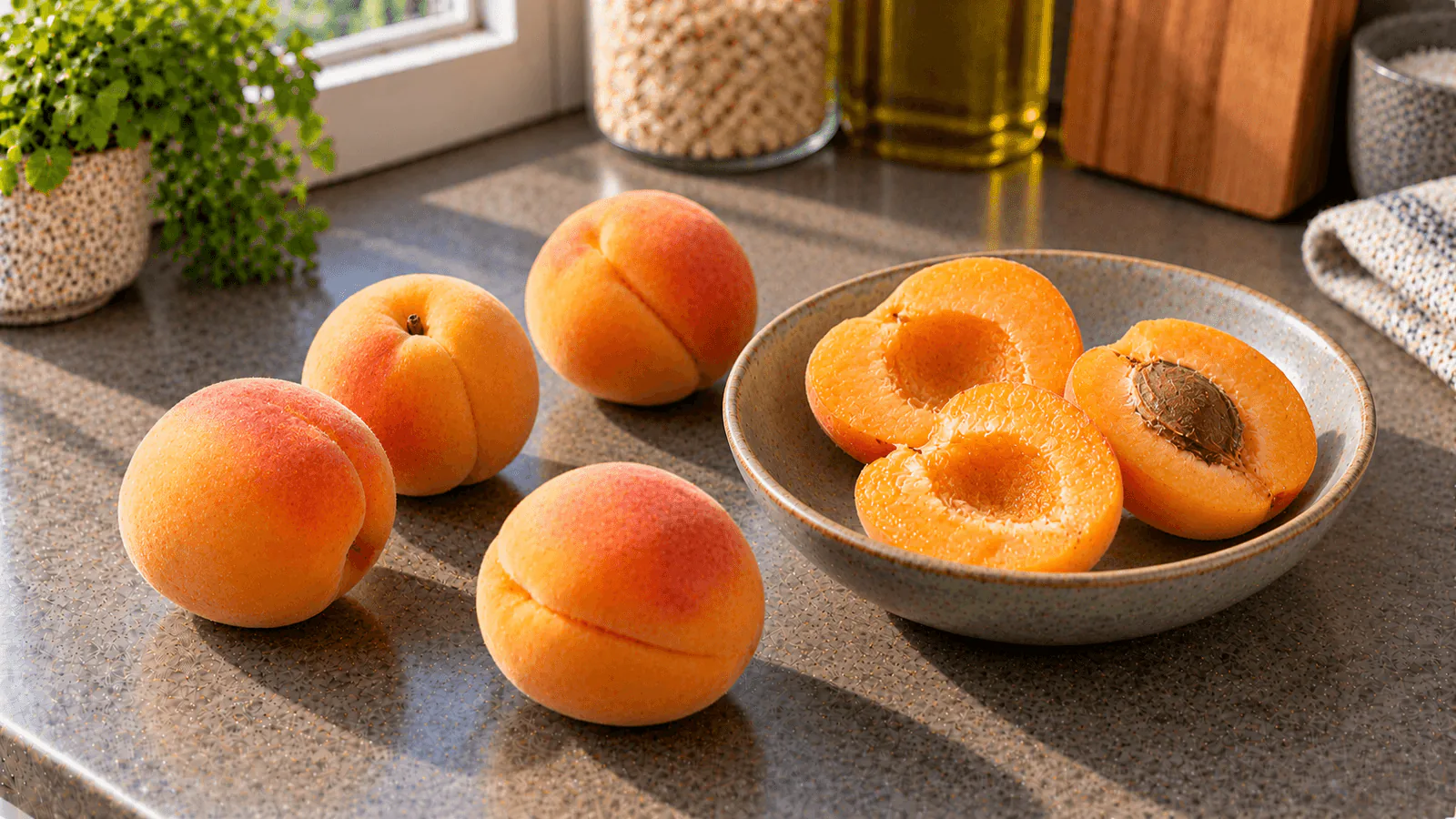
Fresh apricots contain approximately 48 calories per 100 g of edible flesh and skin, according to the USDA FoodData Central SR Legacy entry for raw apricots. Their high water content makes them much less energy-dense by weight than dried apricots. How many calories you actually eat depends on the weight of the flesh, not simply on how many fruits are on your plate.
This guide focuses on fresh, raw apricots. It covers 100 g nutrition, realistic single-fruit and multi-fruit portions, the stone and edible yield, the difference between fresh and dried fruit, and how to calculate desserts and cooked preparations without confusing the two forms.
Fresh apricot calories and nutrition per 100 g
The figures below use the USDA entry “Apricots, raw” (FDC 171697). They refer to edible fresh fruit rather than the whole fruit with its stone.
| Nutrient | Per 100 g raw, edible apricot |
|---|---|
| Energy | 48 kcal |
| Protein | 1.40 g |
| Total carbohydrate | 11.12 g |
| Total sugars | 9.24 g |
| Dietary fibre | 2.00 g |
| Total fat | 0.39 g |
| Water | 86.35 g |
| Potassium | 259 mg |
| Vitamin C | 10.0 mg |
| Vitamin A | 96 µg RAE |
Source: USDA FoodData Central — Apricots, raw. USDA values describe a reference food: the fruit's actual composition may change somewhat with cultivar, growing conditions and ripeness. The US total-carbohydrate figure includes fibre; European labels generally separate available carbohydrate from fibre. Do not assume that the two reporting conventions are identical.
Apricots are a source of carotenoid pigments, but their orange colour does not give a reliable measurement of vitamin A content in any individual fruit. They provide some fibre and vitamin C, but should be one part of a varied diet rather than the sole source of either nutrient.
Apricot calories by edible portion
Use 48 kcal per 100 g to calculate the raw edible weight. These values exclude the stone and any discarded damaged portions.
| Raw edible weight | Calories | Natural sugars | Fibre |
|---|---|---|---|
| 35 g | 17 kcal | 3.2 g | 0.7 g |
| 50 g | 24 kcal | 4.6 g | 1.0 g |
| 70 g | 34 kcal | 6.5 g | 1.4 g |
| 100 g | 48 kcal | 9.2 g | 2.0 g |
| 150 g | 72 kcal | 13.9 g | 3.0 g |
| 200 g | 96 kcal | 18.5 g | 4.0 g |
| 250 g | 120 kcal | 23.1 g | 5.0 g |
Each number is a rounded calculation, not a separately tested portion. Calories = edible grams × 48 ÷ 100. For example, 125 g of fresh apricot flesh contains approximately 60 kcal. If you buy a product with its own nutrition declaration, use the relevant product value.
How many calories are in one apricot?
There is no universal weight for a small, medium or large apricot. A reference portion of 35 g of edible apricot has about 17 kcal, but this is a weight-based example rather than a guarantee about every fruit. A larger 50 g edible portion contains about 24 kcal, while a 70 g edible portion gives roughly 34 kcal.
For three apricots supplying a combined 105 g of edible flesh, the estimate is about 50 kcal. Counting fruits can be convenient, but the result changes if their size changes. When you need better accuracy, pit and weigh the quantity you will actually eat, or weigh the whole batch and subtract the stones.
As an illustration, suppose six whole apricots weigh 240 g and the removed stones and discarded pieces weigh 24 g. The edible yield is then 216 g, equivalent to about 104 kcal. That is an illustrative household measurement, not an assumed universal waste percentage.
Fresh apricots versus dried apricots
Fresh apricots have roughly 48 kcal per 100 g. The USDA entry for dried, sulfured, uncooked apricots (FDC 173941) gives around 241 kcal per 100 g. The difference mostly reflects removal of water during drying: energy and sugars become more concentrated in a smaller weight of fruit.
| Form | Reference calories per 100 g | How to use the figure |
|---|---|---|
| Fresh apricots, raw | 48 kcal | Weigh flesh and skin without stones |
| Dried apricots, sulfured and uncooked | 241 kcal | Weigh the dried fruit as purchased, excluding packaging |
Sources: USDA raw apricots and USDA dried apricots. At equal weights the two are not interchangeable, but a comparison of 100 g of each also does not represent the same number of original fruits.
Read our separate guide to dried apricot calories and portions when logging dried fruit. The fresh-fruit figures in this article should not be used for dried apricots, sweetened dried fruit or chocolate-coated apricots.
Do the skin, stone and ripeness change the count?
Apricot skin is edible and is included in the USDA raw-fruit reference. If you eat it, count it as part of the edible weight. The hard stone is excluded. Do not use the total supermarket purchase weight if the stones and any removed parts will not be eaten.
A very ripe apricot may taste sweeter and feel softer than a firmer one. Taste alone is not a reliable way to infer a new calorie figure for the same 100 g serving. Use the reference number unless there is more specific composition data for a particular product.
Wash fresh apricots under running water before eating or cutting them, and keep cut fruit suitably chilled. See the CDC's food-safety guidance.
Raw, baked, stewed and canned apricots
Baking or stewing changes the texture and may change the finished weight through water loss or absorption. Heat itself does not add calories. If 300 g of raw edible apricots enter a recipe, they contribute about 144 kcal before any additional ingredients. The concentration per 100 g of finished fruit may be different if the batch loses water.
For example, 300 g apricots plus 20 g added sugar contributes roughly 144 + 80 = 224 kcal before other ingredients, assuming about 4 kcal per gram of sugar. If that mixture makes four equal servings and all ingredients are consumed, the apricot-and-sugar contribution is around 56 kcal per serving. The figures describe this example, not all stewed apricots.
Canned apricots can be packed in water, juice or syrup. Check whether the nutrition label describes fruit with liquid, drained fruit or a full serving. A canned product in syrup cannot be logged automatically as plain raw apricots. For homemade compote, count all sugar, honey or other additions that are actually eaten.
Apricots in yogurt, breakfast bowls and desserts
A breakfast portion with 150 g fresh apricot pieces contains about 72 kcal from the apricots. If the bowl also contains yogurt, oats, nuts or honey, each ingredient adds its own energy and nutrients. An apricot crumble likewise gets substantial calories from flour, butter and sugar; the fruit value alone is not the value of the dessert.
Our guides to peaches and mango provide other fruit-specific numbers. Compare fresh fruits at similar edible weights if your goal is to understand their nutritional differences. Comparing one large mango to one small apricot says more about portion size than about food composition.
If you add fresh fruit to porridge, a smoothie or a salad, weigh the actual fruit pieces. Blending does not make calories disappear, although it can affect the texture and the ease with which the drink is consumed.
Natural sugars, fibre and portion choice
In the USDA reference, fresh apricots contain 9.24 g naturally occurring sugars and 2 g fibre per 100 g. A 150 g edible portion therefore contributes around 13.9 g total sugars and 3 g fibre. That does not mean sugar has been added to the fruit. By contrast, a fruit spread, canned syrup or sweetened apricot dessert may include added sugars.
For weight management, fresh apricots may help create a satisfying fruit component in a meal for relatively few calories, but no fruit alone causes weight loss. If you need to log food consistently, separate the apricot contribution from the rest of the meal and check your overall intake.
A manufacturer's serving size is not always the same as the quantity you actually eat. Our portion size versus serving size guide explains how to interpret the difference.
A food-safety note about apricot stones
Eat the fresh fruit, not the raw kernel inside the stone. The European Food Safety Authority warns that raw apricot kernels contain amygdalin, which can release cyanide when consumed. This warning concerns the kernels, not ordinary consumption of apricot flesh. See EFSA's apricot-kernel risk assessment. Do not confuse a stone's inedible contents with the edible weight used in calorie tables.
A reliable way to log apricots
For plain fresh apricots, choose a raw-fruit entry and weigh the edible flesh and skin. If you only know the whole-fruit weight, subtract stones and other uneaten portions rather than applying a fixed per-fruit number. Use a dried-fruit entry for dried apricots and the manufacturer's label for canned or formulated products. In a recipe, add all ingredients, then calculate how much of the finished batch was actually eaten.
Data sources: USDA SR Legacy, Apricots, raw, FDC 171697; USDA SR Legacy, Apricots, dried, sulfured, uncooked, FDC 173941; EFSA on raw apricot kernels. All portion calculations are rounded estimates.