
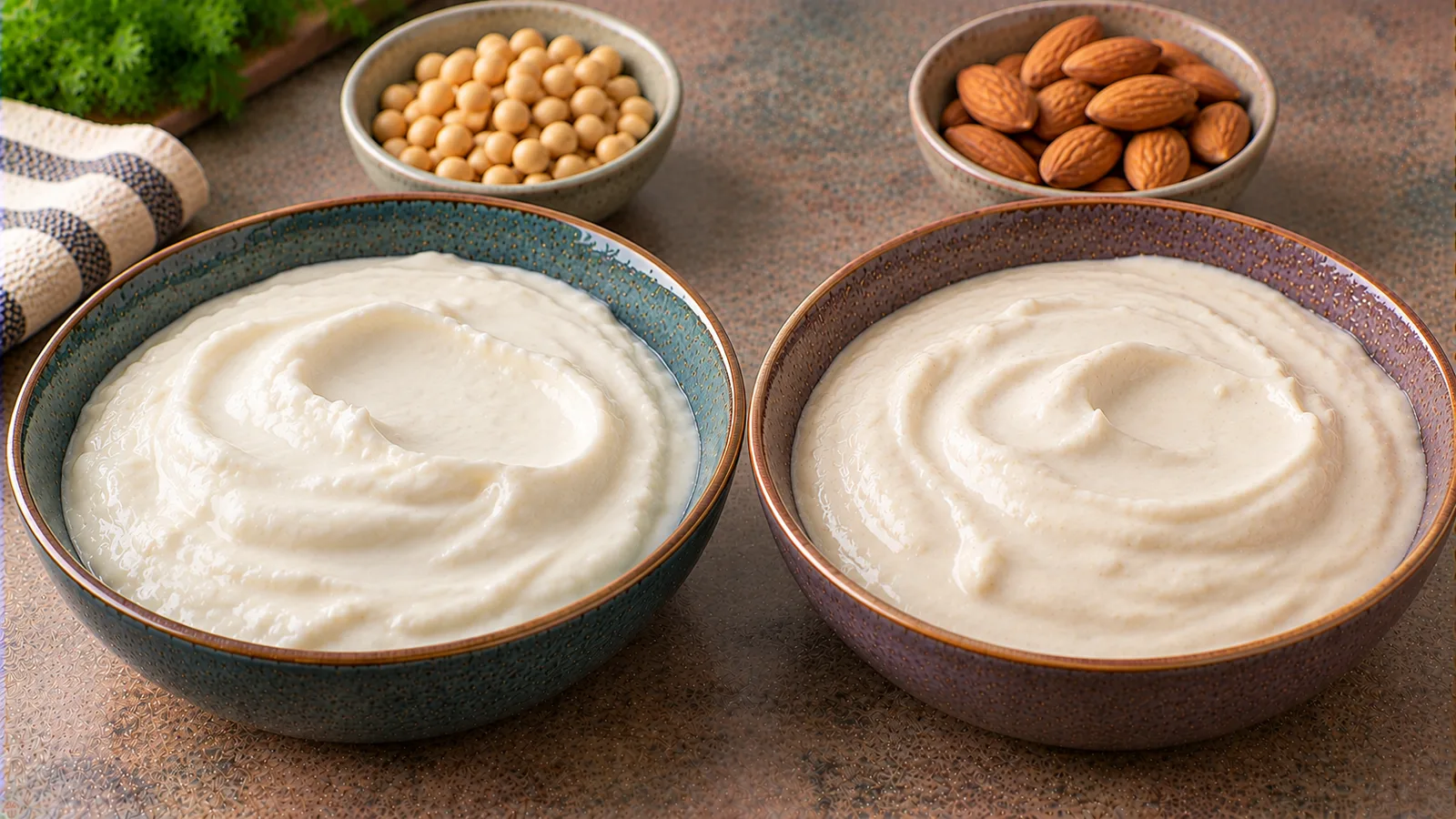
A soy yogurt alternative and an almond yogurt alternative can look almost identical in a breakfast bowl. That does not mean they supply the same protein or calcium. The most useful comparison is the same edible portion, with the exact product names and labels stated, rather than an assumed average for all plant-based yogurts.
Here we compare 150 g of Alpro Natur Ohne Zucker (soy-based) with 150 g of dmBio Joghurtalternative Mandel Natur (almond-based) sold in Germany. Both are plain-style plant alternatives, but they are different brands and formulations. Crucially, the Alpro product explicitly declares added calcium; the dmBio almond product has no calcium figure on the product nutrition listing. That missing entry is not a measured zero.
The 150 g comparison
| Nutrient, edible 150 g | Alpro plain unsweetened soy | dmBio plain almond |
|---|---|---|
| Protein | 6.0 g | 1.8 g |
| Calcium declared | 180 mg | Not declared |
| Energy | 63 kcal | 72 kcal |
| Fat | 3.45 g | 4.05 g |
| Carbohydrate | 0 g | 6.75 g |
| Sugars | 0 g | 0.45 g |
| Fibre | 1.35 g | 0.90 g |
| Salt | 0.36 g | 0.21 g |
| Reference product size | 400 g | 160 g |
All numbers in the table use the published per-100 g figures multiplied by 1.5. The primary sources are the Alpro manufacturer label and the dmBio product listing. This is not a laboratory analysis, a market-wide average or a comparison of almond drinks with soy drinks. The date of this label-based comparison is 22 October 2026; recipes and packaging can change.
Protein: the soy option provides 4.2 g more
Alpro's unsweetened soy alternative declares 4.0 g protein per 100 g, compared with 1.2 g per 100 g for dmBio's almond alternative. At 150 g, the calculation is 4.0 × 1.5 = 6.0 g for soy and 1.2 × 1.5 = 1.8 g for almond. The difference is 4.2 g protein for an identically sized serving.
For breakfast this can matter if the yogurt base is supposed to contribute meaningful protein. For example, adding fruit to a 150 g bowl does not remove that difference; you would need to consider the protein in any further ingredients separately. Still, 6.0 g is only the protein supplied by this one serving, not a guarantee that the whole breakfast is high in protein.
The difference is explained partly by formulation: the Alpro product lists 10.7% peeled soybeans, while dmBio lists 6% almonds, along with water and starch. Protein cannot be inferred from the word 'plant-based' alone. Other brands may use soy protein, pea protein or a mixed base, so their results can be different. Our guide to guide to daily protein needs can help place protein from one food in the context of an entire day.
Calcium: a declared figure versus missing data
The Alpro soy label lists 120 mg calcium per 100 g, supplied through added calcium (tricalcium citrate). Therefore 150 g provides 180 mg declared calcium. The EU nutrient reference value for adults is 800 mg, so 180 ÷ 800 × 100 = 22.5% of that EU labelling reference value. It is a label reference, not a personalised calcium prescription or an assertion that 150 g meets everyone's individual requirement. The legal reference is in Regulation (EU) No 1169/2011, Annex XIII.
The dmBio almond listing gives protein, fats, carbohydrate, sugars, fibre and salt, but does not give a calcium value; its listed ingredients do not include an added calcium mineral. This permits the narrow statement 'no calcium value declared on the consulted listing'. It does not permit '0 mg calcium' or a numerical calculation of the calcium difference. Almonds naturally contain some calcium, and the amount in this finished product was not established from the available label.
EU labelling rules require certain nutrition figures, but vitamins and minerals can be declared under the applicable conditions rather than being listed in every basic nutrition table. See the European Commission's nutrition-labelling explanation. If calcium matters to your diet, choose a product that actually lists mg calcium per 100 g, preferably on the package you buy.
Why a name with 'almond' can be misleading
Not every yogurt alternative advertised 'with almonds' is an almond-base yogurt. As an important example, Alpro Natur mit Mandeln lists 9.8% soybeans and 1.5% almonds and declares 3.9 g protein and 120 mg calcium per 100 g. Its protein is much closer to Alpro soy because soy is a major ingredient.
That product is not the almond yogurt used in our table. Substituting it would turn the comparison into soy versus soy-with-almond, hiding the main question. Always read the legal food description and the first ingredients: they reveal whether soy, almond, coconut or another base dominates. 'Almond flavour' and 'almond-based' are not interchangeable descriptions.
This distinction is especially important for food allergies. Someone avoiding soy cannot assume that a product is soy-free just because almonds appear on the front. Conversely, the dmBio almond product contains almonds, which are a tree-nut allergen. Labels and cross-contact statements must be checked individually.
Sugar, energy and salt in the same bowl
For these particular plain products, the 150 g soy serving lists 63 kcal, 0 g sugars and 0.36 g salt. The 150 g almond serving lists 72 kcal, 0.45 g sugars and 0.21 g salt. The energy difference is just 9 kcal, much smaller in practical terms than the difference in protein. The almond item has less declared salt but more declared carbohydrate. None of those figures should be transferred to flavoured or sweetened alternatives.
'No added sugar' and 'zero sugar' are also different concepts. A food can contain naturally occurring sugars even where the manufacturer has not added sugar. In this specific comparison, the Alpro product is labelled Natur Ohne Zucker, while dmBio declares 0.3 g sugars per 100 g despite having a short ingredient list without added sugar. Read the sugar row rather than guessing from package colour or style.
If you add cereal, fruit, nut butter or syrup, calculate the bowl from the yogurt plus each topping. A useful practical method is to write down the 150 g base first, then add the labelled portions of toppings. This avoids comparing a bare almond yogurt with a soy yogurt already mixed with granola.
How to choose for breakfast or a snack
Choose the compared soy product when protein and a declared calcium contribution are priorities. It provides 6.0 g protein and 180 mg labelled calcium for 150 g, plus manufacturer-declared added vitamins. It is not suitable for someone with a soy allergy, and the manufacturer's allergen statement also advises about possible tree-nut traces.
Choose the compared almond product when you specifically want an almond-based texture or flavour and can cover protein elsewhere. It contributes 1.8 g protein per 150 g in this formulation. Because calcium is not declared, do not count it toward a calculated calcium target without better product-specific data. dmBio describes it as a shelf-stable, heat-treated almond preparation; follow its exact storage instructions rather than those for a chilled soy alternative.
For a fuller breakfast, pair either base with fruit and a suitable cereal or seed portion. If the total meal needs more protein, measure an additional protein source rather than assuming every plant-based yogurt delivers the same. For a broader comparison that includes dairy-based yogurt, see soy yogurt versus Greek yogurt comparison; that page answers a different question.
A five-step label check for other brands
- Identify the base. Confirm whether soybeans, almonds or a blend dominates the ingredient list; check allergens before comparing anything else.
- Standardise the serving. Use a common weight such as 150 g, multiplying values for 100 g by 1.5. Do not compare one 160 g pot with a 400 g tub as if their whole packs were equal portions.
- Read protein separately. Copy grams per 100 g and calculate the serving; marketing phrases alone are not sufficiently precise.
- Check calcium fortification. Look for calcium in the ingredients and a quantitative value in mg on the label. If no value is declared, record 'not declared', not zero.
- Check sugars and practical constraints. Ingredients, allergens, price per 100 g, storage after opening and availability can change which product fits your needs.
A useful label comparison is a short calculation anchored to real packaging. For the specific products checked here, soy wins on declared protein and provides an explicit calcium quantity; the almond product's calcium level remains unknown from the consulted label. That limitation is part of the answer, not a detail to conceal.
Sources and calculation method
- Alpro Natur Ohne Zucker, manufacturer nutrition and ingredient declaration: per 100 g, 4.0 g protein, 120 mg calcium, 42 kcal, 2.3 g fat, 0 g carbohydrate and sugar, 0.9 g fibre, 0.24 g salt.
- dmBio Joghurtalternative Mandel Natur, 160 g, official retailer listing: per 100 g, 1.2 g protein, 48 kcal, 2.7 g fat, 4.5 g carbohydrate, 0.3 g sugar, 0.6 g fibre, 0.14 g salt; no calcium figure listed.
- Alpro Natur mit Mandeln, manufacturer ingredients: mixed soy/almond example, not included in the two-product table.
- European Commission: nutrition declaration and Regulation (EU) No 1169/2011, Annex XIII: required versus voluntary nutrition declarations and the 800 mg EU adult calcium nutrient reference value.
Method: published label figures × 1.5 for 150 g edible product; all calculated quantities refer to the plain product without toppings. Label pages checked 22 October 2026. No estimate or invented zero was used for undeclared calcium.