
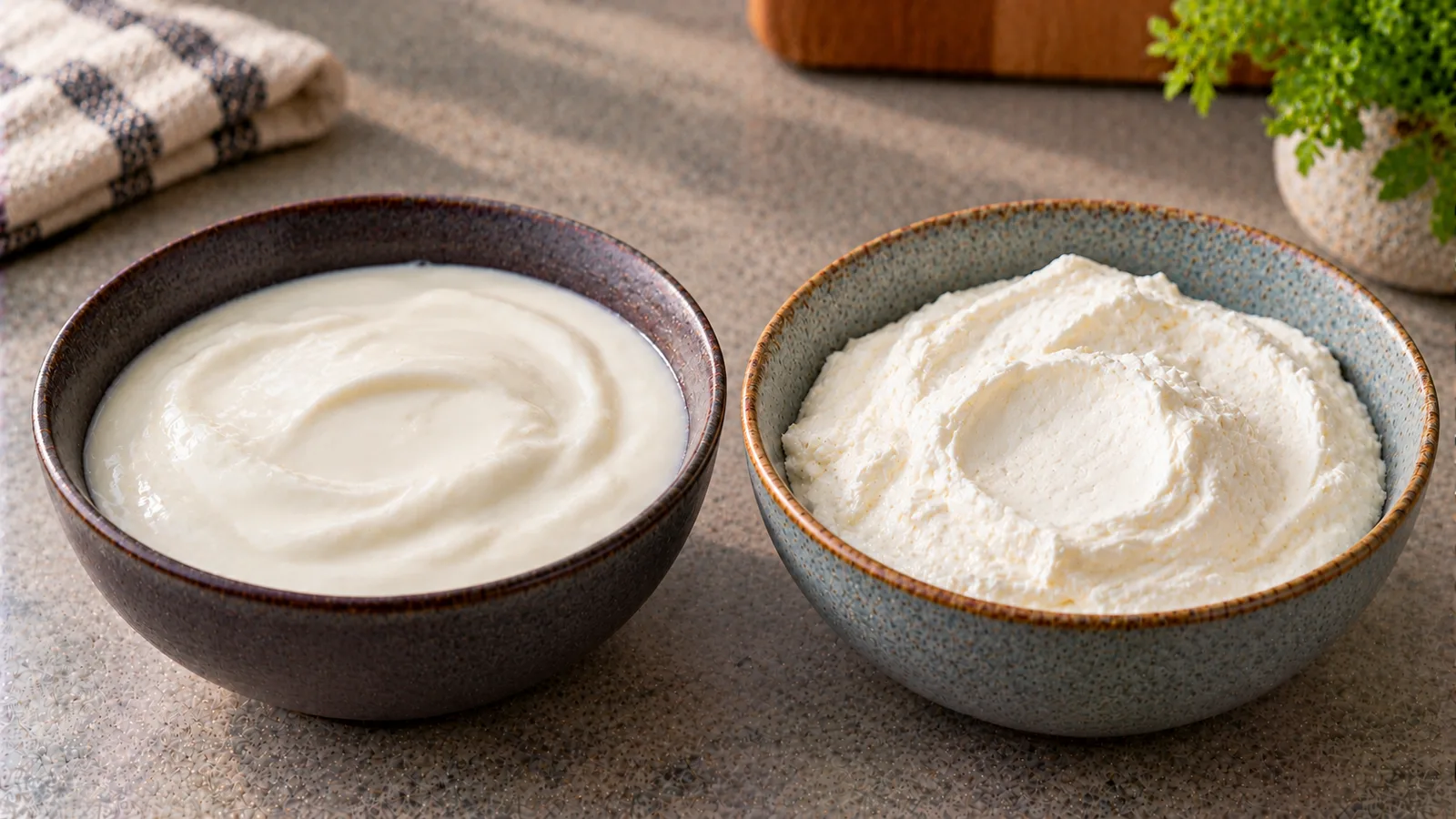
What the comparison actually means
Soy yogurt and Greek yogurt may both be spoonable, tangy and suitable for breakfast, but their nutrition labels can tell very different stories. The fair comparison is plain, unsweetened soy yogurt alternative versus plain Greek yogurt, on an equal 100 g basis. A high-protein strained Greek yogurt cannot be treated as identical to every Greek-style product, and some soy alternatives contain added starch, sugars or protein isolates. Read the actual pack before using any typical values.
This guide is about protein, sugars, fortification, price and practical swaps; it is not a claim that one food is universally healthier. The ingredient list and the declared nutrition table matter more than the front-of-pack adjective. Different fat levels, fermentation methods and brands can make two containers with the same broad name behave differently.
Snapshot: two illustrative label examples
The following are constructed examples, not verified brand labels or database averages. They demonstrate how to compare packs and must not be cited as the composition of soy yogurt or Greek yogurt generally.
| Per 100 g | Plain soy alternative (example) | Plain Greek yogurt (example) |
|---|---|---|
| Energy | 55 kcal | 90 kcal |
| Protein | 4.0 g | 9.0 g |
| Total sugars | 2.0 g | 3.5 g |
| Fat | 2.5 g | 4.0 g |
| Calcium | 120 mg (added) | 110 mg (declared example) |
| Price assumption | €0.35 | €0.48 |
These example values are deliberately explicit assumptions for arithmetic, not the results of a market survey. They cannot establish which product usually has more protein, which is cheaper in Germany, or the typical calcium content of either category. For real grocery decisions, photograph or transcribe two labels and compare the corresponding rows. The EU food-information regulation requires nutrition declarations to express energy and nutrients per 100 g or 100 ml, enabling comparisons on a common base.
Protein: compare like with like
In the hypothetical table, Greek yogurt supplies 9.0 g protein per 100 g versus 4.0 g for the soy alternative. That difference is 5.0 g per 100 g, not 5%. At a 200 g portion the corresponding amounts are 18 g and 8 g. A 150 g pot supplies 13.5 g and 6 g. Multiplying by portion mass is essential; comparing one large tub with one small cup will mislead.
These are label examples, not guaranteed values. Strained Greek yogurt often concentrates protein compared with ordinary yogurt, but some products labelled Greek-style are thickened rather than similarly strained. Likewise a soy product fortified with added soy protein can outperform an ordinary soy alternative. Find the protein (g) line and ignore marketing words unless their claims are substantiated by the pack. Protein quantity alone does not describe the whole meal. Our Protein Digestibility and Quality: What the Scores Actually Mean discussion explains why digestibility and amino-acid context differ from a simple protein-grams comparison.
Total sugar is not the same as added sugar
EU labels declare total sugars, which include naturally present sugars. Plain dairy yogurt may contain lactose even when no sugar is added. Plain soy alternatives may have low total sugars, but sweetened vanilla, fruit and dessert versions can contain substantial added sugar. You cannot calculate added sugar by subtracting an assumed amount of lactose from the declared sugar line. Instead read the ingredients for sugar, syrups, concentrated juice or other sweetening ingredients, and consider the full serving.
In our examples the 200 g portions contain 4.0 g versus 7.0 g total sugars. That arithmetic does not show that the Greek yogurt contains 7.0 g of added sugar. Nor does the lower example sugar number make every soy yogurt a better choice. Compare plain with plain, then separately compare flavoured products if that is what you intend to eat. An unsweetened claim does not automatically mean sugar-free.
Calcium fortification changes the answer
Calcium is an especially important variable when replacing dairy with a plant-based alternative. Fortified soy yogurt can have calcium added, but many versions are not fortified. If calcium is absent from the nutrition declaration, do not assume that the food contains zero calcium or the same level as a similar brand. Check the ingredients for calcium salts and the nutrition panel for a quantified calcium value. The NIH calcium fact sheet discusses dairy and fortified alternatives as dietary calcium sources.
The illustrative 120 mg versus 110 mg per 100 g translates to 240 mg versus 220 mg per 200 g. It does not mean fortified soy yogurt always contains more calcium than Greek yogurt. Vitamin B12 and vitamin D may also be added to plant products, but fortification varies. Examine each vitamin and mineral separately, and never infer an amount solely from a front label saying “with vitamins.”
Fat, energy and texture
Fat level can overwhelm category averages. A Greek yogurt made from whole milk can be considerably richer than a fat-free strained version; soy alternatives likewise vary with added oils, soy content and thickeners. In the fictional comparison 200 g provides 110 kcal versus 180 kcal (soy versus Greek). This is an arithmetic example, not a recommendation to select the lowest-calorie food. Calories depend on the specific tub and on additions such as honey, granola, nuts and fruit.
Greek yogurt often offers a dense, creamy texture and tangy flavour. Soy alternatives can be silky or gel-like depending on stabilisers and protein content. Texture is relevant for overnight oats, smoothies, dips and baking; substitution one-to-one may change water release or firmness. Use a small batch to test recipes rather than assuming thickness proves a high protein level.
How price changes the protein calculation
A shelf price per pot says little if pot sizes differ. Convert both prices to price per 100 g, then compare the nutrient you care about. In the purely illustrative case €0.35 buys 4.0 g protein from 100 g soy yogurt, while €0.48 buys 9.0 g from 100 g Greek yogurt. The cost per 10 g protein is €0.875 and approximately €0.533 respectively. Rounded to cents: €0.88 versus €0.53.
| Illustrative metric | Soy alternative | Greek yogurt |
|---|---|---|
| Price per 100 g | €0.35 | €0.48 |
| Protein per 100 g | 4.0 g | 9.0 g |
| Cost per 10 g protein | €0.88 | €0.53 |
| Cost for a 200 g bowl | €0.70 | €0.96 |
Formula: cost per 10 g protein = price per 100 g × 10 ÷ protein per 100 g. This metric does not measure calcium, taste, sustainability, suitability for vegan diets or overall meal quality. A cheaper-per-protein food need not be the best option for a specific person. Use today's actual shelf price rather than treating these illustrative euros as observed retail data.
A practical 200 g breakfast comparison
For a real choice, weigh or measure 200 g of the exact product you have. Then add an identical portion of oats and fruit to each bowl if you want to compare only the yogurts. In our label examples, the yogurt portions differ by 10 g protein, 3 g total sugars, 70 kcal and 20 mg calcium. Those differences disappear or reverse if you choose different brands or fat levels.
Make the rest of the plate count. Fruit adds flavour and fibre; oats add bulk and whole grains; nuts change energy and fat. Our What Is a Balanced Meal? A Simple Plate-Building Guide guide can help place either yogurt into an overall meal. For someone prioritising a dairy-free breakfast, a clearly labelled suitable soy product may be the deciding factor irrespective of the hypothetical protein ranking.
Ingredients and suitability
Greek yogurt is made from milk and is unsuitable for someone avoiding milk protein. It also contains lactose unless the label specifically states otherwise. Soy yogurt contains soy and is unsuitable for someone with a soy allergy. Neither label name by itself establishes suitability for a medical allergy, and cross-contact warnings deserve attention. Check the actual allergen declaration, especially when serving other people.
Plant-based does not automatically mean fortified, high-protein, low-sugar or low-cost. Dairy does not automatically mean that every Greek-style yogurt is high-protein. A product may be vegan yet sweetened, or dairy-based yet naturally low in total fat if manufactured from skimmed milk. Ingredient order gives useful context but does not replace the nutrition table.
Five-step supermarket label check
| Step | What to check | Why it matters |
|---|---|---|
| 1 | Plain versus flavoured; unsweetened versus sweetened | Prevents mismatched comparisons |
| 2 | Protein and sugars per 100 g | Gives a common denominator |
| 3 | Calcium and any added B12 or vitamin D | Verifies fortification rather than assuming it |
| 4 | Fat content and ingredient list | Explains energy and texture differences |
| 5 | Shelf price divided by pack weight | Allows a fair cost comparison |
If packaging gives a serving size as well as 100 g, keep the 100 g figures for comparison and then scale to the amount you truly eat. Our Portion Size vs Serving Size: What’s the Difference? article explains why a serving printed on a label and an actual portion can differ. Do not compare a soy alternative per 100 ml with a Greek yogurt per 100 g without first checking product density or using the same mass unit.
Interpreting nutritional databases carefully
Food-composition databases can provide background benchmarks but are not a substitute for a live product label. The USDA FoodData Central search contains different food records and preparation states, so select a comparable plain unsweetened product and read its description before adopting any value. A database entry for “yogurt, Greek, nonfat” must not be applied to full-fat Greek yogurt, and a generic soy drink is not a soy yogurt alternative.
The EFSA dietary reference values overview offers wider nutritional context; it does not set a verdict on these two supermarket products. Think about your total daily diet rather than declaring a winner from one nutrient. When products change their formulations, nutrition and fortification can change too, so repeat the comparison when you buy a new formulation.
Which should you buy?
Choose by your requirements and the actual pack. Greek yogurt may be a convenient protein-dense option if you eat dairy and prefer its flavour. A plain fortified soy alternative may suit someone avoiding dairy and looking for a calcium source, provided its label supports that choice. For budget shopping, compare unit prices and calculate cost per relevant nutrient only if that metric advances your goal.
There is no universal winner. Compare plain products at 100 g, check protein and total sugars, verify calcium fortification separately, then consider a realistic portion and price. The example values in this article are constructed for demonstration and should not be used as manufacturer specifications.