
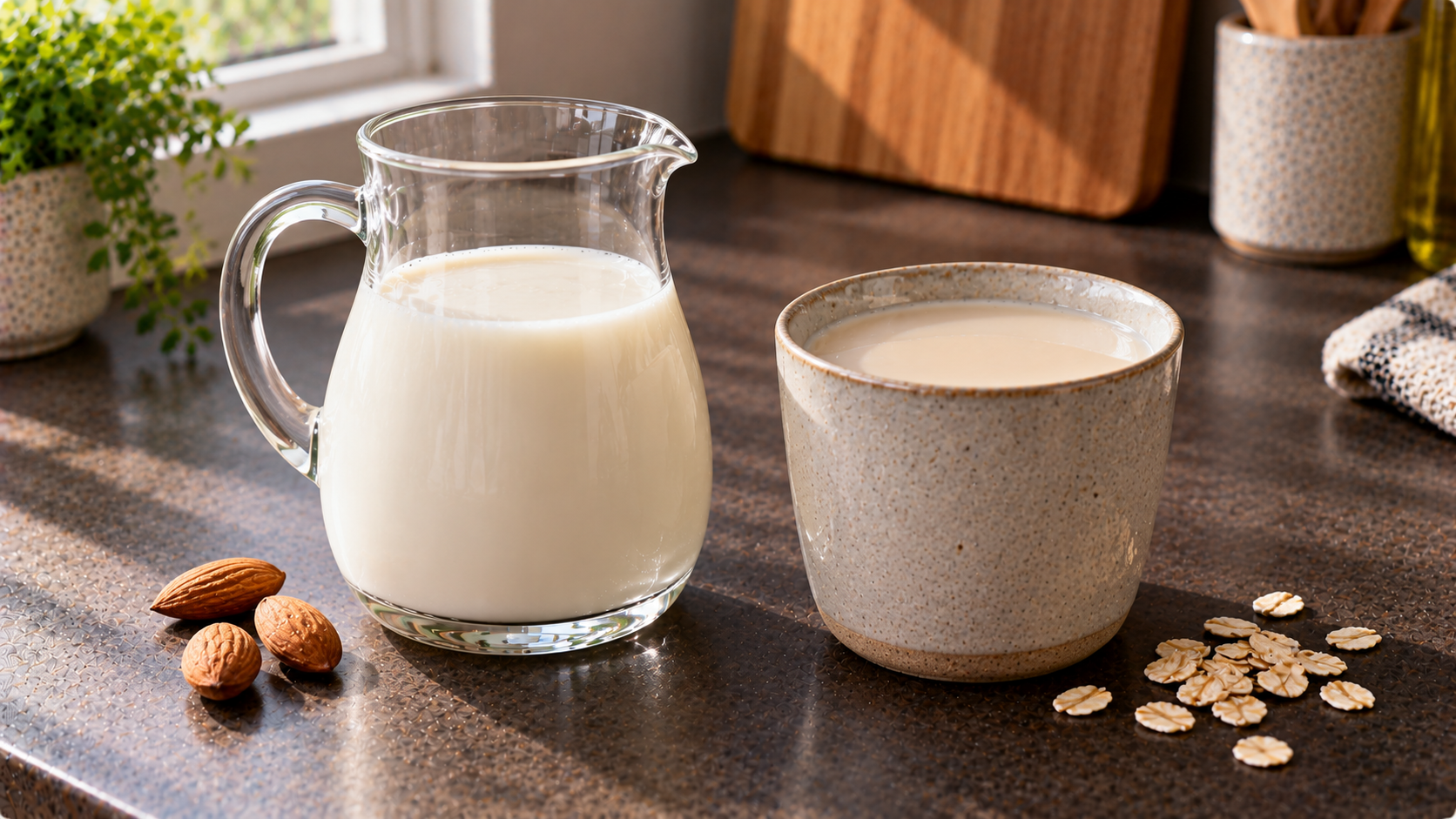
Almond milk and oat milk are both plant-based drinks, but they do different jobs nutritionally and in the kitchen. For a lower-energy unsweetened drink, almond often has the advantage; for a naturally fuller texture and a higher carbohydrate contribution, oat often wins. Neither is usually a meaningful protein source. The result depends on the exact carton, its fortification, and how much you use. This guide compares like with like rather than treating all almond and oat beverages as identical.
Quick answer: which should you choose?
Choose unsweetened almond drink when you want a mild nut-flavored beverage with relatively little carbohydrate, provided you have no almond allergy. Choose unsweetened oat drink if you prefer its grain flavor, a thicker feel in coffee or porridge, or need to avoid tree nuts. Choose either with appropriate fortification when you are replacing dairy milk regularly: calcium and vitamins matter more than the name of the base ingredient. If protein is a major goal, compare soy or pea-based drinks as well rather than expecting almond or oat to supply much.
An important qualification: an oat product labeled “no added sugar” can still declare sugars because its processing may break oat starch into smaller sugars. Likewise, an almond beverage can be low in calories partly because its almond content is low. Read the ingredient list and full nutrition declaration, not just a front-of-pack slogan.
Almond versus oat: compare the same amount
Nutrition varies substantially among brands and between ordinary, unsweetened, sweetened, organic and barista formulations. The following figures are illustrative label profiles, not laboratory averages, named products, or values guaranteed for a particular store. Use actual packaging for tracking.
| Example unsweetened drink | Almond, per 100 ml | Oat, per 100 ml |
|---|---|---|
| Energy | 15 kcal | 45 kcal |
| Protein | 0.5 g | 1.0 g |
| Carbohydrate | 0.3 g | 6.5 g |
| Of which sugars | 0 g | 3.0 g |
| Total fat | 1.2 g | 1.5 g |
| Saturated fat | 0.1 g | 0.2 g |
| Calcium, if fortified to 120 mg/100 ml | 120 mg | 120 mg |
These example profiles highlight a direction frequently found on labels, not a reliable rule for every brand. Barista oat drinks may contain additional vegetable oil. Some almond beverages contain more nuts, fat or calories; some oat products have no declared sugars. The numbers should never replace the label of the carton you actually buy. The FDA and Germany's DGE both emphasize substantial variation across plant-based beverages. FDA — plant-based milk alternatives; DGE — plant-based milk alternatives.
For a 250 ml glass, multiply a per-100-ml figure by 2.5. In this illustrative comparison, almond drink gives about 38 kcal and oat drink about 113 kcal. For a 40 ml splash in coffee, those same examples provide approximately 6 versus 18 kcal. The gap is modest in one small coffee, but can become meaningful over several substantial servings. The drink should be evaluated within the entire eating pattern, not declared inherently better because of one nutrient.
If you need separate serving-size references rather than a brand-neutral comparison, see the guides to almond milk and oat milk. Choose the entry matching the drink and portion you actually use.
Why are the carbohydrate and calorie values different?
Almond-based drinks are commonly made with water and a relatively small amount of finely processed almonds. Almonds themselves are energy-dense, but the beverage can be dilute. The proportion of nuts, emulsifiers, flavorings and any added sugar determines the finished drink's profile.
Oat drinks start with a cereal ingredient containing starch. Industrial preparation may use enzymes to change starch into smaller carbohydrates; the resulting texture and sweetness can differ from a home-blended oat drink. That helps explain why a package marked without added sugar can nevertheless list several grams of sugars per 100 ml. It does not mean the manufacturer necessarily added table sugar. The ingredients list, declared sugars and applicable claim wording must be considered together.
A drink with 45 kcal per 100 ml is not necessarily “unhealthy,” nor is a 15-kcal drink necessarily more nutritious. Oat drinks can be convenient as a carbohydrate-containing addition to breakfast; almond drinks may make it easier to keep a low-calorie beverage low in energy. Neither supplies the protein of an ordinary glass of dairy milk simply because the beverage looks similar.
Protein: neither drink is equivalent to dairy milk
A central mistake is comparing plant-based drinks solely by color and intended use. Almond and oat options are often low in protein relative to milk or fortified soy drink. Using the illustrative table above, a 250 ml glass supplies about 1.25 g protein from almond or 2.5 g from oat. Even though oat gives twice as much in this example, neither amount is a substantial contribution to a high-protein meal.
If breakfast already includes eggs, skyr, tofu or legumes, this difference may be unimportant. If you rely on plant drinks as a major substitute for dairy across the day, it becomes more relevant. The US FDA advises comparing protein, calcium, vitamin D and other nutrients instead of assuming all milk alternatives are nutritionally interchangeable. FDA — know the nutrient difference.
Protein content can change significantly with added pea or soy ingredients. That turns a standard almond-versus-oat comparison into a different comparison: a blended or protein-enriched product should be assessed from its own ingredient and nutrition labels.
Calcium, vitamin B12, vitamin D and iodine: check fortification
For someone who regularly replaces dairy milk with a plant drink, fortification can be more consequential than whether the base is almond or oat. Many products are fortified with calcium, vitamin B12 and sometimes vitamin D, vitamin B2 or iodine. Others, including some organic products in particular markets, are not fortified at all.
A package declaring 120 mg calcium per 100 ml contributes 300 mg calcium from a 250 ml glass. An unfortified drink with a similar-looking package cannot be assumed to provide that amount. The value is an arithmetic example, not a claim about every almond or oat product.
DGE points out that milk and dairy foods contribute calcium, iodine, riboflavin and vitamin B12 in Germany, and advises particular attention to these nutrients when replacing dairy products. It also notes that added minerals can settle: shake the carton as instructed. DGE — plant-based milk alternatives.
Do not assume calcium-fortified means fortified with B12, vitamin D and iodine as well; each has to be checked separately. Iodine is especially easy to overlook because many drinks do not contain an iodine fortificant. If you avoid dairy completely, assess the whole diet and other appropriate sources rather than relying on one beverage. For young children, especially under two, adult plant drinks require separate age-specific nutritional advice; they must not substitute for breast milk or infant formula for infants.
Ingredients, allergies and gluten: what the label tells you
Almonds are tree nuts; an almond drink is unsuitable for someone with an almond allergy unless their clinician has advised otherwise. Oat drink does not automatically contain nuts, but mixed-product or shared-production warnings should be assessed for individual allergy needs. Oats can also be contaminated by gluten-containing grains during growing or processing; a person with coeliac disease should choose an appropriately labeled gluten-free product instead of assuming every oat drink is safe.
The ingredient list may reveal added oils, stabilizers, sweeteners, flavorings and the proportion of almonds or oats. Such ingredients do not by themselves establish that a product is harmful, but they help explain texture, calories and suitability for a particular diet. The term barista describes intended performance, not a standard nutrient composition.
A practical label review should cover per 100 ml energy, protein, carbohydrates, sugars, fat, saturated fat and salt, followed by calcium, B12, D and iodine where declared. Compare two cartons in the same units. In EU countries, ingredient and nutrition information follows the EU food-information framework. EU Regulation 1169/2011.
In coffee: frothing, acidity and barista versions
Oat drinks commonly provide a fuller cereal-like body and may foam consistently in barista formulations. Almond drinks usually give a thinner texture with a recognizable almond taste; their foam performance varies. Both can separate when added to very hot or acidic coffee, depending on formulation. A carton designed for coffee may behave differently from its unsweetened standard version.
Barista performance is sometimes achieved using oils, emulsifiers, stabilizers or altered ingredient ratios. That means the barista carton may not have the same calories as the standard carton from the same brand. Check the label rather than assuming that because both say oat or almond, they share nutrition values.
Taste is subjective: oat is often perceived as creamier and grainier, while almond tastes nuttier and lighter. If coffee is your main use, testing a small carton may be more informative than debating a generic nutritional winner. For calorie tracking, count the actual volume added. A 200 ml oat latte is a different use case from a 20 ml splash in espresso.
Porridge, smoothies, baking and savory cooking
Porridge: oat drink reinforces a cereal flavor and often produces a creamier bowl. Almond drink makes a nuttier, lighter-tasting porridge. The oats in the porridge itself usually contribute far more protein and fiber than the modest amount of drink, so calculate the whole bowl.
Smoothies: almond drink can provide a relatively low-calorie liquid base, while oat drink can add body and carbohydrates. Protein in a smoothie will primarily come from substantial foods such as yogurt, soy products or an appropriate protein ingredient, not automatically from these drinks.
Baking: both may replace liquid in pancakes or muffins, but sweetness, fat and emulsifiers influence browning and texture. Choose unsweetened unflavored cartons for recipes intended to be neutral. If a recipe depends on dairy protein or acidity, a one-to-one liquid swap may not produce identical results.
Savory dishes: plain oat drink may work in some sauces or soups, but its cereal sweetness can be noticeable. Unsweetened almond may add a nut note. For a béchamel-type sauce, taste and thickening depend on the flour, fat and liquid together. Neither drink is universally interchangeable with dairy for every culinary purpose.
Budget: compare the usable serving, not just the carton price
Shelf prices vary by country, retailer, promotions, organic certification and package size. A simple comparison is price per liter, then cost of your realistic portion. If one illustrative carton costs €1.49 per liter and another €1.99, a 250 ml serving costs about €0.37 and €0.50 respectively. Those are hypothetical prices, not verified current German market prices.
If the more expensive drink is the only one whose taste and texture work for your daily coffee, the difference per serving may still be acceptable. If your goal is nutrition, compare the price alongside the actual fortification and protein values. Paying more does not guarantee more calcium, B12 or protein. Consider waste as well: buying a large carton that goes unused can be worse value than a smaller carton that is consumed before its stated use-by guidance.
Three practical decisions
| Your priority | More useful starting point | What to confirm |
|---|---|---|
| Lower calories in a large drink | Unsweetened almond | Actual kcal per 100 ml and almond allergy |
| Creamy coffee or cereal flavor | Oat, especially a tested barista version | Calories, sugars, oils and foam performance |
| Replacing dairy milk daily | Either fortified product if nutritionally suitable | Calcium, B12, D, iodine and adequate protein elsewhere |
| Minimizing carbohydrate | Usually unsweetened almond | Compare carbohydrate rather than sweetness claims |
| Avoiding tree nuts | Oat may be an option | Allergen statements and gluten-free certification if needed |
For most adults, there is no single universally superior carton. Compare the two specific unsweetened products you can actually buy, assess nutrient fortification and intended use, and measure the portion you consume. If a beverage is your main nutritional replacement for milk, include the rest of the diet in the decision; if it is merely a small addition to coffee, taste and practical convenience may reasonably dominate.
Sources and further verification
- US FDA — Plant-Based Milk Alternatives: why nutrient composition varies and which nutrients to compare.
- US FDA — Milk and Plant-Based Milk Alternatives: Know the Nutrient Difference: protein, calcium, vitamin D and label selection.
- DGE — Pflanzliche Milchalternativen: German guidance on fortification, iodine, B12 and shaking fortified drinks.
- EU Regulation 1169/2011: labeling framework.
Illustrative numerical profiles and prices in this article are examples for explaining how to compare labels; they are not measured averages or verified store listings.