
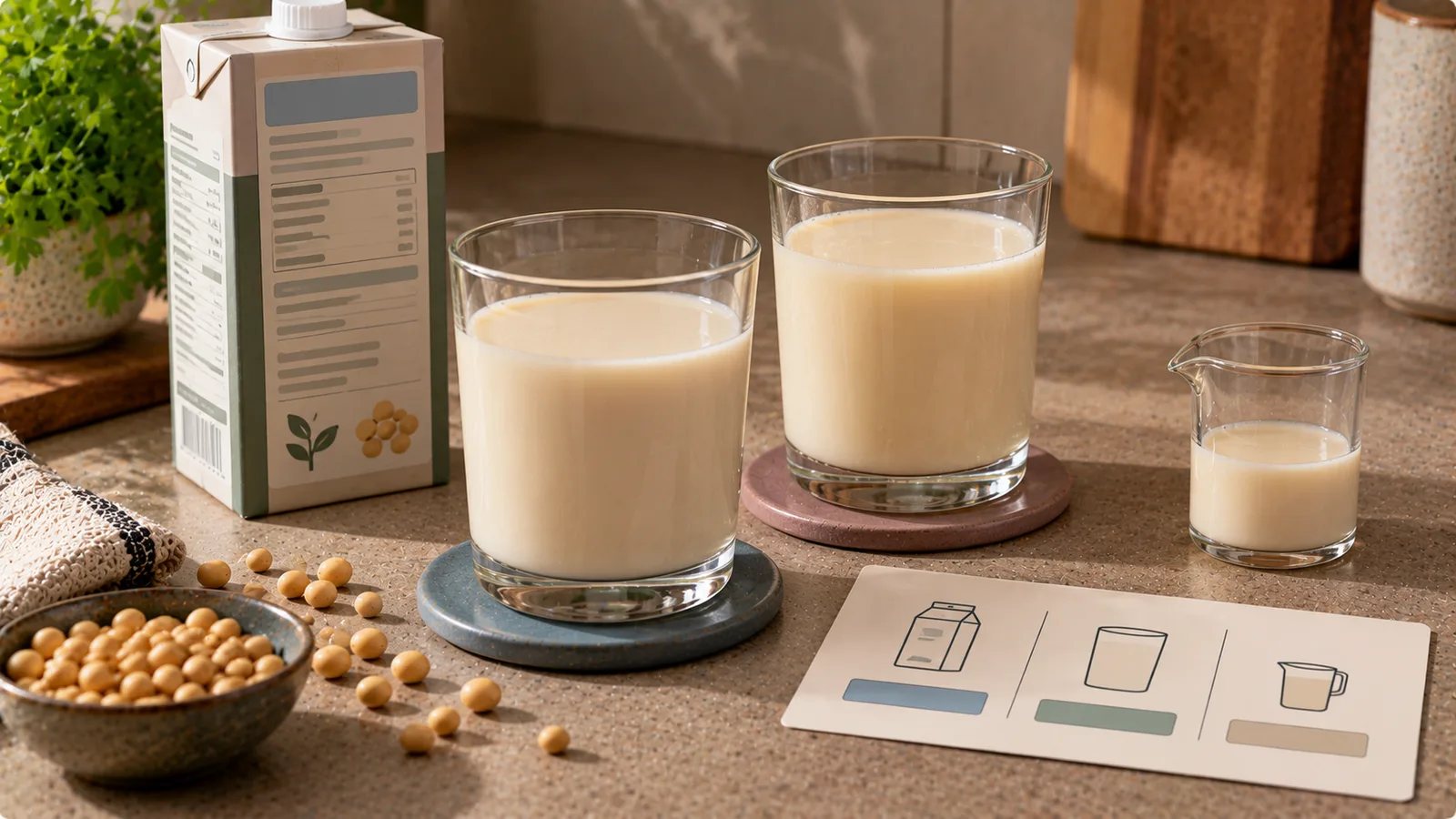
Soy milk can vary substantially in calories depending on whether it is unsweetened, sweetened, flavored or formulated for a particular use.
A typical unsweetened soy milk often provides roughly:
30–45 kcal per 100 ml
A 250 ml glass therefore commonly contains approximately:
75–115 kcal
Sweetened and flavored products can contain more because of added sugars and other ingredients.
The nutrition label on the specific carton is the best source for accurate tracking.
Soy milk calories by serving size
Using a representative unsweetened soy milk with 40 kcal per 100 ml:
| Amount | Approximate calories |
|---|---|
| 50 ml | 20 kcal |
| 100 ml | 40 kcal |
| 150 ml | 60 kcal |
| 200 ml | 80 kcal |
| 250 ml | 100 kcal |
| 300 ml | 120 kcal |
| 500 ml | 200 kcal |
These numbers are an example rather than a universal value.
Some unsweetened products are lower, while sweetened or flavored versions may be considerably higher.
Calories in 100 ml of soy milk
Plain unsweetened soy milk often falls around:
30–45 kcal per 100 ml
The exact number depends on the formulation.
Differences can come from:
- the proportion of soybeans or soy protein;
- added oil;
- added sugar;
- flavorings;
- stabilizers and other ingredients.
This is why two cartons of plain-looking soy milk can have different calorie values.
Calories in one glass of soy milk
There is no universal glass size.
If your glass contains 250 ml and the product provides 40 kcal per 100 ml:
40 × 250 ÷ 100 = 100 kcal
If your glass contains 300 ml:
40 × 300 ÷ 100 = 120 kcal
For accurate tracking, use the actual volume rather than simply logging one glass.
Calories in one cup of soy milk
Cup measurements differ slightly between systems, but a US cup is approximately 240 ml.
At 40 kcal per 100 ml:
40 × 240 ÷ 100 = 96 kcal
So one cup would contain approximately:
96 kcal
A product containing 33 kcal per 100 ml would instead provide:
33 × 240 ÷ 100 = about 79 kcal
The carton value therefore matters more than a generic cup estimate.
Unsweetened vs sweetened soy milk
One of the largest differences between soy drinks is whether sugar has been added.
A simplified comparison might look like:
| Type | Typical calorie range per 100 ml |
|---|---|
| Unsweetened soy milk | 30–45 kcal |
| Sweetened soy milk | 45–65 kcal |
| Flavored soy milk | 50–80+ kcal |
These are broad ranges.
Some products fall outside them.
Always check the label if you are comparing specific brands.
Why sweetened soy milk has more calories
Added sugar contributes carbohydrate and energy.
Suppose an unsweetened product contains:
35 kcal per 100 ml
and a sweetened version contains:
55 kcal per 100 ml
For a 250 ml serving:
Unsweetened:
35 × 2.5 = 87.5 kcal
Sweetened:
55 × 2.5 = 137.5 kcal
Difference:
50 kcal per glass
If soy milk is consumed several times per day, this difference can become meaningful.
Typical macronutrients
An unsweetened soy milk may provide approximately per 100 ml:
| Nutrient | Typical amount |
|---|---|
| Calories | 30–45 kcal |
| Protein | 3–4 g |
| Carbohydrate | 0–3 g |
| Fat | 1.5–2.5 g |
Sweetened products usually contain more carbohydrate.
Exact values vary significantly by manufacturer.
Soy milk and protein
Soy milk generally contains more protein than many other plant-based drinks.
A typical product may provide around:
3–4 g protein per 100 ml
A 250 ml glass can therefore provide roughly:
7.5–10 g protein
For example, if a carton lists 3.3 g protein per 100 ml:
3.3 × 2.5 = 8.25 g protein
in 250 ml.
This can make soy milk nutritionally different from plant drinks that contain very little protein.
Is all soy milk made the same way?
No.
Products can be made from:
- whole soybeans;
- soy protein isolates;
- soy protein concentrates;
- combinations of soy ingredients.
Manufacturers can also add:
- vegetable oils;
- sugars;
- calcium;
- vitamins;
- salt;
- stabilizers;
- flavorings.
The resulting calorie and nutrient profiles can therefore differ.
Fortified soy milk
Many commercial soy drinks are fortified with nutrients such as:
- calcium;
- vitamin D;
- vitamin B12;
- riboflavin.
Fortification itself does not necessarily add a meaningful number of calories.
Two products with similar calories can still differ substantially in micronutrient content.
If calcium or vitamin intake matters to you, check the nutrition label rather than using calories as a proxy for overall nutritional value.
Shake the carton
Some fortified soy drinks advise shaking before use.
Minerals such as calcium can settle during storage.
Following the package instructions helps distribute the product more evenly.
This does not change the total calories in the carton, but it can matter for the consistency of the drink's nutrient content from one serving to another.
Soy milk with added oil
Some soy drinks contain added vegetable oil to modify texture or mouthfeel.
Because fat provides approximately:
9 kcal per gram
additional oil can raise calorie density even when the product is unsweetened.
Therefore, the absence of added sugar does not guarantee that two unsweetened soy drinks have identical calories.
Barista soy milk
Barista-style soy drinks are designed to foam and perform well in coffee.
Their formulation may differ from standard unsweetened soy milk.
They can contain:
- additional oil;
- sugar or carbohydrate;
- stabilizers;
- acidity regulators.
A barista product may therefore contain more calories than a basic unsweetened version.
Do not automatically use the nutrition entry for regular soy milk when you actually use a barista formulation.
Chocolate and vanilla soy milk
Flavored soy drinks frequently contain added sugar.
Chocolate versions may also contain cocoa and other ingredients.
For example, a flavored product might provide:
65 kcal per 100 ml
A 250 ml serving would contain:
65 × 2.5 = 162.5 kcal
That is substantially different from a 35–40 kcal per 100 ml unsweetened product.
How to calculate calories from the carton
Suppose the label says:
42 kcal per 100 ml
and you drink:
280 ml
Calculate:
42 × 280 ÷ 100 = 117.6 kcal
You can log approximately:
118 kcal
The same formula works for any volume.
What if the label gives calories per serving?
Suppose the carton lists:
95 kcal per 250 ml
but you use only 100 ml in cereal.
Calculate:
95 × 100 ÷ 250 = 38 kcal
You do not need to consume the manufacturer's full serving size.
Use the amount you actually consume.
Soy milk in coffee
A small amount of soy milk in coffee may contribute relatively few calories, but the amount can vary widely.
For example, using a product with 40 kcal per 100 ml:
30 ml = 12 kcal
50 ml = 20 kcal
100 ml = 40 kcal
A large milk-based coffee can contain much more soy milk than a small splash.
Example: soy latte
Suppose a homemade latte contains:
250 ml soy milk
The soy milk provides 48 kcal per 100 ml.
Calculation:
48 × 2.5 = 120 kcal
If sugar or syrup is added, count it separately.
Coffee itself contributes very little energy unless other ingredients are added.
Soy milk in oatmeal
Suppose you prepare oats with:
200 ml soy milk
and the carton provides:
38 kcal per 100 ml
Soy milk calories:
38 × 2 = 76 kcal
The oats, fruit, nuts or other ingredients should be counted separately.
Soy milk in smoothies
Smoothies can contain substantial quantities of liquid.
If you use:
300 ml soy milk
at 40 kcal per 100 ml:
300 ml = 120 kcal
If the smoothie also contains banana, nut butter, oats or protein powder, those ingredients can contribute much more energy than the soy milk itself.
Milliliters vs grams
Soy milk is a liquid, so it is commonly measured in milliliters.
For ordinary household tracking, using the labeled volume is usually the simplest approach.
Do not automatically assume every liquid has exactly the same density as water when extreme precision is required.
However, for everyday food logging, a measuring jug or the package volume is usually adequate.
Does heating soy milk change its calories?
Heating does not create calories.
If 200 ml of soy milk is warmed without meaningful evaporation, it contains essentially the same energy as before heating.
If a substantial amount of water evaporates during cooking, the remaining product becomes more concentrated per gram or milliliter.
The total energy from the original soy milk remains in the dish unless some of it is discarded.
Soy milk in cooking
Soy milk can be used in:
- sauces;
- soups;
- pancakes;
- baking;
- mashed potatoes;
- desserts.
When it is part of a multi-serving recipe, add the amount used to the complete recipe rather than logging it separately for every portion.
Example: sauce for four servings
A sauce contains:
400 ml soy milk
The product provides:
40 kcal per 100 ml
Total from soy milk:
40 × 4 = 160 kcal
If the sauce is divided evenly between four servings:
160 ÷ 4 = 40 kcal
per serving from the soy milk.
Other ingredients must still be included.
Soy milk vs dairy milk
The calorie difference depends on which products are compared.
Unsweetened soy milk can have fewer calories than some dairy milks, while sweetened or enriched formulations can be closer to them.
Protein content can also be relatively similar between some soy drinks and cow's milk.
Instead of assuming one is always lower in calories, compare the actual nutrition values per equal volume.
Soy milk vs almond milk
Unsweetened almond drinks are often lower in calories than soy milk, but they also commonly contain less protein.
For example, a product might contain:
15 kcal per 100 ml
while a soy milk contains:
40 kcal per 100 ml
However, calorie content alone does not make the products nutritionally equivalent.
Their protein, fat, carbohydrate and micronutrient profiles can differ substantially.
Soy milk vs oat milk
Oat drinks frequently contain more carbohydrate than unsweetened soy milk.
Some oat drinks, especially barista products, can also be more calorie-dense.
Again, the useful comparison is the actual label per 100 ml rather than the product category alone.
Does homemade soy milk have the same calories?
Not necessarily.
Homemade soy milk can vary according to:
- the amount of soybeans;
- the amount of water;
- how much pulp is removed;
- whether sugar is added;
- whether oil or other ingredients are used.
A generic commercial soy milk entry may therefore be inaccurate for homemade soy milk.
If you need a detailed estimate, calculate from the ingredients and final yield.
Example for homemade soy milk
Suppose the ingredients used contribute:
700 kcal
and the final batch produces:
1,800 ml
Average energy density:
700 ÷ 1,800 = 0.389 kcal/ml
Per 100 ml:
0.389 × 100 = about 39 kcal
A 250 ml serving would contain approximately:
97 kcal
This assumes the calories from the ingredients are retained in the final drink. If substantial soybean solids are strained out and discarded, the calculation becomes more complex.
Is soy milk low in calories?
Unsweetened soy milk can be relatively moderate in calories compared with many caloric beverages.
But whether it is low or high in the context of a diet depends on:
- the product;
- the portion;
- how often it is consumed;
- what else is added.
A 50 ml splash and a 500 ml drink are very different portions.
At 40 kcal per 100 ml:
50 ml = 20 kcal
while:
500 ml = 200 kcal
Portion size matters
The label may show values per 100 ml, but people often consume much larger amounts.
If your cereal contains 200 ml and your coffee contains another 100 ml, your total is:
300 ml
At 40 kcal per 100 ml:
120 kcal
This is more useful than considering each use in isolation.
How much soy milk is 100 calories?
If the product contains 40 kcal per 100 ml:
100 ÷ 40 × 100 = 250 ml
So:
250 ml = approximately 100 kcal
For a product containing 50 kcal per 100 ml:
100 ÷ 50 × 100 = 200 ml
The volume corresponding to 100 kcal depends directly on the product.
Reading the ingredient list
If two soy drinks have very different calorie values, the ingredient list can help explain why.
Look for differences such as:
- added sugar;
- syrups;
- vegetable oils;
- cocoa;
- flavorings.
The ingredient list and nutrition table answer different questions and are most useful together.
Tracking soy milk accurately
For a packaged soy milk:
- identify the exact product;
- check whether the values are per 100 ml or per serving;
- measure the amount you actually use;
- calculate from that volume;
- distinguish unsweetened, sweetened, flavored and barista versions.
Do not select a generic unsweetened soy milk entry when your carton is a sweetened or barista product.
Soy milk calories at a glance
A useful general reference:
- unsweetened soy milk: often around 30–45 kcal per 100 ml;
- 250 ml unsweetened serving: often around 75–115 kcal;
- sweetened soy milk: commonly higher;
- flavored and barista versions: can be higher again depending on formulation.
Soy milk is not one nutritionally identical product across every brand.
For accurate calorie tracking, the most reliable combination is the specific carton label plus the actual volume consumed.
Nutrition data sources and product differences
The records below describe only the named foods, fat levels and preparation states. USDA figures are per 100 g; manufacturer figures retain their stated unit. These sources do not independently prove every approximate figure in the article.
USDA FoodData Central (search by FDC ID):
- FDC 1999630 — Soy milk, unsweetened, plain, shelf stable (38.48 kcal/100 g)
- FDC 2257044 — Soy milk, sweetened, plain, refrigerated (40.7 kcal/100 g)