
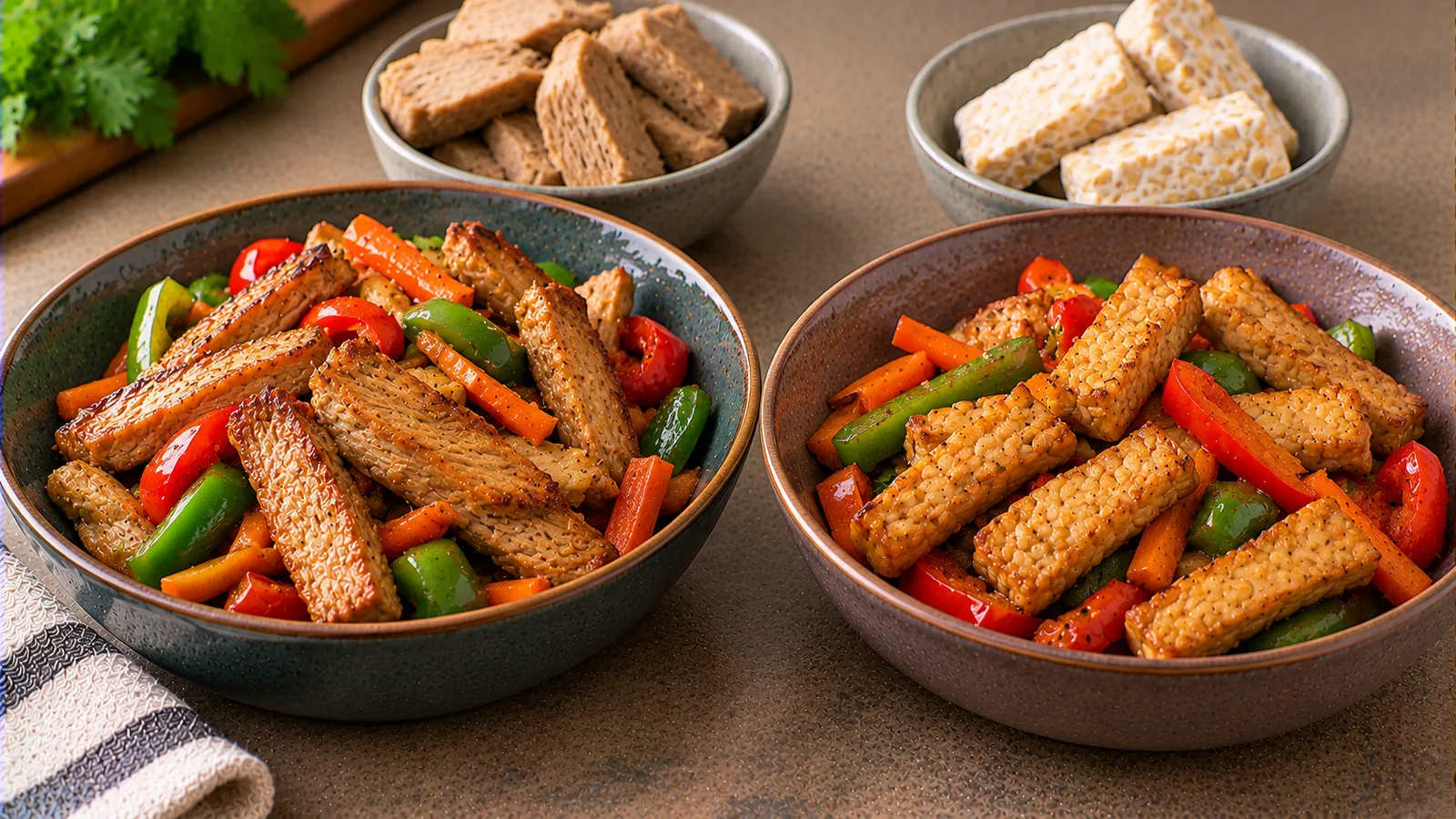
Seitan and tempeh can both be sliced or cubed for a vegetable stir-fry, but their nutrition labels and ingredients are very different. Seitan is made primarily from wheat protein; traditional tempeh is made from fermented soybeans. The practical question is not which food is universally “healthier”, but what 150 g of a particular ready-to-cook product contributes in protein, salt, energy and shopping cost.
To make the numbers reproducible, we compare dmBio Seitan, 200 g from dm and NUR NUR NATUR Bio-Tempeh Natur, 200 g from Aldi Süd. The stores are different, the products have distinct recipes, and the listed online prices are a 22 October 2026 snapshot, not a permanent or same-store offer. Product packaging may change, and Aldi warns that suppliers and nutrition information can vary.
At a glance: what is in 150 g?
| Label value or cost | dmBio Seitan, 150 g | Aldi Süd Bio-Tempeh Natur, 150 g |
|---|---|---|
| Protein | 42 g | 27.15 g |
| Salt | 1.65 g | 0.195 g |
| Energy | 220.5 kcal | 270 kcal |
| Fat | 3.15 g | 14.55 g |
| Fibre | 1.5 g | 11.655 g |
| Example product cost for 150 g | €1.69 | €2.24 |
| Main allergen | Wheat (gluten) | Soy |
The seitan example supplies 14.85 g more labelled protein in the same 150 g raw-product portion, while the tempeh example supplies 1.455 g less labelled salt. These statements describe the chosen packs alone. Seasoning a stir-fry with soy sauce or salty marinades can materially change its final salt total.
The nutrient figures are calculated directly from the dmBio Seitan product declaration and Aldi Süd's Natur Bio-Tempeh product page. Both publish nutrition per 100 g. We multiply each value by 1.5 for the comparison; we are not weighing a cooked serving after moisture loss.
Exactly what products are being compared?
The dmBio product is a 200 g pack of prepared seitan containing water, 35% wheat gluten, 1% wheat flour and sea salt. It is a moist product designed for cooking in a pan, not a jar of dry vital wheat gluten flour. The label lists 28 g protein and 1.1 g salt per 100 g. Its salt reflects the specific seasoned product; it is not a universal characteristic of all seitan.
The Aldi Süd 200 g natural tempeh is a fermented soybean product. Its published declaration lists 18.1 g protein and 0.13 g salt per 100 g. It also lists 7.77 g fibre per 100 g, compared with 1 g per 100 g for the chosen seitan. Tempeh brands with other bean blends, coatings, sauces or starter ingredients will differ.
For the actual shopping decision, inspect the ingredient and nutrition panel on the package you can buy. If you substitute a smoked seitan or marinated tempeh, repeat every calculation rather than applying the numbers above automatically. The category names do not uniquely determine protein or salt content.
Protein: seitan leads in this matched portion
The seitan's 28 g protein per 100 g becomes 42 g per 150 g: 28 × 1.5 = 42. The tempeh's 18.1 g per 100 g becomes 27.15 g per 150 g: 18.1 × 1.5 = 27.15. The matched-portion difference is 14.85 g.
That is a meaningful label quantity difference, not proof that every gram of protein is nutritionally identical or that either single food should be your only protein source. Seitan is dominated by wheat protein, while soy tempeh contributes soybean protein along with fat and fibre. Protein quality, individual dietary needs and the overall daily food pattern are separate questions.
If you normally cook 100 g, not 150 g, use the per-100-g values rather than increasing your plate to fit an article's comparison size. If you are making two servings, weigh the ingredient you actually use and divide the amount across plates. The table excludes noodles, rice, vegetables and any sauce.
This comparison is intentionally narrower than tofu versus seitan and tofu versus tempeh. Those pages compare tofu with one alternative; here the decision is specifically seitan versus tempeh at the same uncooked 150 g weight for a quick stir-fry.
Salt: why the gap is larger than it first looks
The dmBio seitan label contains 1.1 g salt per 100 g, or 1.65 g in 150 g. The Aldi Natur tempeh lists 0.13 g salt per 100 g, or 0.195 g per 150 g. That is a product-specific difference of 1.455 g salt before anything else enters the pan.
Salt numbers refer to salt as declared on the European label, not milligrams of sodium. Do not compare one manufacturer's sodium quantity with another manufacturer's salt declaration without a consistent conversion. The European Commission's labelling overview confirms that prepacked-food nutrition values are normally expressed per 100 g.
A stir-fry can change this ranking in practice. Adding a salty soy sauce, stock cube, miso glaze or packaged marinade changes the meal's salt total; the table covers only the base protein product. Tempeh itself can become a high-salt meal if marinated heavily, while choosing an unsalted homemade seitan recipe could change the seitan value substantially.
If limiting salt is the priority, the natural tempeh in this specific pair offers a much lower starting point. Do not interpret that as a medical recommendation or a statement about every seitan or tempeh product.
Calories, fat and fibre also differ
Per 150 g, the seitan label yields 220.5 kcal and 3.15 g fat; tempeh yields 270 kcal and 14.55 g fat. Fermented whole soybeans retain more fat than this wheat-gluten-based seitan formulation. Those values do not include the oil used to fry either product.
The fibre calculation moves the opposite way: 1.5 g for the chosen seitan versus 11.655 g for the chosen tempeh. These are label-derived values, not measures of how much fibre will remain after adding vegetables. A lunch with vegetables may have substantially different total fibre regardless of which protein you choose.
For energy tracking, note whether you weighed the 150 g before cooking. Stir-frying can change the finished weight by evaporation or oil absorption. Dividing the original labelled nutrients by a smaller cooked weight and treating the result as a fresh product label would introduce avoidable errors.
Price per 150 g: transparent arithmetic
The published 22 October 2026 online reference prices were €2.25 for the 200 g dmBio Seitan pack at dm and €2.99 for the 200 g Aldi Süd tempeh pack at Aldi Süd. These are two different retailers. They are not a basket from the same shop, and Aldi prices, supplier details, local availability and delivery charges can vary.
Cost of 150 g = pack price × 150 ÷ pack weight in grams.
| Product and example pack price | Arithmetic | Calculated cost for 150 g |
|---|---|---|
| Seitan: €2.25 / 200 g | €2.25 × 150 ÷ 200 | €1.69 |
| Tempeh: €2.99 / 200 g | €2.99 × 150 ÷ 200 | €2.24 |
Before rounding, these are €1.6875 and €2.2425. They are theoretical consumed-portion costs: you still pay for a whole 200 g pack at checkout, and the unused 50 g has value only if you store and use it safely. Oil, vegetables, rice, sauce, travel and delivery are excluded.
The illustrative seitan portion costs about €0.55 less when comparing the displayed rounded prices. In another shop or during a promotion the gap could disappear or reverse. For a live purchase, compare current price per kilogram or use the formula with the actual shelf prices rather than copying this dated ranking.
Which one works better in a stir-fry?
Choose seitan when you want firm, chewy strips that brown quickly and can hold their shape in a hot pan. Because the example already contains salt, taste your sauce before adding more. Cut into narrow strips for a quicker surface sear and follow the pack instructions for preparation and storage.
Choose natural tempeh when you prefer compact cubes with a nutty fermented-soy taste and a lower-salt base. Let the cubes develop a browned surface before adding a liquid sauce. Tempeh may be more noticeable in flavour than neutral seitan; whether this is a benefit is personal preference.
For one stir-fry serving, a practical assembly is 150 g of either base product, around 250–300 g mixed vegetables, and a carbohydrate side if wanted. Any sauce and oil need to be counted separately; this is an assembly example, not a calculated nutritional total or an instruction to consume exactly 150 g.
Avoid crowding the pan: cook the protein in one layer, remove it briefly if needed, cook the vegetables, then combine and heat according to package directions. Do not guess safe handling from the label table. Respect the storage directions and any product-specific cooking instructions.
Allergens and dietary suitability
dmBio seitan contains wheat and gluten and is not suitable for someone who must avoid gluten, including people with coeliac disease. The product label also notes possible traces of other allergens. Aldi natural tempeh contains soy, and its ingredients and any possible cross-contact statements must be checked if allergies matter. Do not infer that every tempeh product is gluten-free: marinades or manufacturing cross-contact may introduce gluten.
EU rules require key allergens to be highlighted in ingredient lists; see the European Commission's labelling guidance. Neither food should be called universally better for allergies. The relevant choice depends on the specific allergen and the actual package.
A shopping decision you can repeat
If your first goal is labelled protein in 150 g, this dmBio seitan wins at 42 g versus 27.15 g. If you are reducing the salt contributed by the base product, this Aldi natural tempeh wins at 0.195 g versus 1.65 g. In the dated cross-retailer example, seitan is also less expensive at €1.69 versus €2.24 per 150 g. Tempeh provides more declared fibre at the same weight.
The reusable method is simple: choose the two actual products, compare per-100-g labels, multiply by 1.5, and calculate consumed-portion price using each current pack's price and net weight. Keep added cooking oil and sauces separate. That creates a useful stir-fry choice without confusing this comparison with the existing tofu-versus-seitan or tofu-versus-tempeh articles.
Sources
- dm — dmBio Seitan, 200 g. Ingredients, allergies, price snapshot and per-100-g protein, salt, fibre, fat and energy.
- Aldi Süd — NUR NUR NATUR Bio-Tempeh Natur, 200 g. Product-specific nutrition values, current pack price illustration and supplier-variation warning.
- European Commission — Nutrition labelling. Mandatory per-100-g presentation and how nutrition declarations work.
- European Commission — Food labelling and allergens. Allergen and ingredient-list disclosure framework.
All numeric comparisons are transparent calculations from specified product labels. Prices were checked as a 22 October 2026 online snapshot at different shops, exclude other shopping costs, and must be rechecked when purchased.