
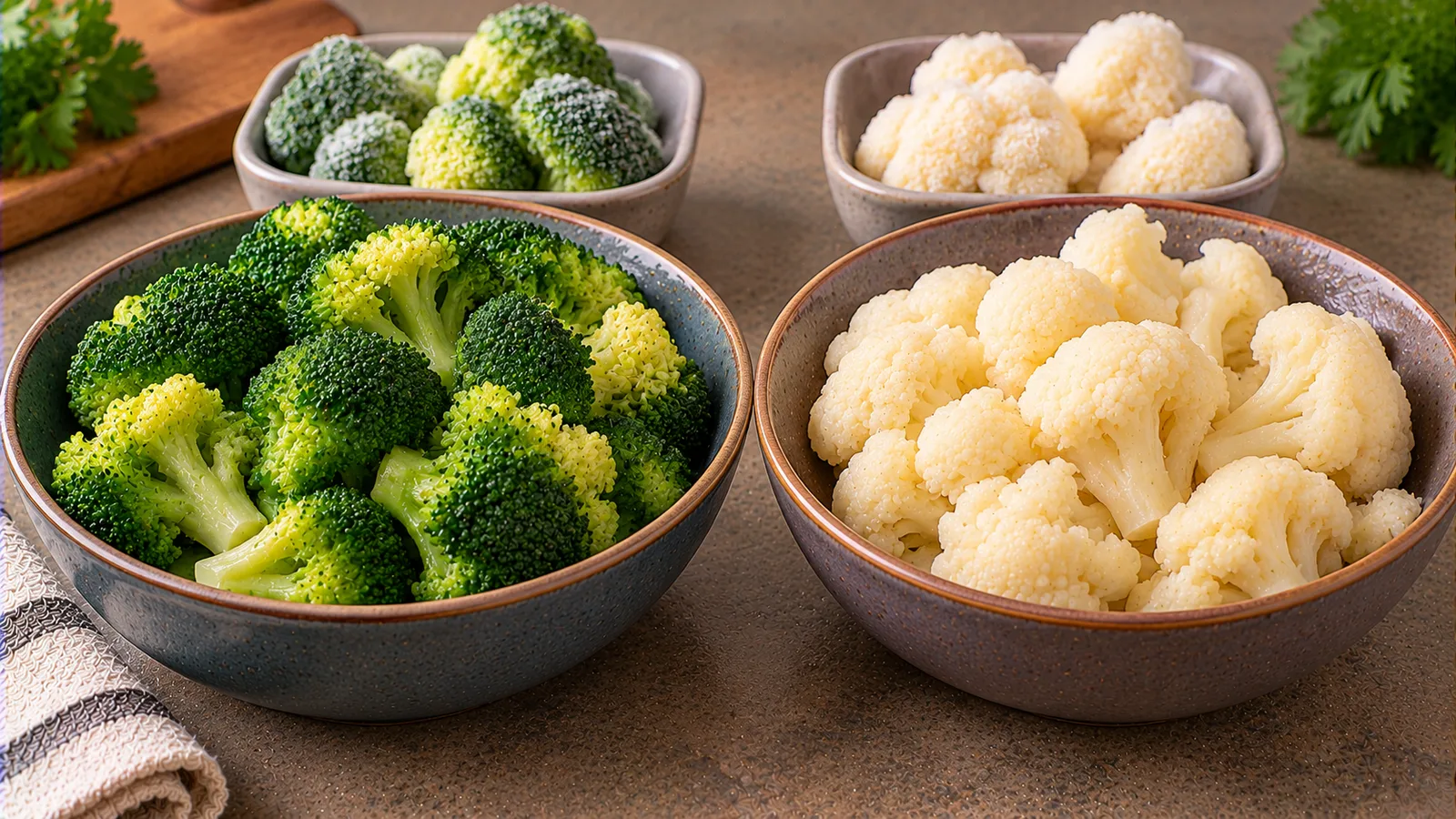
Frozen broccoli and frozen cauliflower are easy substitutes when you need a vegetable side without using a fresh head before it spoils. But which gives you more fiber, and which costs less for an ordinary 150 g cooked serving? Comparing the same portion and a matching package size is more useful than comparing unrelated nutrition panels or one promotion-priced bag with a premium product.
Short answer: In the German Federal Food Key (BLS 4.0) entries for frozen vegetables boiled in water, 150 g of broccoli provides about 5.4 g fiber and 150 g of cauliflower about 4.5 g. That is a 0.9 g fiber difference, not a reason to dismiss either vegetable. A reference retail comparison found €2.39 per 1 kg bag for each specified REWE ja! product, equivalent to €0.36 per 150 g frozen input. That is a benchmark, not a live-verified lowest available price or an exact cost for 150 g after cooking.
The matched comparison: 150 g cooked
| Metric | Frozen broccoli, boiled | Frozen cauliflower, boiled |
|---|---|---|
| Portion weighed after cooking and draining | 150 g | 150 g |
| Energy | about 50 kcal | about 44 kcal |
| Protein | about 3.5 g | about 1.8 g |
| Fiber | 5.4 g | 4.5 g |
| Fiber difference | +0.9 g versus cauliflower | — |
| Model ingredient-cost benchmark | €0.36* | €0.36* |
Nutrition comes from BLS 4.0: frozen broccoli, boiled (G312232: 33 kcal, 2.3 g protein, 3.6 g fiber per 100 g) and frozen cauliflower, boiled (G311232: 29 kcal, 1.2 g protein, 3.0 g fiber per 100 g). Each value was multiplied by 1.5 to obtain a cooked 150 g portion. Figures are rounded at the end, not derived from a product's frozen-weight serving panel. See the official BLS database and look up those specific codes.
The €0.36 benchmark represents 150 g taken from an unopened 1 kg frozen bag priced at €2.39, not a measured cost of exactly 150 g cooked. Actual cooked yield can differ. The price was last publicly reported by third-party listings for those exact products, not verified at a selected checkout on the publication date.
Which contains more fiber?
At matched cooked weight, the cited BLS entries favour broccoli: 5.4 g versus 4.5 g for the same 150 g on the plate. Both contribute fiber, and the difference of 0.9 g is modest in the context of an entire day. It does not justify a claim that one vegetable is universally healthier.
BLS provides reference-food averages rather than a guarantee about every individual bag. Variety, processing, cooking method and cooking losses may change results. For example, do not take a label that says 2.8 g per 100 g of frozen broccoli and compare it directly with a boiled cauliflower database figure; those are not identical measurement bases.
Cauliflower can still be a useful choice when you prefer its milder taste or softer texture. Alternating both vegetables may be a more sustainable shopping habit than choosing only the one with a small numerical lead in fiber.
What exactly was priced?
We used ordinary, unseasoned, frozen 1 kg bags from the same mainstream supermarket to keep the unit and product form consistent:
| Comparable retail item | Pack | Publicly reported reference price | Price / 1 kg | Nominal 150 g frozen |
|---|---|---|---|---|
| REWE ja! Broccoli Röschen | 1,000 g | €2.39 | €2.39 | €0.36 |
| REWE ja! Blumenkohl | 1,000 g | €2.39 | €2.39 | €0.36 |
The price observations come from the respective broccoli price record and cauliflower price record. Checked as publicly displayed on 21 October 2026; the original customer-reported price dates are not confirmed, and the official REWE shop requires a selected delivery location to show a checkout price. These are therefore traceable reference observations, not verified current shelf prices, a nationwide price guarantee or proof that another store is not cheaper.
Our comparison deliberately does not include seasoned cauliflower, cream-style broccoli or mixed vegetables: sauces, salt and added fats would distort both the cost and nutrition comparison. Aldi, EDEKA and other widely available chains may have lower prices for a comparable plain product; use a newer, actually confirmed non-promotional price when one is available rather than averaging retailers' prices.
How to calculate the real price of 150 g cooked
A 1,000 g bag costing €2.39 has a frozen-weight ingredient rate of €0.00239 per gram. Thus 150 × €2.39 ÷ 1,000 = €0.3585, rounded to €0.36. This is the same calculation for each of the two reference products.
But a cooked 150 g side is weighed after cooking. If 150 g frozen becomes exactly 150 g cooked, its ingredient cost remains €0.36. If your kitchen test finds 150 g frozen → 135 g cooked and drained, a 150 g finished serving needs about 166.7 g frozen, costing approximately €0.40 (166.7 × €2.39 ÷ 1,000). This 135 g outcome is only an illustrated yield, not a measured universal loss.
For your own result, cook and drain a weighed frozen batch, note the actual cooked weight and use:
Cost of 150 g cooked = pack price × (150 ÷ measured cooked yield) × (frozen batch weight ÷ pack weight).
Example inputs: pack price €2.39; package weight 1,000 g; frozen batch 150 g; cooked batch 135 g. Price is for food only, excluding electricity, water, seasoning and transport. Use the identical approach for both vegetables, and compare your actual receipts rather than assuming reference prices remain available.
Cooking method changes the comparison
Use the same method for both products if you are testing cost, drained yield and texture. For a straightforward household check, take 150 g frozen from each bag, cook separately in unsalted boiling water according to the package instructions, drain in the same way and record both cooked weights. This tests yield from an equal frozen input. For nutritional comparison, weigh out a new 150 g cooked portion of each; do not confuse the two experiments.
Frozen florets differ in size, so they may not become tender simultaneously. Avoid cooking only by colour. An ordinary plain frozen vegetable should be cooked as indicated by the package; it is not automatically ready to eat directly from the freezer. Drain well to avoid counting excess water as part of the side dish.
Steaming with a little water may retain a different amount of water than boiling. Roasting with oil adds fat and energy not included in the plain-boiled BLS table. If you add 10 g oil to either dish, the resulting meal should not be described by the no-oil nutrition row above. For a texture-first side, broccoli tends to offer firmer stems; cauliflower produces a softer, less assertive vegetable accompaniment after thorough cooking.
Does the cheaper bag always save money?
Not necessarily. Calculate the cost per kilogram of plain frozen vegetables, then account for the cooked yield and how much you actually use. A smaller bag can be cheaper at the till but more expensive per portion. A large pack that sits unused in the freezer is not automatically an economical choice.
For example, if a 750 g comparable bag costs €1.99, its rate is €2.65/kg after rounding. That is higher than the illustrated €2.39/kg, even though the total bill for one bag is lower. Do not label €1.99 the cheaper unit price. The 750 g figure here is arithmetic practice, not a verified current supermarket offer.
Check that both packs contain plain florets without dressing or a blended vegetable mix, that pack weights refer to the same product state, and that promotions are identified separately from regular prices. When a genuine lower verified regular price appears at Aldi, REWE or EDEKA, it should replace the older reference rather than be averaged with it.
Which is better for your dinner?
Choose broccoli if you specifically want the slightly higher fiber and protein values in these matched cooked reference entries. Choose cauliflower if you prefer the flavour, intend to mash it or want a milder side for strongly seasoned food. If both bags cost the same where you shop, neither offers an ingredient-price advantage on the nominal 150 g frozen measure.
For a fuller plate, either 150 g vegetable side can accompany beans, fish, eggs, tofu or another main food and a carbohydrate source. A cooked vegetable side does not need to supply all the protein or fiber in the meal. See our guide to building a balanced meal for the broader meal context. For a different freezer-versus-can cost comparison, see frozen green beans compared with canned green beans.
What this comparison can and cannot tell you
This is a comparison of plain frozen broccoli versus plain frozen cauliflower, not a fresh-versus-frozen review. It answers a narrow practical question at the same cooked portion size. The BLS fiber numbers are based on identified boiled-food entries; the store numbers are price-reference observations for identified 1 kg products, with no claim of live checkout verification.
Before spending, check your store's regular shelf or online price, the exact pack weight and whether your portion is weighed frozen or cooked. That one distinction prevents a common false precision: a nutritional figure for cooked 150 g placed beside a price for frozen 150 g as if they were measured in the same state.
Sources
- German Federal Food Key (BLS 4.0) — codes G312232 (frozen broccoli, boiled) and G311232 (frozen cauliflower, boiled). Reference values per 100 g edible cooked portion.
- REWE ja! Broccoli Röschen, 1 kg — product identity and nutrition panel; product label values are not substituted for the BLS cooked analysis.
- REWE ja! Blumenkohl, 1 kg — product identity and its own nutrition panel.
- Broccoli retail price record and cauliflower retail price record — customer-reported retail price observations; these do not verify the price at a specific store today.