
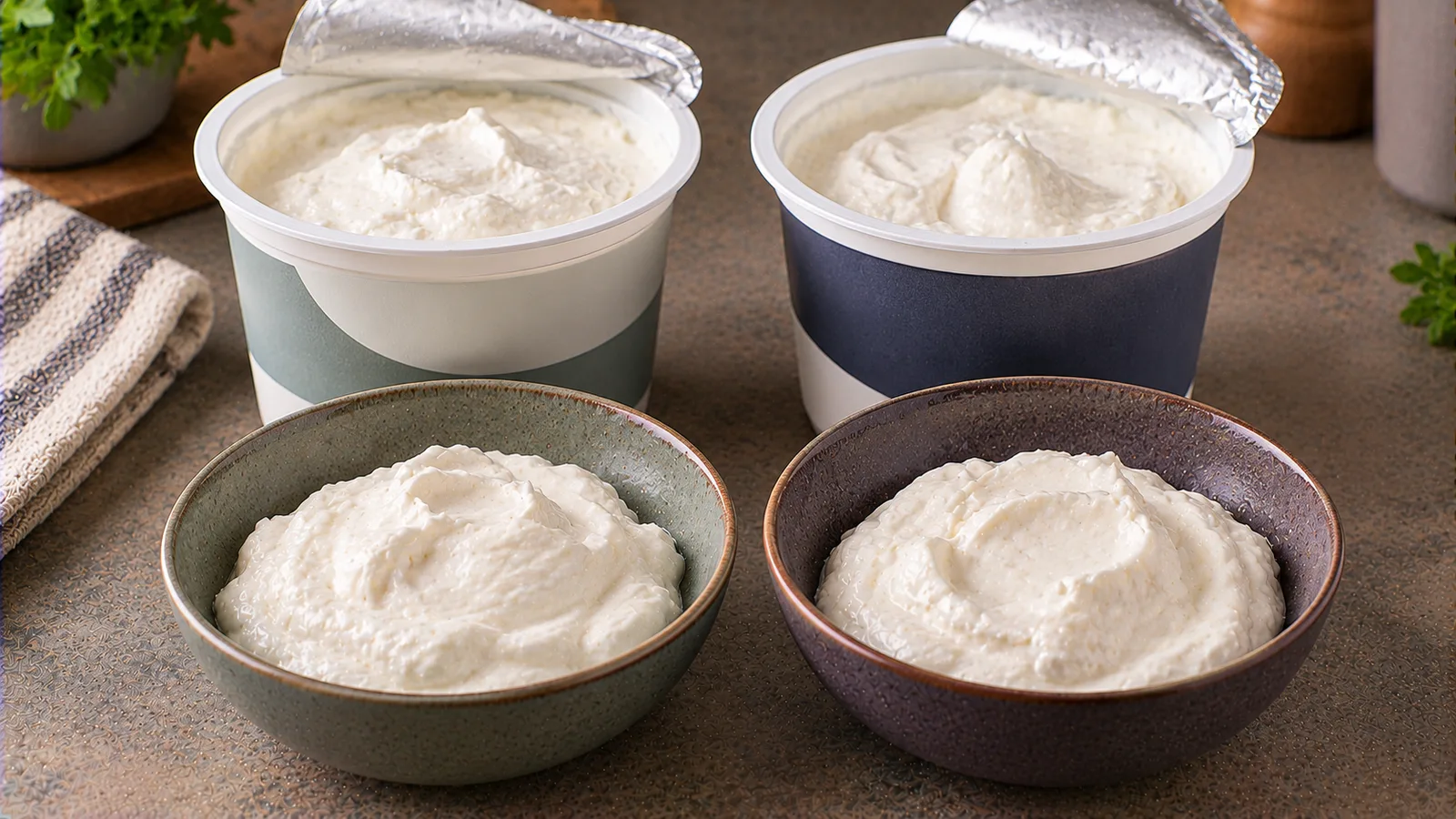
A premium-looking tub of skyr is not automatically a better protein purchase. What matters for the protein-per-euro question is the declared protein per 100 g, the weight you can actually use and the price you pay at the same store on the same date. To make the method concrete, this article compares two identifiable products in the German REWE assortment: REWE Bio Skyr Natur 400 g and Arla Skyr Natur 450 g. Both are plain dairy skyr, not flavored dessert cups or plant-based substitutes.
There is an important limit: REWE's public product pages say the actual price depends on your selected store or location. They provide nutrition information, but no universally valid checkout prices. Accordingly, the €1.59 and €2.39 prices used below are deliberately hypothetical exercise inputs, not observed REWE shelf prices or a claim of a promotion. Replace them with two real receipts or a same-day local listing before declaring a winner. Comparing two different supermarkets or dates would answer a different question.
At a glance: the two verified labels
These are the current product-page declarations, not laboratory remeasurements. Both list 11 g protein per 100 g. The store-brand item is REWE Bio, so this comparison also differs in organic designation; “premium” refers here only to the nationally marketed Arla brand, not a proven higher nutrient quality. The products are similar enough in type and protein to be a useful real-world shopping example, but do not have identical pack weights.
| Label item | REWE Bio Skyr Natur | Arla Skyr Natur |
|---|---|---|
| Identified tub | 400 g | 450 g |
| Energy per 100 g | 60 kcal | 63 kcal |
| Protein per 100 g | 11 g | 11 g |
| Sugars per 100 g | 3.5 g | 4 g |
| Total fat per 100 g | 0.2 g | 0.2 g |
| Salt per 100 g | 0.10 g | 0.14 g |
| Protein per entire tub | 44 g | 49.5 g |
Sources: the exact REWE Bio label and Arla listing. The second tub contains 5.5 g more protein in total because it contains 50 g more product, not because its protein density is higher. Those two explanations must not be confused in a comparison or a headline.
What 150 g in a real bowl contributes
A common 150 g serving makes the comparison fairer for someone assembling breakfast or a snack. By multiplying each 100 g label by 1.5, the REWE Bio serving supplies 16.5 g protein, 90 kcal, 5.25 g sugars and 0.15 g salt. The Arla serving also supplies 16.5 g protein, but 94.5 kcal, 6 g sugars and 0.21 g salt. The energy difference is just 4.5 kcal per 150 g; it does not establish a meaningful real-life health advantage on its own. The values are label calculations and may be rounded by the manufacturer.
| Equal edible serving | REWE Bio | Arla |
|---|---|---|
| Amount served | 150 g | 150 g |
| Protein | 16.5 g | 16.5 g |
| Energy | 90 kcal | 94.5 kcal |
| Total sugars | 5.25 g | 6 g |
| Salt | 0.15 g | 0.21 g |
The sugar declared in unflavored skyr can principally reflect milk sugar; total sugars on a label do not automatically mean added sugar. To check this, read the ingredient list, not only the sugar line. The REWE Bio product page explicitly lists skimmed milk and lactic acid cultures. Check the ingredient list on the particular Arla tub you buy as well. If sweetened vanilla, fruit preparation or added syrup is involved, you are no longer comparing the same kind of plain skyr.
Protein per euro: one clearly hypothetical price scenario
Suppose, solely to demonstrate the calculation, you wrote down €1.59 for 400 g REWE Bio and €2.39 for 450 g Arla. These numbers are not current price quotations. The resulting calculation is straightforward: divide the tub's total declared protein by the tub price. Expressing the answer as grams of protein per €1 lets you compare differently sized tubs without mistaking volume for efficiency.
| Hypothetical scenario, NOT live prices | REWE Bio | Arla |
|---|---|---|
| Assumed pack price | €1.59 | €2.39 |
| Protein per complete tub | 44 g | 49.5 g |
| Protein per €1 | 27.67 g/€ | 20.71 g/€ |
| Cost per 20 g protein | €0.72 | €0.97 |
| Price for 150 g eaten | €0.60 | €0.80 |
Check the formulas yourself: 44 ÷ 1.59 = 27.67 g/€, 49.5 ÷ 2.39 = 20.71 g/€. For the equivalent 20 g protein, use 20 ÷ 27.67 ≈ €0.72 and 20 ÷ 20.71 ≈ €0.97. A 150 g bowl is 150 ÷ 400 × €1.59 ≈ €0.60 from the first tub, or 150 ÷ 450 × €2.39 ≈ €0.80 from the second. All results have been rounded after calculation. They describe ingredient-use cost, not necessarily how much cash you spend at the checkout: you still pay for the entire tub.
When would the brand become the better deal?
Because both labels state 11 g protein per 100 g, this particular protein comparison is equivalent to comparing price per 100 g, assuming no waste. For the illustrative €1.59/400 g store brand, the break-even price for a 450 g Arla tub is €1.59 × 450 ÷ 400 = €1.78875, approximately €1.79. At a lower Arla shelf price, Arla would supply more protein per euro. Above that threshold, the store brand wins for this narrowly defined metric.
The threshold changes each time the shelf price changes. For example, a one-week discount, app coupon, loyalty-card offer, deposit arrangement or reduced-to-clear pack can reverse the answer. If the two products have different protein declarations on a future label, use the general threshold: brand break-even price = store-brand price × (brand tub protein ÷ store-brand tub protein). Do not extrapolate today's numerical label example forever.
Put one retailer, one location and one date on the record
The REWE skyr category shows both products, but it also states that prices depend on your location. To run a reproducible actual comparison, choose the same REWE store or delivery area, open both product listings, record the date and local offer condition, and verify that neither is a different flavor or pack variant. The original 400 g REWE Bio and 450 g Arla item numbers are 8354670 and 2458768. A receipt or local price tag is stronger evidence for the checkout number than a search-engine snippet with no location.
Write the two shelf prices next to the 44 g and 49.5 g total-protein figures, calculate grams per euro, and state any promotions. If you cannot verify both prices under the same conditions, show the formula without naming a winner. One brand may be cheaper in a different city, store or week. A comparison that ignores that uncertainty would be unnecessarily misleading.
Label checks beyond the protein headline
First identify plain/unflavored skyr. Flavored versions sometimes have fruit mixtures or sweetened preparations that alter sugar and protein per 100 g. Second, inspect the ingredient list for skimmed milk, cultures and possible additions. Third, look for the milk allergen: neither ordinary product is a dairy-free choice. Fourth, compare nutrients per 100 g, not per pack when the packs differ. Fifth, look at serving suggestions only after the underlying values are matched. A marketing claim such as “protein-rich” does not tell you grams per euro.
The European Commission explains that an authorized “high protein” nutrition claim requires at least 20% of a food's energy to come from protein, while “source of protein” uses a 12% threshold. Those are energy-share labelling rules, not a statement that a high-protein product is cheapest. See the EU nutrition claims guidance and Regulation (EU) 1169/2011 for the wider mandatory nutrition panel. Protein content alone cannot prove that a branded product is healthier, more filling or higher quality for every consumer.
Bio certification, flavor and texture: separate shopping questions
REWE Bio is explicitly organic. The Arla Skyr Natur listing does not establish that the branded comparison item is an organic equivalent. That means a shopper prioritizing organic certification might reasonably choose the store brand even when its protein-per-euro result was worse. Another shopper might prefer the flavor, acidity or texture of one brand; those sensory preferences cannot be inferred from the 11 g protein figure.
A smaller pack may also produce less food waste for someone who eats little skyr, despite having a worse price per 100 g. Conversely, a larger pack can suit families but only if consumed before spoiling. This is why a cost-per-gram calculation is useful without being the sole purchase criterion. Store unopened dairy as directed on the pack; after opening, follow the storage advice on the actual tub and keep it refrigerated. Do not assume the best-before date guarantees quality after opening.
Three practical buyer situations
Case 1: a fixed 150 g breakfast. Both items give 16.5 g protein in that serving; choose on actual price, taste, organic preference and how fast you'll use leftovers. Add oats or fruit if you want a more complete breakfast, but calculate their cost and nutrients separately.
Case 2: you want 20 g protein from skyr alone. At 11 g per 100 g, you need about 182 g of either skyr. Under the exercise prices, that costs roughly €0.72 versus €0.97. The required portion is not automatically the entire tub. If you prefer a smaller serving, other foods in the meal may contribute the rest.
Case 3: you purchase one entire tub. The 450 g Arla tub provides 49.5 g protein, while the 400 g REWE tub provides 44 g. Comparing only the absolute protein in a package would favor the larger tub even if the smaller one delivered more grams per euro. Do not conflate those two questions.
For a broader framework involving eggs, pulses and meat, use a method to compare protein per euro across supermarket foods; for ideas that make supermarket high-protein snacks into servings, consult measured high-protein supermarket snack ideas. This page stays focused on two named plain skyr tubs and the same-store shopping test, rather than becoming another generic protein-price ranking.
The purchase decision in one calculation
Get the actual local prices for the same date, divide 44 g and 49.5 g by those prices and choose the better protein-per-euro value if that is your priority. The two listed skyr products are tied at 11 g per 100 g, so brand prestige alone buys no extra protein concentration on these declarations. The €1.59 and €2.39 example is hypothetical and proves only how to calculate, not what REWE charges. Save the labels and receipt if you want a comparison you can update later.