
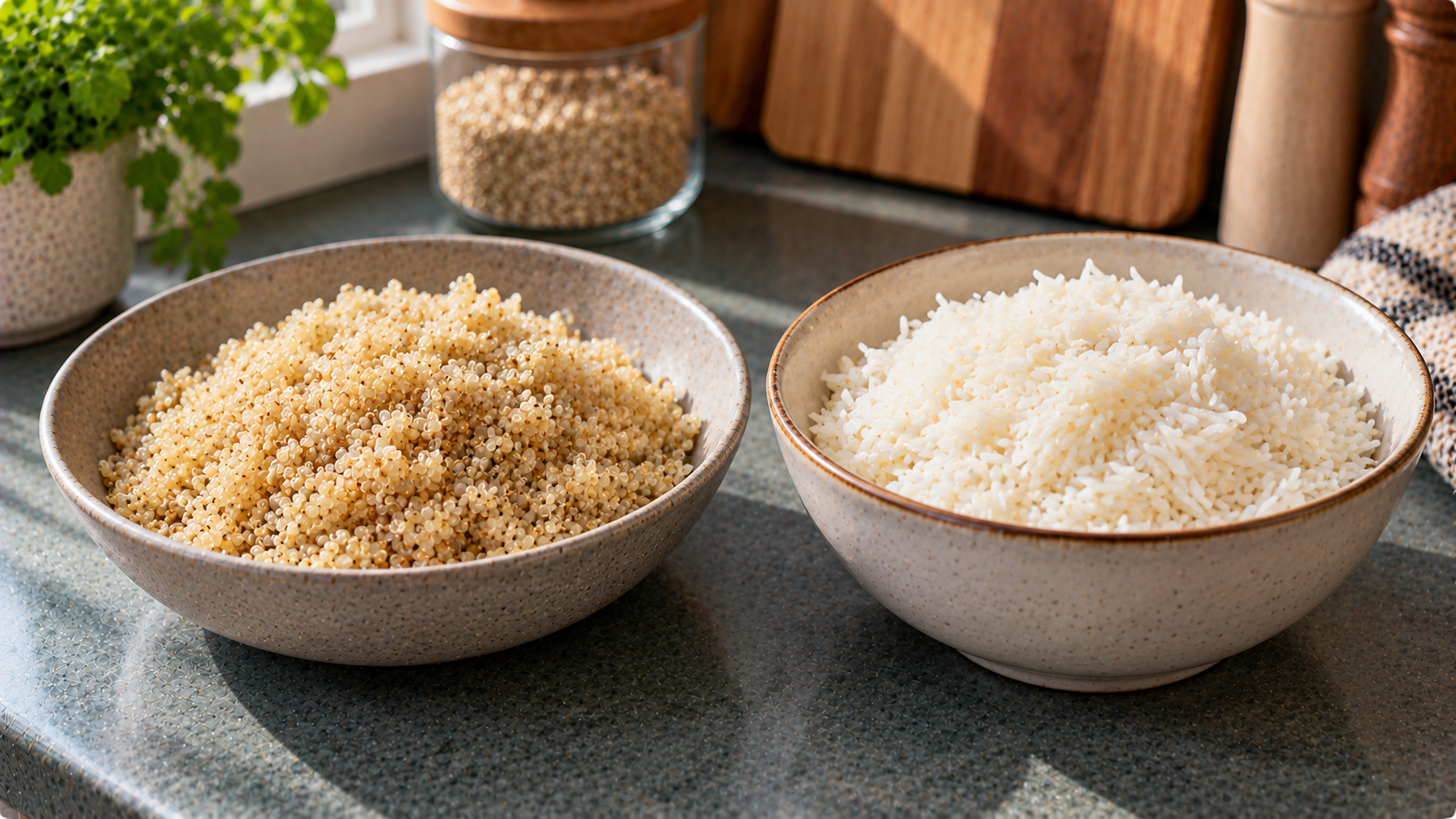
Quinoa and rice can occupy exactly the same place on a plate, but they are not nutritionally identical. Quinoa generally provides more protein and fiber than cooked white rice, while rice may be cheaper, milder, or better suited to a particular dish. The useful question is not which one is universally healthier. It is which type, serving size, preparation method, and meal combination best meets your needs.
Quinoa vs rice: the practical comparison
The table compares plain foods after cooking in water, without oil, butter, salt, or sauce. Values are rounded reference estimates per 100 g of edible cooked food, not promises about every brand or kitchen. Cooking water changes the final weight, so figures for dry grains cannot be substituted for cooked values.
| Per 100 g, cooked | Quinoa | White rice | Brown rice |
|---|---|---|---|
| Energy | About 120 kcal | About 130 kcal | About 123 kcal |
| Protein | About 4.4 g | About 2.7 g | About 2.7 g |
| Carbohydrate | About 21 g | About 28 g | About 26 g |
| Fiber | About 2.8 g | About 0.4 g | About 1.6 g |
| Fat | About 1.9 g | About 0.3 g | About 1.0 g |
These are representative food-composition values. White rice can be enriched, parboiled, basmati, jasmine, short-grain or long-grain; brown rice retains more of its bran. Quinoa varieties and cooking ratios differ too. Check the product information if exact tracking matters. Energy differences are small compared with changes caused by cooking oil, creamy sauces, meat, or the size of your helping.
What changes in a real 150 g or 200 g portion?
A side dish of 150 g cooked quinoa contributes roughly 180 kcal, 6.6 g protein and 4.2 g fiber. A comparable serving of cooked white rice contributes roughly 195 kcal, 4.1 g protein and 0.6 g fiber. At 200 g, the estimate becomes 240 kcal, 8.8 g protein and 5.6 g fiber for quinoa, versus 260 kcal, 5.4 g protein and 0.8 g fiber for white rice. The larger the serving, the more visible the differences, yet even 200 g quinoa is not a high-protein main course by itself.
| Cooked portion | Quinoa: kcal / protein / fiber | White rice: kcal / protein / fiber |
|---|---|---|
| 100 g | 120 / 4.4 g / 2.8 g | 130 / 2.7 g / 0.4 g |
| 150 g | 180 / 6.6 g / 4.2 g | 195 / 4.1 g / 0.6 g |
| 200 g | 240 / 8.8 g / 5.6 g | 260 / 5.4 g / 0.8 g |
The serving weight must be measured after cooking for this table. If you weigh 70 g uncooked quinoa and later enter 70 g cooked quinoa into a tracker, the meal will be substantially underestimated. Likewise, a cup is not a reliable substitute for a kitchen scale: compacting, draining and grain shape all affect volume.
The ingredient-level pages for quinoa and rice provide additional portion examples. Pay attention to whether the listed values describe dry grain or cooked food, particularly when logging a prepared bowl.
Protein: quinoa wins the comparison, but the meal matters more
Quinoa provides more protein gram for gram after cooking than either common white or brown rice. It also contains all nine essential amino acids, often described as a complete protein. That description does not mean quinoa provides a large protein dose in a modest serving. A 150 g portion contains about 6–7 g; a person planning a 25–35 g protein meal usually needs a substantial additional source.
One option is 150 g quinoa with cooked lentils and roasted vegetables. Another is 150 g rice with tofu, fish, eggs, chicken, beans or a yogurt-based sauce. Depending on the amounts, the rice bowl may contain more protein overall than a bowl of quinoa without a protein-rich topping. A varied plant-based diet need not obtain every essential amino acid from a single ingredient at every meal; diversity across the day is helpful.
Protein per calorie is another lens. With the rounded table, 100 kcal cooked quinoa yields roughly 3.7 g protein and cooked white rice roughly 2.1 g. But neither matches legumes, tofu or lean protein foods. If your goal is meeting a daily protein target, treat the choice of grain as a supporting decision, not the whole strategy.
Fiber: compare quinoa, white rice and brown rice separately
Quinoa typically offers appreciably more fiber than white rice. Brown rice narrows that difference because its bran is retained, although values vary by cultivar and reference database. Fiber can contribute to fullness, normal bowel function and dietary variety. The difference between a quinoa side and a white-rice side becomes more meaningful when vegetables and beans are otherwise scarce in the meal.
However, a serving of rice topped with chickpeas, lentils, peas, or plenty of vegetables may supply more total fiber than quinoa with a low-fiber sauce. Look at the entire plate rather than awarding a health label to the starch alone. If you currently eat little fiber, increasing it gradually and drinking normally can make the transition more comfortable.
Carbohydrates, blood sugar and energy
Cooked white rice contains more carbohydrate per 100 g than quinoa in the representative table. Quinoa also contains more fiber and protein. These differences may change the way a meal is digested, but they do not establish a fixed blood-sugar response for every individual. Rice cultivar, grain structure, cooking time, cooling, portion size, and what accompanies the grain all matter.
Whole-grain choices such as quinoa and brown rice are generally useful foundations in a varied diet. Yet a practical plate of white rice with vegetables, beans and a source of healthy fat can still be balanced. If someone manages diabetes, carbohydrate quantity and individual glucose responses may matter more than the simple quinoa-versus-rice label. Do not treat a single glycemic-index number as a prediction for a mixed meal.
For weight management, neither food causes weight gain on its own. Counting energy requires the cooked portion and any added oil. One tablespoon of oil can add around 120 kcal to the dish, dwarfing the approximately 10 kcal difference between 100 g cooked quinoa and 100 g cooked white rice in this comparison.
Minerals, vitamins and enrichment
Quinoa contributes magnesium, manganese, phosphorus and folate; the exact amount depends on composition and cooking. Brown rice generally retains more naturally occurring nutrients than refined white rice. White rice can nevertheless be enriched or fortified, especially in some countries, with nutrients such as iron, folate or certain B vitamins. Therefore, a nutrition table for unenriched white rice may not describe the bag in your cupboard.
Mineral numbers also require context: a food may contain a mineral without providing the majority of daily requirements. Plant foods contain compounds such as phytates that can influence mineral availability; normal varied diets accommodate this better than a fixation on a single micronutrient figure. Compare the precise label and the rest of your diet when a particular nutrient is important.
Is quinoa gluten-free? What about rice?
Plain quinoa and plain rice are naturally gluten-free. They are useful alternatives to wheat, rye and barley for people avoiding gluten. For celiac disease, check for cross-contact during processing, in bulk bins and at home, and select appropriately labelled products when necessary. Seasoned microwave rice, grain mixes and prepared quinoa salads may contain gluten-containing sauces or additives. The product name alone is not an allergen assessment.
Quinoa is botanically a seed used like a grain, while rice is a cereal grain. That distinction is interesting but less important to a meal plan than the actual nutritional composition and ingredient list. Neither grain automatically makes a prepared dish safe for every allergy or dietary restriction.
Arsenic in rice: sensible variety, not alarm
Rice can absorb inorganic arsenic from its growing environment more readily than many other crops. The US Food and Drug Administration advises variety in grains, particularly for infants and young children; rice can remain part of a balanced diet. This is a reason not to rely exclusively on rice, rather than a reason to eliminate it.
The FDA reports that boiling rice in excess water and draining it can reduce inorganic arsenic, though it can also wash away added B vitamins and iron from enriched rice. Washing rice before cooking has much less effect on arsenic than commonly assumed. Quinoa offers another grain-like choice, alongside oats, barley, buckwheat and others. For an infant's or child's diet, follow age-appropriate guidance rather than trying to solve exposure with one preparation trick.
Taste and texture: why rice still has advantages
Quinoa tastes slightly earthy or nutty and has a small, separate-grain texture with a gentle bite. Some varieties can taste bitter if residual saponins remain. Rice offers many distinct textures: fluffy long-grain basmati, aromatic jasmine, sticky short-grain, firmer brown rice and soft rice for porridge. Those differences influence whether a meal is satisfying and how successfully a recipe works.
For pilaf, grain salads, stuffed peppers and roast-vegetable bowls, quinoa is often particularly convenient. For sushi, risotto, congee and dishes designed around a particular rice variety, substituting quinoa may change the intended result completely. A nutrition comparison should not ignore the pleasure and practicality of eating food consistently.
Cooking quinoa without bitterness or mushiness
Read the packet first; many commercial quinoa products are already rinsed. If instructed, rinse in a fine mesh sieve with cool water to remove remaining saponins. A commonly used starting point is about two parts liquid for one part dry quinoa by volume, although some brands need less liquid. Simmer covered until the grains are tender, allow a brief rest, and fluff with a fork.
Cooking time, evaporation and final yield differ by saucepan and brand. For precise nutrition tracking, record the dry quantity for the whole pot and divide the result by the actual cooked yield. If 200 g dry quinoa becomes 560 g cooked, a 140 g serving represents one quarter of the original dry product. This method is often more accurate than a generic cooked database entry.
Cooking rice and handling leftovers safely
Follow instructions for the variety: brown rice usually needs more time than many white varieties, while absorption and boiling methods produce different textures. If rice is prepared in bulk, food safety is especially important. Cooked rice can contain Bacillus cereus spores that survive cooking; leaving rice warm or at room temperature for long periods permits growth and possible toxin formation.
Cool leftovers quickly in shallow portions, refrigerate promptly, and reheat thoroughly following relevant local food-safety guidance. Do not leave cooked rice sitting on the stove overnight. Quinoa and other cooked grains also require safe refrigeration: the fact that they are not rice does not make room-temperature meal prep safe.
The cost calculation: compare cooked servings, not just bag prices
Quinoa frequently costs more per kilogram of dry product than ordinary rice, but supermarket prices and cooking yields differ. Use a simple model. Assume, purely for illustration, dry quinoa costs €6 per kilogram and dry rice €2 per kilogram, and both yield approximately three times their dry weight when cooked. A 150 g cooked serving then uses roughly 50 g dry grain: €0.30 for quinoa or €0.10 for rice. The difference is €0.20 per side dish, not €4 per plate.
Those are hypothetical prices and yields, not live offers. Your actual cost changes with store brand, organic certification, bulk packs, cooking yield and waste. A mixed approach—rice most days and quinoa when its flavor or fiber is welcome—may be more sustainable than replacing every serving.
Three balanced plate examples
Vegetable and bean bowl: 150 g cooked quinoa, a generous serving of roasted vegetables, cooked beans, lemon and olive oil. Quinoa adds texture and fiber; beans contribute much of the bowl's protein and additional fiber. Measure oil if you track calories.
Rice and tofu stir-fry: 150 g cooked rice, tofu, broccoli, carrots and a modest amount of sauce. Protein comes chiefly from tofu, and vegetables make the rice-centered meal nutritionally substantial. Sodium will depend heavily on the sauce.
Half-and-half base: 75 g cooked quinoa plus 75 g cooked brown or white rice with eggs or lentils and vegetables. This keeps a familiar texture while adding variety. The mixture is not a special metabolic formula; it is simply a practical way to use both ingredients.
Which should you choose for your goal?
| Your priority | Useful starting point | What to check |
|---|---|---|
| More fiber in the grain itself | Quinoa; compare with brown rice | Actual portion and vegetable/legume content |
| Slightly more grain-based protein | Quinoa | Protein in the entire meal |
| Lower everyday cost | Often basic rice | Local prices and dry-to-cooked yield |
| Traditional sushi or risotto | Appropriate rice variety | Recipe texture and cooking method |
| More whole-grain variety | Rotate quinoa and brown rice | Overall diet diversity |
| Gluten-free base | Plain rice or quinoa | Label and cross-contact |
| Child-friendly variety | Rotate suitable grains | Age-appropriate preparation and food safety |
A simple rule for choosing without overthinking
Select the grain that fits the recipe and your budget, then build the rest of the meal around vegetables, a meaningful protein source and suitable fats. Choose quinoa when you want its texture and modest advantages in protein and fiber, brown rice when you want a whole-grain rice option, and white rice when its flavor, digestibility or recipe performance is preferred. You do not need to call one a superfood and the other unhealthy.
Sources and further reading
- Harvard T.H. Chan School of Public Health: Quinoa — nutrient profile, complete protein and cooking.
- Harvard Nutrition Source: Healthy Eating Plate — role of whole grains in meal composition.
- FDA: What You Can Do to Limit Exposure to Arsenic — rice, grain variety and cooking trade-offs.
- USDA FoodData Central — reference food-composition data; values differ by entry and preparation.