
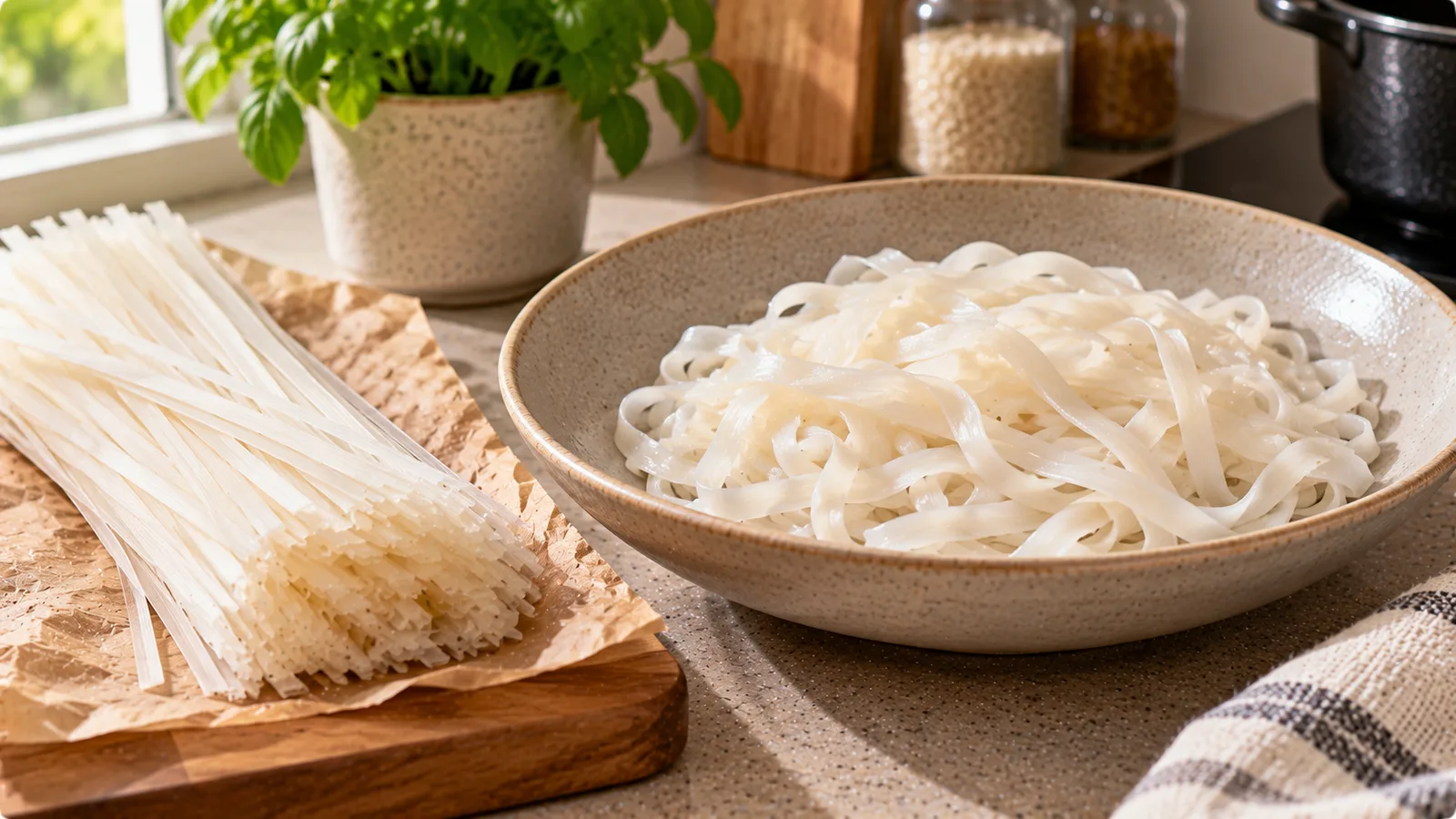
Rice noodles are a common ingredient in Asian soups, stir-fries, salads and noodle bowls.
They are typically made from rice flour and water, although some products contain additional starches or other ingredients.
Their calorie content depends heavily on whether they are weighed dry or after cooking.
Dry rice noodles commonly contain approximately 350–370 kcal per 100 g, while cooked rice noodles often contain around 105–150 kcal per 100 g.
The difference is mainly caused by water absorption during cooking, not by calories disappearing.
Rice noodle calories at a glance
| Rice noodle portion | Estimated calories |
|---|---|
| Dry rice noodles, 25 g | 88–93 kcal |
| Dry rice noodles, 50 g | 175–185 kcal |
| Dry rice noodles, 75 g | 263–278 kcal |
| Dry rice noodles, 100 g | 350–370 kcal |
| Cooked rice noodles, 100 g | 105–150 kcal |
| Cooked rice noodles, 150 g | 158–225 kcal |
| Cooked rice noodles, 200 g | 210–300 kcal |
| Cooked rice noodles, 250 g | 263–375 kcal |
These are practical estimates, not universal product specifications.
Cooking time, noodle thickness, starch composition and water absorption can change the cooked values.
For packaged noodles, the manufacturer's nutrition declaration is the best starting point.
Why dry rice noodles have more calories per 100 g
When rice noodles cook, they absorb water.
Water increases their weight without adding energy.
For example, imagine 75 g of dry rice noodles containing 360 kcal per 100 g.
The dry portion contains:
75 × 360 ÷ 100 = 270 kcal.
After cooking, suppose the noodles weigh 210 g.
They still contain approximately 270 kcal, assuming no meaningful loss of energy-containing solids.
Their cooked energy density is:
270 ÷ 210 × 100 = 129 kcal per 100 g.
The noodles did not lose 170 calories.
They simply became heavier because they absorbed water.
This distinction is essential when recording food intake.
Dry versus cooked rice noodles
The most common tracking mistake is choosing the wrong database entry.
A 100 g portion of dry noodles is not equivalent to 100 g of cooked noodles.
| Measurement | Example weight | Calories at 360 kcal/100 g dry |
|---|---|---|
| Dry noodles | 50 g | 180 kcal |
| Cooked yield | 140 g | 180 kcal |
| Dry noodles | 75 g | 270 kcal |
| Cooked yield | 210 g | 270 kcal |
| Dry noodles | 100 g | 360 kcal |
| Cooked yield | 280 g | 360 kcal |
This table assumes a cooked yield of 2.8 times the dry weight.
That ratio is only an example.
Actual rice noodles may absorb more or less water.
Some products are softened by soaking rather than boiling.
Others are sold fresh and already contain considerable moisture.
Always check the product instructions and the state described by its nutrition label.
How much do rice noodles weigh after cooking?
A practical starting estimate is that many dried rice noodles become approximately 2–3 times heavier after hydration.
However, the actual yield varies considerably.
Factors include:
- Thickness and shape.
- Rice flour and starch composition.
- Cooking or soaking time.
- Water temperature.
- Draining method.
- Whether the noodles are rinsed.
- How much water remains on their surface.
For accurate tracking, measure your own cooked yield.
Example: measuring your batch
Suppose you start with 200 g of dry rice noodles.
After cooking and draining, the batch weighs 520 g.
The yield factor is:
520 ÷ 200 = 2.6.
If the dry noodles contain 360 kcal per 100 g, the entire batch contains:
200 × 360 ÷ 100 = 720 kcal.
Cooked energy density:
720 ÷ 520 × 100 = 138.5 kcal per 100 g.
A cooked serving weighing 180 g contains:
180 × 138.5 ÷ 100 = 249 kcal, approximately.
This method is particularly useful when cooking several servings at once.
Calories in different rice noodle types
Rice noodles come in several shapes and styles.
Their energy content per 100 g dry is often similar when their ingredients are comparable.
Their cooked energy density may differ because they absorb different amounts of water.
Thin rice vermicelli
Thin rice vermicelli is commonly used in salads, soups and spring roll fillings.
It hydrates relatively quickly.
A dry 50 g portion may provide approximately 175–185 kcal.
The cooked weight depends on the preparation method.
Flat rice noodles
Flat rice noodles are often used in dishes such as pad Thai and stir-fried noodle meals.
Dried versions commonly have a calorie density similar to other dried rice noodles.
Fresh flat rice noodles contain more moisture and should not be tracked using dry values.
Wide rice noodles
Wide rice noodles may be used in soups and stir-fries.
Their thickness affects cooking time and hydration.
The exact calorie value depends more on ingredients and water content than on width alone.
Fresh rice noodles
Fresh rice noodles already contain water.
Their calories per 100 g can therefore be substantially lower than those of dried noodles.
Use the nutrition information for the actual fresh product.
Do not automatically apply a dry-noodle database entry.
Rice noodles nutrition per 100 grams
Plain rice noodles are primarily a carbohydrate source.
The following values are approximate examples for a typical dry product.
| Nutrient | Dry rice noodles, 100 g |
|---|---|
| Energy | 350–370 kcal |
| Protein | 5–8 g |
| Carbohydrates | 78–84 g |
| Fat | 0.5–2 g |
| Fiber | Usually relatively low; varies by product |
These ranges describe typical products rather than every brand.
Cooked values depend on hydration.
Rice noodles generally provide less protein than many protein-rich pasta alternatives.
They can still be part of a balanced meal when combined with vegetables and protein sources.
Are rice noodles gluten-free?
Traditional rice noodles made only from rice and water are naturally free from gluten-containing ingredients.
However, some commercial products include wheat or other ingredients.
Cross-contact during manufacturing is also possible.
For people with celiac disease or another medical need to avoid gluten, check the ingredient list and suitable gluten-free labeling.
Rice noodles versus wheat noodles
Both rice and wheat noodles are carbohydrate-rich foods.
Their calories per 100 g dry can be fairly similar.
| Food | Typical calories per 100 g dry |
|---|---|
| Rice noodles | 350–370 kcal |
| Regular wheat pasta | 350–375 kcal |
| Egg noodles | 350–390 kcal |
These are broad reference ranges.
Differences between specific products can be larger or smaller.
Wheat pasta often contains more protein than plain rice noodles.
Whole-wheat pasta may provide more fiber.
Rice noodles can be useful for people avoiding wheat, provided the product meets their dietary requirements.
No single noodle type is automatically the best choice for every person.
Rice noodles versus glass noodles
Rice noodles and glass noodles are different products.
Rice noodles are typically made from rice flour.
Glass noodles are commonly made from starches such as mung bean, sweet potato or tapioca starch.
Both can be relatively high in calories when dry.
Their cooked calorie density depends on how much water they absorb.
Transparent appearance alone is not a reliable way to identify a noodle's ingredients.
Check the package description.
How many calories are in a serving of rice noodles?
A reasonable dry portion depends on appetite, the rest of the meal and individual energy needs.
The following examples use 360 kcal per 100 g dry.
| Dry portion | Calories |
|---|---|
| 40 g | 144 kcal |
| 50 g | 180 kcal |
| 60 g | 216 kcal |
| 75 g | 270 kcal |
| 90 g | 324 kcal |
| 100 g | 360 kcal |
A smaller dry portion may be sufficient when the meal includes substantial vegetables, tofu, chicken, fish or beans.
A larger portion may be appropriate for someone with higher energy needs.
These are calculation examples, not prescribed serving sizes.
Calories in popular rice noodle dishes
The final meal can contain substantially more calories than the plain noodles.
Sauces, cooking oil, meat, tofu, peanuts and other additions all contribute energy.
Chicken rice noodle bowl
Example:
| Ingredient | Amount | Estimated calories |
|---|---|---|
| Dry rice noodles | 70 g | 252 kcal |
| Cooked chicken breast | 100 g | 165 kcal |
| Mixed vegetables | 150 g | 50 kcal |
| Cooking oil | 10 g | 90 kcal |
| Light sauce | 40 g | 35 kcal |
| Total | 592 kcal |
These are illustrative estimates.
Actual values depend on the products and cooking method.
Tofu rice noodle stir-fry
| Ingredient | Amount | Estimated calories |
|---|---|---|
| Dry rice noodles | 65 g | 234 kcal |
| Firm tofu | 120 g | 145 kcal |
| Vegetables | 200 g | 65 kcal |
| Cooking oil | 10 g | 90 kcal |
| Sauce | 40 g | 45 kcal |
| Total | 579 kcal |
The tofu value can vary substantially by brand and water content.
Rice noodle soup
A soup may contain a similar dry noodle portion but less added oil.
For example:
- Dry rice noodles, 60 g: 216 kcal.
- Broth, 350 ml: 25 kcal.
- Cooked chicken, 80 g: 132 kcal.
- Vegetables, 150 g: 45 kcal.
Estimated total: 418 kcal.
Broth composition, toppings and additional sauces can change this figure.
Do stir-fried rice noodles have more calories?
The noodles themselves do not automatically become more calorie-dense because they are stir-fried.
However, added oil increases the energy of the dish.
For example:
10 g of oil adds approximately 90 kcal.
20 g adds approximately 180 kcal.
Sweet sauces, peanuts and fatty meats can increase the total further.
When tracking a stir-fry, record the dry noodles and the other ingredients separately.
If cooking for several people, divide the total recipe into portions.
Are rice noodles good for weight loss?
Rice noodles can fit into an eating pattern intended for weight management.
Their suitability depends on the overall meal and energy intake.
A rice noodle dish with vegetables and a protein source may be satisfying.
Large portions combined with substantial oil and calorie-dense sauces can contain much more energy.
Rice noodles are not inherently fattening or slimming.
Portion size and the complete recipe matter more than the name of the noodle.
How to log rice noodles accurately
If you weigh noodles dry
- Read the dry nutrition values on the package.
- Weigh the uncooked noodles.
- Calculate calories from the dry weight.
- Record sauces, oil and toppings separately.
Example:
80 g dry noodles at 360 kcal per 100 g:
80 × 360 ÷ 100 = 288 kcal.
If you weigh noodles after cooking
Use a cooked nutrition entry that matches the product as closely as possible.
For greater precision, weigh the dry batch before cooking and the cooked batch afterward.
Calculate the total batch calories from the dry amount.
Then divide by the cooked batch weight.
If you cook for several people
Suppose:
- Dry noodles: 250 g.
- Energy: 360 kcal per 100 g.
- Cooked batch weight: 650 g.
Total noodle calories:
250 × 360 ÷ 100 = 900 kcal.
Cooked energy density:
900 ÷ 650 × 100 = 138.5 kcal per 100 g.
A cooked portion of 200 g contains approximately:
200 × 138.5 ÷ 100 = 277 kcal.
Add other ingredients separately.
Common mistakes when counting rice noodle calories
Confusing dry and cooked weights
This is the biggest source of error.
A 100 g dry portion contains far more calories than 100 g of hydrated noodles.
Assuming every cooked noodle has the same calorie density
Water absorption differs by product and cooking method.
Using dry values for fresh noodles
Fresh noodles already contain moisture and require their own nutrition values.
Forgetting cooking oil
Even a modest amount of oil can noticeably increase meal calories.
Counting the noodles but not the sauce
Peanut sauces, sweet dressings and other additions can contribute significant energy.
Treating rice noodles as automatically gluten-free
Traditional rice noodles may be gluten-free, but commercial ingredients and manufacturing conditions must be checked.
Frequently asked questions
How many calories are in 100 g of cooked rice noodles?
Often approximately 105–150 kcal, depending on the product and water absorption.
How many calories are in 100 g of dry rice noodles?
Commonly around 350–370 kcal.
How many calories are in 200 g of cooked rice noodles?
Approximately 210–300 kcal, depending on hydration and the product.
Are rice noodles lower in calories than pasta?
Not necessarily. Dry rice noodles and dry wheat pasta often have similar energy densities.
Do rice noodles lose calories when cooked?
Not simply through absorbing water. Their calories per 100 g decrease mainly because the noodles become heavier.
Are rice noodles high in carbohydrates?
Yes. Plain rice noodles are primarily made from starch and are generally carbohydrate-rich.
Can I use rice noodles in a calorie-controlled diet?
Yes. Consider the dry portion size and the calories from oil, sauces and toppings.
Sources
- USDA FoodData Central — reference data for noodles and other ingredients.
- European Commission: Food Information to Consumers — EU nutrition labeling requirements.
- USDA MyPlate — general guidance on grains and balanced meals.
Key takeaway
The most important distinction when counting rice noodle calories is dry versus cooked weight.
Dry rice noodles commonly contain about 350–370 kcal per 100 g.
Cooked rice noodles contain fewer calories per 100 g mainly because they absorb water.
For accurate tracking, use the product label, weigh the dry portion whenever possible and include cooking oil, sauces and other ingredients in the total meal.