
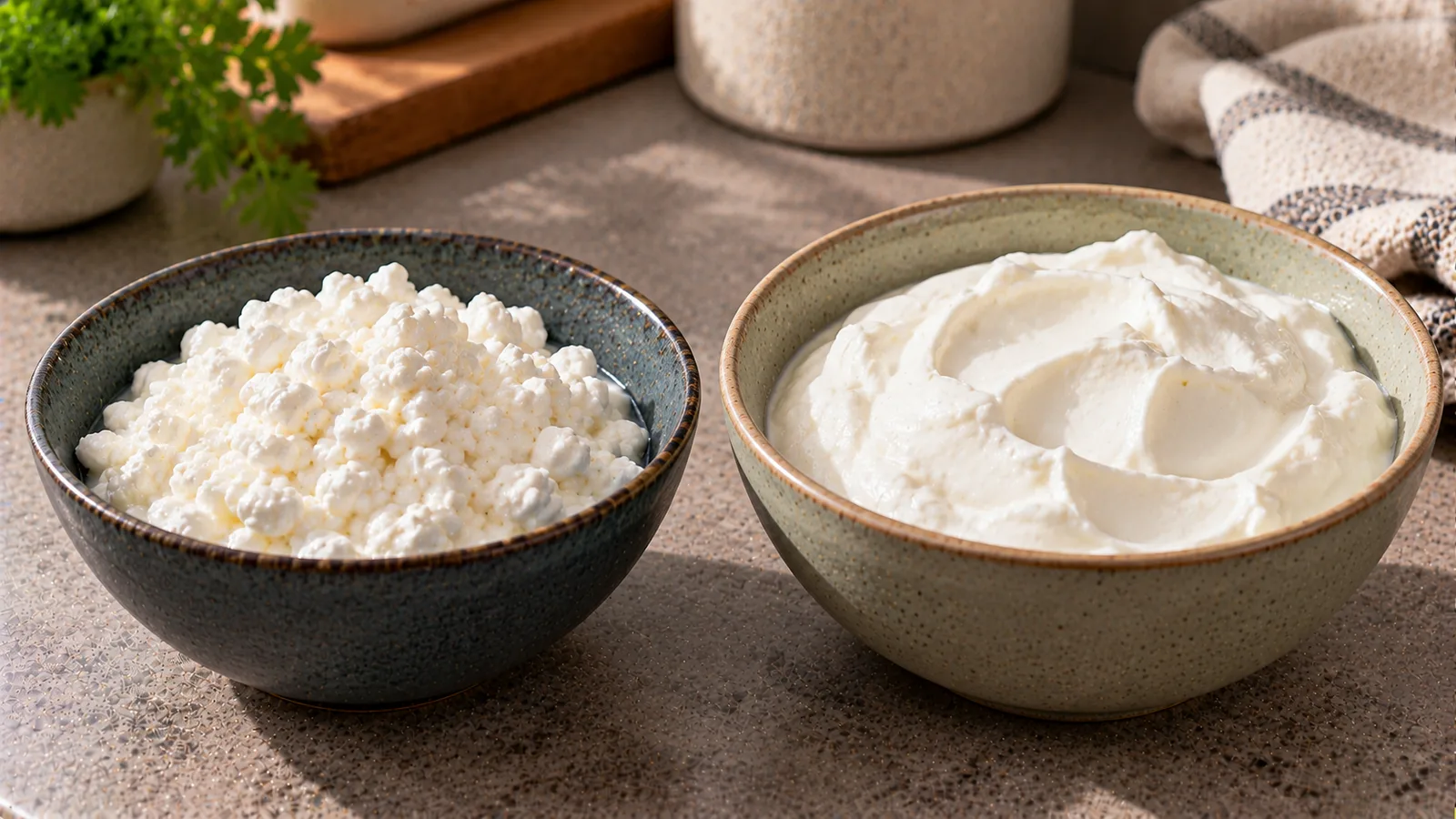
Cottage cheese and plain skyr are both dairy products that can make a useful protein-rich snack, but the choice is not just about which tub has the biggest protein number. In this comparison, REWE Bio Körniger Frischkäse has 12.7 g protein and 0.70 g salt per 100 g, while REWE Bio Skyr Natur has 11 g protein and 0.10 g salt per 100 g. These are the figures on two specific German product pages, not universal nutritional averages for cottage cheese and skyr. Their difference becomes clearer when you compare an actual bowl and the amount needed for 20 g of protein.
The two products also come in different pack sizes: 200 g for the cottage cheese and 400 g for the skyr. No single REWE price applies in every town, so the shopping comparison below uses explicit illustrative German prices, not claimed current store prices. It distinguishes the price of buying a whole tub from the cost of the quantity eaten.
Same label basis: what is in 100 g?
Both products are plain, unsweetened examples. The cottage cheese is a half-fat, granular fresh cheese with salt listed among its ingredients; the skyr lists organic skimmed milk and lactic-acid cultures. The figures below are copied from the REWE Bio cottage cheese nutrition panel and REWE Bio skyr nutrition panel. The values refer to 100 g of the product as sold, not to 100 g of a meal with bread or fruit.
| Nutrient per 100 g | Cottage cheese | Plain skyr |
|---|---|---|
| Energy | 91.0 kcal | 60.0 kcal |
| Protein | 12.7 g | 11.0 g |
| Fat | 4.0 g | 0.2 g |
| Saturated fat | 2.6 g | 0.1 g |
| Carbohydrate | 1.0 g | 3.5 g |
| Sugars | 1.0 g | 3.5 g |
| Salt | 0.7 g | 0.1 g |
Cottage cheese has 1.7 g more protein per 100 g in this pair. Skyr has substantially less fat and a lower energy value. More protein per 100 g does not mean it is automatically the better purchase: the skyr is available in a larger tub in this example, and the salt difference is much larger than the protein difference. Both have 0 g fibre in these product listings; a fruit or wholegrain addition changes the fibre in the finished meal, not in the dairy itself.
Notice that the skyr's 3.5 g of sugars per 100 g are on an unsweetened product label. That number should not be confused with 3.5 g of added sugar. It largely reflects naturally occurring milk sugars. Chocolate, vanilla or fruit-flavoured versions need their own labels. Likewise, cottage cheese with herbs, cream or a different fat grade may not resemble the numbers above.
A real 150 g bowl and a 20 g protein target
A label can rank a food differently depending on the unit. If you eat 150 g of each food, the cottage cheese provides 19.05 g protein and the skyr 16.5 g. If the target is 20 g protein, you need approximately 157.5 g cottage cheese or 181.8 g skyr, based on these two labels. These weights are calculations, not standard serving recommendations.
| Edible amount | Cottage: protein / kcal / salt | Skyr: protein / kcal / salt |
|---|---|---|
| 100 g | 12.70 g / 91.0 kcal / 0.70 g | 11.00 g / 60.0 kcal / 0.10 g |
| 150 g | 19.05 g / 136.5 kcal / 1.05 g | 16.50 g / 90.0 kcal / 0.15 g |
| 200 g | 25.40 g / 182.0 kcal / 1.40 g | 22.00 g / 120.0 kcal / 0.20 g |
| To reach 20 g protein | 157.5 g / 143.3 kcal / 1.10 g | 181.8 g / 109.1 kcal / 0.18 g |
The salt result is particularly revealing: matching 20 g protein gives about 1.10 g salt with this cottage cheese but 0.18 g salt with this skyr. That is not a claim that cottage cheese always contains this much salt or that the rest of the day's intake should be determined by a single product. It is a product-level comparison useful for someone reading nutrition labels. An ordinary 200 g cottage-cheese tub contains 25.4 g protein and 1.40 g salt; 200 g of this skyr contains 22 g protein and 0.20 g salt.
Weight matters more than vague words such as “a bowl” or “one scoop”. A large 300 g bowl doubles every value calculated for 150 g. For context, our cottage cheese calorie and portion guide describes a single food across portions, while the skyr calorie guide covers the other. This page uses them as different products that meet one purchasing decision, rather than claiming a new universal calorie value.
Salt: what the EU label actually means
On an EU nutrition label, salt is an equivalent quantity derived from sodium, and it is not necessarily the literal weight of crystals someone sprinkled into a recipe. The European Commission's dietary salt and sodium guidance explains the conversion: salt = sodium × 2.5. The label already reports salt, so it would be a mistake to multiply the displayed 0.70 g or 0.10 g by 2.5 again. The salt value includes sodium naturally present in food as well as sodium associated with added ingredients.
In this example the ingredient list of the cottage cheese contains added table salt. The plain skyr does not list added salt. Neither observation proves the same for all brands. Some cottage cheese types use different brines or fat contents; some skyr-style desserts use flavours or added ingredients. Compare the exact variety you intend to eat.
Salt becomes a more useful question when the dairy food is served with bread, smoked fish, olives or a savoury topping. Counting 0.7 g salt for 100 g cottage cheese but ignoring salty bread and toppings understates the meal. By contrast, adding fruit and oats to skyr contributes nutritional components whose labels must also be considered. If a health professional has advised an individual sodium restriction, follow that advice rather than deriving a medical target from this product comparison.
Buying price versus protein cost
REWE's public product listings describe the nutritional composition but state that a specific price depends on location. To illustrate a method that readers can repeat with their own receipts, suppose a 200 g tub of cottage cheese costs €1.39 and a 400 g tub of skyr costs €1.49. These are invented budget assumptions, not observed REWE prices. The formula is the purchase price multiplied by the edible grams used, divided by pack grams. For price per 20 g protein, also divide by the pack's declared protein content.
| Comparison basis | Cottage (assumed €1.39/200 g) | Skyr (assumed €1.49/400 g) |
|---|---|---|
| Full pack | 200 g / €1.39 | 400 g / €1.49 |
| 100 g eaten | €0.69 | €0.37 |
| 150 g eaten | €1.04 | €0.56 |
| 20 g protein | €1.09 | €0.68 |
With these illustrative prices, cottage cheese costs €1.09 per 20 g protein and skyr €0.68 per 20 g protein, despite cottage cheese containing more protein in each 100 g. The reason is the assumed price per gram of food and the much larger skyr tub. The full pack cost of €1.39 or €1.49 must actually be paid at checkout, even though the amount charged to a 150 g serving in a recipe calculation is lower.
Do not treat unused skyr as free, and do not assume you will necessarily eat a whole pack before its use-by date. If you only need 150 g once, compare smaller pack sizes and likely waste. A larger tub is less attractive if you cannot safely finish it. The calculations also exclude bread, fruit, granola, transport and refrigeration electricity.
How sensitive is the result to a special offer?
The “cheaper protein” result is not stable if the shelf prices change. The next table holds the same nutrition labels fixed and varies only two hypothetical shelf prices. It does not represent documented REWE promotions. Use it to see how quickly an offer can reverse the ranking.
| Illustrative price scenario | Cost per 20 g protein: cottage | Cost per 20 g protein: skyr |
|---|---|---|
| Baseline (€1.39/200 g; €1.49/400 g) | €1.09 | €0.68 |
| Cottage promo (€0.79/200 g; €1.49/400 g) | €0.62 | €0.68 |
| Skyr dearer (€1.39/200 g; €2.49/400 g) | €1.09 | €1.13 |
At the assumed €1.49 price for 400 g skyr, the 200 g cottage tub would need to cost about €0.86 or less to match the skyr on price per 20 g protein. Conversely, if the skyr costs €2.49 for the same 400 g and cottage cheese remains €1.39 for 200 g, the cottage cheese becomes slightly cheaper per 20 g protein. This threshold is simply the ratio of price to label protein. It is not an estimate of the usual supermarket price.
The unit price per kilogram can help screen products quickly, but it cannot show whether a product supplies more protein. To compare fairly, check both the €/kg figure and the g protein/100 g value. For a deeper walkthrough of these label units, use our guide to reading a nutrition label.
Which one works better in different meals?
Plain skyr is usually smooth and spoonable, which can make it convenient with berries, banana, oats or as part of a cold dip. Cottage cheese has visible curds and a savoury, naturally salty profile in this example; that may suit toast, baked potatoes or a lunch bowl. These are culinary observations, not controlled measurements of satiety. The protein contents are similar enough that portion size and other ingredients can change the practical difference.
For a savoury 150 g bowl, cottage cheese brings approximately 19.05 g protein before adding vegetables or bread. For a 150 g skyr bowl, the base is 16.5 g protein, 90 kcal and 0.15 g salt before fruit or cereals. They are both dairy products and should not be presented as suitable substitutes for people with a milk allergy. People with lactose intolerance may tolerate particular dairy preparations differently; neither of the two cited plain labels promises lactose-free status.
If comparing cottage cheese to thick Greek yogurt is your actual question, it is a different product pair: see cottage cheese vs Greek yogurt. Our present comparison does not relabel skyr as Greek yogurt, and it does not turn a nutrition-label calculation into medical advice. A yoghurt-style alternative with a different protein fraction, sweetener or texture needs its own data.
A repeatable four-step shop comparison
Start by selecting the exact plain versions on the shelf, not just their product categories. Read the protein, salt, calories and pack weight per 100 g. Next set one meaningful comparison basis—perhaps a 150 g serving for a snack or 20 g protein for a higher-protein meal. Calculate the required weight, and then compute its share of the pack price. Finally, consider whether you can consume the remainder before it spoils, and whether toppings, bread or preparation change the result.
EU nutrition declarations normally list energy, fat, saturates, carbohydrate, sugar, protein and salt; the European Commission's nutrition-labelling page explains these mandatory items. The term “high protein” also has a specific EU claims threshold based on the proportion of energy supplied by protein, not simply a large font on the tub; consult the EU nutrition claims conditions. Those rules do not say which of these two products an individual must eat.
The defensible conclusion from this specific label pair is narrow but useful: cottage cheese has slightly more protein per 100 g, while skyr has much less salt and fat; which costs less per protein serving depends on shelf prices, pack size and waste. Numbers in the tables are arithmetic derived from the two public listings and explicitly illustrative prices, not measurements from a new nutritional experiment.
Sources
Product labels: REWE Bio cottage cheese and REWE Bio plain skyr. Label interpretation: EU dietary salt/sodium, nutrition labelling and permitted nutrition claims. All prices in this article are labelled hypothetical German shopping scenarios; nutrition figures are the published labels of those two named products.