
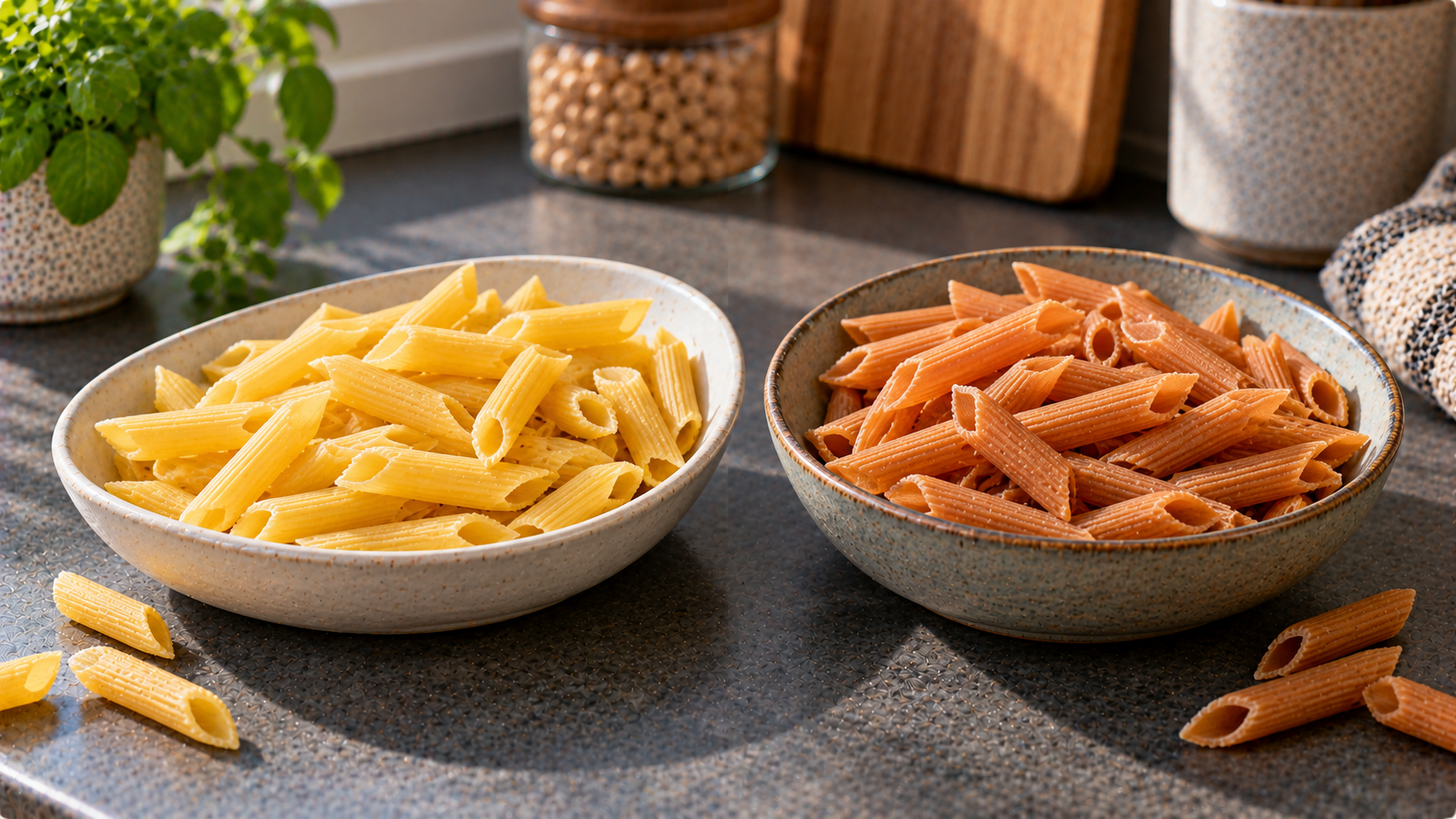
Protein-enriched pasta sounds like an obvious upgrade over regular pasta: more protein in a familiar meal, without changing the sauce. Sometimes that is exactly what you get. But “protein pasta” is a product category, not a single recipe. A chickpea-only pasta, a wheat pasta with added pea protein and a conventional durum-wheat spaghetti can have very different amounts of protein, fibre, carbohydrates, gluten and calories. The useful question is how much your actual serving changes the meal.
Protein pasta vs regular pasta: what changes?
| Feature, per 100 g dry | Regular durum-wheat pasta | Protein-enriched wheat blend | Lentil or chickpea pasta |
|---|---|---|---|
| Protein | Often about 12–14 g | Commonly around 18–25 g | Often about 20–26 g |
| Fibre | Often roughly 3–4 g | Varies with added ingredients | Often higher, but formulation matters |
| Carbohydrate | Usually the main macronutrient | Often lower, not necessarily low-carb | Often lower than durum wheat, not carbohydrate-free |
| Calories | Usually around 340–370 kcal | Often a similar order of magnitude | Often a similar order of magnitude |
| Gluten | Contains wheat gluten | May contain wheat gluten | Single-ingredient legume versions may be gluten-free; check packaging and cross-contact |
| Texture | Familiar bite and elasticity | Depends on protein source and processing | Can soften, break or become grainy if overcooked |
All ranges above are illustrative category-level examples, not a tested brand comparison or a substitute for a label. Dry-product labels can differ markedly. A blend marketed as protein-enriched may contain much less legume flour than a pasta made entirely from lentils. Compare two labels per 100 g, in the same country, before deciding.
The regular pasta nutrition guide offers a baseline for ordinary pasta portions. Do not apply that entry to lentil, chickpea or protein-enriched pasta without checking the product’s own label. For a more specific comparison of pulse-based and conventional pasta, see chickpea pasta versus whole-wheat pasta.
Three different products sold as “protein pasta”
Durum wheat with added protein
Some manufacturers keep durum wheat as the main ingredient but include added wheat gluten, pea protein, soy protein, legumes or other concentrated ingredients. This may preserve the texture expected from conventional spaghetti. It does not automatically make the product suitable for someone avoiding gluten: wheat and wheat gluten remain allergens. Extra protein does not tell you how much fibre is present; a formulation based on purified protein may contain relatively little.
Pasta made from lentils, chickpeas or peas
Single-ingredient legume pasta changes the underlying food rather than just fortifying wheat pasta. Lentils and chickpeas supply protein and fibre together, although processing, cooking and the particular raw material affect the finished nutrition profile. Harvard’s Nutrition Source describes pulses as foods that provide protein, fibre and carbohydrates; no legume pasta should be presented as carbohydrate-free. Some products use several pulse flours rather than a single one.
Conventional wheat pasta, including whole-wheat versions
Regular dried pasta is not protein-free: wheat already supplies a meaningful amount. Whole-wheat pasta can contribute more fibre without being marketed as protein pasta. When choosing between these products, compare fibre and taste as well as the protein number. A well-composed meal with ordinary pasta, legumes and a protein-containing sauce may supply as much or more protein than a dish based only on specialist pasta.
Compare the amount you will actually eat
A dry serving of 75 g is a convenient calculation reference, but it is not a rule about how much anyone should eat. Imagine two hypothetical labels: regular pasta with 13 g protein and 355 kcal per 100 g dry, and protein pasta with 23 g protein and 350 kcal per 100 g dry.
| Dry amount | Regular pasta: protein | Protein pasta: protein | Difference | Approximate energy, regular / protein |
|---|---|---|---|---|
| 50 g | 6.5 g | 11.5 g | +5 g | 178 / 175 kcal |
| 75 g | 9.8 g | 17.3 g | +7.5 g | 266 / 263 kcal |
| 100 g | 13 g | 23 g | +10 g | 355 / 350 kcal |
| 150 g shared by two | 19.5 g total | 34.5 g total | +15 g total | 533 / 525 kcal |
These figures are worked examples, not measured values for a named product. The arithmetic is straightforward: label protein per 100 g × dry weight ÷ 100. Someone eating 75 g dry would get about 7.5 g more protein from the illustrated protein pasta, not 10 g. That extra amount could matter, but it is only one component of the meal.
Why cooked weight causes misleading comparisons
Pasta absorbs water. A 75 g dry portion might weigh substantially more after cooking, depending on shape, ingredients, cooking time and draining. Water adds weight but no protein or calories. That means protein per 100 g cooked is not directly comparable with protein per 100 g dry. Different pasta types can take up different amounts of water, so even two cooked weights are not always fair comparisons.
Suppose 75 g dry pasta containing 17.25 g protein ends up at 180 g cooked. Dividing 17.25 by 180 and multiplying by 100 gives roughly 9.6 g protein per 100 g cooked. If a different pasta reaches 225 g cooked, its protein concentration per 100 g cooked looks lower simply because it contains more water. The meal still started with the same 75 g of dry product. Use dry weights for label calculations whenever possible; if weighing cooked pasta, use the manufacturer’s cooked serving information or a consistent measured yield.
The same issue affects logging in nutrition apps. Selecting “100 g pasta, cooked” after weighing uncooked spaghetti can seriously distort results. Record the right product, state and weight. Sauces, cheese, olive oil and additional ingredients should be logged separately.
Does more protein mean fewer calories?
Usually not by much. Pasta made with more protein can still be an energy-dense dried food. Protein and carbohydrate each contribute approximately 4 kcal per gram and fat about 9 kcal per gram; replacing some carbohydrate with protein does not automatically cause a large energy reduction. Recipes with chickpea or soy flour can differ in fat as well as protein.
For weight management, the serving size, the sauce and the overall meal matter more than the word protein on the package. A tablespoon of oil, a generous cheese topping or a creamy sauce can add more energy than the small calorie difference between two dried pasta labels. Conversely, adding vegetables, beans or lean protein may make a pasta meal more satisfying without requiring specialist pasta. There is no credible rule that a higher-protein pasta produces weight loss on its own.
Protein quality and the rest of the plate
Protein quantity is not identical to protein quality. Wheat proteins tend to be relatively limited in lysine, whereas many legumes contribute lysine; the exact amino-acid profile depends on ingredients. A mixed diet can provide complementary amino acids across meals without combining specific foods in a prescribed ratio at every sitting. The total amount and distribution of dietary protein remain relevant to individual requirements.
Consider a meal of 75 g dry regular pasta, a tomato-and-lentil sauce and vegetables. Its total protein can be higher than the pasta figure alone suggests. Replacing the base with protein pasta adds protein if the sauce stays the same, but the meal may already meet its purpose. On a day with little other protein, the substitution may be convenient; for someone whose protein intake is already sufficient, it may offer little additional practical value.
This is also why comparing pasta alone with chicken, fish, tofu, beans or cheese is not very useful. A complete meal can obtain protein from several ingredients. Decide first whether you need more protein from the pasta itself or simply a sensible, enjoyable dinner.
Fibre: often the more overlooked difference
Fibre can change the comparison more than expected. Some legume pastas are rich in fibre; some wheat-protein-enriched products are not. Whole-wheat pasta can outperform a nominally high-protein pasta on fibre. The only reliable way to find out is to check the fibre line in the same per-100-g table.
In the EU, regulated nutrition claims have defined thresholds: “source of fibre” requires at least 3 g per 100 g or 1.5 g per 100 kcal; “high fibre” requires at least 6 g per 100 g or 3 g per 100 kcal. By contrast, “source of protein” requires at least 12% of food energy to come from protein and “high protein” at least 20%. These rules concern defined claims, not how suitable a product is for a particular person. A prominent protein claim can coexist with a relatively low fibre amount.
For someone increasing their intake of pulse-based foods, fibre content may also affect digestive comfort. A large sudden serving may cause gas or bloating in some people. Begin with a portion you tolerate, cook as directed and assess the whole diet rather than treating one product as a digestive intervention.
Blood sugar, digestion and health claims
A higher protein or fibre value alone does not establish a specific glucose response. Pasta shape, ingredient processing, starch structure, cooking time, portion size and accompanying food can all influence digestion. Legume-based pasta is sometimes studied for metabolic outcomes, but findings about a particular formulation should not be generalized to every lentil, chickpea or protein-fortified pasta.
People managing diabetes may need to account for the actual carbohydrate grams in the planned portion, not just a marketing claim such as “smart carb” or “protein-rich”. A pasta with fewer carbohydrates per 100 g is not automatically free of starch. Medical nutrition decisions should be individualized, especially for people taking glucose-lowering medication.
Gluten, soy, chickpeas and other allergens
Check the ingredients, not the colour or name of the pasta. A product labelled “chickpea pasta” may still include wheat; a wheat protein blend definitely cannot be assumed gluten-free. A single-ingredient lentil product may be made in a facility that handles gluten-containing grains. People with coeliac disease need packaging that meets the relevant gluten-free requirements, not a guess based on raw materials.
Protein enrichment may involve soy, wheat, peas or eggs. Soy, wheat and egg are allergens subject to mandatory declaration in EU ingredient labelling; individual legume allergies may also matter. Anyone with a diagnosed food allergy should check the exact product and follow clinical guidance. Cooking does not reliably eliminate allergen risk.
Taste, sauce pairing and cooking behaviour
The practical difference can be bigger in the pot than on the label. Standard durum pasta typically keeps a familiar bite across a reasonable cooking window. Some high-protein wheat blends are similar; pulse-based shapes can become soft or break when overcooked. Begin checking shortly before the package’s lower suggested cooking time, stir gently and taste. Cooking-water starchiness and how sauce coats the pasta may differ.
For a simple tomato or vegetable sauce, almost any pasta can work. Strongly flavoured lentil pasta may pair well with roast vegetables, garlic, tomato and herbs. Chickpea pasta can be pleasant with lemon, olive oil and greens; a mild wheat-protein blend may suit a creamy sauce when texture is the priority. None of those combinations has a special metabolic advantage. The best option is one you enjoy sufficiently to use consistently.
If batch-cooking, test the pasta separately before preparing many portions. Refrigerated and reheated pulse pasta may soften more than expected. Storing sauce separately can help preserve texture. Always follow safe food-storage practices for prepared meals.
Is the extra protein worth the extra money?
Compare the price for a dry serving and the price for the additional protein, rather than comparing package prices. Suppose ordinary pasta costs €1.60 for 500 g and protein pasta costs €2.80 for 250 g. At 75 g dry, their costs are €0.24 and €0.84 respectively. In our illustrative label example, the €0.60 premium supplies 7.5 g additional protein: about €0.08 per extra gram.
| Illustrative comparison | Regular pasta | Protein pasta |
|---|---|---|
| Package and price | 500 g / €1.60 | 250 g / €2.80 |
| Price per 100 g dry | €0.32 | €1.12 |
| Price for 75 g | €0.24 | €0.84 |
| Protein in 75 g | 9.8 g | 17.3 g |
| Added cost for added protein | — | €0.60 for 7.5 g |
Prices are hypothetical, not current retail quotes. Sometimes ordinary pasta plus lentils, eggs, tuna, quark, tofu or a bean-based sauce is a cheaper way to reach the same meal protein target. But convenience, allergies, appetite and available cooking time also have value. A premium product can be worthwhile if it simplifies an otherwise difficult routine.
A practical label-reading checklist
- Choose comparable forms. Compare dry pasta to dry pasta, both per 100 g. Do not mix cooked and dry values.
- Read the first ingredients. Durum wheat plus added protein is different from 100% pulses. Check gluten and other allergens.
- Calculate your serving. Multiply protein, carbohydrate and fibre per 100 g by the actual dry grams divided by 100.
- Look at fibre and salt. Extra protein does not guarantee either a high-fibre or low-salt product.
- Compare calories honestly. Many protein and regular pastas are in a similar energy range.
- Consider the entire meal. Sauce, toppings and vegetables can change the overall nutrition substantially.
- Test taste and cost. A higher label number is not beneficial if you dislike the texture or pay more than the convenience is worth.
Which pasta should you choose?
Choose protein-enriched pasta when its actual label shows a useful protein gain for your portion, you like its texture and you value the convenience. Choose ordinary durum pasta when price, familiar cooking results and versatility matter, especially if other ingredients already supply protein. Consider whole-wheat pasta when more fibre is your main objective. Try lentil or chickpea pasta if you want a legume-based alternative and can tolerate its flavour and fibre content. There is no single winner for all meals.
The most useful number is not the bold protein claim on the front. It is the additional grams of protein, fibre and total cost in the portion you actually eat, considered alongside the sauce and your wider diet.
Sources and methodology
- European Commission — nutrition claims and legal thresholds.
- Harvard T.H. Chan School of Public Health — Legumes and Pulses.
- USDA FoodData Central — ingredient-level nutrition reference database.
- European Commission — food information to consumers.
Displayed product profiles and costs are explicit illustrative calculations, not laboratory results, brand-specific labels, independent product rankings or current store prices. Check packaging for the exact item purchased.