
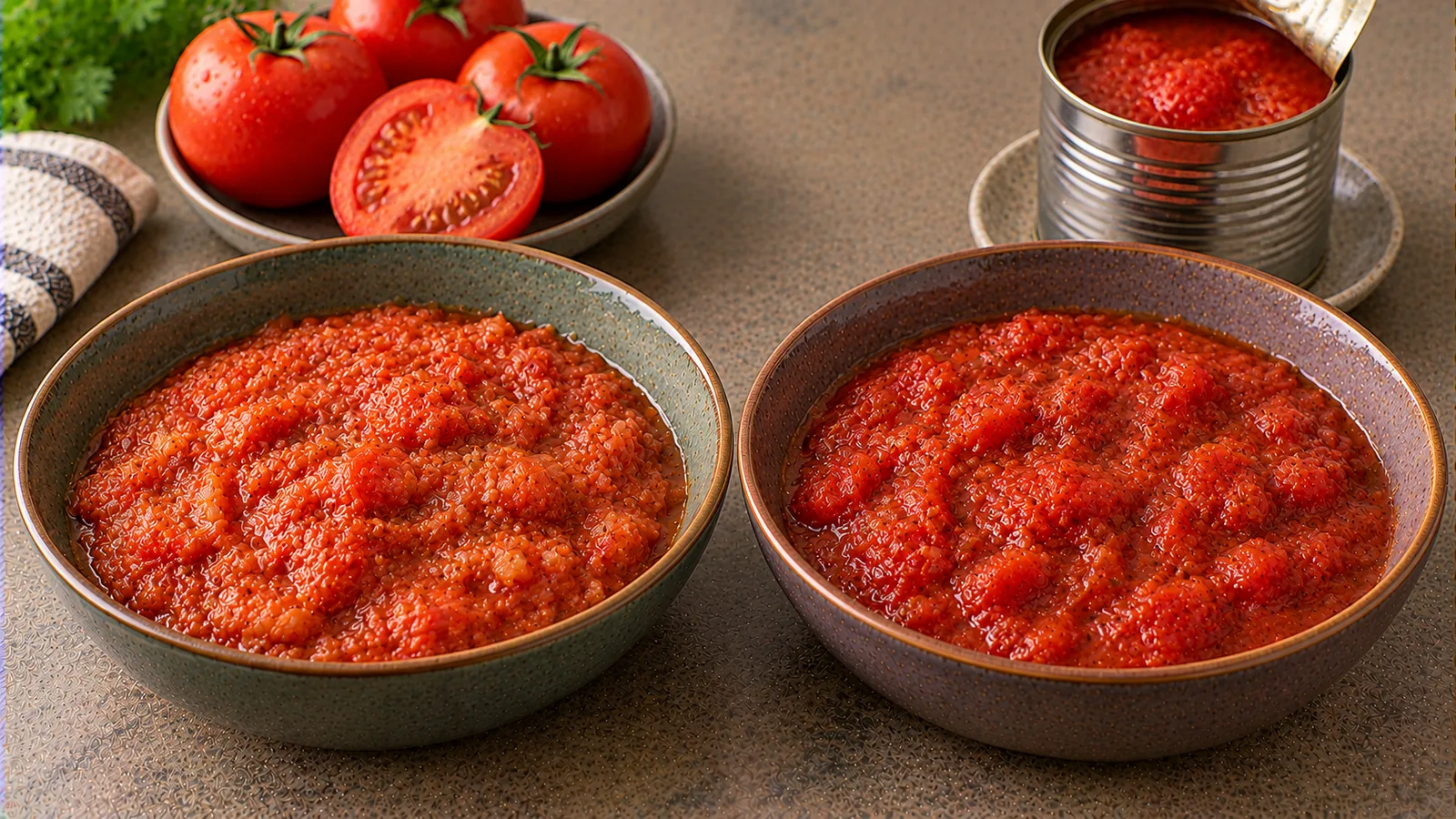
Fresh tomatoes and canned chopped tomatoes can both make a good pasta sauce. But the cheapest-looking pack is not necessarily the cheapest finished sauce. Fresh tomatoes may need trimming and longer reduction. Canned tomatoes usually arrive peeled or chopped with juice already included. What matters for a fair cost comparison is the price of a specified amount after both sauces have been cooked to a measured final weight.
For a worked example, compare 600 g finished plain tomato sauce made from either 1 kg fresh Roma tomatoes or two 400 g cans of chopped tomatoes. A publicly listed, not checkout-verified German price example gives €1.79 for 1 kg fresh Roma tomatoes and €0.59 for a 400 g can of ja! chopped tomatoes. On these specific inputs, the 600 g final batch costs €1.79 fresh versus €1.18 canned before oil, onion, garlic, energy and labour. These amounts are illustrative, not measured cooking yields or universal supermarket prices.
Cost per equal amount of finished sauce
| Measure | Fresh Roma tomatoes | Canned chopped tomatoes |
|---|---|---|
| Product purchased | 1 kg fresh | 2 × 400 g cans |
| Publicly listed example price | €1.79 | 2 × €0.59 = €1.18 |
| Product put into sauce pot | 950 g after trimming | 800 g with juice |
| Target cooked sauce yield | 600 g | 600 g |
| Hypothetical water lost in cooking | 350 g | 200 g |
| Ingredient cost for 600 g sauce | €1.79 | €1.18 |
| Ingredient cost per 100 g finished | €0.30 | €0.20 |
| Ingredient cost per 150 g finished | €0.45 | €0.30 |
Price inputs: SupermarktCheck's last-reported REWE fresh-tomato listing and its last-reported REWE chopped-tomato listing. These are third-party listings, not an independently confirmed price at your local till; the fresh and canned price reports do not guarantee identical store availability or observation dates. The 950 g, 800 g and 600 g weights form a transparent hypothetical kitchen calculation; they are not claims about typical trimming or evaporation rates.
The math behind the table
The example assumes a purchase price of €1.79 for 1 kg fresh tomatoes. Removing 50 g of stems or unusable parts leaves 950 g, which is then simmered until the pot contains 600 g finished sauce. Everything purchased goes into this batch except the discarded 50 g. Cost per 100 g cooked equals €1.79 ÷ 600 × 100 = €0.30, rounded; per 150 g it is €1.79 ÷ 600 × 150 = €0.45.
For canned tomatoes, two cans cost 2 × €0.59 = €1.18 and provide 800 g net contents, including tomato juice. Reducing them to the same 600 g final weight gives €1.18 ÷ 600 × 100 = €0.20 per 100 g, or €0.30 per 150 g, rounded. The ingredient-cost difference for the entire 600 g batch is €0.61, not a guaranteed saving on every shop. Do not charge the canned side for only one can if the recipe uses two.
What does edible yield actually mean?
Fresh tomatoes are bought by the weight on the scale, which may include a stem, tough core, damaged area or skin you choose to remove. Trimming loss depends on freshness, cultivar and whether you strain the sauce. There is no universal percentage that can be safely applied to every kilo. In this worked example, the chosen 50 g loss is only a scenario. If you use the seeds and skins, the edible yield will be different than if you peel and strain everything.
For canned chopped tomatoes, the declared 400 g net weight generally represents the full product in the can, including any tomato juice. A separate drained weight, when stated, is not automatically the correct basis for a sauce if the juice also goes into the pan. The European Commission's guidance on mandatory food information explains why net quantity, ingredients and storage instructions are important label fields. If a can contains herbs, salt or thickening ingredients, it is no longer a like-for-like single-ingredient tomato comparison.
In both cases, a major change happens during cooking: water evaporates. The final pot weight becomes smaller while the food cost already paid stays the same. A thicker sauce may need more reduction than a light, loose sauce. That is why buying cost per kilogram of raw tomatoes is not the same as price per kilogram of ready-to-serve pasta sauce.
How to reproduce the comparison in your kitchen
- Choose comparable products. Use ripe fresh tomatoes suitable for sauce and an unsalted or simply seasoned canned chopped product. Avoid comparing expensive cherry tomatoes with a budget tin unless that reflects your actual shopping decision.
- Record actual prices. Write down price paid, unit size, special offers and the exact shop. For canned tomatoes, check whether a 400 g weight is the full net content or a drained figure. Keep the juice for the sauce test.
- Weigh the fresh batch before trimming. Wash tomatoes under running water, according to FDA produce-handling guidance, then cut away damaged sections or hard cores. Weigh the edible prepared tomatoes and record what you discarded.
- Cook the fresh sauce. Chop or crush the prepared tomatoes. Simmer in a wide saucepan without adding water or other ingredients, stirring regularly. If necessary use a lid briefly to prevent splashing, then remove it to let moisture evaporate.
- Cook the canned sauce separately. Open and weigh the full contents of the cans, including the tomato juice. Simmer in a second pan with comparable surface area. Avoid adding oil, vegetables or cheese to only one side of the test.
- Weigh the final sauce. Tare or separately weigh each empty pot, then subtract pot weight from pot plus sauce. For this example, aim for 600 g finished sauce on each side, but record the result actually achieved. If either batch cannot reasonably reach the planned weight, use its measured weight instead and recalculate.
- Calculate cost per 100 g and 150 g. Divide the amount paid for tomatoes by the real final sauce weight. Multiply by 100 or 150. Note any purchased ingredient left unused, because that changes the cost attributable to the batch.
Equal cooked weight does not guarantee equal thickness, acidity or tomato solids. One sauce could be thicker even at 600 g. For a truly equal sensory comparison, also judge consistency and record any extra reduction required. Do not quietly dilute the thicker sauce merely to make a price claim look better.
Why the result changes with tomato price
The canned example costs €1.18 for 600 g finished. Under the chosen model, the fresh option would need a total purchased tomato price of €1.18 or less for the same 600 g sauce to tie on tomato ingredients alone. A change in yield, can size or discarded amount changes that break-even point.
| Fresh 1 kg price | Fresh cost per 150 g sauce at 600 g finished | Compared with canned example (€0.30) |
|---|---|---|
| €1.18 | €0.30 | Roughly equal |
| €1.79 | €0.45 | Fresh higher |
| €2.50 | €0.63 | Fresh higher |
These are scenario calculations, not price forecasts or verified sale offers. If fresh tomatoes are discounted, already overripe but still safe to cook, or home-grown, the answer can reverse. If the chosen canned tomatoes cost €0.85 per 400 g rather than €0.59, two cans would cost €1.70, and the difference would be much smaller. Likewise, needing three cans instead of two can make the canned batch more expensive.
Do not silently compare a promotional one-kilogram box of fresh tomatoes against a premium canned brand. The relevant question is which two products you can buy today, for your desired flavour and finishing weight.
Preparation time, texture and flavour
Fresh ripe tomatoes can make a light, bright sauce with visible pieces of fruit. If they contain a lot of water, they may take longer to cook down; the exact time depends on pan width, heat and batch size. Peeling is optional, and finely chopped skins may remain noticeable in a quick sauce. Removing skins and seeds creates more waste and work.
Canned chopped tomatoes often save washing and chopping time and provide a convenient tomato base outside the fresh-tomato season. However, canned texture varies by manufacturer. Some contain firm pieces in juice; others are finely chopped or more pulpy. Tomato variety, ripeness, acidity and additions influence the flavour. There is no scientific basis here for declaring all fresh or all canned sauces tastier.
Neither option automatically needs added sugar. Taste the cooked sauce before adjusting salt, acid or sweetness. If you add 10 g olive oil to both sides, that same extra ingredient cost should be charged to each batch. If you add a different amount of onion or cheese to one side, you are comparing two recipes rather than tomato formats.
How this differs from passata
Passata is normally a sieved or puréed tomato product; canned chopped tomatoes still contain pieces, and fresh tomatoes need cutting or crushing. The discussion here tests fresh whole tomatoes against canned chopped tomatoes, using the finished sauce weight as the denominator. It is not the same purchasing question as canned tomatoes versus passata for bean dinners, which compares two packaged processed tomato formats for a different cooking use.
For a quick weeknight sauce, canned tomatoes may be more predictable in prep effort; for a seasonal summer sauce, fresh tomatoes may be desirable for their particular taste. The best choice is not decided by price alone. Check the label for added salt and ingredients, especially when you need to manage sodium or avoid a specific additive.
Food safety and storage
Keep fresh tomatoes free from contamination and wash them before cutting. Discard visibly spoiled or rotten produce instead of attempting to rescue it in a long simmer. The FDA guidance on produce safety recommends rinsing under running water and removing damaged areas. Do not wash produce with soap.
An unopened, intact commercial can is different from an opened can. Do not use bulging, leaking or severely damaged cans. Once opened, transfer unused tomatoes to a clean covered food-grade container and refrigerate; Food Standards Australia New Zealand's canned-food guidance explains safe handling after opening. Follow a manufacturer's more restrictive post-opening instructions when provided.
Cooked tomato sauce is perishable. Cool leftovers quickly in shallow containers and refrigerate within 2 hours. For a plain cooked sauce handled safely, use the general USDA guideline of 3–4 days for refrigerated cooked leftovers, or freeze suitable portions. Reheat portions thoroughly and do not rely on boiling to make badly stored sauce safe again. Sauce containing meat or other additions needs the safety rules for those ingredients too.
Practical buying decision
Choose canned chopped tomatoes if you want less chopping, consistent pantry availability and the example price advantage of €1.18 vs €1.79 per 600 g sauce at the specified weights. Choose fresh tomatoes if they are in season, competitively priced and you want their particular texture and flavour. Record the real finished yield rather than repeating the example as though every sauce reduced in exactly the same way.
The central lesson is simple: compare the price per 100 g or 150 g of finished, edible sauce, after trimming and evaporation, using the price you actually paid. The numerical result here is a reproducible illustration rather than a promise that one tomato format is always cheaper.
Sources
- SupermarktCheck — REWE fresh Roma tomato listing. Third-party last-reported example price, not a verified checkout transaction.
- SupermarktCheck — REWE chopped canned tomato listing. Third-party last-reported example 400 g can price; prices may vary.
- European Commission — mandatory food information. Net quantity, ingredients and storage guidance for packaged foods.
- FDA — selecting and serving produce safely. Washing and handling fresh produce.
- Food Standards Australia New Zealand — canned foods. Safe handling of opened containers.
- USDA FSIS — leftovers and food safety. Prompt refrigeration and general cooked-leftover storage guidance.
No independent kitchen experiment was performed. The yields and the break-even examples are explicitly hypothetical and must be recalculated for real produce, can contents and sauce consistency.