
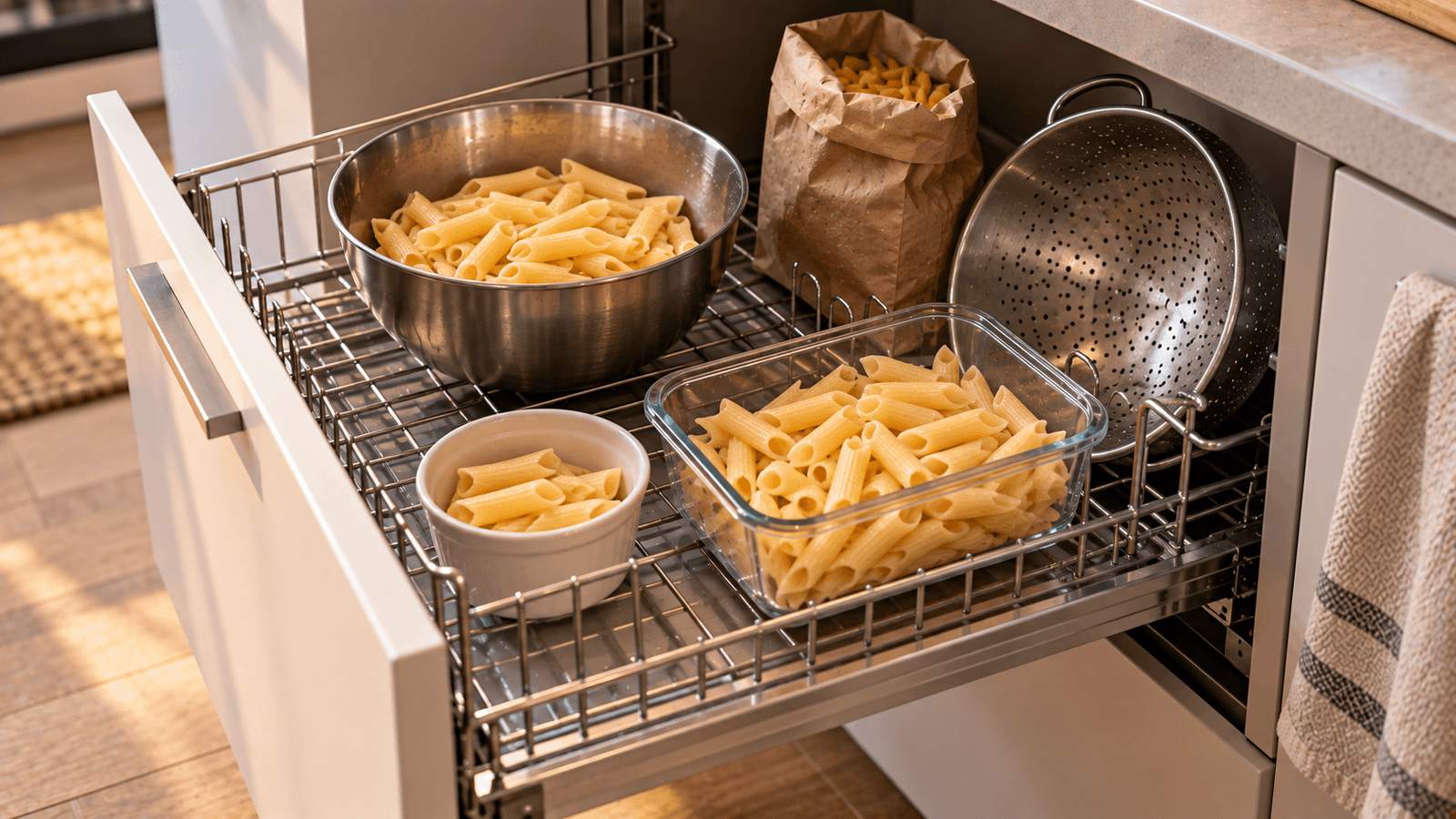
Pasta calories depend heavily on whether you are looking at the dry weight or the cooked weight.
Plain dry pasta typically provides roughly 350–370 kcal per 100 g, while plain cooked pasta often contains around 140–160 kcal per 100 g.
The large difference does not mean cooking removes calories. Pasta absorbs water as it cooks, increasing its weight without adding calories.
Pasta calories at a glance
Approximate values for plain wheat pasta:
| Pasta amount | Approximate calories |
|---|---|
| 50 g dry | 175–185 kcal |
| 75 g dry | 260–280 kcal |
| 100 g dry | 350–370 kcal |
| 100 g cooked | 140–160 kcal |
| 150 g cooked | 210–240 kcal |
| 200 g cooked | 280–320 kcal |
| 250 g cooked | 350–400 kcal |
Exact values vary by product, pasta type and how much water the pasta absorbs during cooking.
For packaged pasta, the nutrition label on the product you actually use is the best reference.
Dry pasta vs cooked pasta
This is the most important distinction when tracking pasta.
Imagine 100 g of dry pasta contains 360 kcal.
After cooking, it may weigh around 230–250 g because it has absorbed water.
The cooked batch still contains approximately 360 kcal.
If the final cooked weight is 240 g:
360 ÷ 240 = 1.5 kcal per gram
So:
100 g cooked pasta ≈ 150 kcal
The calorie density has fallen because water increased the weight of the food.
The total calories in the batch have not disappeared.
Calories in 100 g of pasta
100 g dry pasta
A typical plain dry wheat pasta is often around:
350–370 kcal per 100 g
This is close to the amount you may see on a package nutrition label.
100 g cooked pasta
After boiling in water, a typical value is approximately:
140–160 kcal per 100 g
The exact number depends on how much water the pasta absorbed.
That means two servings with the same cooked weight can differ slightly if one pasta was cooked more softly and absorbed more water.
Common cooked pasta portions
Cooked pasta portions can vary substantially.
Here is a practical reference using approximately 150 kcal per 100 g:
| Cooked pasta | Approximate calories |
|---|---|
| 100 g | 150 kcal |
| 125 g | 188 kcal |
| 150 g | 225 kcal |
| 175 g | 263 kcal |
| 200 g | 300 kcal |
| 250 g | 375 kcal |
| 300 g | 450 kcal |
These figures refer to plain cooked pasta before sauce, oil, cheese or other additions.
Common dry pasta portions
If you weigh pasta before cooking, tracking can be simpler because the dry weight is not affected by water absorption.
Using 360 kcal per 100 g as an example:
| Dry pasta | Approximate calories |
|---|---|
| 40 g | 144 kcal |
| 50 g | 180 kcal |
| 60 g | 216 kcal |
| 75 g | 270 kcal |
| 80 g | 288 kcal |
| 100 g | 360 kcal |
| 125 g | 450 kcal |
Always use the calorie value from your own package when available.
How much does pasta weigh after cooking?
There is no universal conversion.
The final weight depends on:
- pasta shape
- wheat and product formulation
- cooking time
- how soft the pasta is cooked
- how thoroughly it is drained
A useful method is to weigh the entire cooked batch instead of relying on a fixed conversion factor.
Example: calculate calories from a cooked batch
Suppose you cook:
300 g dry pasta
The package says:
360 kcal per 100 g dry
Total calories before cooking:
300 × 3.6 = 1,080 kcal
After cooking and draining, the entire batch weighs:
720 g
Calories per gram of cooked pasta:
1,080 ÷ 720 = 1.5 kcal
Therefore:
100 g cooked = 150 kcal
If you serve yourself 180 g:
180 × 1.5 = 270 kcal
This method automatically accounts for the amount of water your particular pasta absorbed.
Another example with a larger portion
Using the same batch:
- 720 g cooked pasta
- 1,080 kcal total
A 240 g serving is one third of the batch.
Therefore:
1,080 ÷ 3 = 360 kcal
This is more reliable than using a generic cooked-pasta entry when you know the dry pasta nutrition and final batch weight.
Nutrition in pasta
Plain wheat pasta is primarily a carbohydrate-rich food.
Typical pasta also provides:
- protein
- a relatively small amount of fat
- some fiber
- vitamins and minerals depending on the flour and whether the product is enriched or whole grain
The exact nutrient profile varies considerably between products.
Whole-wheat pasta generally contains more fiber than standard refined wheat pasta.
Legume-based pasta can have a substantially different protein and fiber profile, so it should not automatically be tracked using standard wheat-pasta values.
Does pasta shape change the calories?
For plain pasta made from the same dough, shape itself usually does not create a major calorie difference by dry weight.
Spaghetti, penne, fusilli and farfalle made from similar ingredients can have very similar calories per 100 g dry.
However, shape affects:
- how densely pasta fits into a cup
- how much sauce it holds
- cooked volume
- water absorption
That is why grams are usually more useful than cups for calorie tracking.
Spaghetti calories
Plain spaghetti follows the same basic principle as other wheat pasta.
If the package contains around 360 kcal per 100 g dry:
- 50 g dry ≈ 180 kcal
- 75 g dry ≈ 270 kcal
- 100 g dry ≈ 360 kcal
Once cooked, the calories per 100 g decrease because the spaghetti absorbs water.
Penne, fusilli and other shapes
The same rule applies to short pasta.
If two products have similar ingredients and nutrition labels, equal dry weights will usually provide similar calories.
But equal cups of cooked penne and spaghetti may not weigh the same.
For portion tracking, use grams whenever practical.
Whole-wheat pasta vs regular pasta
Whole-wheat pasta is not necessarily dramatically lower in calories.
The main nutritional difference is usually not calorie content but the use of whole-grain flour and its resulting fiber and micronutrient profile.
For calorie tracking, check the package rather than assuming whole-wheat pasta is automatically lower-calorie.
Fresh pasta vs dried pasta
Fresh pasta should not automatically be tracked with dry-pasta values.
Fresh pasta already contains more water before cooking and may also contain ingredients such as egg.
As a result, calories per 100 g can differ substantially from dried pasta.
Use the nutrition information for the specific fresh pasta whenever possible.
Egg pasta
Egg pasta can have a somewhat different nutrient profile from pasta made primarily from durum wheat and water.
The difference depends on the recipe and manufacturer.
Again, the package value is more useful than assuming one universal calorie number.
Gluten-free pasta
Gluten-free pasta can be made from:
- corn
- rice
- lentils
- chickpeas
- peas
- combinations of different flours
These products can have different calorie, protein and fiber values.
Do not assume that "gluten-free" means lower in calories.
Track the specific product.
Legume pasta
Pasta made primarily from lentils, chickpeas or peas often contains more protein and fiber than conventional refined wheat pasta.
Its calorie content may still be in a broadly similar range by dry weight.
If you are tracking macros as well as calories, selecting the correct product matters.
Pasta calories change much more when ingredients are added
Plain pasta is only one part of many pasta meals.
Common additions include:
- olive oil
- butter
- pesto
- cream sauce
- tomato sauce
- cheese
- meat
- fish
- vegetables
These ingredients can substantially change the total calories of the finished dish.
For example, 200 g of plain cooked pasta might be around 300 kcal using a 150 kcal/100 g estimate.
If oil, pesto and cheese are added, the finished meal can be considerably higher.
That does not mean the pasta itself changed.
The meal now contains additional ingredients.
Why restaurant pasta is difficult to estimate
Restaurant pasta can be harder to track because you may not know:
- dry pasta quantity
- oil used during cooking
- amount of sauce
- cheese quantity
- butter or cream in the sauce
- final serving weight
A photo can help estimate the visible portion, but it cannot reveal all hidden ingredients.
For restaurant meals, treat calorie values as estimates unless the restaurant provides nutrition information for the exact dish.
How to track homemade pasta dishes
For a homemade recipe, calculate the entire dish first.
Suppose you use:
- 300 g dry pasta
- tomato sauce
- olive oil
- vegetables
- cheese
Add the calories of all ingredients.
Then weigh the finished recipe or divide it into known portions.
If the whole recipe contains 2,000 kcal and the final cooked dish weighs 1,600 g:
2,000 ÷ 1,600 = 1.25 kcal per gram
A 400 g portion would contain approximately:
400 × 1.25 = 500 kcal
This is more accurate than tracking only the pasta and ignoring the rest of the recipe.
Should pasta be weighed dry or cooked?
Either method can work.
The important rule is:
Match the weight state to the nutrition entry.
If you weigh pasta dry, use nutrition data for dry pasta.
If you weigh it cooked, use a cooked-pasta value or calculate the cooked value from your own batch.
Do not weigh cooked pasta and enter it using a dry-pasta calorie value.
That can produce a large tracking error.
What if you forgot to weigh the pasta dry?
If the pasta is already cooked:
- Weigh your cooked portion if possible.
- Use an appropriate cooked-pasta database entry.
- If you know the original dry quantity and total cooked batch weight, calculate the batch value.
- If none of those are available, use a reasonable cooked-pasta estimate.
Avoid pretending that an estimated portion is exact.
Cups vs grams
Volume measurements can be convenient, but they are less consistent for pasta.
One cup can contain different weights depending on:
- pasta shape
- how tightly it is packed
- cooked softness
- whether pieces are broken
- how the cup is filled
For more consistent tracking, grams are preferable.
A practical tracking rule
When you eat plain pasta:
Package available + dry weight known → use the package value.
When you cook a batch:
Dry calories + final cooked batch weight → calculate calories per gram cooked.
When you eat homemade pasta with sauce:
Track the whole recipe.
When you eat restaurant pasta:
Use restaurant data if available; otherwise estimate the major components and accept a wider uncertainty range.
This avoids one of the most common sources of confusion in pasta tracking: mixing dry and cooked weights.
Nutrition data sources
The examples use 360 kcal per 100 g dry and 150 kcal per 100 g cooked.
The USDA references below describe the particular foods and preparation states named in their records; they do not establish every rounded example or product variation in this article. Check the label of a specific product when available.
- USDA FoodData Central — Pasta, dry, enriched (FDC 169736; 371 kcal/100 g).
- USDA FoodData Central — Pasta, cooked, enriched, with added salt (FDC 169751; 157 kcal/100 g).