
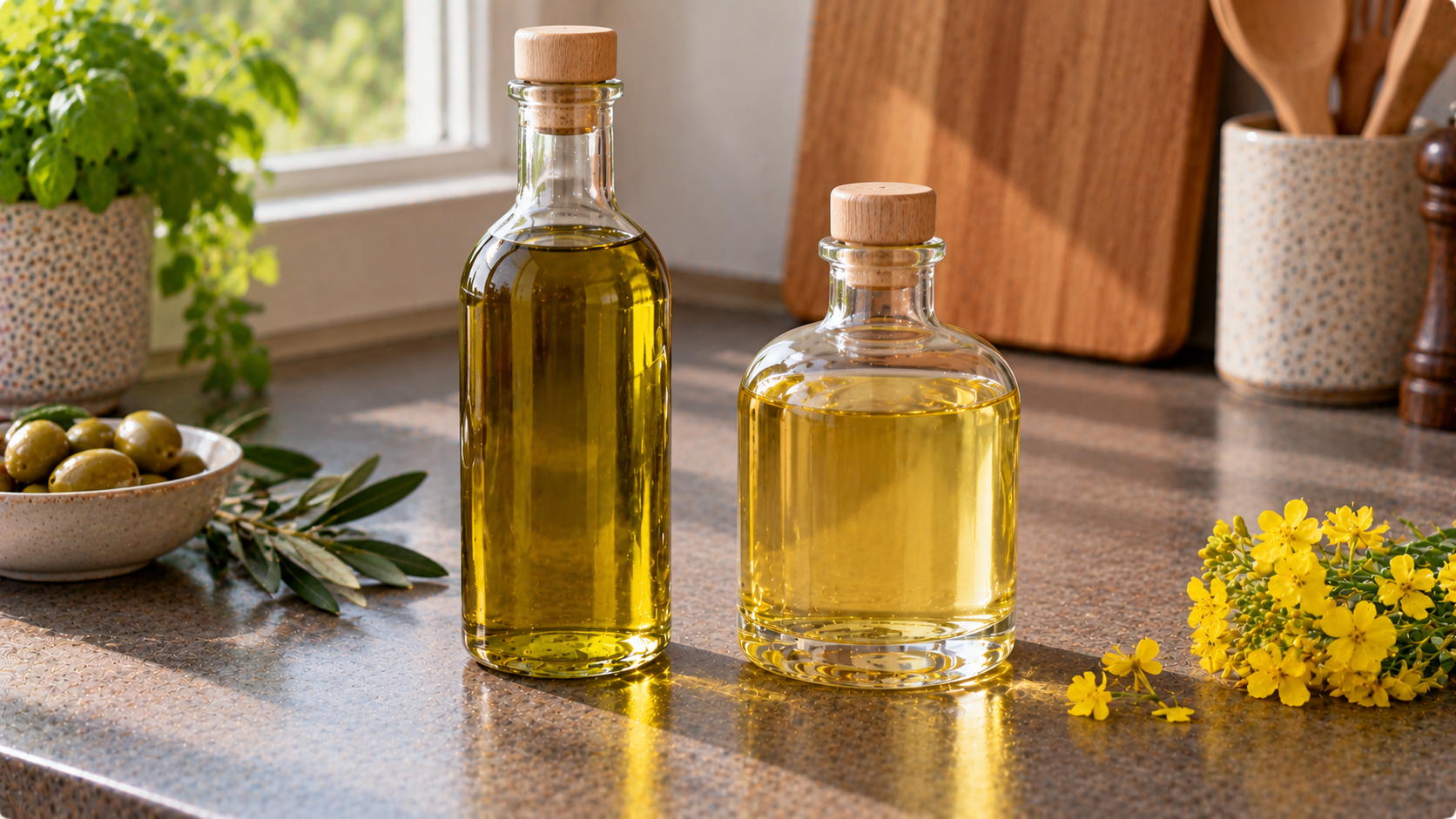
Olive oil and rapeseed oil (called canola oil in many North American food labels) are both practical sources of unsaturated fat. Choosing between them is not a matter of one oil having dramatically fewer calories: both are almost entirely fat. The meaningful differences involve fatty-acid composition, flavor, refinement, cooking temperature, price and the role of the oil in a meal. A fair comparison also distinguishes European food-grade rapeseed oil from the broad botanical category of rapeseed products.
For everyday use, there is no need to declare one oil universally superior. Rapeseed oil is a versatile neutral cooking option and a source of alpha-linolenic acid (ALA), a plant omega-3 fatty acid. Extra-virgin olive oil adds characteristic flavors and minor plant compounds. Both can fit an evidence-based healthy eating pattern. Germany's DGE recommends vegetable oils including rapeseed and olive oil.
Nutrition side by side: match the edible weight
Typical reference values per 100 g are shown below. These are rounded composition estimates, not tested values for a specific brand or extraction process. Oil naturally contains little or no protein, carbohydrate or fiber. The fatty-acid classes are approximate and do not necessarily add to exactly 100 g because of rounding and other lipid constituents.
| Measure | Olive oil | Food-grade rapeseed/canola oil |
|---|---|---|
| Energy per 100 g | about 884 kcal | about 884 kcal |
| Total fat | about 100 g | about 100 g |
| Saturated fat | about 14 g | about 7 g |
| Monounsaturated fat | about 73 g | about 63 g |
| Polyunsaturated fat | about 11 g | about 28 g |
| Plant omega-3 ALA | relatively little | meaningful amount |
| Protein / carbohydrate / fiber | approximately 0 g | approximately 0 g |
Source for the rounded basic composition: USDA FoodData Central; interpret figures as representative entries, not a universal specification. Different cultivars, varieties and analytical databases give somewhat different values. A high-oleic specialty oil is not interchangeable with conventional rapeseed oil in the fatty-acid comparison. For a branded bottle, read the nutrition label.
Notice the most important comparison: rapeseed oil usually has less saturated fat and appreciably more polyunsaturated fat, including ALA, while olive oil is especially rich in oleic acid, a monounsaturated fat. Neither profile makes the other oil unhealthy. The DGE recommends both as alternatives to fats high in saturated fatty acids.
What changes in a tablespoon or a measured recipe?
Per-100-g tables are useful for chemistry but not enough for preparing dinner. Ten grams of either pure oil supply roughly 88 kcal. A normal pour can be several times that quantity. The amount absorbed by food or actually eaten can be different from the amount initially poured into a pan, so a recipe estimate is not a laboratory measurement.
When weighing oil for a recipe, the amount left in the pan can matter; the cooking-oil logging guide covers this practical uncertainty.
| Oil used and consumed | Approximate calories, either oil |
|---|---|
| 5 g | 44 kcal |
| 10 g | 88 kcal |
| 15 g | 133 kcal |
| 20 g | 177 kcal |
| 30 g | 265 kcal |
These examples apply the USDA reference of 884 kcal per 100 g and round to the nearest whole calorie. Oil is often sold in milliliters. Because its density is below that of water, 10 ml is not 10 g; as a rough working estimate, 10 ml of cooking oil weighs around 9 g. A scale is preferable where a precise recipe calculation matters.
Imagine roasting 600 g vegetables with 25 g of oil and making three equal portions. The oil contributes around 221 kcal to the tray, or about 74 kcal per portion if it is all eaten. Changing olive oil to rapeseed oil does not meaningfully change those calories. Changing 25 g to 10 g does: that reduces the oil component by around 133 kcal for the tray. The vegetables and any cheese, nuts or sauce must be counted separately.
Omega-3 is the clearest fatty-acid distinction
Rapeseed oil contains alpha-linolenic acid (ALA), an essential omega-3 fatty acid. Olive oil usually contributes a smaller amount. This makes rapeseed oil useful for diversifying plant fat sources, especially if a person rarely eats foods containing ALA. The DGE highlights rapeseed oil's favorable omega-3 to omega-6 balance.
To put rapeseed oil’s plant-based ALA in context, see the overview of omega-3 food sources and the difference from EPA/DHA.
However, ALA is not the same as the long-chain omega-3 fatty acids EPA and DHA found in oily fish and some algae products. The human body converts some ALA, but conversion is limited and variable. It would therefore be incorrect to claim that a spoon of rapeseed oil supplies the same EPA/DHA as a serving of salmon. See the NIH Office of Dietary Supplements omega-3 fact sheet for the distinction.
Olive oil's high monounsaturated-fat content remains nutritionally useful. Extra-virgin olive oil also contains phenolic substances whose quantities depend on cultivar, harvest, processing, age and storage. A darker color or stronger peppery sensation does not give an exact numeric antioxidant value. Claims about treating disease require much stronger evidence than the presence of such compounds.
Which oil is better for frying, roasting and high heat?
The answer depends more on refinement and the cooking process than on the oil's name alone. The German Federal Centre for Nutrition (BZfE) recommends refined rapeseed oil for higher-temperature cooking because it is relatively heat-stable and neutral. Cold-pressed rapeseed oil is particularly suitable for dressings, dips and gentle cooking. The DGE's guidance also distinguishes refined from cold-pressed oils when recommending high-temperature preparations.
Extra-virgin olive oil is often suitable for ordinary sauteing and moderate oven cooking; it is not restricted to salad dressing. Its suitability depends on the specific oil, heat exposure and intended dish. Refining generally makes an oil milder and changes its minor compounds as well as its high-heat characteristics. Avoid treating a single smoke-point number from an internet chart as an absolute safety line for every bottle.
| Kitchen job | Useful starting choice | Practical reason |
|---|---|---|
| Cold tomato salad | Extra-virgin olive oil | Distinctive flavor |
| Neutral vinaigrette or slaw | Cold-pressed rapeseed or mild olive oil | Different taste profiles |
| Gentle sauteing | Either oil, depending on the product | Control heat and flavor |
| Hot pan frying | Refined rapeseed oil | Heat stability and neutral taste |
| High-temperature deep-frying | An explicitly suitable refined frying oil | Check product instructions and temperature |
| Cakes requiring little oil flavor | Refined rapeseed oil | Neutral background flavor |
| Finishing soup or grilled vegetables | Extra-virgin olive oil | Flavor added after cooking |
These are cooking choices, not evidence that every oil of one category performs identically. Do not let oil smoke, do not leave a pan heating unattended, and avoid repeatedly overheating used oil. Temperature, oxygen, time and the presence of food all influence deterioration. BZfE's olive-oil guidance notes that olive oil can be used for a range of cooked dishes, even though the choice of product and temperature still matters.
Cold-pressed, virgin and refined: labels explain more than color
Cold pressing uses mechanical extraction without the same refining stages. The finished oil can retain more aroma and certain minor compounds; that does not necessarily create a large change in its calories or basic fat profile. Refined oils undergo additional processing that removes many odor and flavor components along with some minor substances. Their neutral flavor can be useful in baking or cooking. Read the actual bottle: the label should indicate whether it is cold-pressed, virgin, refined or a blend.
For olive oil, extra virgin describes an established quality category and production characteristics. It is not synonymous with fat-free, unheated or universally better for every cooking technique. Rapeseed oil may be described as cold-pressed or refined; food-grade canola in North America usually refers to varieties bred with suitable fatty-acid and low-erucic-acid characteristics. Do not equate food-grade rapeseed oil with industrial-purpose products simply because the plant names overlap.
An unrefined bottle and a refined bottle may provide different cooking experiences even if the same plant is pictured on both. Choose based on the dish rather than automatically paying a premium for a descriptor unrelated to your intended use.
Which one should you choose for heart health?
Both oils are predominantly unsaturated-fat foods. Replacing a substantial source of saturated fat with an unsaturated vegetable oil is generally consistent with mainstream cardiovascular dietary guidance. But swapping rapeseed for olive oil in a recipe that already uses an unsaturated oil is a much smaller change than replacing butter or coconut fat. The overall pattern — vegetables, legumes, whole grains, nuts, sufficient variety and reasonable total energy — matters much more than a single spoon of oil.
The lower saturated-fat share and ALA content make rapeseed oil an appealing everyday option. Olive oil, especially extra virgin, is also a well-established choice in Mediterranean-style eating. Neither oil should be described as curing high cholesterol or inflammation. Your individual lipid levels and clinical risk depend on far more than the oil in one meal.
If dietary fat quality is the goal, consider what you are replacing, the amount you consume and the other sources of fat throughout the day. For individuals with medical restrictions or specific lipid disorders, follow individualized clinical advice rather than interpreting a food comparison as treatment.
Taste can determine whether an oil works in your recipe
Extra-virgin olive oil may taste grassy, fruity, bitter or peppery. Some varieties are mild and others assertive. That character can add value to tomato salads, hummus, vegetable soups and pasta. In a delicate cake or a neutral stir-fry, the same flavor might be unwanted. Refined rapeseed oil is commonly chosen because it stays relatively unobtrusive. Cold-pressed rapeseed oil can be more nutty or seed-like and is useful in potatoes, grain salads and dressings.
A simple tasting experiment uses the same base ingredients and measured amounts. Dress two portions of cooked lentils with equal weights of oil, lemon juice and salt. Which one you prefer depends on the food and your taste; it does not change the basic calorie calculation. Do not perform a test by heating oil until it smokes.
What about price, local sourcing and sustainability?
In Germany, rapeseed is widely grown and refined oil is often an economical kitchen staple, whereas extra-virgin olive oil may reflect origin, harvest, quality grading and processing. That is not a guarantee about current shelf prices. Check the price per liter or per 100 ml, then calculate the amount actually used rather than comparing unrelated bottle sizes. A €6 bottle of 750 ml costs €0.08 per 10 ml, whereas a €10 bottle of 500 ml costs €0.20 per 10 ml. These are hypothetical arithmetic examples, not current store quotations.
Locally sourced rapeseed oil may sometimes reduce transport distance, but transport alone does not establish a complete lifecycle environmental ranking. Cultivation, irrigation, processing, packaging, yield and supply chain matter. BZfE discusses the role of rapeseed oil from German agriculture. Olive oil production also differs greatly by region and producer. For a responsible purchase, look for credible product-specific origin and certification information.
Three realistic meals and the right comparison
Weekday stir-fried vegetables: Use 12 g refined rapeseed oil for a hot pan because you want a neutral flavor and a product suited to the heat. That adds about 106 kcal to the complete batch if fully consumed. A similarly measured suitable olive oil would add almost the same amount.
Tomato and white bean salad: Use 10 g extra-virgin olive oil for its characteristic flavor. Add 10 g to the recipe calculation, not 10 g to every plate if the salad makes three servings. The oil contributes roughly 88 kcal to the whole bowl.
Roasted root vegetables: Use 20 g of either oil for a large tray. The oil contributes about 177 kcal in total if eaten completely. What matters nutritionally is portioning the vegetables, the full ingredients and how much oil is actually retained.
For a meal-planning budget, you might keep a neutral refined rapeseed oil for everyday cooking and a smaller bottle of extra-virgin olive oil for finishing and salads. One good, versatile oil is also sufficient if you use it appropriately. You do not need multiple expensive bottles to follow evidence-based dietary guidance.
Quick decision: olive or rapeseed?
Choose rapeseed oil when you want a neutral, versatile and often economical cooking fat with some plant omega-3 ALA. Choose extra-virgin olive oil when its distinctive flavor improves a dish or you want a cold finishing oil. For very high heat, read the product's refining and frying suitability rather than selecting by the word “olive” or “rapeseed” alone. Both deliver roughly the same calories by weight; measure portions when calorie tracking matters. The bigger long-term principle is selecting predominantly unsaturated fats within a varied diet.
Sources and limitations
- DGE — Prefer vegetable oils
- BZfE — Rapeseed oil in the kitchen
- BZfE — Rapeseed oil from field to kitchen
- BZfE — Cooking with olive oil
- USDA FoodData Central
- NIH — Omega-3 fatty acids
Figures are rounded reference estimates. Particular bottles, varieties, labels and cooking conditions may differ; this is general nutrition information, not individual medical advice.