
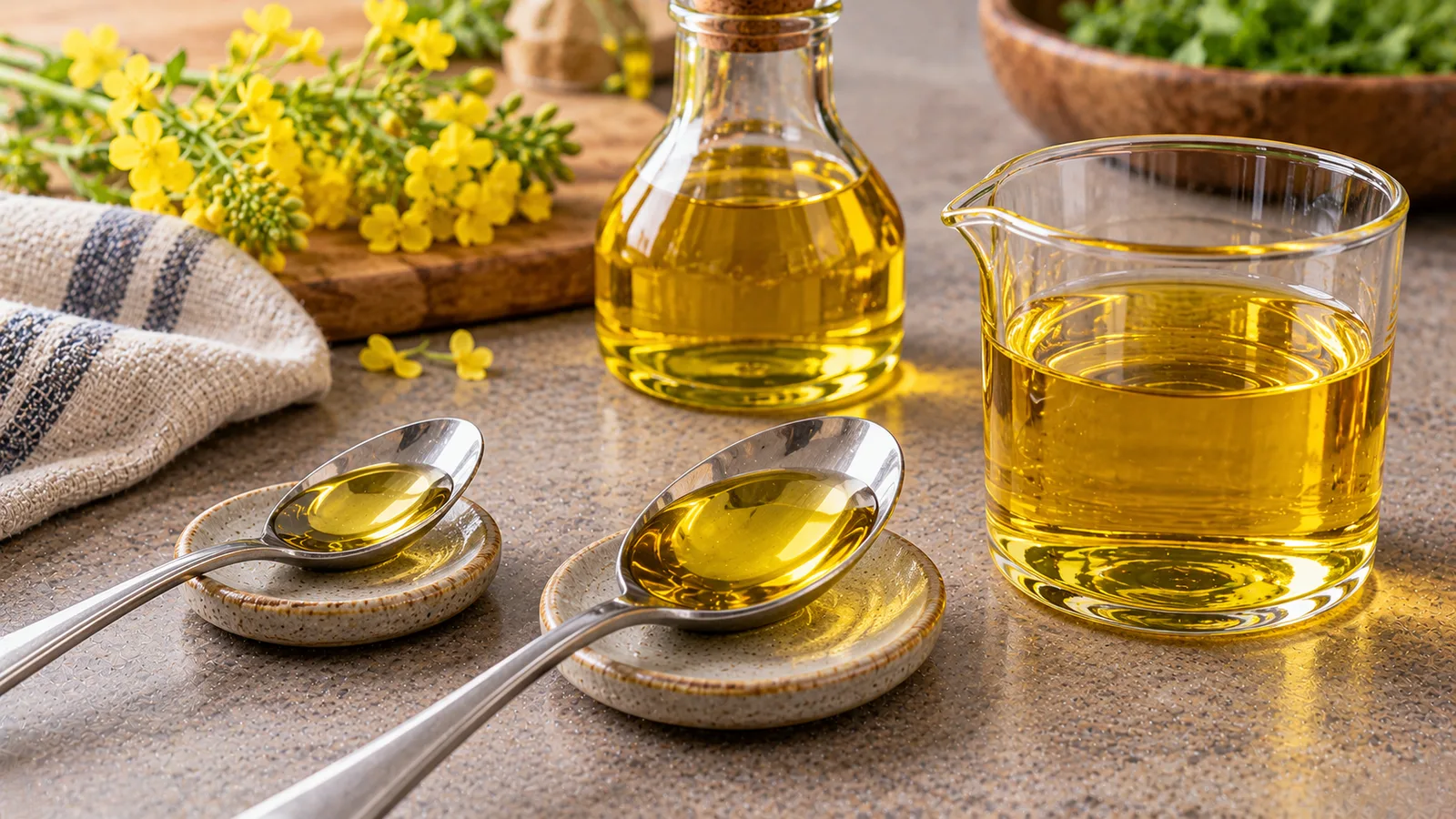
Rapeseed oil is sold as rapeseed oil in much of Europe and as canola oil in many North American shops. The names and varieties are not perfectly interchangeable for every regulatory or agricultural purpose, but for an ordinary plain edible canola/rapeseed oil the key calorie calculation is nearly the same: this is a concentrated source of fat. The mistake to avoid is treating a volume in millilitres as if it weighed the same number of grams. Oil is less dense than water.
This guide answers the practical question of how many calories a teaspoon, tablespoon or 100 ml contributes. It does not attempt to replace the separate comparison of different cooking oils. All numerical examples state their starting assumptions, so you can adapt them to the product and spoon you actually use.
What counts as rapeseed or canola oil?
For the reference calculation, use USDA FoodData Central Oil, canola, SR Legacy record 172336: 884 kcal and 100 g fat per 100 g, with practically no protein or carbohydrate. This describes plain oil, not a salad dressing, a mayonnaise or a sauce. A product labelled rapeseed oil may be refined or cold-pressed; read its own nutrition panel if it differs. A calorie value rounded to 900 kcal per 100 g on a local label does not mean a different serving becomes calorie-free.
Calories per spoon and per 100 ml
A household teaspoon is often defined for calculations as 5 ml and a tablespoon as 15 ml, but spoons in a cutlery drawer are not calibrated measuring tools. Assuming oil density of 0.92 g/ml, a 5 ml teaspoon holds about 4.6 g, a 15 ml tablespoon 13.8 g, and 100 ml weighs 92 g. Multiply the mass by 8.84 kcal/g to obtain the approximate result. The frequently cited USDA tablespoon serving is 14 g, or about 124 kcal. Our 15 ml spoon estimate is 122 kcal. Both are defensible approximations with different rounding and portion assumptions.
Example portions
| Volume | Approx. mass | Calories |
|---|---|---|
| 5 ml | 4.6 g | 41 kcal |
| 10 ml | 9.2 g | 81 kcal |
| 15 ml | 13.8 g | 122 kcal |
| 20 ml | 18.4 g | 163 kcal |
| 30 ml | 27.6 g | 244 kcal |
| 100 ml | 92 g | 813 kcal |
Reference portions are approximate, not package guarantees.
Why 100 ml is not 100 g
100 ml is a volume, not 100 g. At the stated density it is 92 g; the associated energy is about 813 kcal, not 884 kcal. Conversely, 100 g of the same oil occupies about 109 ml. Density changes somewhat with oil type and temperature. Oklahoma State University gives a measured relative-density range of 0.914–0.920 for canola oil at about 20 °C; using 0.92 is a convenient rounded kitchen assumption, not a test of your bottle.
How to measure oil in a recipe
The most reliable home method is to put the oil bottle or a small container on a digital scale, tare it, pour the amount you will actually use, and read the grams. For instance 10 g oil contributes about 88 kcal. If you must measure volume, use a genuine measuring spoon or graduated vessel. Write down whether you measured 5 ml, 15 ml or a different local spoon size. Sprays are not zero-calorie: count their actual dispensed mass rather than relying on very small rounded label serving sizes.
Oil poured into a pan is not always oil eaten
When 20 ml is poured into a roasting dish the starting amount contains about 163 kcal. Yet some may remain in the tin, on the brush or in discarded cooking liquid. Do not automatically assume either that every drop is eaten or that none counts. For a practical recipe estimate, start by counting the quantity added. If you intentionally measure a substantial leftover amount, subtract only that measured leftover; otherwise state the uncertainty. For vegetables or meat, oil is one ingredient among many, and the final portion calculation also depends on the number of servings.
Refined, cold-pressed and flavoured oils
Cold-pressed and refined rapeseed oils may differ in flavour, processing and some minor constituents. Both are energy-dense fats; a pale colour or the word “light” does not mean low calories. Check whether a flavoured preparation includes garlic, herbs or another oil. Heating does not simply destroy the calories in oil. Losses, residue and oil taken up by food are separate measurement problems; frying temperature is not a calorie conversion factor.
For more about how oils differ in cooking uses—not their basic portion arithmetic—see the separate comparison: olive oil and rapeseed oil compared
A worked cooking example
Suppose four portions of roasted vegetables use 30 ml of rapeseed oil, with no measurable leftover. The oil is about 27.6 g, equivalent to 244 kcal in the batch, or approximately 61 kcal per portion. If only 15 ml is used instead, the batch oil contribution is 122 kcal and about 31 kcal per portion. These are contributions from oil, not full meal calories. Keep vegetables, seasonings and other ingredients in the same recipe calculation. Record any oil added at the table as a separate addition.
What a label can change
Nutrition panels may declare energy per 100 ml, per 100 g or per suggested serving, and rounding rules can differ between countries. Compare like with like. Check the serving definition before copying a number into a food log: a one-tablespoon entry recorded as 14 g is not identical to an extra-generous unmeasured spoon. For health questions about dietary fat, this article intentionally limits itself to portion energy and measurement; calorie values alone cannot establish that one oil is superior for everyone.
How to keep the calculation consistent
If a recipe is shared, divide the calculated oil calories actually used by the number of servings. A salad shared between two people and a tray of vegetables divided between six have different oil contributions even with the same bottle. Record the volume or weight before cooking so it is not accidentally counted a second time when plating.
Do not confuse oil energy with the energy of food cooked in oil. A potato, egg or salad has its own nutrition values; the oil is an additional component. Avoid an apparently precise claim when the volume was estimated by eye. For a mixed oil dressing, calculate each ingredient separately, especially if part is poured away.